Wholesome Badass

A Work in Progress — Healing from All the Things​

Black-and-white illustration of a distressed girl telling her mother and sister something hurts. They press buttons producing labels including dramatic, selfish, ungrateful, and too sensitive, leaving comfort and support untouched.

When Distress Is Dismissed as Negativity or Drama

I came into the family as the youngest, with a tightly wound nervous system and a way of taking in the world that was unusually sensitive—to sensory and emotional input, even chemical sensitivity to basic food ingredients. What I recognize now is how easily my frequent, unbridled emotional displays of despair could steal the show. Once I was visibly distressed, the distress itself was identified as the issue. Only in 12-step recovery did I learn to withhold the gift of distraction of my reaction. Before developing the metacognitive ability and language to name what was happening inside me, I certainly failed to make a persuasive case for myself. I have now accessed language for what happened, but no one in my family has shown even remote interest in understanding it—or me. I do not recall being met with curiosity by any single person, about what I was experiencing or what I might need. I remember correction, judgment, banishment, and even mocking by the actual adults. It was as though there was one established way to deal with me. I think of that as the branding. The packaging. The lens through which everything about me was processed. My discomfort, which went unconsoled and therefore persisted and compounded, was treated as evidence that something was fundamentally wrong with me. Dramatic. Histrionic. Too sensitive. Attention-seeking. Always the problem with problems. Over time, the branding hardened into vilification. Definitely an othering. Whatever I was reacting to could disappear behind the reaction. That created an ecosystem in which anything reductive, degrading, hurtful, or upsetting to me could pass without resistance or examination. Whatever else may be true, this is my experience. The branding did not merely shape my understanding of myself and my family. It made harming me easier, more permissible, and more deniable. I emerged from that environment with few models for self-soothing, compassion, or kindness, and with maladaptive ways of coping. I could be unreasonable, highly reactive, and say deeply hurtful things. I do not need to minimize any of that to understand where some of those patterns were formed, or to recognize how much I have unlearned and changed outside the relationships in which they were shaped and reinforced. Part of that growth has been learning to identify and intentionally choose something different from the kinds of personalities and relational patterns I had come to associate with what was normal, loving, kind, or healthy. I am still working on not mistaking familiarity for safety or connection.
Read More
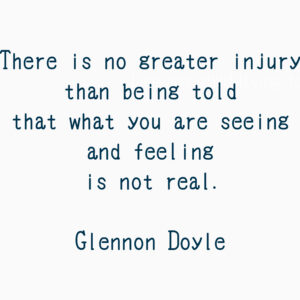
A clean, minimalist square graphic with clear text on a solid, neutral background. The text reads: "There is no greater injury than being told that what you are seeing and feeling is not real. — Glennon Doyle"

A Systemic Disregard

Someone once told me that the cruelest thing you can do to another human being is to label their suspicions as false when you know them to be true. It would be impossible to count the instances where my questioning led to the same responses: You’re crazy. You made that up. Stop trying to manufacture chaos.  It’s in your head. I don’t know what you’re talking about. Something inside of me shattered each time these sentiments were hurled at me. My self-esteem, confidence, and sense of self were deeply compromised- crushing to my spirit. The continued touching of me left me confused, unwanted contact in place of connection- resulting in lifelong emotional deprivation, self-doubt, fear, disordered sleeping, disordered eating, and trust issues that defy articulation. When I threatened to tell on her, she laughed- boasting how nobody would believe me. She made sure of it. Since I’m Not Gay, I Couldn’t Have Done That She spent a fair amount of talking to me about friends of hers who were or seemed gay or butchy, and how repulsive it felt to her, while simultaneously feeling generous that she was friends with them. Like always trying to convince me she wasn’t gay—because in that logic, if she wasn’t gay, she couldn’t possibly have done what she did repeatedly. But being gay does not make someone a predator. She dedicated her life to making me feel crazy and afraid, while simultaneously offering intermittent reinforcement as my heroine—the only person who could understand or protect me. She made it clear that she would be in charge of my relief and my punishment. Like any child looking to assign reasons to that which they cannot control, I blamed myself and spent my life trying to get worthy or at least pretend to. Identity Theft My personhood was snatched–erased. I could not count on myself to know what I felt or wanted, what I needed, and what was true. Whether it was my favorite color, or if I was hungry, tired, or cold, these things were either criticized or treated as debatable. I lost touch with my ability and confidence to know what was true, important, and real. The Fast Track to Addiction It makes sense to me now why I started so early using alcohol, food, drugs, shoplifting, sex—literally anything to alter my brain chemistry for even a brief respite. To feel better. To feel different. To feel nothing. There was never enough. Addiction, impulsive, and compulsive behaviors. A lifetime of instability, insecurity, and unsafety at a cellular level. A systemic disregard for my well-being. I had so many self-help books, so much therapy, 12-step programs, journaling, and any kind of exercise to try to unlock the secrets of how to just fucken be—or maybe even just how to pretend to be better than I actually am. How Are You? For more than forty years, the question “How are you?” has felt like a trick. I always answer “Super duper.” I would say that if I won the lottery or if I crashed my car, because legit nobody actually cared, but also—how am I? How should I know?  Hold on let me check with those who have a monopoly on my truth. As I look back, realizing that I can only remember what I remember how I remember it, I was in no way groomed for success, self-mastery, or even self-sufficiency. In fact, the opposite- I was dismantled. And then I was judged for the exact outcome that was engineered for me. Constant messaging: “You are fundamentally different, and nobody has any interest in building a bridge to where you are.”

Read More
Text image reading: “Trauma Bonding can make you terrified of ‘losing’ your abuser. Just keep in mind that you’ll also be losing the gaslighting, the sleepless nights, the knots in your stomach while they were ignoring you, the feeling of being blamed, and the stress of holding onto something that always felt like it was slipping away."

Trauma Bond: Addiction to the Abuser 

Across my closest relationships—mother, sister, husband, children—harm was never something to repair. It wasn’t acknowledged as harm at all, but reframed as my perception, my fault, my failure. Peace was never on offer. If I stayed, there was no peace. If I left, I wasn’t allowed to go in peace either. Departure had to hurt—because how could being without them be permitted to feel better than being with them? Relief was available only through my disappearance or my transformation. A structural issue. This closed system demands erasure or alteration, never mutual change. My pain is not evidence of harm, only inconvenience. I continue to bind myself to systems in which harm is normalized, repair is forbidden, and my full presence threatens the equilibrium. Trauma bonding pulls me in. Scapegoating keeps me in place. I’m recognizing pattern familiarity, not personal defect. “In a narcissistic family system, the scapegoat is forced to carry collective shame, guilt, and dysfunction. The family denies reality, refuses outside help, and isolates the victim, perpetuating the cycle. The result is long-term harm: C-PTSD, anxiety, depression. Leaving feels terrifying, even though staying is destructive, because the bond convinces you that survival depends on the abuser. Under extreme pressure, the scapegoat may break—reactive anger that the family then weaponizes as proof of their narrative: See? They’re crazy.“

Read More
Text graphic explaining the concept of a family scapegoat as the person a family targets to avoid addressing harmful patterns or abuse.

The Pattern Beneath Estrangement

I’m learning to recognize a pattern. I name something specific: a word that was said, a boundary crossed, a moment that caused distress.The response shifts quickly—to my tone, my sensitivity, my way of being, my capacity to perceive. What starts as a conversation about what happened becomes a conversation about who I am. That shift does the work. It replaces interest and accountability with assessment. What remains is a familiar choice: explain myself, or step away—often described as opting out of connection, though it feels more like leaving a diminishing exchange. I step away from being disregarded. Over time, this response teaches what will and won’t be tolerated. Naming limits or discomfort leads to character judgment. Peace is kept through silence or compliance, not reflection or repair. The system protects itself by working efficiently. Questioning a person’s perception instead of engaging their experience ends the conversation and thins the connection. This took me a long time to understand: patterns like this resist being named. Accountability is replaced by distance, then by a story about why connection became difficult. The focus shifts. The pattern disappears. The person who noticed it remains. I’ve watched this repeat across relationships and roles. Discussion of behavior is rerouted into judgment of character. Repair is replaced by quiet. Distance forms without being acknowledged. And this becomes disorienting. Attempts to understand or address what happened are treated as evidence of being “too much,” while the questioned behavior itself remains unexamined and unamended. Connection is offered provided that nothing difficult is said.

Read More

Tools for Life

Coming from a long lines of mental illness and untreated addiction, where every non-happy feeling was perceived as anger and responded to with anger, I picked up some unfortunate coping and operating styles.  This wall of tools is the perfect metaphor for the tools for life before and now, with recovery.  The left side needs little explanation. The dustpan and brush, I need for for cleaning up little messes I make.  Tape for repairing things that are fixable.  Soft gloves, for handling of fragile or prickly things with care.  A measuring tape and timer to help me give space and time between an incident and my response.  Knee pads for the time I spend on my knees waiting and asking for guidance.   A flashlight for times when it feels dark for me or a trusted other.  A needle and thread for sewing back together those things which can be mended.  Love is always the answer.  Accepting my full range of emotions and developing healthy tools for coping are miracles of recovery. Recovery tools are wholesome and 100%badass.  What are some of your metaphorical tools for life?

Read More

Good Grief

I cannot help but feel charmed when I hear people in utter exasperation calmly say “Good Grief”.  It is so completely wholesome(benevolent) and old school. While grief, may not be good, it is essential, and a natural part of life.  We all deserve to grieve and heal from heartbreak.  My sons’ deserve a healed and whole mother. As an adult with choices, recovery of my spirit takes priority over my seat at “the family table”.    My first choice is to recover with my family of origin.  The alternative is to recover on my own.  It has been collectively declared that “There is nothing to heal from, just move on, Already, goddammit”.  My sister’s locking onto my ex-husband(any excuse at all to fawn and connect(gag)) has troubled us as co-parents, as well as divided me from our confused and aging mother.  I have nearly quit judging that behavior, but still, I REFUSE to dine with abusers of my sons’ parents.  The idea of sharing a meal is sickening.  Our next genetic gathering will be for a death.  While the passing of any family member will be unfortunate, the death itself, will not erase or stop the damage.  I will pray for the grace to show up only as a mourner for the passing of whomever it is.  The service will not pose as a union or a re-union.  Just a memorial  for the deceased; a ceremony dedicated to those who need to grieve the passing of a loved one.  I respect and honor the need to grieve.   For me, it will be a day of exercising courage, humility, and compassion–100% wholesome and badass.

Read More
Black-and-white illustration of a distressed girl telling her mother and sister something hurts. They press buttons producing labels including dramatic, selfish, ungrateful, and too sensitive, leaving comfort and support untouched.

When Distress Is Dismissed as Negativity or Drama

I came into the family as the youngest, with a tightly wound nervous system and a way of taking in the world that was unusually sensitive—to sensory and emotional input, even chemical sensitivity to basic food ingredients. What I recognize now is how easily my frequent, unbridled emotional displays of despair could steal the show. Once I was visibly distressed, the distress itself was identified as the issue. Only in 12-step recovery did I learn to withhold the gift of distraction of my reaction. Before developing the metacognitive ability and language to name what was happening inside me, I certainly failed to make a persuasive case for myself. I have now accessed language for what happened, but no one in my family has shown even remote interest in understanding it—or me. I do not recall being met with curiosity by any single person, about what I was experiencing or what I might need. I remember correction, judgment, banishment, and even mocking by the actual adults. It was as though there was one established way to deal with me. I think of that as the branding. The packaging. The lens through which everything about me was processed. My discomfort, which went unconsoled and therefore persisted and compounded, was treated as evidence that something was fundamentally wrong with me. Dramatic. Histrionic. Too sensitive. Attention-seeking. Always the problem with problems. Over time, the branding hardened into vilification. Definitely an othering. Whatever I was reacting to could disappear behind the reaction. That created an ecosystem in which anything reductive, degrading, hurtful, or upsetting to me could pass without resistance or examination. Whatever else may be true, this is my experience. The branding did not merely shape my understanding of myself and my family. It made harming me easier, more permissible, and more deniable. I emerged from that environment with few models for self-soothing, compassion, or kindness, and with maladaptive ways of coping. I could be unreasonable, highly reactive, and say deeply hurtful things. I do not need to minimize any of that to understand where some of those patterns were formed, or to recognize how much I have unlearned and changed outside the relationships in which they were shaped and reinforced. Part of that growth has been learning to identify and intentionally choose something different from the kinds of personalities and relational patterns I had come to associate with what was normal, loving, kind, or healthy. I am still working on not mistaking familiarity for safety or connection.

Read More
A clean, minimalist square graphic with clear text on a solid, neutral background. The text reads: "There is no greater injury than being told that what you are seeing and feeling is not real. — Glennon Doyle"

A Systemic Disregard

Someone once told me that the cruelest thing you can do to another human being is to label their suspicions as false when you know them to be true. It would be impossible to count the instances where my questioning led to the same responses: You’re crazy. You made that up. Stop trying to manufacture chaos.  It’s in your head. I don’t know what you’re talking about. Something inside of me shattered each time these sentiments were hurled at me. My self-esteem, confidence, and sense of self were deeply compromised- crushing to my spirit. The continued touching of me left me confused, unwanted contact in place of connection- resulting in lifelong emotional deprivation, self-doubt, fear, disordered sleeping, disordered eating, and trust issues that defy articulation. When I threatened to tell on her, she laughed- boasting how nobody would believe me. She made sure of it. Since I’m Not Gay, I Couldn’t Have Done That She spent a fair amount of talking to me about friends of hers who were or seemed gay or butchy, and how repulsive it felt to her, while simultaneously feeling generous that she was friends with them. Like always trying to convince me she wasn’t gay—because in that logic, if she wasn’t gay, she couldn’t possibly have done what she did repeatedly. But being gay does not make someone a predator. She dedicated her life to making me feel crazy and afraid, while simultaneously offering intermittent reinforcement as my heroine—the only person who could understand or protect me. She made it clear that she would be in charge of my relief and my punishment. Like any child looking to assign reasons to that which they cannot control, I blamed myself and spent my life trying to get worthy or at least pretend to. Identity Theft My personhood was snatched–erased. I could not count on myself to know what I felt or wanted, what I needed, and what was true. Whether it was my favorite color, or if I was hungry, tired, or cold, these things were either criticized or treated as debatable. I lost touch with my ability and confidence to know what was true, important, and real. The Fast Track to Addiction It makes sense to me now why I started so early using alcohol, food, drugs, shoplifting, sex—literally anything to alter my brain chemistry for even a brief respite. To feel better. To feel different. To feel nothing. There was never enough. Addiction, impulsive, and compulsive behaviors. A lifetime of instability, insecurity, and unsafety at a cellular level. A systemic disregard for my well-being. I had so many self-help books, so much therapy, 12-step programs, journaling, and any kind of exercise to try to unlock the secrets of how to just fucken be—or maybe even just how to pretend to be better than I actually am. How Are You? For more than forty years, the question “How are you?” has felt like a trick. I always answer “Super duper.” I would say that if I won the lottery or if I crashed my car, because legit nobody actually cared, but also—how am I? How should I know?  Hold on let me check with those who have a monopoly on my truth. As I look back, realizing that I can only remember what I remember how I remember it, I was in no way groomed for success, self-mastery, or even self-sufficiency. In fact, the opposite- I was dismantled. And then I was judged for the exact outcome that was engineered for me. Constant messaging: “You are fundamentally different, and nobody has any interest in building a bridge to where you are.”

Read More
Text image reading: “Trauma Bonding can make you terrified of ‘losing’ your abuser. Just keep in mind that you’ll also be losing the gaslighting, the sleepless nights, the knots in your stomach while they were ignoring you, the feeling of being blamed, and the stress of holding onto something that always felt like it was slipping away."

Trauma Bond: Addiction to the Abuser 

Across my closest relationships—mother, sister, husband, children—harm was never something to repair. It wasn’t acknowledged as harm at all, but reframed as my perception, my fault, my failure. Peace was never on offer. If I stayed, there was no peace. If I left, I wasn’t allowed to go in peace either. Departure had to hurt—because how could being without them be permitted to feel better than being with them? Relief was available only through my disappearance or my transformation. A structural issue. This closed system demands erasure or alteration, never mutual change. My pain is not evidence of harm, only inconvenience. I continue to bind myself to systems in which harm is normalized, repair is forbidden, and my full presence threatens the equilibrium. Trauma bonding pulls me in. Scapegoating keeps me in place. I’m recognizing pattern familiarity, not personal defect. “In a narcissistic family system, the scapegoat is forced to carry collective shame, guilt, and dysfunction. The family denies reality, refuses outside help, and isolates the victim, perpetuating the cycle. The result is long-term harm: C-PTSD, anxiety, depression. Leaving feels terrifying, even though staying is destructive, because the bond convinces you that survival depends on the abuser. Under extreme pressure, the scapegoat may break—reactive anger that the family then weaponizes as proof of their narrative: See? They’re crazy.“

Read More
Text graphic explaining the concept of a family scapegoat as the person a family targets to avoid addressing harmful patterns or abuse.

The Pattern Beneath Estrangement

I’m learning to recognize a pattern. I name something specific: a word that was said, a boundary crossed, a moment that caused distress.The response shifts quickly—to my tone, my sensitivity, my way of being, my capacity to perceive. What starts as a conversation about what happened becomes a conversation about who I am. That shift does the work. It replaces interest and accountability with assessment. What remains is a familiar choice: explain myself, or step away—often described as opting out of connection, though it feels more like leaving a diminishing exchange. I step away from being disregarded. Over time, this response teaches what will and won’t be tolerated. Naming limits or discomfort leads to character judgment. Peace is kept through silence or compliance, not reflection or repair. The system protects itself by working efficiently. Questioning a person’s perception instead of engaging their experience ends the conversation and thins the connection. This took me a long time to understand: patterns like this resist being named. Accountability is replaced by distance, then by a story about why connection became difficult. The focus shifts. The pattern disappears. The person who noticed it remains. I’ve watched this repeat across relationships and roles. Discussion of behavior is rerouted into judgment of character. Repair is replaced by quiet. Distance forms without being acknowledged. And this becomes disorienting. Attempts to understand or address what happened are treated as evidence of being “too much,” while the questioned behavior itself remains unexamined and unamended. Connection is offered provided that nothing difficult is said.

Read More

Tools for Life

Coming from a long lines of mental illness and untreated addiction, where every non-happy feeling was perceived as anger and responded to with anger, I picked up some unfortunate coping and operating styles.  This wall of tools is the perfect metaphor for the tools for life before and now, with recovery.  The left side needs little explanation. The dustpan and brush, I need for for cleaning up little messes I make.  Tape for repairing things that are fixable.  Soft gloves, for handling of fragile or prickly things with care.  A measuring tape and timer to help me give space and time between an incident and my response.  Knee pads for the time I spend on my knees waiting and asking for guidance.   A flashlight for times when it feels dark for me or a trusted other.  A needle and thread for sewing back together those things which can be mended.  Love is always the answer.  Accepting my full range of emotions and developing healthy tools for coping are miracles of recovery. Recovery tools are wholesome and 100%badass.  What are some of your metaphorical tools for life?

Read More

Good Grief

I cannot help but feel charmed when I hear people in utter exasperation calmly say “Good Grief”.  It is so completely wholesome(benevolent) and old school. While grief, may not be good, it is essential, and a natural part of life.  We all deserve to grieve and heal from heartbreak.  My sons’ deserve a healed and whole mother. As an adult with choices, recovery of my spirit takes priority over my seat at “the family table”.    My first choice is to recover with my family of origin.  The alternative is to recover on my own.  It has been collectively declared that “There is nothing to heal from, just move on, Already, goddammit”.  My sister’s locking onto my ex-husband(any excuse at all to fawn and connect(gag)) has troubled us as co-parents, as well as divided me from our confused and aging mother.  I have nearly quit judging that behavior, but still, I REFUSE to dine with abusers of my sons’ parents.  The idea of sharing a meal is sickening.  Our next genetic gathering will be for a death.  While the passing of any family member will be unfortunate, the death itself, will not erase or stop the damage.  I will pray for the grace to show up only as a mourner for the passing of whomever it is.  The service will not pose as a union or a re-union.  Just a memorial  for the deceased; a ceremony dedicated to those who need to grieve the passing of a loved one.  I respect and honor the need to grieve.   For me, it will be a day of exercising courage, humility, and compassion–100% wholesome and badass.

Read More