Wholesome Badass

A Work in Progress — Healing from All the Things​

Black-and-white cartoon of Wholesome Badass in a jujutsu stance, holding up a glowing shield against dark arrows and scribbles. A speech bubble says, “But here’s what also happened.”

The Power of an Incomplete Truth

In my tagline, I reveal myself as navigating the storm of neurodivergence, trauma, and toxic family systems. For the archetypes with whom I have navigated strife or rupture, I imagine this perspective may feel unwelcome because it adds context to a much simpler explanation: I was just bad. Difficult. Crazy. Selfish. Unreasonable. Context provides nuance that the simpler explanation leaves out. Whatever may have been said or done to diminish me was charged to me: I caused it, deserved it, exaggerated it, or imagined it. The tagline isn’t an attempt to excuse myself, but the closest language I have found for an experience I spent decades unable to articulate. Naming neurodivergence, trauma, and a dysfunctional family system does not make every choice I have ever made harmless, good, or right. It allows nuance into a story where my context was effectively disregarded. And I can’t help but ask, in all earnestness: if my “craziness” was the explanation for every instance of hardship for me, why wasn’t anyone’s response concern, curiosity, or support? What I am chasing is not agreement but a fuller record. More of what actually happened allowed into the room. Other people’s explanations have passed for the complete story, while mine were categorically rejected as inadmissible. If I asked questions, I was manufacturing chaos. If I offered context, I was making excuses. If I remembered something differently, I was rewriting history. I was seeking a clean signal—clarity, cohesion, some way to sew the pieces together for a story that makes sense, even if what emerged was painful or unflattering to me. Apparently, asking clarifying questions seems to threaten the prescribed narrative. Providing context is recieved as equally troublesome. So I am left trying to make sense of a story I was expected to accept, while relevant context was not allowed into consideration. Have you ever realized that what seemed like the only obvious conclusion was actually inaccurate and deeply unfair — once you had a more complete account of the story? One real-life example: I’m in a hurry and stuck behind a man in a posh new Jaguar, stopped in the road and holding up traffic for what I assume is no good reason—just entitled and inconsiderate. Then I SEE he has gotten out of his car to help a disabled elderly person with a heavy package cross the street. Nothing about the stopped car changed. The context did. I feel some of that same aha humbling energy when I think about people like Howard Stern, Monica Lewinsky, Stormy Daniels, Pamela Anderson, and others whom I experienced through a particular public narrative without bothering to question what might have been missing from it. Sometimes the framing was profitable. Sometimes powerful people had an enormous stake in which version prevailed. Either way, I accepted a conclusion before I had much interest in the fuller record. Just saaaaayin.

Read More
Black-and-white cartoon of a woman asking if something is wrong. Another woman denies it, then meets privately with two others to discuss a folder labeled “The Problem With Her.”

When the Narrative Outranks What Happened

The Alchemy of the Unexitable Loop: Someone behaves toward you in bullying, degrading, diminishing, or disruptive ways, then denies it or explains it as a consequence of who you are. Literally: they turn their own behavior into evidence against you. I am wired to sense shifts in energy. I don’t mean that in some mystical way, and I don’t mean that I am being paranoid. I am attuned at a sensory and emotional level to things other people may have the luxury of not noticing. Cold, detached silence. Avoidant eye contact. Being ignored. A change in tone. The almost imperceptible shift from being in connection with someone to being very clearly outside of it. And because nothing had been indicated, I would ask. What’s wrong? Nothing. And the coldness intensified. Naturally I would ask again. So fkn earnest. And now the inquiry itself was the only issue. Suddenly there was something concrete to point to: my questioning. My inability to leave it alone. My insistence that something was wrong when I had been clearly told there wasn’t. And there is the loop. I experienced the tension. I inquired directly. My asking was labeled as escalation. The heightened tension was then used to explain the tension I had originally asked about. Therefore, apparently, I had imagined it. Or caused it. Or manufactured chaos where none had existed. And now my behavior could justify whatever came next. There was no direct confrontation. No, “I’m angry with you.” No, “I didn’t love that.” No, “Can we talk about what happened?” No good-faith request to understand. Not even a simple statement of displeasure. At least not to me. The displeasure was expressed elsewhere, to others. So while insisting that nothing was wrong, an entirely different conversation could be unfolding outside of my participation. Because gossip and triangulation are somehow more dignified and “peace-keeping” than openly addressing friction? There was no opportunity to acknowledge the discord, clarify anything, take responsibility for what was actually mine, or repair the relationship. Instead, the grievance traveled laterally. Triangulation. Gossip. Division. And if it eventually did come directly to me, it wasn’t offered as information that might help us understand each other. It came with teeth, delivered for maximum injury. Not: Here is what landed poorly for me. More: Here is what is wrong with you. There was a negative space where repair should have happened, while a narrative developed without me. By then, the equation was complete. I had detected something I wasn’t supposed to detect. I had asked about something I was told wasn’t happening. My asking was cast as evidence that I had created the problem. And having created the problem, I had apparently earned whatever harmful thing followed. Another person’s harmful reaction gets explained entirely by my character. That’s the alchemy. Have you ever been in a relationship with someone whose coldness you could feel, but when you asked what was wrong, you were told nothing? And asking only made things worse. Whatever happened next was regarded only as the thing you had coming to you. For being this way. Literally: their behavior gets reassigned to your character.

Read More
The Narcissist’s Prayer showing six statements that progress from denial and minimization to blame-shifting, beside an image of a cracked mask.

Gaslighting, Blame-Shifting, and the Absence of Repair

A person can know something experientially long before they can articulate it. They might know, for example, “After X is upset with me, I end up confused. I initiate communication thinking I had a legitimate concern, and somehow I leave apologizing and wondering whether I caused everything.” They don’t necessarily have words or concepts to process what happened. Once someone learns concepts like blame-shifting, triangulation, invalidation, stonewalling, double standards, DARVO, conditional approval, or refusal of repair, those concepts can provide handles for examining an interaction: Wait—was I actually heard? Did we each consider or examine our contributions? Was disagreement permitted? Did responsibility somehow become entirely mine? And importantly, language doesn’t have to supply the verdict. It can supply questions. That may be especially valuable for someone who’s been raised inside a particular relational system, because whatever happened repeatedly can simply register as this is how relationships work. Conflict is information, not a trial where somebody has to be found guilty. You can finish a disagreement still thinking, I was right about the original issue, and nevertheless learn: I interrupted you. I got defensive. I misunderstood what you meant. I didn’t realize that mattered so much to you. Or: I still disagree, but now I understand your reasoning. Or my most favorite of all: I think I understtand but I still do not agree. And the other person can do the same. Someone can be displeased with you without their displeasure becoming evidence that you’re bad. They can misunderstand you without their interpretation replacing your knowledge of yourself. And you can discover something uncomfortable about your own behavior without having to collapse into therefore I am the problem. In a healthy rupture, both people have something to metabolize. Not necessarily equal blame—sometimes one person really did behave badly—but both people still have an encounter to process. What happened? What did I do? What did you experience? What did I misunderstand? What does this change between us? What is needed for repair? In the archetypal dynamic, one person effectively exempts themselves from that process. Their internal work stops at: I was right to do or say X because of what you did. Everything downstream gets assigned to the other person. But the person on the receiving end doesn’t get to bypass metabolizing the rupture. They can end up metabolizing too much. They process the original conflict, the accusation, the other person’s certainty, the withdrawal, their own behavior, their memory, their motives, what they could have done differently, whether they’re actually the problem—and they do it without the other person’s participation. Then contact resumes without repair. All of that processing has nowhere relational to land. It can instead become adaptation: anxiety, self-doubt, vigilance, accommodation, rehearsing, overexplaining, trying harder, monitoring tone, becoming increasingly careful. The rupture isn’t unprocessed. The processing is asymmetrical. One person preserves their existing understanding of themselves. The other person is left reorganizing themselves around the unresolved rupture. Repair brings the information back into the relationship, where both people can examine it instead of one person having to carry and interpret the whole thing alone. One person is trying to understand what happened. The archetype is operating from the position that nothing happened that requires understanding. One person is asking, What happened between us? How did we get here? What needs to be repaired? And the answer—explicitly or through behavior—is essentially: There is nothing between us to repair. The problem is that you’re confused, anxious, sensitive, difficult, or unable to let things go. So the effect of the interaction gets reassigned as a characteristic of the recipient. The anxiety created by unresolved rupture becomes evidence that you’re “anxious.” The confusion created by contradictory interactions becomes evidence that you’re “confused.” Your attempts to get resolution become evidence that you “can’t let things go.” Your attempts to clarify what happened become evidence that you’re “overthinking.” The interaction disappears from the explanation. Then when ordinary contact resumes without acknowledgment, one person can experience that as moving on, while the other person is still carrying an unresolved event that supposedly never happened. There can be no repair when only one person is able to acknowledge that there was a rupture. You can say, “Something you did didn’t land well with me,” and get: Nothing happened. You’re misinterpreting me. You’re too sensitive. Or you can notice distance and say, “Something seems different between us. Did something happen?” and get: Nothing’s different. You’re imagining things. Why do you always do this? If you name an impact, you’re creating a problem. If you notice an impact, you’re creating a problem. If you ask about a rupture, you’re creating a problem. If you remain unsettled because there was no repair, that becomes the problem. The recipient isn’t just processing a conflict alone. They’re being asked to process a conflict whose existence has been denied. There isn’t even an agreed-upon event to work with. Something happened between us. I can observe the change. I’m experiencing the consequences. But I’m being told there is nothing here to discuss. Which may be why “nothing happened” is so consequential. It doesn’t merely refuse repair. It removes the shared reality from which repair would have been possible. Nothing happened. Nothing’s wrong. There is nothing to discuss. But then there’s silence. Distance. Withdrawal. Maybe coldness. You’re left alone with whatever the fuck just happened. That’s the contradiction. You’re experiencing the consequences of a rupture while being denied the existence of the rupture itself. Whatever else may be true, this is a defining structure within the archetypal dynamic.

Read More
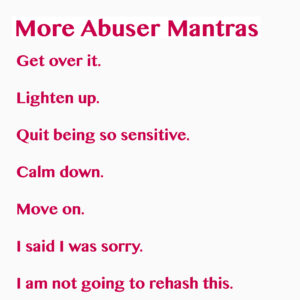
Abusers Mantra- That Did Not Happen

“But What Did She Do?”

Friend: So you’re not in contact with your daughter anymore? Family Member: No, she’s just too much. Always some issue with her. Always making everything harder than it has to be. Friend: Wow. What happened exactly? Did she hurt someone? Lie? Betray you? Family Member: No, not really. It’s more like… she always has needs and limits and feelings that are too much and make no sense. So sensitive. Demanding. Needy. Always demanding conversation. It’s exhausting. Friend: That doesn’t sound like a crime. Did she ask to talk about something hard? Family Member: Yeah, but she turns everything into a problem. Like, she’ll say something felt hurtful, or ask someone to stop doing something—and suddenly, it’s a whole thing. She speaks problems into existence. If she’s upset, that’s the problem. Not what caused it. Friend: So she brings up something painful and you say she’s just trying to cause drama? Family Member: Exactly. We always told her: stop manufacturing chaos. If you’re hurting, you probably imagined it, earned it, or brought it on yourself. Friend: What happens when she does try to talk about it? Family Member: She gets overwhelmed. Emotional. Then she cries and it’s like, see? You can’t even talk to her. She’s unstable. Friend: Did you ever try family therapy? Family Member: Yes, once. She completely fell apart in the session. Couldn’t handle us calmly telling the therapist how hard she is. The therapist saw right through her. Friend: Or maybe she broke down because the room was against her and you used that as proof? Family Member: Whatever. She just needs everything to be her way. We can’t do that. Friend: So what’s the worst thing she actually did? Family Member: She refused to keep showing up—opted out until we had more useless conversations. She always said she’d come to the table if people would be kind. But she made herself the outsider. Ask anyone—she sucks. Friend: But if nobody can name what she actually did—not how she felt, or how you felt about her, but what she really did—then what was she punished for? Family Member: For being impossible. Creating tension to get attention. Friend: Hmmm. 14 Years Later Friend: Wait… so you don’t talk to your mom anymore? Son: Nah. She’s impossible. Always on my case, trying to control everything. Friend: That sucks. But like—what did she do? Was she abusive? Did she lie to you or betray you? Son: No. She just… always had these expectations…demands. And like tried to be my boss. Always correcting me. She wanted me to be perfect. Friend: Okay… but was she unfair? Like punishing you for stuff that wasn’t real? Was she constantly grounding you or taking your phone for no reason? Son: No, not really. I think I got grounded maybe once. She barely ever took my phone. Friend: So you weren’t in trouble all the time? Son: No, not really. She’d just get mad when I didn’t follow through or when I ignored her. Friend: So… she had rules? Son: Yeah, but she wanted consistency. Like, if I did something well for three weeks, and then I would drop the ball and she would correct or redirect me. Like the three weeks did not even count. Friend: That doesn’t sound crazy. That sounds like accountability… parenting? Son: She just wouldn’t let me do whatever I wanted. She’d say no to stuff sometimes. She expected respect. Friend: Did you guys ever try family therapy? Son: Yeah, but I went thinking it’d be my chance to explain my side, and maybe get the therapist to see how hard she is. I don’t think she went in expecting that. Friend: So… you weren’t there to try to heal things? Son: Not really. And she got upset in the session, started crying, and then it was like—“see? She’s so emotional, you can’t even talk to her.” Friend: So her emotional reaction to being overwhelmed was used as proof that she’s the problem? Son: I mean… yeah. Friend: And the worst thing she did was… not agree immediately to let you drive across the country at 16 without a plan? Son: She said I could if I had check-ins and stayed with people we know. But it felt like she didn’t trust me. Friend: So she wanted to keep you safe and be part of the planning, and that made her the enemy? Son: I guess. But still… she sucks. Narrator: This is the anatomy of a smear campaign. A person becomes “too much” only after they become unwilling to be mistreated. They say, “She’s hard to deal with.” But what did she do? Ask again. From every angle. Ask louder. Ask in front of the people who repeat the story. Ask the ones who believe it. What did she do? What did she do? And if no one can name it, then maybe— just maybe— she didn’t do anything at all. Maybe she just stopped agreeing to be the scapegoat. Below are just a few of the books that have been especially informative and healing for me as I navigate my journey of recovery and self-understanding:

Read More
Black-and-white illustration of a woman isolated behind a wall as family members reinforce the divide, symbolizing triangulation and parental alienation.

Your Enemy’s Enemy Is Your Friend

Being publicly told “you’re welcome to join” by people who openly disregard and disrespect me is hardly evidence of genuine inclusion. The invitation is presented as evidence of goodwill, while my condition of repair before returning is presented as proof that I’m choosing to separate myself from the family. No contact was a tragic last resort. There’s something particularly cruel about weaponizing my decision to protect myself from further harm. Years after a loveless, volatile marriage and unnecessarily contentious divorce, my estranged sister and ex-husband established an alliance of their own. I had married a man whose emotional patterns mirrored my sister’s, recreating the same relational dynamic. Given their shared, longstanding patterns of divisive behavior, their alliance was hardly surprising. They began gathering with my children while excluding me, despite my repeated requests that my sister stop. The resulting division extended beyond my relationships with either of them, affecting my children, our co-parenting relationship, and my already strained relationship with my mother. As my mother liked to say, “Your enemy’s enemy is your friend.” Whatever their intentions or explanations, their words and actions hurt our family. That harm was not mitigated by context or justification.

Read More
Black-and-white cartoon of Wholesome Badass in a jujutsu stance, holding up a glowing shield against dark arrows and scribbles. A speech bubble says, “But here’s what also happened.”

The Power of an Incomplete Truth

In my tagline, I reveal myself as navigating the storm of neurodivergence, trauma, and toxic family systems. For the archetypes with whom I have navigated strife or rupture, I imagine this perspective may feel unwelcome because it adds context to a much simpler explanation: I was just bad. Difficult. Crazy. Selfish. Unreasonable. Context provides nuance that the simpler explanation leaves out. Whatever may have been said or done to diminish me was charged to me: I caused it, deserved it, exaggerated it, or imagined it. The tagline isn’t an attempt to excuse myself, but the closest language I have found for an experience I spent decades unable to articulate. Naming neurodivergence, trauma, and a dysfunctional family system does not make every choice I have ever made harmless, good, or right. It allows nuance into a story where my context was effectively disregarded. And I can’t help but ask, in all earnestness: if my “craziness” was the explanation for every instance of hardship for me, why wasn’t anyone’s response concern, curiosity, or support? What I am chasing is not agreement but a fuller record. More of what actually happened allowed into the room. Other people’s explanations have passed for the complete story, while mine were categorically rejected as inadmissible. If I asked questions, I was manufacturing chaos. If I offered context, I was making excuses. If I remembered something differently, I was rewriting history. I was seeking a clean signal—clarity, cohesion, some way to sew the pieces together for a story that makes sense, even if what emerged was painful or unflattering to me. Apparently, asking clarifying questions seems to threaten the prescribed narrative. Providing context is recieved as equally troublesome. So I am left trying to make sense of a story I was expected to accept, while relevant context was not allowed into consideration. Have you ever realized that what seemed like the only obvious conclusion was actually inaccurate and deeply unfair — once you had a more complete account of the story? One real-life example: I’m in a hurry and stuck behind a man in a posh new Jaguar, stopped in the road and holding up traffic for what I assume is no good reason—just entitled and inconsiderate. Then I SEE he has gotten out of his car to help a disabled elderly person with a heavy package cross the street. Nothing about the stopped car changed. The context did. I feel some of that same aha humbling energy when I think about people like Howard Stern, Monica Lewinsky, Stormy Daniels, Pamela Anderson, and others whom I experienced through a particular public narrative without bothering to question what might have been missing from it. Sometimes the framing was profitable. Sometimes powerful people had an enormous stake in which version prevailed. Either way, I accepted a conclusion before I had much interest in the fuller record. Just saaaaayin.

Read More
Black-and-white cartoon of a woman asking if something is wrong. Another woman denies it, then meets privately with two others to discuss a folder labeled “The Problem With Her.”

When the Narrative Outranks What Happened

The Alchemy of the Unexitable Loop: Someone behaves toward you in bullying, degrading, diminishing, or disruptive ways, then denies it or explains it as a consequence of who you are. Literally: they turn their own behavior into evidence against you. I am wired to sense shifts in energy. I don’t mean that in some mystical way, and I don’t mean that I am being paranoid. I am attuned at a sensory and emotional level to things other people may have the luxury of not noticing. Cold, detached silence. Avoidant eye contact. Being ignored. A change in tone. The almost imperceptible shift from being in connection with someone to being very clearly outside of it. And because nothing had been indicated, I would ask. What’s wrong? Nothing. And the coldness intensified. Naturally I would ask again. So fkn earnest. And now the inquiry itself was the only issue. Suddenly there was something concrete to point to: my questioning. My inability to leave it alone. My insistence that something was wrong when I had been clearly told there wasn’t. And there is the loop. I experienced the tension. I inquired directly. My asking was labeled as escalation. The heightened tension was then used to explain the tension I had originally asked about. Therefore, apparently, I had imagined it. Or caused it. Or manufactured chaos where none had existed. And now my behavior could justify whatever came next. There was no direct confrontation. No, “I’m angry with you.” No, “I didn’t love that.” No, “Can we talk about what happened?” No good-faith request to understand. Not even a simple statement of displeasure. At least not to me. The displeasure was expressed elsewhere, to others. So while insisting that nothing was wrong, an entirely different conversation could be unfolding outside of my participation. Because gossip and triangulation are somehow more dignified and “peace-keeping” than openly addressing friction? There was no opportunity to acknowledge the discord, clarify anything, take responsibility for what was actually mine, or repair the relationship. Instead, the grievance traveled laterally. Triangulation. Gossip. Division. And if it eventually did come directly to me, it wasn’t offered as information that might help us understand each other. It came with teeth, delivered for maximum injury. Not: Here is what landed poorly for me. More: Here is what is wrong with you. There was a negative space where repair should have happened, while a narrative developed without me. By then, the equation was complete. I had detected something I wasn’t supposed to detect. I had asked about something I was told wasn’t happening. My asking was cast as evidence that I had created the problem. And having created the problem, I had apparently earned whatever harmful thing followed. Another person’s harmful reaction gets explained entirely by my character. That’s the alchemy. Have you ever been in a relationship with someone whose coldness you could feel, but when you asked what was wrong, you were told nothing? And asking only made things worse. Whatever happened next was regarded only as the thing you had coming to you. For being this way. Literally: their behavior gets reassigned to your character.

Read More
The Narcissist’s Prayer showing six statements that progress from denial and minimization to blame-shifting, beside an image of a cracked mask.

Gaslighting, Blame-Shifting, and the Absence of Repair

A person can know something experientially long before they can articulate it. They might know, for example, “After X is upset with me, I end up confused. I initiate communication thinking I had a legitimate concern, and somehow I leave apologizing and wondering whether I caused everything.” They don’t necessarily have words or concepts to process what happened. Once someone learns concepts like blame-shifting, triangulation, invalidation, stonewalling, double standards, DARVO, conditional approval, or refusal of repair, those concepts can provide handles for examining an interaction: Wait—was I actually heard? Did we each consider or examine our contributions? Was disagreement permitted? Did responsibility somehow become entirely mine? And importantly, language doesn’t have to supply the verdict. It can supply questions. That may be especially valuable for someone who’s been raised inside a particular relational system, because whatever happened repeatedly can simply register as this is how relationships work. Conflict is information, not a trial where somebody has to be found guilty. You can finish a disagreement still thinking, I was right about the original issue, and nevertheless learn: I interrupted you. I got defensive. I misunderstood what you meant. I didn’t realize that mattered so much to you. Or: I still disagree, but now I understand your reasoning. Or my most favorite of all: I think I understtand but I still do not agree. And the other person can do the same. Someone can be displeased with you without their displeasure becoming evidence that you’re bad. They can misunderstand you without their interpretation replacing your knowledge of yourself. And you can discover something uncomfortable about your own behavior without having to collapse into therefore I am the problem. In a healthy rupture, both people have something to metabolize. Not necessarily equal blame—sometimes one person really did behave badly—but both people still have an encounter to process. What happened? What did I do? What did you experience? What did I misunderstand? What does this change between us? What is needed for repair? In the archetypal dynamic, one person effectively exempts themselves from that process. Their internal work stops at: I was right to do or say X because of what you did. Everything downstream gets assigned to the other person. But the person on the receiving end doesn’t get to bypass metabolizing the rupture. They can end up metabolizing too much. They process the original conflict, the accusation, the other person’s certainty, the withdrawal, their own behavior, their memory, their motives, what they could have done differently, whether they’re actually the problem—and they do it without the other person’s participation. Then contact resumes without repair. All of that processing has nowhere relational to land. It can instead become adaptation: anxiety, self-doubt, vigilance, accommodation, rehearsing, overexplaining, trying harder, monitoring tone, becoming increasingly careful. The rupture isn’t unprocessed. The processing is asymmetrical. One person preserves their existing understanding of themselves. The other person is left reorganizing themselves around the unresolved rupture. Repair brings the information back into the relationship, where both people can examine it instead of one person having to carry and interpret the whole thing alone. One person is trying to understand what happened. The archetype is operating from the position that nothing happened that requires understanding. One person is asking, What happened between us? How did we get here? What needs to be repaired? And the answer—explicitly or through behavior—is essentially: There is nothing between us to repair. The problem is that you’re confused, anxious, sensitive, difficult, or unable to let things go. So the effect of the interaction gets reassigned as a characteristic of the recipient. The anxiety created by unresolved rupture becomes evidence that you’re “anxious.” The confusion created by contradictory interactions becomes evidence that you’re “confused.” Your attempts to get resolution become evidence that you “can’t let things go.” Your attempts to clarify what happened become evidence that you’re “overthinking.” The interaction disappears from the explanation. Then when ordinary contact resumes without acknowledgment, one person can experience that as moving on, while the other person is still carrying an unresolved event that supposedly never happened. There can be no repair when only one person is able to acknowledge that there was a rupture. You can say, “Something you did didn’t land well with me,” and get: Nothing happened. You’re misinterpreting me. You’re too sensitive. Or you can notice distance and say, “Something seems different between us. Did something happen?” and get: Nothing’s different. You’re imagining things. Why do you always do this? If you name an impact, you’re creating a problem. If you notice an impact, you’re creating a problem. If you ask about a rupture, you’re creating a problem. If you remain unsettled because there was no repair, that becomes the problem. The recipient isn’t just processing a conflict alone. They’re being asked to process a conflict whose existence has been denied. There isn’t even an agreed-upon event to work with. Something happened between us. I can observe the change. I’m experiencing the consequences. But I’m being told there is nothing here to discuss. Which may be why “nothing happened” is so consequential. It doesn’t merely refuse repair. It removes the shared reality from which repair would have been possible. Nothing happened. Nothing’s wrong. There is nothing to discuss. But then there’s silence. Distance. Withdrawal. Maybe coldness. You’re left alone with whatever the fuck just happened. That’s the contradiction. You’re experiencing the consequences of a rupture while being denied the existence of the rupture itself. Whatever else may be true, this is a defining structure within the archetypal dynamic.

Read More
Abusers Mantra- That Did Not Happen

“But What Did She Do?”

Friend: So you’re not in contact with your daughter anymore? Family Member: No, she’s just too much. Always some issue with her. Always making everything harder than it has to be. Friend: Wow. What happened exactly? Did she hurt someone? Lie? Betray you? Family Member: No, not really. It’s more like… she always has needs and limits and feelings that are too much and make no sense. So sensitive. Demanding. Needy. Always demanding conversation. It’s exhausting. Friend: That doesn’t sound like a crime. Did she ask to talk about something hard? Family Member: Yeah, but she turns everything into a problem. Like, she’ll say something felt hurtful, or ask someone to stop doing something—and suddenly, it’s a whole thing. She speaks problems into existence. If she’s upset, that’s the problem. Not what caused it. Friend: So she brings up something painful and you say she’s just trying to cause drama? Family Member: Exactly. We always told her: stop manufacturing chaos. If you’re hurting, you probably imagined it, earned it, or brought it on yourself. Friend: What happens when she does try to talk about it? Family Member: She gets overwhelmed. Emotional. Then she cries and it’s like, see? You can’t even talk to her. She’s unstable. Friend: Did you ever try family therapy? Family Member: Yes, once. She completely fell apart in the session. Couldn’t handle us calmly telling the therapist how hard she is. The therapist saw right through her. Friend: Or maybe she broke down because the room was against her and you used that as proof? Family Member: Whatever. She just needs everything to be her way. We can’t do that. Friend: So what’s the worst thing she actually did? Family Member: She refused to keep showing up—opted out until we had more useless conversations. She always said she’d come to the table if people would be kind. But she made herself the outsider. Ask anyone—she sucks. Friend: But if nobody can name what she actually did—not how she felt, or how you felt about her, but what she really did—then what was she punished for? Family Member: For being impossible. Creating tension to get attention. Friend: Hmmm. 14 Years Later Friend: Wait… so you don’t talk to your mom anymore? Son: Nah. She’s impossible. Always on my case, trying to control everything. Friend: That sucks. But like—what did she do? Was she abusive? Did she lie to you or betray you? Son: No. She just… always had these expectations…demands. And like tried to be my boss. Always correcting me. She wanted me to be perfect. Friend: Okay… but was she unfair? Like punishing you for stuff that wasn’t real? Was she constantly grounding you or taking your phone for no reason? Son: No, not really. I think I got grounded maybe once. She barely ever took my phone. Friend: So you weren’t in trouble all the time? Son: No, not really. She’d just get mad when I didn’t follow through or when I ignored her. Friend: So… she had rules? Son: Yeah, but she wanted consistency. Like, if I did something well for three weeks, and then I would drop the ball and she would correct or redirect me. Like the three weeks did not even count. Friend: That doesn’t sound crazy. That sounds like accountability… parenting? Son: She just wouldn’t let me do whatever I wanted. She’d say no to stuff sometimes. She expected respect. Friend: Did you guys ever try family therapy? Son: Yeah, but I went thinking it’d be my chance to explain my side, and maybe get the therapist to see how hard she is. I don’t think she went in expecting that. Friend: So… you weren’t there to try to heal things? Son: Not really. And she got upset in the session, started crying, and then it was like—“see? She’s so emotional, you can’t even talk to her.” Friend: So her emotional reaction to being overwhelmed was used as proof that she’s the problem? Son: I mean… yeah. Friend: And the worst thing she did was… not agree immediately to let you drive across the country at 16 without a plan? Son: She said I could if I had check-ins and stayed with people we know. But it felt like she didn’t trust me. Friend: So she wanted to keep you safe and be part of the planning, and that made her the enemy? Son: I guess. But still… she sucks. Narrator: This is the anatomy of a smear campaign. A person becomes “too much” only after they become unwilling to be mistreated. They say, “She’s hard to deal with.” But what did she do? Ask again. From every angle. Ask louder. Ask in front of the people who repeat the story. Ask the ones who believe it. What did she do? What did she do? And if no one can name it, then maybe— just maybe— she didn’t do anything at all. Maybe she just stopped agreeing to be the scapegoat. Below are just a few of the books that have been especially informative and healing for me as I navigate my journey of recovery and self-understanding:

Read More
Black-and-white illustration of a woman isolated behind a wall as family members reinforce the divide, symbolizing triangulation and parental alienation.

Your Enemy’s Enemy Is Your Friend

Being publicly told “you’re welcome to join” by people who openly disregard and disrespect me is hardly evidence of genuine inclusion. The invitation is presented as evidence of goodwill, while my condition of repair before returning is presented as proof that I’m choosing to separate myself from the family. No contact was a tragic last resort. There’s something particularly cruel about weaponizing my decision to protect myself from further harm. Years after a loveless, volatile marriage and unnecessarily contentious divorce, my estranged sister and ex-husband established an alliance of their own. I had married a man whose emotional patterns mirrored my sister’s, recreating the same relational dynamic. Given their shared, longstanding patterns of divisive behavior, their alliance was hardly surprising. They began gathering with my children while excluding me, despite my repeated requests that my sister stop. The resulting division extended beyond my relationships with either of them, affecting my children, our co-parenting relationship, and my already strained relationship with my mother. As my mother liked to say, “Your enemy’s enemy is your friend.” Whatever their intentions or explanations, their words and actions hurt our family. That harm was not mitigated by context or justification.

Read More