Wholesome Badass

A Work in Progress — Healing from All the Things​

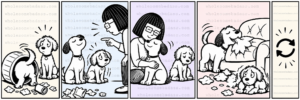
Five-panel cartoon showing one dog rummaging through the trash while another watches nervously. The anxious dog is scolded while the calm dog receives affection. Later, the calm dog tears apart a couch as the other trembles nearby. Circular arrows suggest the pattern continues.

The Benefit of the Doubt

You know that saying, “Whether you believe you can or you believe you can’t, you’re probably right”? Well… I’ve come to recognize how much of what we believe about ourselves is shaped by the responses we consistently receive from our “care”givers. How those responses shape our nervous systems, our sense of who we are, where we do or don’t belong, and what to expect and accept from others. And eventually, the effects of that conditioning can be mistaken for evidence that the treatment was appropriate all along. I know something about that conditioning. I’ve been well trained to take accountability and blame for things that were mine, as well as things that weren’t. And after enough years of being treated as wrong regardless of what I actually did, I developed a rather spectacular why the fuck bother? mentality. I genuinely couldn’t imagine how things could possibly get worse. I’ve done plenty of unwholesome and regrettable things. The only thing I claim innocence for is having not known better. Pride, ego, and managing the optics have never particularly interested me. I had so little control over how I was perceived that, by the time I understood what was happening, much of the damage had already been done. Knowing better and doing better have always mattered more to me.
Read More
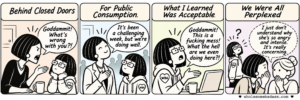
Four-panel cartoon showing the difference between how someone behaves behind closed doors and how they present themselves publicly. A child learns that anger and harsh language are acceptable, but later faces judgment for expressing what she learned.

I Didn’t Know to Hide It

I make no claims to benevolence. For my first 40 years, my default behavior was often diminishing and hurtful. Openly aggressive, harsh, and raging. I hated how reactive and hurtful I could be. But decades of mistreatment taught me only to mistreat, not how to respond appropriately to mistreatment or treat others with consistently high regard. What I couldn’t have known was that the behavior being modeled at home was also being carefully contained. Without any meaningful contrast of kindness, mercy, or respect, I didn’t recognize the behavior as irregular. I’ll always be sensitive, with my tightly wound nervous system basically on the outside of my body—easily overstimulated and dysregulated. But NOW I understand how to soothe and regulate myself. Struggling to regulate one’s emotions, however visibly expressed, should not be confused with exhibiting contempt or disrespect for another person. I get to distance myself from people who consider diminishing words or behaviors acceptable. And it’s been decades since I said or did a mean thing. It seems a ridiculous brag, but it’s quite the overcoming and miracle. One of many things that differentiated me from my family—and the similar relational patterns I later sought out—was that I didn’t know to conceal cruelty. My sister would scold, “You just don’t get it.” Straight facts. I super didn’t get it. What I did get: Apparently, it was okay to say and do cruel and damaging things to me. Because if you did, that was my fault, as my shittiness made you behave that way. This became my relational template, shaping my life’s trajectory. I can’t help but wonder why nobody was concerned enough to get me help. Only judge, punish, judge, repeat. Actually… 🤔 I think I understand why professional guidance was not provided. Getting me help might have meant examining what was happening at home, rather than continuing to treat me as THE problem. And why was I deemed the sinful one? But seriously—for those who know to hide it, what excuse even is there?

Read More
Five-panel cartoon showing one dog rummaging through the trash while another watches nervously. The anxious dog is scolded while the calm dog receives affection. Later, the calm dog tears apart a couch as the other trembles nearby. Circular arrows suggest the pattern continues.

The Benefit of the Doubt

You know that saying, “Whether you believe you can or you believe you can’t, you’re probably right”? Well… I’ve come to recognize how much of what we believe about ourselves is shaped by the responses we consistently receive from our “care”givers. How those responses shape our nervous systems, our sense of who we are, where we do or don’t belong, and what to expect and accept from others. And eventually, the effects of that conditioning can be mistaken for evidence that the treatment was appropriate all along. I know something about that conditioning. I’ve been well trained to take accountability and blame for things that were mine, as well as things that weren’t. And after enough years of being treated as wrong regardless of what I actually did, I developed a rather spectacular why the fuck bother? mentality. I genuinely couldn’t imagine how things could possibly get worse. I’ve done plenty of unwholesome and regrettable things. The only thing I claim innocence for is having not known better. Pride, ego, and managing the optics have never particularly interested me. I had so little control over how I was perceived that, by the time I understood what was happening, much of the damage had already been done. Knowing better and doing better have always mattered more to me.

Read More
Four-panel cartoon showing the difference between how someone behaves behind closed doors and how they present themselves publicly. A child learns that anger and harsh language are acceptable, but later faces judgment for expressing what she learned.

I Didn’t Know to Hide It

I make no claims to benevolence. For my first 40 years, my default behavior was often diminishing and hurtful. Openly aggressive, harsh, and raging. I hated how reactive and hurtful I could be. But decades of mistreatment taught me only to mistreat, not how to respond appropriately to mistreatment or treat others with consistently high regard. What I couldn’t have known was that the behavior being modeled at home was also being carefully contained. Without any meaningful contrast of kindness, mercy, or respect, I didn’t recognize the behavior as irregular. I’ll always be sensitive, with my tightly wound nervous system basically on the outside of my body—easily overstimulated and dysregulated. But NOW I understand how to soothe and regulate myself. Struggling to regulate one’s emotions, however visibly expressed, should not be confused with exhibiting contempt or disrespect for another person. I get to distance myself from people who consider diminishing words or behaviors acceptable. And it’s been decades since I said or did a mean thing. It seems a ridiculous brag, but it’s quite the overcoming and miracle. One of many things that differentiated me from my family—and the similar relational patterns I later sought out—was that I didn’t know to conceal cruelty. My sister would scold, “You just don’t get it.” Straight facts. I super didn’t get it. What I did get: Apparently, it was okay to say and do cruel and damaging things to me. Because if you did, that was my fault, as my shittiness made you behave that way. This became my relational template, shaping my life’s trajectory. I can’t help but wonder why nobody was concerned enough to get me help. Only judge, punish, judge, repeat. Actually… 🤔 I think I understand why professional guidance was not provided. Getting me help might have meant examining what was happening at home, rather than continuing to treat me as THE problem. And why was I deemed the sinful one? But seriously—for those who know to hide it, what excuse even is there?

Read More