Wholesome Badass

A Work in Progress — Healing from All the Things​

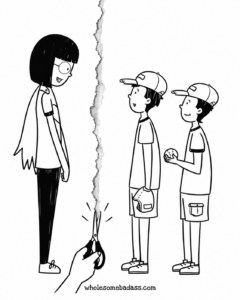
Black-and-white illustration of a mother separated from her two sons by a torn divide, while a hand with scissors cuts between them, symbolizing triangulation and parental alienation.

Paranoia or Pattern Recognition?

Sometimes the most disturbing part of a pattern isn’t what eventually happens. It’s remembering how clearly you could see it taking shape. The small exclusions. The shifting alliances. The selective sharing of information. The quiet rearranging of relationships until someone who once belonged is increasingly treated as an outsider. Each incident, on its own, can be explained away. Questioning the pattern can become a bigger offense than the pattern itself. And when children are involved, I find that especially troubling. I cannot imagine how children benefit from arrangements in which belonging to one relationship gradually comes at the expense of another. What happens when choosing sides becomes so familiar that it no longer feels like choosing? And then there’s the accusation of paranoia. As though recognizing something that has happened repeatedly is the same as inventing something that hasn’t happened at all. How many times does something have to happen before recognizing it is no longer treated as imagining the worst? Or being negative? I remember being asked why I always imagined the worst. I wasn’t imagining. I was recalling. There is a difference between expecting the worst and recognizing something you’ve already lived. And sometimes, years later, you come across something that reminds you just how early you recognized it. Years later, I came across a video I recorded on the morning of my mother’s funeral, after receiving less than 24 hours’ notice of her death and the service. Even then, I was describing what I feared was taking shape and what it might eventually ask of my children. Whatever else may be true, this is what I was seeing, experiencing, and fearing at the time. A recording from that morning.  

Read More