Wholesome Badass

A Work in Progress — Healing from All the Things​

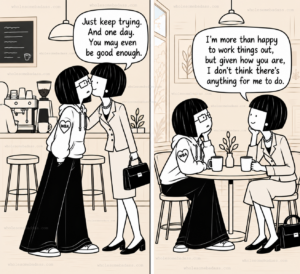
Two-panel illustration showing a woman suggesting someone may eventually be good enough, then claiming she wants reconciliation while insisting the other person is entirely responsible for the conflict.

Maybe One Day You’ll Be Worthy

There’s a deviant cruelty in having it said that you “got what you deserved.” Who even thinks like that? (Clears throat.) When I question the unequal terms of a relationship or ask for mutual consideration, the focus shifts from my concerns to how I’m showing an emotional reaction. My “intensity” is condemned, and my requests for change and repair are dismissed as manufacturing chaos. My credibility is systematically dismantled, while the unequal terms themselves go unexamined. Disqualified. And I am repeatedly (seriously, repeatedly) told, “You are welcome to join, provided you change,” while simultaneously being assured that such change is unlikely. Something astonishing happened when I healed enough to stop providing the convenient distraction of my large emotional reactions: rather than easing the conflict, the pressure intensified. Without my dysregulation to focus on, the very dynamics I had been questioning became difficult to ignore. Requesting mutually healthy terms and finally having enough self-esteem to refuse being disregarded or diminished is characterized as having “opted out.” As though I unilaterally chose to abandon a perfectly good relationship rather than asking whether we could find a way forward that works for us both. The estrangement that follows is framed as the natural consequence of “my choice.” Even hostility is justified as something my supposed deficiencies made necessary. If only I were different, they wouldn’t have to treat me this way. It’s fkn bananas. 🍌
Read More

Toxic and Nurturing Relationship Data

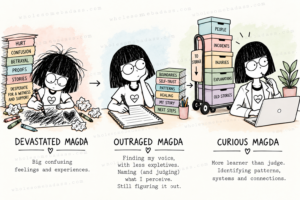
For most of my life, I didn’t even recognize healthy and unhealthy connection as distinct possibilities. Like a fish unaware of the water it’s swimming in, I understood relationships through the only environment I’d ever known. I had learned distorted definitions of love, safety, trust, and connection. What if the most important measure of love isn’t how much someone loves a person, but what happens in the experience of being loved by them? Family ties, intensity, chemistry, and intermittently good experiences aren’t evidence of a healthy relationship. I’m recognizing how toxicity can exist in the way a relationship functions—the architecture of the bond—not simply in either person. Someone may have an entirely different experience with a person than I did, particularly when admiration, usefulness, or reliance shapes how that person relates to them. When someone says, “I’ve never experienced them that way,” I recognize that may be true. What’s hurtful and inappropriate, is when their experience is intended to invalidate mine. Their experience doesn’t disprove mine, any more than mine disproves theirs. I’m describing the relationship I experienced, not issuing a verdict on every relationship that person has. I’m going to place my trust in the prevailing patterns over the peak moments and occasional exceptions. ♡ Feelings I Associate with Nourishing Love ♡ ☠ Feelings I Associate with Harmful Relationship Dynamics ☠ Healing ♡ Alienation-Division Soothing ♡ Diminished-Disregarded Safety ♡ Confused Growth ♡ Silenced Exploration ♡ Frightened Self-expression ♡ Power-imbalance Expansion ♡ Contracted Yes, I am the common denominator in all my relationships—as are we all. So is the relational template I carried into them. It influenced not only the relationships I entered, but what I helped create and sustain within them. That template shaped: I recognize my contribution to my relational patterns without taking ANY esponsibility for another person’s behavior.

Read More
Two-panel illustration showing a woman suggesting someone may eventually be good enough, then claiming she wants reconciliation while insisting the other person is entirely responsible for the conflict.

Maybe One Day You’ll Be Worthy

There’s a deviant cruelty in having it said that you “got what you deserved.” Who even thinks like that? (Clears throat.) When I question the unequal terms of a relationship or ask for mutual consideration, the focus shifts from my concerns to how I’m showing an emotional reaction. My “intensity” is condemned, and my requests for change and repair are dismissed as manufacturing chaos. My credibility is systematically dismantled, while the unequal terms themselves go unexamined. Disqualified. And I am repeatedly (seriously, repeatedly) told, “You are welcome to join, provided you change,” while simultaneously being assured that such change is unlikely. Something astonishing happened when I healed enough to stop providing the convenient distraction of my large emotional reactions: rather than easing the conflict, the pressure intensified. Without my dysregulation to focus on, the very dynamics I had been questioning became difficult to ignore. Requesting mutually healthy terms and finally having enough self-esteem to refuse being disregarded or diminished is characterized as having “opted out.” As though I unilaterally chose to abandon a perfectly good relationship rather than asking whether we could find a way forward that works for us both. The estrangement that follows is framed as the natural consequence of “my choice.” Even hostility is justified as something my supposed deficiencies made necessary. If only I were different, they wouldn’t have to treat me this way. It’s fkn bananas. 🍌

Read More

Toxic and Nurturing Relationship Data

For most of my life, I didn’t even recognize healthy and unhealthy connection as distinct possibilities. Like a fish unaware of the water it’s swimming in, I understood relationships through the only environment I’d ever known. I had learned distorted definitions of love, safety, trust, and connection. What if the most important measure of love isn’t how much someone loves a person, but what happens in the experience of being loved by them? Family ties, intensity, chemistry, and intermittently good experiences aren’t evidence of a healthy relationship. I’m recognizing how toxicity can exist in the way a relationship functions—the architecture of the bond—not simply in either person. Someone may have an entirely different experience with a person than I did, particularly when admiration, usefulness, or reliance shapes how that person relates to them. When someone says, “I’ve never experienced them that way,” I recognize that may be true. What’s hurtful and inappropriate, is when their experience is intended to invalidate mine. Their experience doesn’t disprove mine, any more than mine disproves theirs. I’m describing the relationship I experienced, not issuing a verdict on every relationship that person has. I’m going to place my trust in the prevailing patterns over the peak moments and occasional exceptions. ♡ Feelings I Associate with Nourishing Love ♡ ☠ Feelings I Associate with Harmful Relationship Dynamics ☠ Healing ♡ Alienation-Division Soothing ♡ Diminished-Disregarded Safety ♡ Confused Growth ♡ Silenced Exploration ♡ Frightened Self-expression ♡ Power-imbalance Expansion ♡ Contracted Yes, I am the common denominator in all my relationships—as are we all. So is the relational template I carried into them. It influenced not only the relationships I entered, but what I helped create and sustain within them. That template shaped: I recognize my contribution to my relational patterns without taking ANY esponsibility for another person’s behavior.

Read More