Wholesome Badass

A Work in Progress — Healing from All the Things​

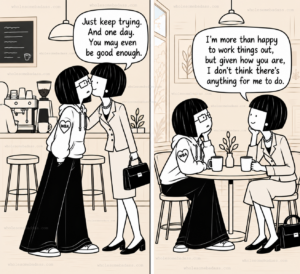
Two-panel illustration showing a woman suggesting someone may eventually be good enough, then claiming she wants reconciliation while insisting the other person is entirely responsible for the conflict.

Maybe One Day You’ll Be Worthy

There’s a deviant cruelty in having it said that you “got what you deserved.” Who even thinks like that? (Clears throat.) When I question the unequal terms of a relationship or ask for mutual consideration, the focus shifts from my concerns to how I’m showing an emotional reaction. My “intensity” is condemned, and my requests for change and repair are dismissed as manufacturing chaos. My credibility is systematically dismantled, while the unequal terms themselves go unexamined. Disqualified. And I am repeatedly (seriously, repeatedly) told, “You are welcome to join, provided you change,” while simultaneously being assured that such change is unlikely. Something astonishing happened when I healed enough to stop providing the convenient distraction of my large emotional reactions: rather than easing the conflict, the pressure intensified. Without my dysregulation to focus on, the very dynamics I had been questioning became difficult to ignore. Requesting mutually healthy terms and finally having enough self-esteem to refuse being disregarded or diminished is characterized as having “opted out.” As though I unilaterally chose to abandon a perfectly good relationship rather than asking whether we could find a way forward that works for us both. The estrangement that follows is framed as the natural consequence of “my choice.” Even hostility is justified as something my supposed deficiencies made necessary. If only I were different, they wouldn’t have to treat me this way. It’s fkn bananas. 🍌

Read More
Rattlesnake wearing a party hat on a pink unicorn bed, symbolizing hidden danger in plain sight.

The Curated Impression

How a Narrative Protects Predatory Behavior The Branding Becomes the Lens I am recognizing something in real time: the story about someone can matter more than what they actually say and do. When someone is characterized unfavorably by a person of greater status or influence, the language is often directed toward creating a shared lens through which others understand them. That version can serve as the starting assumption. Hierarchy gives it weight. This is the branding. The packaging. And it matters who establishes it. From there, a trajectory takes shape. The branding creates two outcomes at once: one person is invalidated while the other is insulated and immune to scrutiny. The branding calls the person to defense, then uses that defense as evidence that the characterization was right. Distress is recast as instability, attempts at clarity as difficulty, withdrawal as withholding, and any strong response as confirmation. Evidence to the contrary is inadmissible. It does not weaken the characterization. This is what makes the role difficult to escape. The arrangement is zero-sum: for one person to remain credible and protected, the other has to remain discredited. This is not a self-fulfilling prophecy in the usual sense because the premise does not originate with the branded one. It is imposed from “above,” then used to interpret everything that follows. Reality gets outranked by narrative. A response can be disproportionate, messy, or wrong without making the underlying experience unreal. Someone can be difficult or unpopular and still have been treated poorly. But the formula reigns: When the conduct of the protected archetype is questioned: Well, I only acted this way because of who and how YOU/THEY are. Have you been in a relationship in which another person’s missteps, poor choices, words, or conduct were repeatedly assigned to something supposedly wrong with you? WTAF? As in: If I behave like an asshole, it is only because you suck.

Read More
Two-panel illustration showing a woman suggesting someone may eventually be good enough, then claiming she wants reconciliation while insisting the other person is entirely responsible for the conflict.

Maybe One Day You’ll Be Worthy

There’s a deviant cruelty in having it said that you “got what you deserved.” Who even thinks like that? (Clears throat.) When I question the unequal terms of a relationship or ask for mutual consideration, the focus shifts from my concerns to how I’m showing an emotional reaction. My “intensity” is condemned, and my requests for change and repair are dismissed as manufacturing chaos. My credibility is systematically dismantled, while the unequal terms themselves go unexamined. Disqualified. And I am repeatedly (seriously, repeatedly) told, “You are welcome to join, provided you change,” while simultaneously being assured that such change is unlikely. Something astonishing happened when I healed enough to stop providing the convenient distraction of my large emotional reactions: rather than easing the conflict, the pressure intensified. Without my dysregulation to focus on, the very dynamics I had been questioning became difficult to ignore. Requesting mutually healthy terms and finally having enough self-esteem to refuse being disregarded or diminished is characterized as having “opted out.” As though I unilaterally chose to abandon a perfectly good relationship rather than asking whether we could find a way forward that works for us both. The estrangement that follows is framed as the natural consequence of “my choice.” Even hostility is justified as something my supposed deficiencies made necessary. If only I were different, they wouldn’t have to treat me this way. It’s fkn bananas. 🍌

Read More
Rattlesnake wearing a party hat on a pink unicorn bed, symbolizing hidden danger in plain sight.

The Curated Impression

How a Narrative Protects Predatory Behavior The Branding Becomes the Lens I am recognizing something in real time: the story about someone can matter more than what they actually say and do. When someone is characterized unfavorably by a person of greater status or influence, the language is often directed toward creating a shared lens through which others understand them. That version can serve as the starting assumption. Hierarchy gives it weight. This is the branding. The packaging. And it matters who establishes it. From there, a trajectory takes shape. The branding creates two outcomes at once: one person is invalidated while the other is insulated and immune to scrutiny. The branding calls the person to defense, then uses that defense as evidence that the characterization was right. Distress is recast as instability, attempts at clarity as difficulty, withdrawal as withholding, and any strong response as confirmation. Evidence to the contrary is inadmissible. It does not weaken the characterization. This is what makes the role difficult to escape. The arrangement is zero-sum: for one person to remain credible and protected, the other has to remain discredited. This is not a self-fulfilling prophecy in the usual sense because the premise does not originate with the branded one. It is imposed from “above,” then used to interpret everything that follows. Reality gets outranked by narrative. A response can be disproportionate, messy, or wrong without making the underlying experience unreal. Someone can be difficult or unpopular and still have been treated poorly. But the formula reigns: When the conduct of the protected archetype is questioned: Well, I only acted this way because of who and how YOU/THEY are. Have you been in a relationship in which another person’s missteps, poor choices, words, or conduct were repeatedly assigned to something supposedly wrong with you? WTAF? As in: If I behave like an asshole, it is only because you suck.

Read More