Wholesome Badass

A Work in Progress — Healing from All the Things​

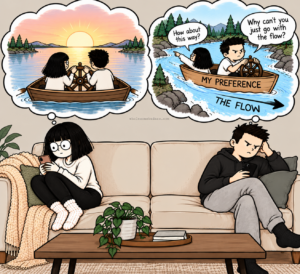
Two people sit apart on a couch. She imagines them steering a boat together. He imagines himself steering a boat labeled “MY PREFERENCE” along “THE FLOW,” dismissing her suggestion with, “Why can’t you just go with the flow?”

Expecting to Matter

In my family and marriage, my emotional and sensory sensitivities were treated as unreasonable burdens and acts of defiance. Rather than information worth considering, my preferences and limitations were interpreted as resistance. I struggled to navigate these relationships, which I experienced as structured around coercion and submission, where consideration wasn’t a shared value. Expressing individual needs was treated as not being a team player—a punishable offense. And when those needs were accommodated, they were logged as personal favors and evidence of fairness, further reinforcing the power imbalance. When a person can only tolerate having their way, even the possibility of not getting what they want can create considerable tension. Despite my best efforts, I found no way to remain under those rules of engagement. The only healthy option was to surrender the relationships rather than submit to unfavorable terms or keep fighting for better ones while being treated as though their  proximity was a privilege, easily revoked. Fuck that. No, thank you.

Read More
Black-and-white line drawing of two stick figures in a leaking boat. One figure wears a life vest, holds a life preserver, and says, “You need to calm down,” while the other figure looks distressed and bails water out of the boat.

The Advantage of Appearing Unbothered

I am beginning to recognize and more effectively name and navigate familiar systems, patterns, and personalities. In power imbalances, the person with more status or authority can seem even more credible when appearing almost completely unaffected — mildly inconvenienced at most. Beneath a curated exterior — detached, unreadable, even smiling or measured — strategically executed impunity may pass for sovereignty, shielded from challenge by status/rank itself. By contrast, an emotional response to threat or injury can be marked as excessive: evidence of defect, weakness, and wrongness, rendering the account of what happened inadmissible. Once that logic is established, power-over can pass as reasonable and justified. This is where emotional violence can comfortably hide: in the latitude granted by role, status, or perceived legitimacy to diminish, exclude, intimidate, or overpower another person while the resulting distress is treated as further proof that the response was warranted.

Read More
Black-and-white illustration of a smiling priest holding someone underwater during a baptism. A crowd admires him while a concerned girl notices the harm.

Perception vs. Reality

There is a scene in Boardwalk Empire in which a priest is standing in a river performing a baptism. He is wearing white robes. He is smiling. He occupies a position of moral authority. He presents as a good man offering salvation. The priest is holding the man beneath the water, while keeping a calmly arranged placid smile on his face, his confidence in plausible deniability. Here is a man cloaked in goodness, purity, and authority, protected by the very role that allows him to publicly and confidently carry out something profoundly sinister. People see the robes, the smile, the holy father offering salvation. His authority goes unchecked because the story has already been written. The role itself pre-decides what is possible to notice. In that way, the people witnessing from the shore become part of the story as well. The disturbance is not confined to the harm itself. It is also the protection, restoration, accommodation, and assumption of goodness that surround it. It is the way the narratives that shape our understanding pre-decide what is possible to notice.

Read More
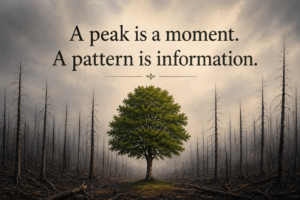
One healthy green tree standing in the middle of a forest of dead trees beneath the quote, “A peak is a moment. A pattern is information.”

The Truth Is in the Pattern

Sheesh. How many more times will I have to navigate this particular circuit before I have learned everything I can from it? The turth is in the pattern, not the explanation. It almost feels as though I have been given a false map. There are things people say that, if I allow them to guide me, will take me completely off course because they don’t align with reality, their actions, or my lived experience. I am starting to recognize that the real story lives inside the patterns. Words do matter. Conversations matter. Moments matter. But patterns persist regardless of what is said. Sometimes there is an incongruency or lack of alignment between words, the suggested intent of those words, and actions. Sometimes things are not communicated directly at all, and yet they are communicated clearly through repeated behaviors. I am intentionally allowing patterns to inform me more than peak moments, conversations, or exchanges. If there is a pleasurable moment in a relationship, I can no longer hold onto that moment as though it represents restoration or the relationship as a whole. I will not waste energy trying to figure out how to get back to that place, as though I have somehow lost the thread. Perhaps it was the exception. Possibly, it was simply a moment. The information is in the pattern. That doesn’t necessarily tell me what is true in some absolute sense, but it does tell me what is real. And when I allow patterns to inform what I say or do next, I am able to remain aligned with my quest for sovereignty and radical neutrality. A thing has happened. I don’t get to change it, reinterpret it, or spin it into something else. I don’t have to lose myself reacting or trying to understand it from every possible angle. I don’t have to overexplain my experience or convince anyone else of it. I can simply acknowledge what is and decide what my actual options are, keeping in alignment with my North Star. Whatever else may be true, this also happened.

Read More
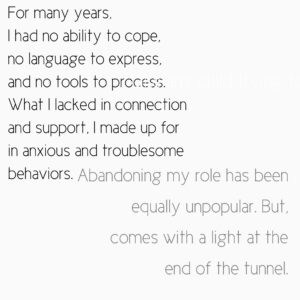
A minimalist graphic with white text on a solid, neutral background. The text reads: "I had no ability to cope, no language to express, and no tools to process. What I lacked in connection, I made up for in anxious behaviors. It was a costly way to exist—paying with myself just for proximity. Abandoning my role has been equally unpopular. But, it comes with a light at the end of the tunnel."⁠

When Victory Demands Wreckage

The Architecture of Binary Victory I have intentionally been studying a particular archetype whose sense of rightness often seems to depend on projecting wrongness onto someone else. The Perceived Victimization The archetype appears to operate under a specific system of binary beliefs: the conviction that winning and “being right” at all costs remains the ultimate proof of goodness, and that causing another to struggle is a valid tool to establish who is in the wrong. Under this framework, if someone in anyway interferes with what the archetype feels entitled to, it is experienced as a personal victimization. To restore the power imbalance, the system demands the plight of the person who deviated from the script. The Circular Trap of Blame Within this structure, a peaceful disagreement, ending or exit is out of the question; the archetype often requires visible social, financial, or professional struggle. Resulting pain is regarded not as a wound in need of care, but as proof of a deserving loser. The narrative becomes circular: the imposed hardship(which they rationalize as natural consequences–but natural consequences by definition are not imposed) is held up as evidence of “bad choices” and a “bad personality,” while the behaviors that contributed to the struggle are casually dismissed. Claiming the Third Way The fixed mindset of the archetype fights hard against a third way—a reality where someone can step away, choose peace, and quietly build a life outside of those win-loss columns.

Read More
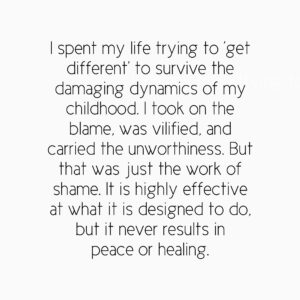
Unpacking the exhausting cycle of trying to "get different" to survive childhood dynamics, and why shame never produces the goodness we are looking for.⁠

The Cost of Challenging Toxic Systems

The Sovereignty Tax (My Refusal to Bleed) I am 57 years old, and I am only just now learning the practices of sovereignty and radical neutrality. Until recently, no one who has known me would have thought me even remotely sovereign or neutral- as I was NOT at all. And in a dedicated quest to actually live my life, to inhabit my own actual space, I have poked a few hornets’ nests. Different nests, but always an insidious sting. Me thinks me see a pattern. The Posture of Royalty Throughout my life—my family of origin, my marriage, historical friendships, and recently a neighbor—I have navigated people who try to assume a posture of royalty. For now, I will apply the term archetype to this personality. The archetype’s need for elevated status seems heavily reliant on a network of enablers propping them up—people who are either dependent, impressed, or intimidated by them in some way. I think there may be confsuion around those, as proxies for respect. With fragility of said crown, there is no such thing as safe, neutral ground(autonomy). If you aren’t actively prioritizing- propping them up (keeping them rightfully pleased), they perceive a traitor- actively trying to reduce or defy them. “You are either blindly for me or you are against me.” In each instance in which I have attempted to inhabit my space with an upright posture, I find myself squarely in the crosshairs of the archetype—and therefore, the crosshairs of the enablers. In psychology, there is a term “flying monkeys”. The Weaponized Concern Once inside the crosshairs, the campaign begins—wrapped in the soft language of concern. They don’t attack openly or directly check in. Instead, they whisper to friends, neighbors, managers, family, and peers: “Oh my gosh, I’m just worried about her. She seems so overwhelmed. She seems frantic. Confused.” It is a brilliant, insidious strategy to strip away validity and leave you vulnerable. By painting you as “frantic” or “struggling,” they accomplish three things at once: 1. They position themselves as THE “compassionate, stable” ones. 2. They pre-emptively compromise your credibility and validity. When you question the impact of their behavior, the script flips back to said problematic personality, perception, sensitivity, or struggles. The initiatives contributing negative impact are not acknowledged. In calling them out, you are accused of speaking problems into existence that don’t exist and creating drama. Abuse did not cause drama. Not quietly absorbing it did. 3. They set the trap. If you react, defend yourself, express discomfort, they get to sigh, throw up their hands, and say, “See? I told you she was unstable.” They get to confirm the very narrative they artfully spun and spread about you. When you dare to sit or stand upright to claim your own space and they can’t knock you down directly (because that would be questionable behavior), they set promptly to working to dissolve the ground beneath you. The Science of the Shark It is basic science that if you are bleeding in the water, you will attract sharks. That is just biology. I see the role I was cast in and have played with dedication. When you are born to sharks, you neeeeed the sharks! To be clear, I don’t make people behave sharkishly. I dont force or imagine them to behave as predators, and I didn’t knowingly choose to bleed out for a lifetime. It’s a dynamic, a well documented and studied pattern. Those who choose the comforting lie that “anything is possible if you just make the right choices” would love to hang this on me—to suggest that my bleeding was my own doing,earning, or imangining since clearly, I was “such a bloody mess.” But the truth is, a shark was always going to do the sharky things. For a long time, it seems my only clear option was to keep offering up the blood—to keep them close, because their attention—even when violent—felt safer than being entirely abandoned. Often, I attempted to mimic shark behavior that never fit my soul. Now, adopting the practices of radical neutrality has changed the water. The Unwelcome Healing When bleeding supply is curtailed, the sharks are disoriented. Because if I am not chumming the waters for them, how will they establish their mighty sharkiness? As if I must have forgotten how powerful and dangerous they are. “Don’t you know who you are dealing with?“ So, the system responds to my autonomy(my intentional choice to nurture and protect my most basic needs and limits) as an attack. The system functions smoothly as long as I agree to stay broken and matter less. The archetype—and enablers—respond with a highly specific theater of terror aimed at diminishing me, clawing at my peace- to prove they possess the power to make me flinch. I think there may be more favorable powers than this. I recall, with chilling clarity, my sister boasting about doing this thing to a woman at work. She literally glowed as she reported, “I know exactly how to make her cook her own goose,” simply because the woman carried herself in a way that made my sister feel non elevated and non- revered. The Third Way I am no authority on anyone else’s family or relationships. I am simply learning to recognize the cost of quietly claiming my right to peaceful ground. I have chosen to pay the heavy price of refusing to kiss the ring. Stepping away from my assigned script and choosing a third way—neither escalation nor collapse—has unsettled the system around me. There is a cost to no longer playing the role others expect you to play. It is a steep tax. But for the first time in my life, I am paying that price for my dignity instead of surrendering it to maintain unsafe contact and no connection. I am not proud of many things. But I feel deeply proud of my courage.
Read More
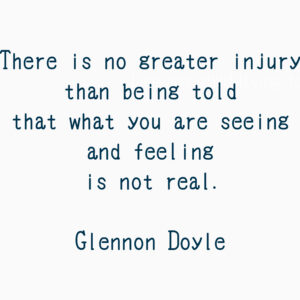
A clean, minimalist square graphic with clear text on a solid, neutral background. The text reads: "There is no greater injury than being told that what you are seeing and feeling is not real. — Glennon Doyle"

A Systemic Disregard

Someone once told me that the cruelest thing you can do to another human being is to label their suspicions as false when you know them to be true. It would be impossible to count the instances where my questioning led to the same responses: You’re crazy. You made that up. Stop trying to manufacture chaos.  It’s in your head. I don’t know what you’re talking about. Something inside of me shattered each time these sentiments were hurled at me. My self-esteem, confidence, and sense of self were deeply compromised- crushing to my spirit. The continued touching of me left me confused, unwanted contact in place of connection- resulting in lifelong emotional deprivation, self-doubt, fear, disordered sleeping, disordered eating, and trust issues that defy articulation. When I threatened to tell on her, she laughed- boasting how nobody would believe me. She made sure of it. Since I’m Not Gay, I Couldn’t Have Done That She spent a fair amount of talking to me about friends of hers who were or seemed gay or butchy, and how repulsive it felt to her, while simultaneously feeling generous that she was friends with them. Like always trying to convince me she wasn’t gay—because in that logic, if she wasn’t gay, she couldn’t possibly have done what she did repeatedly. But being gay does not make someone a predator. She dedicated her life to making me feel crazy and afraid, while simultaneously offering intermittent reinforcement as my heroine—the only person who could understand or protect me. She made it clear that she would be in charge of my relief and my punishment. Like any child looking to assign reasons to that which they cannot control, I blamed myself and spent my life trying to get worthy or at least pretend to. Identity Theft My personhood was snatched–erased. I could not count on myself to know what I felt or wanted, what I needed, and what was true. Whether it was my favorite color, or if I was hungry, tired, or cold, these things were either criticized or treated as debatable. I lost touch with my ability and confidence to know what was true, important, and real. The Fast Track to Addiction It makes sense to me now why I started so early using alcohol, food, drugs, shoplifting, sex—literally anything to alter my brain chemistry for even a brief respite. To feel better. To feel different. To feel nothing. There was never enough. Addiction, impulsive, and compulsive behaviors. A lifetime of instability, insecurity, and unsafety at a cellular level. A systemic disregard for my well-being. I had so many self-help books, so much therapy, 12-step programs, journaling, and any kind of exercise to try to unlock the secrets of how to just fucken be—or maybe even just how to pretend to be better than I actually am. How Are You? For more than forty years, the question “How are you?” has felt like a trick. I always answer “Super duper.” I would say that if I won the lottery or if I crashed my car, because legit nobody actually cared, but also—how am I? How should I know?  Hold on let me check with those who have a monopoly on my truth. As I look back, realizing that I can only remember what I remember how I remember it, I was in no way groomed for success, self-mastery, or even self-sufficiency. In fact, the opposite- I was dismantled. And then I was judged for the exact outcome that was engineered for me. Constant messaging: “You are fundamentally different, and nobody has any interest in building a bridge to where you are.”

Read More
Two people sit apart on a couch. She imagines them steering a boat together. He imagines himself steering a boat labeled “MY PREFERENCE” along “THE FLOW,” dismissing her suggestion with, “Why can’t you just go with the flow?”

Expecting to Matter

In my family and marriage, my emotional and sensory sensitivities were treated as unreasonable burdens and acts of defiance. Rather than information worth considering, my preferences and limitations were interpreted as resistance. I struggled to navigate these relationships, which I experienced as structured around coercion and submission, where consideration wasn’t a shared value. Expressing individual needs was treated as not being a team player—a punishable offense. And when those needs were accommodated, they were logged as personal favors and evidence of fairness, further reinforcing the power imbalance. When a person can only tolerate having their way, even the possibility of not getting what they want can create considerable tension. Despite my best efforts, I found no way to remain under those rules of engagement. The only healthy option was to surrender the relationships rather than submit to unfavorable terms or keep fighting for better ones while being treated as though their  proximity was a privilege, easily revoked. Fuck that. No, thank you.

Read More
Black-and-white line drawing of two stick figures in a leaking boat. One figure wears a life vest, holds a life preserver, and says, “You need to calm down,” while the other figure looks distressed and bails water out of the boat.

The Advantage of Appearing Unbothered

I am beginning to recognize and more effectively name and navigate familiar systems, patterns, and personalities. In power imbalances, the person with more status or authority can seem even more credible when appearing almost completely unaffected — mildly inconvenienced at most. Beneath a curated exterior — detached, unreadable, even smiling or measured — strategically executed impunity may pass for sovereignty, shielded from challenge by status/rank itself. By contrast, an emotional response to threat or injury can be marked as excessive: evidence of defect, weakness, and wrongness, rendering the account of what happened inadmissible. Once that logic is established, power-over can pass as reasonable and justified. This is where emotional violence can comfortably hide: in the latitude granted by role, status, or perceived legitimacy to diminish, exclude, intimidate, or overpower another person while the resulting distress is treated as further proof that the response was warranted.

Read More
Black-and-white illustration of a smiling priest holding someone underwater during a baptism. A crowd admires him while a concerned girl notices the harm.

Perception vs. Reality

There is a scene in Boardwalk Empire in which a priest is standing in a river performing a baptism. He is wearing white robes. He is smiling. He occupies a position of moral authority. He presents as a good man offering salvation. The priest is holding the man beneath the water, while keeping a calmly arranged placid smile on his face, his confidence in plausible deniability. Here is a man cloaked in goodness, purity, and authority, protected by the very role that allows him to publicly and confidently carry out something profoundly sinister. People see the robes, the smile, the holy father offering salvation. His authority goes unchecked because the story has already been written. The role itself pre-decides what is possible to notice. In that way, the people witnessing from the shore become part of the story as well. The disturbance is not confined to the harm itself. It is also the protection, restoration, accommodation, and assumption of goodness that surround it. It is the way the narratives that shape our understanding pre-decide what is possible to notice.

Read More
One healthy green tree standing in the middle of a forest of dead trees beneath the quote, “A peak is a moment. A pattern is information.”

The Truth Is in the Pattern

Sheesh. How many more times will I have to navigate this particular circuit before I have learned everything I can from it? The turth is in the pattern, not the explanation. It almost feels as though I have been given a false map. There are things people say that, if I allow them to guide me, will take me completely off course because they don’t align with reality, their actions, or my lived experience. I am starting to recognize that the real story lives inside the patterns. Words do matter. Conversations matter. Moments matter. But patterns persist regardless of what is said. Sometimes there is an incongruency or lack of alignment between words, the suggested intent of those words, and actions. Sometimes things are not communicated directly at all, and yet they are communicated clearly through repeated behaviors. I am intentionally allowing patterns to inform me more than peak moments, conversations, or exchanges. If there is a pleasurable moment in a relationship, I can no longer hold onto that moment as though it represents restoration or the relationship as a whole. I will not waste energy trying to figure out how to get back to that place, as though I have somehow lost the thread. Perhaps it was the exception. Possibly, it was simply a moment. The information is in the pattern. That doesn’t necessarily tell me what is true in some absolute sense, but it does tell me what is real. And when I allow patterns to inform what I say or do next, I am able to remain aligned with my quest for sovereignty and radical neutrality. A thing has happened. I don’t get to change it, reinterpret it, or spin it into something else. I don’t have to lose myself reacting or trying to understand it from every possible angle. I don’t have to overexplain my experience or convince anyone else of it. I can simply acknowledge what is and decide what my actual options are, keeping in alignment with my North Star. Whatever else may be true, this also happened.

Read More
A minimalist graphic with white text on a solid, neutral background. The text reads: "I had no ability to cope, no language to express, and no tools to process. What I lacked in connection, I made up for in anxious behaviors. It was a costly way to exist—paying with myself just for proximity. Abandoning my role has been equally unpopular. But, it comes with a light at the end of the tunnel."⁠

When Victory Demands Wreckage

The Architecture of Binary Victory I have intentionally been studying a particular archetype whose sense of rightness often seems to depend on projecting wrongness onto someone else. The Perceived Victimization The archetype appears to operate under a specific system of binary beliefs: the conviction that winning and “being right” at all costs remains the ultimate proof of goodness, and that causing another to struggle is a valid tool to establish who is in the wrong. Under this framework, if someone in anyway interferes with what the archetype feels entitled to, it is experienced as a personal victimization. To restore the power imbalance, the system demands the plight of the person who deviated from the script. The Circular Trap of Blame Within this structure, a peaceful disagreement, ending or exit is out of the question; the archetype often requires visible social, financial, or professional struggle. Resulting pain is regarded not as a wound in need of care, but as proof of a deserving loser. The narrative becomes circular: the imposed hardship(which they rationalize as natural consequences–but natural consequences by definition are not imposed) is held up as evidence of “bad choices” and a “bad personality,” while the behaviors that contributed to the struggle are casually dismissed. Claiming the Third Way The fixed mindset of the archetype fights hard against a third way—a reality where someone can step away, choose peace, and quietly build a life outside of those win-loss columns.

Read More
Unpacking the exhausting cycle of trying to "get different" to survive childhood dynamics, and why shame never produces the goodness we are looking for.⁠

The Cost of Challenging Toxic Systems

The Sovereignty Tax (My Refusal to Bleed) I am 57 years old, and I am only just now learning the practices of sovereignty and radical neutrality. Until recently, no one who has known me would have thought me even remotely sovereign or neutral- as I was NOT at all. And in a dedicated quest to actually live my life, to inhabit my own actual space, I have poked a few hornets’ nests. Different nests, but always an insidious sting. Me thinks me see a pattern. The Posture of Royalty Throughout my life—my family of origin, my marriage, historical friendships, and recently a neighbor—I have navigated people who try to assume a posture of royalty. For now, I will apply the term archetype to this personality. The archetype’s need for elevated status seems heavily reliant on a network of enablers propping them up—people who are either dependent, impressed, or intimidated by them in some way. I think there may be confsuion around those, as proxies for respect. With fragility of said crown, there is no such thing as safe, neutral ground(autonomy). If you aren’t actively prioritizing- propping them up (keeping them rightfully pleased), they perceive a traitor- actively trying to reduce or defy them. “You are either blindly for me or you are against me.” In each instance in which I have attempted to inhabit my space with an upright posture, I find myself squarely in the crosshairs of the archetype—and therefore, the crosshairs of the enablers. In psychology, there is a term “flying monkeys”. The Weaponized Concern Once inside the crosshairs, the campaign begins—wrapped in the soft language of concern. They don’t attack openly or directly check in. Instead, they whisper to friends, neighbors, managers, family, and peers: “Oh my gosh, I’m just worried about her. She seems so overwhelmed. She seems frantic. Confused.” It is a brilliant, insidious strategy to strip away validity and leave you vulnerable. By painting you as “frantic” or “struggling,” they accomplish three things at once: 1. They position themselves as THE “compassionate, stable” ones. 2. They pre-emptively compromise your credibility and validity. When you question the impact of their behavior, the script flips back to said problematic personality, perception, sensitivity, or struggles. The initiatives contributing negative impact are not acknowledged. In calling them out, you are accused of speaking problems into existence that don’t exist and creating drama. Abuse did not cause drama. Not quietly absorbing it did. 3. They set the trap. If you react, defend yourself, express discomfort, they get to sigh, throw up their hands, and say, “See? I told you she was unstable.” They get to confirm the very narrative they artfully spun and spread about you. When you dare to sit or stand upright to claim your own space and they can’t knock you down directly (because that would be questionable behavior), they set promptly to working to dissolve the ground beneath you. The Science of the Shark It is basic science that if you are bleeding in the water, you will attract sharks. That is just biology. I see the role I was cast in and have played with dedication. When you are born to sharks, you neeeeed the sharks! To be clear, I don’t make people behave sharkishly. I dont force or imagine them to behave as predators, and I didn’t knowingly choose to bleed out for a lifetime. It’s a dynamic, a well documented and studied pattern. Those who choose the comforting lie that “anything is possible if you just make the right choices” would love to hang this on me—to suggest that my bleeding was my own doing,earning, or imangining since clearly, I was “such a bloody mess.” But the truth is, a shark was always going to do the sharky things. For a long time, it seems my only clear option was to keep offering up the blood—to keep them close, because their attention—even when violent—felt safer than being entirely abandoned. Often, I attempted to mimic shark behavior that never fit my soul. Now, adopting the practices of radical neutrality has changed the water. The Unwelcome Healing When bleeding supply is curtailed, the sharks are disoriented. Because if I am not chumming the waters for them, how will they establish their mighty sharkiness? As if I must have forgotten how powerful and dangerous they are. “Don’t you know who you are dealing with?“ So, the system responds to my autonomy(my intentional choice to nurture and protect my most basic needs and limits) as an attack. The system functions smoothly as long as I agree to stay broken and matter less. The archetype—and enablers—respond with a highly specific theater of terror aimed at diminishing me, clawing at my peace- to prove they possess the power to make me flinch. I think there may be more favorable powers than this. I recall, with chilling clarity, my sister boasting about doing this thing to a woman at work. She literally glowed as she reported, “I know exactly how to make her cook her own goose,” simply because the woman carried herself in a way that made my sister feel non elevated and non- revered. The Third Way I am no authority on anyone else’s family or relationships. I am simply learning to recognize the cost of quietly claiming my right to peaceful ground. I have chosen to pay the heavy price of refusing to kiss the ring. Stepping away from my assigned script and choosing a third way—neither escalation nor collapse—has unsettled the system around me. There is a cost to no longer playing the role others expect you to play. It is a steep tax. But for the first time in my life, I am paying that price for my dignity instead of surrendering it to maintain unsafe contact and no connection. I am not proud of many things. But I feel deeply proud of my courage.

Read More
A clean, minimalist square graphic with clear text on a solid, neutral background. The text reads: "There is no greater injury than being told that what you are seeing and feeling is not real. — Glennon Doyle"

A Systemic Disregard

Someone once told me that the cruelest thing you can do to another human being is to label their suspicions as false when you know them to be true. It would be impossible to count the instances where my questioning led to the same responses: You’re crazy. You made that up. Stop trying to manufacture chaos.  It’s in your head. I don’t know what you’re talking about. Something inside of me shattered each time these sentiments were hurled at me. My self-esteem, confidence, and sense of self were deeply compromised- crushing to my spirit. The continued touching of me left me confused, unwanted contact in place of connection- resulting in lifelong emotional deprivation, self-doubt, fear, disordered sleeping, disordered eating, and trust issues that defy articulation. When I threatened to tell on her, she laughed- boasting how nobody would believe me. She made sure of it. Since I’m Not Gay, I Couldn’t Have Done That She spent a fair amount of talking to me about friends of hers who were or seemed gay or butchy, and how repulsive it felt to her, while simultaneously feeling generous that she was friends with them. Like always trying to convince me she wasn’t gay—because in that logic, if she wasn’t gay, she couldn’t possibly have done what she did repeatedly. But being gay does not make someone a predator. She dedicated her life to making me feel crazy and afraid, while simultaneously offering intermittent reinforcement as my heroine—the only person who could understand or protect me. She made it clear that she would be in charge of my relief and my punishment. Like any child looking to assign reasons to that which they cannot control, I blamed myself and spent my life trying to get worthy or at least pretend to. Identity Theft My personhood was snatched–erased. I could not count on myself to know what I felt or wanted, what I needed, and what was true. Whether it was my favorite color, or if I was hungry, tired, or cold, these things were either criticized or treated as debatable. I lost touch with my ability and confidence to know what was true, important, and real. The Fast Track to Addiction It makes sense to me now why I started so early using alcohol, food, drugs, shoplifting, sex—literally anything to alter my brain chemistry for even a brief respite. To feel better. To feel different. To feel nothing. There was never enough. Addiction, impulsive, and compulsive behaviors. A lifetime of instability, insecurity, and unsafety at a cellular level. A systemic disregard for my well-being. I had so many self-help books, so much therapy, 12-step programs, journaling, and any kind of exercise to try to unlock the secrets of how to just fucken be—or maybe even just how to pretend to be better than I actually am. How Are You? For more than forty years, the question “How are you?” has felt like a trick. I always answer “Super duper.” I would say that if I won the lottery or if I crashed my car, because legit nobody actually cared, but also—how am I? How should I know?  Hold on let me check with those who have a monopoly on my truth. As I look back, realizing that I can only remember what I remember how I remember it, I was in no way groomed for success, self-mastery, or even self-sufficiency. In fact, the opposite- I was dismantled. And then I was judged for the exact outcome that was engineered for me. Constant messaging: “You are fundamentally different, and nobody has any interest in building a bridge to where you are.”

Read More