Wholesome Badass

A Work in Progress — Healing from All the Things​

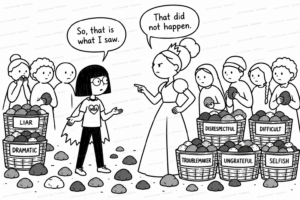
Black-and-white cartoon of a girl describing what she witnessed while a stern woman denies it. Villagers hold baskets of stones labeled liar, dramatic, selfish, ungrateful, and disrespectful, illustrating gaslighting and scapegoating.

Beyond Reproach?

Whatever is said or believed about me does not change what was said and done. I keep coming back to the possibility that the golden child can occupy the position of a protected abuser. So much of my childhood was lost in the shadow of what happened with my female sibling, older than me by 7 years. Decades later, she came for my children. I am only beginning to recognize the correlation between the two. Not identical acts. A familiar code. She acts. I object. My objection is treated as the offense. My experience is displaced. Her version is granted authority. Others are drawn in. Her position remains protected. Mine grows increasingly difficult to hold without defending myself. She was afforded the identity and cover of “good,” while I was named a menace for directly objecting and emotionally reacting to behavior that was, in fact, objectionable by almost any standard. She was able to compromise me in plain sight from behind the protective shield of who everyone believed her to be. It was never-ending. From the outside, it must have looked as if I were crazy—boxing with ghosts. People could see my distress. They could not see the quiet dog whistles, unwanted touching, exclusions, implications, and positioning I was responding to. And I can say now that I was fucking crazed by what was happening—not only because it was harmful, but because the harm was denied and protected. The asymmetry was brutal: one person retained the cover of goodness while my visible distress was treated as if it had appeared out of nowhere- a thing I elected to do. My reaction was indeed spectacular. What preceded it remained invisible. Maybe that is part of what I am processing now. For decades, people must have thought, Yikes. What is wrong with her? I have spent years interrogating that question too. Only recently have I become more interested in a different question: What happened to her, to lil Magda? Why is it easier to ask what is wrong with someone than to ask what happened to them? The first question leaves the existing narrative intact. The second invites examination. It is a fascinating pattern: harm can be easily masked by a role, a reputation, even an act that looks virtuous from across the room. A person can be doing harm while being protected by the belief that they are good. Years later, I would be profoundly affected by a pastor whose attention felt like the most extraordinary care. I can see now how I had been groomed to mistrust my own perception, particularly when harm came through someone occupying a role presumed to be protective—a shepherd, someone understood to be good, trustworthy, and morally authoritative. I keep thinking of the line, “Not all villains wear black.” There is an almost absurd irony in that for me: I tend to dress mostly in black, while my female sibling favors white. hmmmm…. I don’t think clothing color informs us of character, of course. Have you ever watched harmful behavior happen in plain sight while others showed and spoke no objection – maybe because of the status, influence, or authority of the person doing it, or the lesser status of the person being harmed—so that neutrality itself functioned as permission? What is that even called? It reminds me of that scene in Boardwalk Empire where a priest appears to be baptizing a man in front of the entire church. What everyone else sees is a sacred ritual performed by someone occupying one of the most trusted positions in the room. What is actually happening is murder.
Read More
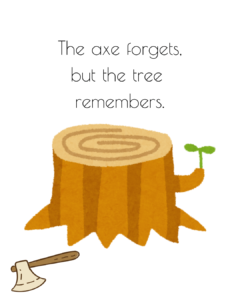
Chopped down tree symbolizing the lasting impact of family betrayal and parental alienation.

How Did We Get Here?

At a very tense Mother’s Day gathering in 2016, I learned that my niece’s graduation was less than four weeks away and on the same night as a concert I had already committed to. The tickets had been a Valentine’s Day gift and the plans had been in place for months. It wasn’t that I chose a concert over her graduation. I simply already had plans by the time I was given the date. With no other way to get my boys to the graduation, and valuing the opportunity for family that being there would give them, I sent them with their dad. Even then, I sensed it could be a fatal choice. Later, my mother told me that while they were at the graduation, plans began for a birthday gathering for my son that would intentionally exclude me. Whatever was happening between the adults, I had directly and repeatedly asked that it stay there, and that we do the work of repair. Something in the fabric of my universe was torn beyond repair. Whatever else may be true, this also happened. I’ve been accused of being negative- always imagining the worst. Maybe I was never imagining the worst. Maybe I’m recognizing and recalling what I have lived. Have you ever been called negative for noticing a pattern that later proved real?

Read More
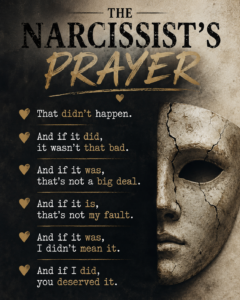
The Narcissist’s Prayer showing six statements that progress from denial and minimization to blame-shifting, beside an image of a cracked mask.

Gaslighting, Blame-Shifting, and the Absence of Repair

A person can know something experientially long before they can articulate it. They might know, for example, “After X is upset with me, I end up confused. I initiate communication thinking I had a legitimate concern, and somehow I leave apologizing and wondering whether I caused everything.” They don’t necessarily have words or concepts to process what happened. Once someone learns concepts like blame-shifting, triangulation, invalidation, stonewalling, double standards, DARVO, conditional approval, or refusal of repair, those concepts can provide handles for examining an interaction: Wait—was I actually heard? Did we each consider or examine our contributions? Was disagreement permitted? Did responsibility somehow become entirely mine? And importantly, language doesn’t have to supply the verdict. It can supply questions. That may be especially valuable for someone who’s been raised inside a particular relational system, because whatever happened repeatedly can simply register as this is how relationships work. Conflict is information, not a trial where somebody has to be found guilty. You can finish a disagreement still thinking, I was right about the original issue, and nevertheless learn: I interrupted you. I got defensive. I misunderstood what you meant. I didn’t realize that mattered so much to you. Or: I still disagree, but now I understand your reasoning. Or my most favorite of all: I think I understtand but I still do not agree. And the other person can do the same. Someone can be displeased with you without their displeasure becoming evidence that you’re bad. They can misunderstand you without their interpretation replacing your knowledge of yourself. And you can discover something uncomfortable about your own behavior without having to collapse into therefore I am the problem. In a healthy rupture, both people have something to metabolize. Not necessarily equal blame—sometimes one person really did behave badly—but both people still have an encounter to process. What happened? What did I do? What did you experience? What did I misunderstand? What does this change between us? What is needed for repair? In the archetypal dynamic, one person effectively exempts themselves from that process. Their internal work stops at: I was right to do or say X because of what you did. Everything downstream gets assigned to the other person. But the person on the receiving end doesn’t get to bypass metabolizing the rupture. They can end up metabolizing too much. They process the original conflict, the accusation, the other person’s certainty, the withdrawal, their own behavior, their memory, their motives, what they could have done differently, whether they’re actually the problem—and they do it without the other person’s participation. Then contact resumes without repair. All of that processing has nowhere relational to land. It can instead become adaptation: anxiety, self-doubt, vigilance, accommodation, rehearsing, overexplaining, trying harder, monitoring tone, becoming increasingly careful. The rupture isn’t unprocessed. The processing is asymmetrical. One person preserves their existing understanding of themselves. The other person is left reorganizing themselves around the unresolved rupture. Repair brings the information back into the relationship, where both people can examine it instead of one person having to carry and interpret the whole thing alone. One person is trying to understand what happened. The archetype is operating from the position that nothing happened that requires understanding. One person is asking, What happened between us? How did we get here? What needs to be repaired? And the answer—explicitly or through behavior—is essentially: There is nothing between us to repair. The problem is that you’re confused, anxious, sensitive, difficult, or unable to let things go. So the effect of the interaction gets reassigned as a characteristic of the recipient. The anxiety created by unresolved rupture becomes evidence that you’re “anxious.” The confusion created by contradictory interactions becomes evidence that you’re “confused.” Your attempts to get resolution become evidence that you “can’t let things go.” Your attempts to clarify what happened become evidence that you’re “overthinking.” The interaction disappears from the explanation. Then when ordinary contact resumes without acknowledgment, one person can experience that as moving on, while the other person is still carrying an unresolved event that supposedly never happened. There can be no repair when only one person is able to acknowledge that there was a rupture. You can say, “Something you did didn’t land well with me,” and get: Nothing happened. You’re misinterpreting me. You’re too sensitive. Or you can notice distance and say, “Something seems different between us. Did something happen?” and get: Nothing’s different. You’re imagining things. Why do you always do this? If you name an impact, you’re creating a problem. If you notice an impact, you’re creating a problem. If you ask about a rupture, you’re creating a problem. If you remain unsettled because there was no repair, that becomes the problem. The recipient isn’t just processing a conflict alone. They’re being asked to process a conflict whose existence has been denied. There isn’t even an agreed-upon event to work with. Something happened between us. I can observe the change. I’m experiencing the consequences. But I’m being told there is nothing here to discuss. Which may be why “nothing happened” is so consequential. It doesn’t merely refuse repair. It removes the shared reality from which repair would have been possible. Nothing happened. Nothing’s wrong. There is nothing to discuss. But then there’s silence. Distance. Withdrawal. Maybe coldness. You’re left alone with whatever the fuck just happened. That’s the contradiction. You’re experiencing the consequences of a rupture while being denied the existence of the rupture itself. Whatever else may be true, this is a defining structure within the archetypal dynamic.

Read More
Black-and-white cartoon of a girl describing what she witnessed while a stern woman denies it. Villagers hold baskets of stones labeled liar, dramatic, selfish, ungrateful, and disrespectful, illustrating gaslighting and scapegoating.

Beyond Reproach?

Whatever is said or believed about me does not change what was said and done. I keep coming back to the possibility that the golden child can occupy the position of a protected abuser. So much of my childhood was lost in the shadow of what happened with my female sibling, older than me by 7 years. Decades later, she came for my children. I am only beginning to recognize the correlation between the two. Not identical acts. A familiar code. She acts. I object. My objection is treated as the offense. My experience is displaced. Her version is granted authority. Others are drawn in. Her position remains protected. Mine grows increasingly difficult to hold without defending myself. She was afforded the identity and cover of “good,” while I was named a menace for directly objecting and emotionally reacting to behavior that was, in fact, objectionable by almost any standard. She was able to compromise me in plain sight from behind the protective shield of who everyone believed her to be. It was never-ending. From the outside, it must have looked as if I were crazy—boxing with ghosts. People could see my distress. They could not see the quiet dog whistles, unwanted touching, exclusions, implications, and positioning I was responding to. And I can say now that I was fucking crazed by what was happening—not only because it was harmful, but because the harm was denied and protected. The asymmetry was brutal: one person retained the cover of goodness while my visible distress was treated as if it had appeared out of nowhere- a thing I elected to do. My reaction was indeed spectacular. What preceded it remained invisible. Maybe that is part of what I am processing now. For decades, people must have thought, Yikes. What is wrong with her? I have spent years interrogating that question too. Only recently have I become more interested in a different question: What happened to her, to lil Magda? Why is it easier to ask what is wrong with someone than to ask what happened to them? The first question leaves the existing narrative intact. The second invites examination. It is a fascinating pattern: harm can be easily masked by a role, a reputation, even an act that looks virtuous from across the room. A person can be doing harm while being protected by the belief that they are good. Years later, I would be profoundly affected by a pastor whose attention felt like the most extraordinary care. I can see now how I had been groomed to mistrust my own perception, particularly when harm came through someone occupying a role presumed to be protective—a shepherd, someone understood to be good, trustworthy, and morally authoritative. I keep thinking of the line, “Not all villains wear black.” There is an almost absurd irony in that for me: I tend to dress mostly in black, while my female sibling favors white. hmmmm…. I don’t think clothing color informs us of character, of course. Have you ever watched harmful behavior happen in plain sight while others showed and spoke no objection – maybe because of the status, influence, or authority of the person doing it, or the lesser status of the person being harmed—so that neutrality itself functioned as permission? What is that even called? It reminds me of that scene in Boardwalk Empire where a priest appears to be baptizing a man in front of the entire church. What everyone else sees is a sacred ritual performed by someone occupying one of the most trusted positions in the room. What is actually happening is murder.

Read More
Chopped down tree symbolizing the lasting impact of family betrayal and parental alienation.

How Did We Get Here?

At a very tense Mother’s Day gathering in 2016, I learned that my niece’s graduation was less than four weeks away and on the same night as a concert I had already committed to. The tickets had been a Valentine’s Day gift and the plans had been in place for months. It wasn’t that I chose a concert over her graduation. I simply already had plans by the time I was given the date. With no other way to get my boys to the graduation, and valuing the opportunity for family that being there would give them, I sent them with their dad. Even then, I sensed it could be a fatal choice. Later, my mother told me that while they were at the graduation, plans began for a birthday gathering for my son that would intentionally exclude me. Whatever was happening between the adults, I had directly and repeatedly asked that it stay there, and that we do the work of repair. Something in the fabric of my universe was torn beyond repair. Whatever else may be true, this also happened. I’ve been accused of being negative- always imagining the worst. Maybe I was never imagining the worst. Maybe I’m recognizing and recalling what I have lived. Have you ever been called negative for noticing a pattern that later proved real?

Read More
The Narcissist’s Prayer showing six statements that progress from denial and minimization to blame-shifting, beside an image of a cracked mask.

Gaslighting, Blame-Shifting, and the Absence of Repair

A person can know something experientially long before they can articulate it. They might know, for example, “After X is upset with me, I end up confused. I initiate communication thinking I had a legitimate concern, and somehow I leave apologizing and wondering whether I caused everything.” They don’t necessarily have words or concepts to process what happened. Once someone learns concepts like blame-shifting, triangulation, invalidation, stonewalling, double standards, DARVO, conditional approval, or refusal of repair, those concepts can provide handles for examining an interaction: Wait—was I actually heard? Did we each consider or examine our contributions? Was disagreement permitted? Did responsibility somehow become entirely mine? And importantly, language doesn’t have to supply the verdict. It can supply questions. That may be especially valuable for someone who’s been raised inside a particular relational system, because whatever happened repeatedly can simply register as this is how relationships work. Conflict is information, not a trial where somebody has to be found guilty. You can finish a disagreement still thinking, I was right about the original issue, and nevertheless learn: I interrupted you. I got defensive. I misunderstood what you meant. I didn’t realize that mattered so much to you. Or: I still disagree, but now I understand your reasoning. Or my most favorite of all: I think I understtand but I still do not agree. And the other person can do the same. Someone can be displeased with you without their displeasure becoming evidence that you’re bad. They can misunderstand you without their interpretation replacing your knowledge of yourself. And you can discover something uncomfortable about your own behavior without having to collapse into therefore I am the problem. In a healthy rupture, both people have something to metabolize. Not necessarily equal blame—sometimes one person really did behave badly—but both people still have an encounter to process. What happened? What did I do? What did you experience? What did I misunderstand? What does this change between us? What is needed for repair? In the archetypal dynamic, one person effectively exempts themselves from that process. Their internal work stops at: I was right to do or say X because of what you did. Everything downstream gets assigned to the other person. But the person on the receiving end doesn’t get to bypass metabolizing the rupture. They can end up metabolizing too much. They process the original conflict, the accusation, the other person’s certainty, the withdrawal, their own behavior, their memory, their motives, what they could have done differently, whether they’re actually the problem—and they do it without the other person’s participation. Then contact resumes without repair. All of that processing has nowhere relational to land. It can instead become adaptation: anxiety, self-doubt, vigilance, accommodation, rehearsing, overexplaining, trying harder, monitoring tone, becoming increasingly careful. The rupture isn’t unprocessed. The processing is asymmetrical. One person preserves their existing understanding of themselves. The other person is left reorganizing themselves around the unresolved rupture. Repair brings the information back into the relationship, where both people can examine it instead of one person having to carry and interpret the whole thing alone. One person is trying to understand what happened. The archetype is operating from the position that nothing happened that requires understanding. One person is asking, What happened between us? How did we get here? What needs to be repaired? And the answer—explicitly or through behavior—is essentially: There is nothing between us to repair. The problem is that you’re confused, anxious, sensitive, difficult, or unable to let things go. So the effect of the interaction gets reassigned as a characteristic of the recipient. The anxiety created by unresolved rupture becomes evidence that you’re “anxious.” The confusion created by contradictory interactions becomes evidence that you’re “confused.” Your attempts to get resolution become evidence that you “can’t let things go.” Your attempts to clarify what happened become evidence that you’re “overthinking.” The interaction disappears from the explanation. Then when ordinary contact resumes without acknowledgment, one person can experience that as moving on, while the other person is still carrying an unresolved event that supposedly never happened. There can be no repair when only one person is able to acknowledge that there was a rupture. You can say, “Something you did didn’t land well with me,” and get: Nothing happened. You’re misinterpreting me. You’re too sensitive. Or you can notice distance and say, “Something seems different between us. Did something happen?” and get: Nothing’s different. You’re imagining things. Why do you always do this? If you name an impact, you’re creating a problem. If you notice an impact, you’re creating a problem. If you ask about a rupture, you’re creating a problem. If you remain unsettled because there was no repair, that becomes the problem. The recipient isn’t just processing a conflict alone. They’re being asked to process a conflict whose existence has been denied. There isn’t even an agreed-upon event to work with. Something happened between us. I can observe the change. I’m experiencing the consequences. But I’m being told there is nothing here to discuss. Which may be why “nothing happened” is so consequential. It doesn’t merely refuse repair. It removes the shared reality from which repair would have been possible. Nothing happened. Nothing’s wrong. There is nothing to discuss. But then there’s silence. Distance. Withdrawal. Maybe coldness. You’re left alone with whatever the fuck just happened. That’s the contradiction. You’re experiencing the consequences of a rupture while being denied the existence of the rupture itself. Whatever else may be true, this is a defining structure within the archetypal dynamic.

Read More