Whatever is said or believed about me does not change what was said and done.
I keep coming back to the possibility that the golden child can occupy the position of a protected abuser.
So much of my childhood was lost in the shadow of what happened with my female sibling, older than me by 7 years. Decades later, she came for my children. I am only beginning to recognize the correlation between the two. Not identical acts. A familiar code.
She acts. I object. My objection is treated as the offense.
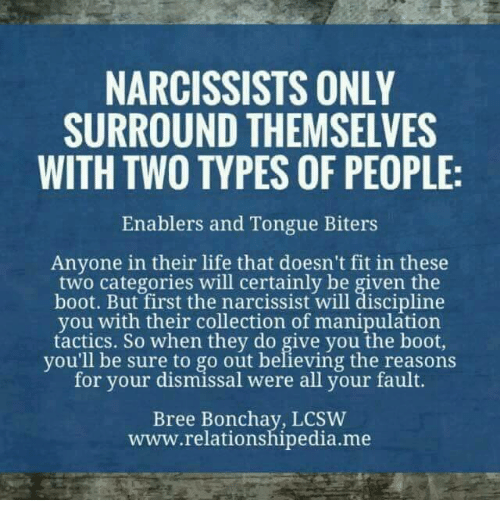
My experience is displaced. Her version is granted authority. Others are drawn in. Her position remains protected. Mine grows increasingly difficult to hold without defending myself.
She was afforded the identity and cover of “good,” while I was named a menace for directly objecting and emotionally reacting to behavior that was, in fact, objectionable by almost any standard.
She was able to compromise me in plain sight from behind the protective shield of who everyone believed her to be. It was never-ending.
From the outside, it must have looked as if I were crazy—boxing with ghosts. People could see my distress. They could not see the quiet dog whistles, unwanted touching, exclusions, implications, and positioning I was responding to.
And I can say now that I was fucking crazed by what was happening—not only because it was harmful, but because the harm was denied and protected. The asymmetry was brutal: one person retained the cover of goodness while my visible distress was treated as if it had appeared out of nowhere- a thing I elected to do.
My reaction was indeed spectacular. What preceded it remained invisible.
Maybe that is part of what I am processing now.
For decades, people must have thought, Yikes. What is wrong with her? I have spent years interrogating that question too. Only recently have I become more interested in a different question:
What happened to her, to lil Magda?
Why is it easier to ask what is wrong with someone than to ask what happened to them?
The first question leaves the existing narrative intact.
The second invites examination.
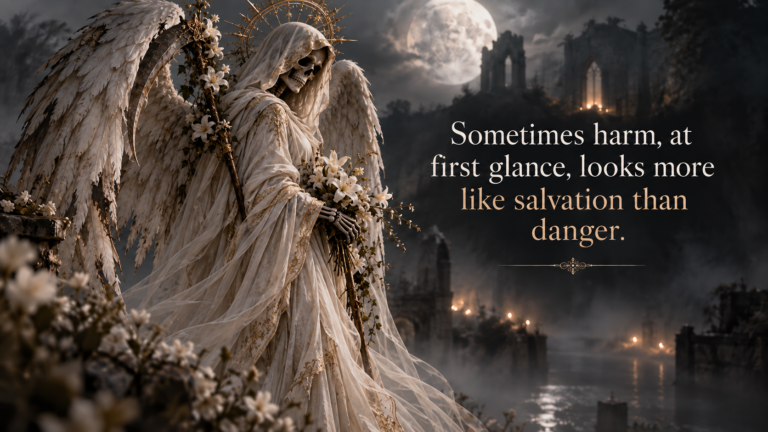
It is a fascinating pattern: harm can be easily masked by a role, a reputation, even an act that looks virtuous from across the room. A person can be doing harm while being protected by the belief that they are good.
Years later, I would be profoundly affected by a pastor whose attention felt like the most extraordinary care. I can see now how I had been groomed to mistrust my own perception, particularly when harm came through someone occupying a role presumed to be protective—a shepherd, someone understood to be good, trustworthy, and morally authoritative.
I keep thinking of the line, “Not all villains wear black.” There is an almost absurd irony in that for me: I tend to dress mostly in black, while my female sibling favors white. hmmmm…. I don’t think clothing color informs us of character, of course.
Have you ever watched harmful behavior happen in plain sight while others showed and spoke no objection – maybe because of the status, influence, or authority of the person doing it, or the lesser status of the person being harmed—so that neutrality itself functioned as permission? What is that even called?