Wholesome Badass

A Work in Progress — Healing from All the Things​

A reflection on how appearances shape credibility, character judgments, and the recognition of harm.

The Art of Concealed Cruelty

The ability to engineer someone else’s downfall while appearing to have had nothing to do with it. I’m intimately familiar with calculated hostility. What I still cannot fathom is the level of executive function required to provoke someone, anticipate their reaction, and use it against them while presenting as entirely uninvolved. For someone as highly sensitive and reactive as I am, with my nervous system pretty much on the outside of my body, that kind of calculation is incomprehensible. My long game and executive function were scorched by ongoing unresolved trauma. As a child, I was frequently crying, throwing up, having meltdowns, and reacting intensely to things that seemed not to even register for others. In my family, my reactivity was met only with shame and punishment. I was judged ungrateful, negative, too sensitive, thin-skinned. I suppose the hope was that enough callousness might eventually toughen me. My skin never thickened, but I learned to be mean. Vicious even. Sometimes it offered a momentary release. The relief was fleeting. The guilt and shame were not. Contempt was standard fare, but some people (audibly clearing my throat) seemed instinctively savvy about rules and skills that eluded me. They could deliver a devastating strike with complete self-possession and have it pass for teasing, a misunderstanding, or a reasonable response to someone who had displeased them. My reactions were unmasked, unbridled. Obvious, undeniable, and punishable. And I was bewildered. Wasn’t I doing as my family does? My sister, seven years older, seemed to have mastered the poise I lacked. Provoking and baiting could pass as harmless while leaving me visibly distraught. Whatever provoked my distress— became secondary to my reaction. My emotional reaction could be counted on to steal the show and seal the case. Poise posed as evidence of good character; my reactivity, evidence of bad. I was innocent only of understanding the rules. Now, nearly 60, with language and recovery, I think the unspoken rule I couldn’t metabolize wasn’t that ridicule and belittling were wrong. Apparently, they were perfectly acceptable, even applauded, when directed at someone considered deserving, provided they were delivered with composure. Only recently have I begun to identify concealed hostility. Diminishing remarks disguised as observations. “Brutal honesty” that is more brutal than honest. Provocations. The ability to degrade or discredit someone while appearing calm, unaffected, reasonable. Have you ever been provoked into a reaction that was then used as evidence against you?

Read More
Wholesome Badass girl draws a new relational blueprint based on nurturing, honest communication, accountability, and trust, while discarding an old blueprint of scapegoating, manipulation, and emotional neglect.

The Caller Was Inside the House

The people I relied on for protection were the same people I needed protection from. They were also the ones teaching lil baby Magda about herself, relationships, and the world. And so she gravitated toward relational patterns imprinted on her lil nervous system long before she could recognize or question them. Always reaching for the emotionally inaccessible archetype… She loved these people and wanted their approval, affection, and inclusion. They were her models for love, conflict, emotional regulation, and accountability. She mimicked some of their harmful behaviors, too. For how could she reject a model she hadn’t yet learned to recognize? I can share how Lil Baby Magda was harmed without asserting I, Big Magda, never caused harm. I own my unwholesome and misguided contributions without accepting responsibility for how others behaved. My first blueprint of the world was emotional instability, chaotic relationships, and illegible, amorphous rules and codes. My internal blueprint developed in response: my lens for perception, beliefs, vigilance, expectations, sense of worth, and capacity to care for myself, regulate my emotions and live with intention and dignity. Life might have been confusing even in a nurturing, steady family system. I might always have required more clarity, consistency, patience, and support. I lost decades tangled up in what the fuck had just happened and why, while forecasting what else would go wrong. What did I do? What did they mean? What did I miss? How do I keep it from happening again? Even when nothing was happening, I was still agonizing over things said and done years earlier. All that attention and energy spent trying to understand and prevent harm left no bandwidth to experience my own life. How much of what I’ve believed about my personality, character, worthiness, and lovability came from the people who taught me how to be a person? What might I have achieved if I hadn’t spent my life trying to figure out what was wrong with me? The messaging was consistent, collective, and insidious: Get different or be erased. If I was the designated problem and couldn’t correct myself, what was left? I couldn’t get different. I couldn’t get gone. I failed at both. And now I’m beginning to see a third way. Finally, I am getting different—not by correcting myself to fit the original blueprint, but by rejecting it.

Read More
Black-and-white cartoon of Wholesome Badass in a jujutsu stance, holding up a glowing shield against dark arrows and scribbles. A speech bubble says, “But here’s what also happened.”

The Power of an Incomplete Truth

In my tagline, I reveal myself as navigating the storm of neurodivergence, trauma, and toxic family systems. For the archetypes with whom I have navigated strife or rupture, I imagine this perspective may feel unwelcome because it adds context to a much simpler explanation: I was just bad. Difficult. Crazy. Selfish. Unreasonable. Context provides nuance that the simpler explanation leaves out. Whatever may have been said or done to diminish me was charged to me: I caused it, deserved it, exaggerated it, or imagined it. The tagline isn’t an attempt to excuse myself, but the closest language I have found for an experience I spent decades unable to articulate. Naming neurodivergence, trauma, and a dysfunctional family system does not make every choice I have ever made harmless, good, or right. It allows nuance into a story where my context was effectively disregarded. And I can’t help but ask, in all earnestness: if my “craziness” was the explanation for every instance of hardship for me, why wasn’t anyone’s response concern, curiosity, or support? What I am chasing is not agreement but a fuller record. More of what actually happened allowed into the room. Other people’s explanations have passed for the complete story, while mine were categorically rejected as inadmissible. If I asked questions, I was manufacturing chaos. If I offered context, I was making excuses. If I remembered something differently, I was rewriting history. I was seeking a clean signal—clarity, cohesion, some way to sew the pieces together for a story that makes sense, even if what emerged was painful or unflattering to me. Apparently, asking clarifying questions seems to threaten the prescribed narrative. Providing context is recieved as equally troublesome. So I am left trying to make sense of a story I was expected to accept, while relevant context was not allowed into consideration. Have you ever realized that what seemed like the only obvious conclusion was actually inaccurate and deeply unfair — once you had a more complete account of the story? One real-life example: I’m in a hurry and stuck behind a man in a posh new Jaguar, stopped in the road and holding up traffic for what I assume is no good reason—just entitled and inconsiderate. Then I SEE he has gotten out of his car to help a disabled elderly person with a heavy package cross the street. Nothing about the stopped car changed. The context did. I feel some of that same aha humbling energy when I think about people like Howard Stern, Monica Lewinsky, Stormy Daniels, Pamela Anderson, and others whom I experienced through a particular public narrative without bothering to question what might have been missing from it. Sometimes the framing was profitable. Sometimes powerful people had an enormous stake in which version prevailed. Either way, I accepted a conclusion before I had much interest in the fuller record. Just saaaaayin.

Read More
Black-and-white cartoon of a woman asking if something is wrong. Another woman denies it, then meets privately with two others to discuss a folder labeled “The Problem With Her.”

When the Narrative Outranks What Happened

The Alchemy of the Unexitable Loop: Someone behaves toward you in bullying, degrading, diminishing, or disruptive ways, then denies it or explains it as a consequence of who you are. Literally: they turn their own behavior into evidence against you. I am wired to sense shifts in energy. I don’t mean that in some mystical way, and I don’t mean that I am being paranoid. I am attuned at a sensory and emotional level to things other people may have the luxury of not noticing. Cold, detached silence. Avoidant eye contact. Being ignored. A change in tone. The almost imperceptible shift from being in connection with someone to being very clearly outside of it. And because nothing had been indicated, I would ask. What’s wrong? Nothing. And the coldness intensified. Naturally I would ask again. So fkn earnest. And now the inquiry itself was the only issue. Suddenly there was something concrete to point to: my questioning. My inability to leave it alone. My insistence that something was wrong when I had been clearly told there wasn’t. And there is the loop. I experienced the tension. I inquired directly. My asking was labeled as escalation. The heightened tension was then used to explain the tension I had originally asked about. Therefore, apparently, I had imagined it. Or caused it. Or manufactured chaos where none had existed. And now my behavior could justify whatever came next. There was no direct confrontation. No, “I’m angry with you.” No, “I didn’t love that.” No, “Can we talk about what happened?” No good-faith request to understand. Not even a simple statement of displeasure. At least not to me. The displeasure was expressed elsewhere, to others. So while insisting that nothing was wrong, an entirely different conversation could be unfolding outside of my participation. Because gossip and triangulation are somehow more dignified and “peace-keeping” than openly addressing friction? There was no opportunity to acknowledge the discord, clarify anything, take responsibility for what was actually mine, or repair the relationship. Instead, the grievance traveled laterally. Triangulation. Gossip. Division. And if it eventually did come directly to me, it wasn’t offered as information that might help us understand each other. It came with teeth, delivered for maximum injury. Not: Here is what landed poorly for me. More: Here is what is wrong with you. There was a negative space where repair should have happened, while a narrative developed without me. By then, the equation was complete. I had detected something I wasn’t supposed to detect. I had asked about something I was told wasn’t happening. My asking was cast as evidence that I had created the problem. And having created the problem, I had apparently earned whatever harmful thing followed. Another person’s harmful reaction gets explained entirely by my character. That’s the alchemy. Have you ever been in a relationship with someone whose coldness you could feel, but when you asked what was wrong, you were told nothing? And asking only made things worse. Whatever happened next was regarded only as the thing you had coming to you. For being this way. Literally: their behavior gets reassigned to your character.

Read More
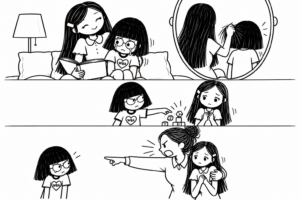
Black-and-white illustration of a distressed girl telling her mother and sister something hurts. They press buttons producing labels including dramatic, selfish, ungrateful, and too sensitive, leaving comfort and support untouched.

When Distress Is Dismissed as Negativity or Drama

I came into the family as the youngest, with a tightly wound nervous system and a way of taking in the world that was unusually sensitive—to sensory and emotional input, even chemical sensitivity to basic food ingredients. What I recognize now is how easily my frequent, unbridled emotional displays of despair could steal the show. Once I was visibly distressed, the distress itself was identified as the issue. Only in 12-step recovery did I learn to withhold the gift of distraction of my reaction. Before developing the metacognitive ability and language to name what was happening inside me, I certainly failed to make a persuasive case for myself. I have now accessed language for what happened, but no one in my family has shown even remote interest in understanding it—or me. I do not recall being met with curiosity by any single person, about what I was experiencing or what I might need. I remember correction, judgment, banishment, and even mocking by the actual adults. It was as though there was one established way to deal with me. I think of that as the branding. The packaging. The lens through which everything about me was processed. My discomfort, which went unconsoled and therefore persisted and compounded, was treated as evidence that something was fundamentally wrong with me. Dramatic. Histrionic. Too sensitive. Attention-seeking. Always the problem with problems. Over time, the branding hardened into vilification. Definitely an othering. Whatever I was reacting to could disappear behind the reaction. That created an ecosystem in which anything reductive, degrading, hurtful, or upsetting to me could pass without resistance or examination. Whatever else may be true, this is my experience. The branding did not merely shape my understanding of myself and my family. It made harming me easier, more permissible, and more deniable. I emerged from that environment with few models for self-soothing, compassion, or kindness, and with maladaptive ways of coping. I could be unreasonable, highly reactive, and say deeply hurtful things. I do not need to minimize any of that to understand where some of those patterns were formed, or to recognize how much I have unlearned and changed outside the relationships in which they were shaped and reinforced. Part of that growth has been learning to identify and intentionally choose something different from the kinds of personalities and relational patterns I had come to associate with what was normal, loving, kind, or healthy. I am still working on not mistaking familiarity for safety or connection.

Read More
Abusers Mantra- That Did Not Happen

“But What Did She Do?”

Friend: So you’re not in contact with your daughter anymore? Family Member: No, she’s just too much. Always some issue with her. Always making everything harder than it has to be. Friend: Wow. What happened exactly? Did she hurt someone? Lie? Betray you? Family Member: No, not really. It’s more like… she always has needs and limits and feelings that are too much and make no sense. So sensitive. Demanding. Needy. Always demanding conversation. It’s exhausting. Friend: That doesn’t sound like a crime. Did she ask to talk about something hard? Family Member: Yeah, but she turns everything into a problem. Like, she’ll say something felt hurtful, or ask someone to stop doing something—and suddenly, it’s a whole thing. She speaks problems into existence. If she’s upset, that’s the problem. Not what caused it. Friend: So she brings up something painful and you say she’s just trying to cause drama? Family Member: Exactly. We always told her: stop manufacturing chaos. If you’re hurting, you probably imagined it, earned it, or brought it on yourself. Friend: What happens when she does try to talk about it? Family Member: She gets overwhelmed. Emotional. Then she cries and it’s like, see? You can’t even talk to her. She’s unstable. Friend: Did you ever try family therapy? Family Member: Yes, once. She completely fell apart in the session. Couldn’t handle us calmly telling the therapist how hard she is. The therapist saw right through her. Friend: Or maybe she broke down because the room was against her and you used that as proof? Family Member: Whatever. She just needs everything to be her way. We can’t do that. Friend: So what’s the worst thing she actually did? Family Member: She refused to keep showing up—opted out until we had more useless conversations. She always said she’d come to the table if people would be kind. But she made herself the outsider. Ask anyone—she sucks. Friend: But if nobody can name what she actually did—not how she felt, or how you felt about her, but what she really did—then what was she punished for? Family Member: For being impossible. Creating tension to get attention. Friend: Hmmm. 14 Years Later Friend: Wait… so you don’t talk to your mom anymore? Son: Nah. She’s impossible. Always on my case, trying to control everything. Friend: That sucks. But like—what did she do? Was she abusive? Did she lie to you or betray you? Son: No. She just… always had these expectations…demands. And like tried to be my boss. Always correcting me. She wanted me to be perfect. Friend: Okay… but was she unfair? Like punishing you for stuff that wasn’t real? Was she constantly grounding you or taking your phone for no reason? Son: No, not really. I think I got grounded maybe once. She barely ever took my phone. Friend: So you weren’t in trouble all the time? Son: No, not really. She’d just get mad when I didn’t follow through or when I ignored her. Friend: So… she had rules? Son: Yeah, but she wanted consistency. Like, if I did something well for three weeks, and then I would drop the ball and she would correct or redirect me. Like the three weeks did not even count. Friend: That doesn’t sound crazy. That sounds like accountability… parenting? Son: She just wouldn’t let me do whatever I wanted. She’d say no to stuff sometimes. She expected respect. Friend: Did you guys ever try family therapy? Son: Yeah, but I went thinking it’d be my chance to explain my side, and maybe get the therapist to see how hard she is. I don’t think she went in expecting that. Friend: So… you weren’t there to try to heal things? Son: Not really. And she got upset in the session, started crying, and then it was like—“see? She’s so emotional, you can’t even talk to her.” Friend: So her emotional reaction to being overwhelmed was used as proof that she’s the problem? Son: I mean… yeah. Friend: And the worst thing she did was… not agree immediately to let you drive across the country at 16 without a plan? Son: She said I could if I had check-ins and stayed with people we know. But it felt like she didn’t trust me. Friend: So she wanted to keep you safe and be part of the planning, and that made her the enemy? Son: I guess. But still… she sucks. Narrator: This is the anatomy of a smear campaign. A person becomes “too much” only after they become unwilling to be mistreated. They say, “She’s hard to deal with.” But what did she do? Ask again. From every angle. Ask louder. Ask in front of the people who repeat the story. Ask the ones who believe it. What did she do? What did she do? And if no one can name it, then maybe— just maybe— she didn’t do anything at all. Maybe she just stopped agreeing to be the scapegoat. Below are just a few of the books that have been especially informative and healing for me as I navigate my journey of recovery and self-understanding:

Read More