Wholesome Badass

A Work in Progress — Healing from All the Things​

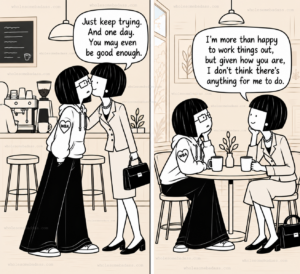
Two-panel illustration showing a woman suggesting someone may eventually be good enough, then claiming she wants reconciliation while insisting the other person is entirely responsible for the conflict.

Maybe One Day You’ll Be Worthy

There’s a deviant cruelty in having it said that you “got what you deserved.” Who even thinks like that? (Clears throat.) When I question the unequal terms of a relationship or ask for mutual consideration, the focus shifts from my concerns to how I’m showing an emotional reaction. My “intensity” is condemned, and my requests for change and repair are dismissed as manufacturing chaos. My credibility is systematically dismantled, while the unequal terms themselves go unexamined. Disqualified. And I am repeatedly (seriously, repeatedly) told, “You are welcome to join, provided you change,” while simultaneously being assured that such change is unlikely. Something astonishing happened when I healed enough to stop providing the convenient distraction of my large emotional reactions: rather than easing the conflict, the pressure intensified. Without my dysregulation to focus on, the very dynamics I had been questioning became difficult to ignore. Requesting mutually healthy terms and finally having enough self-esteem to refuse being disregarded or diminished is characterized as having “opted out.” As though I unilaterally chose to abandon a perfectly good relationship rather than asking whether we could find a way forward that works for us both. The estrangement that follows is framed as the natural consequence of “my choice.” Even hostility is justified as something my supposed deficiencies made necessary. If only I were different, they wouldn’t have to treat me this way. It’s fkn bananas. 🍌

Read More
Black-and-white cartoon of Wholesome Badass in a jujutsu stance, holding up a glowing shield against dark arrows and scribbles. A speech bubble says, “But here’s what also happened.”

The Power of an Incomplete Truth

In my tagline, I reveal myself as navigating the storm of neurodivergence, trauma, and toxic family systems. For the archetypes with whom I have navigated strife or rupture, I imagine this perspective may feel unwelcome because it adds context to a much simpler explanation: I was just bad. Difficult. Crazy. Selfish. Unreasonable. Context provides nuance that the simpler explanation leaves out. Whatever may have been said or done to diminish me was charged to me: I caused it, deserved it, exaggerated it, or imagined it. The tagline isn’t an attempt to excuse myself, but the closest language I have found for an experience I spent decades unable to articulate. Naming neurodivergence, trauma, and a dysfunctional family system does not make every choice I have ever made harmless, good, or right. It allows nuance into a story where my context was effectively disregarded. And I can’t help but ask, in all earnestness: if my “craziness” was the explanation for every instance of hardship for me, why wasn’t anyone’s response concern, curiosity, or support? What I am chasing is not agreement but a fuller record. More of what actually happened allowed into the room. Other people’s explanations have passed for the complete story, while mine were categorically rejected as inadmissible. If I asked questions, I was manufacturing chaos. If I offered context, I was making excuses. If I remembered something differently, I was rewriting history. I was seeking a clean signal—clarity, cohesion, some way to sew the pieces together for a story that makes sense, even if what emerged was painful or unflattering to me. Apparently, asking clarifying questions seems to threaten the prescribed narrative. Providing context is recieved as equally troublesome. So I am left trying to make sense of a story I was expected to accept, while relevant context was not allowed into consideration. Have you ever realized that what seemed like the only obvious conclusion was actually inaccurate and deeply unfair — once you had a more complete account of the story? One real-life example: I’m in a hurry and stuck behind a man in a posh new Jaguar, stopped in the road and holding up traffic for what I assume is no good reason—just entitled and inconsiderate. Then I SEE he has gotten out of his car to help a disabled elderly person with a heavy package cross the street. Nothing about the stopped car changed. The context did. I feel some of that same aha humbling energy when I think about people like Howard Stern, Monica Lewinsky, Stormy Daniels, Pamela Anderson, and others whom I experienced through a particular public narrative without bothering to question what might have been missing from it. Sometimes the framing was profitable. Sometimes powerful people had an enormous stake in which version prevailed. Either way, I accepted a conclusion before I had much interest in the fuller record. Just saaaaayin.

Read More
Black-and-white line drawing of two stick figures in a leaking boat. One figure wears a life vest, holds a life preserver, and says, “You need to calm down,” while the other figure looks distressed and bails water out of the boat.

The Advantage of Appearing Unbothered

I am beginning to recognize and more effectively name and navigate familiar systems, patterns, and personalities. In power imbalances, the person with more status or authority can seem even more credible when appearing almost completely unaffected — mildly inconvenienced at most. Beneath a curated exterior — detached, unreadable, even smiling or measured — strategically executed impunity may pass for sovereignty, shielded from challenge by status/rank itself. By contrast, an emotional response to threat or injury can be marked as excessive: evidence of defect, weakness, and wrongness, rendering the account of what happened inadmissible. Once that logic is established, power-over can pass as reasonable and justified. This is where emotional violence can comfortably hide: in the latitude granted by role, status, or perceived legitimacy to diminish, exclude, intimidate, or overpower another person while the resulting distress is treated as further proof that the response was warranted.

Read More
Black-and-white cartoon of a woman asking if something is wrong. Another woman denies it, then meets privately with two others to discuss a folder labeled “The Problem With Her.”

When the Narrative Outranks What Happened

The Alchemy of the Unexitable Loop: Someone behaves toward you in bullying, degrading, diminishing, or disruptive ways, then denies it or explains it as a consequence of who you are. Literally: they turn their own behavior into evidence against you. I am wired to sense shifts in energy. I don’t mean that in some mystical way, and I don’t mean that I am being paranoid. I am attuned at a sensory and emotional level to things other people may have the luxury of not noticing. Cold, detached silence. Avoidant eye contact. Being ignored. A change in tone. The almost imperceptible shift from being in connection with someone to being very clearly outside of it. And because nothing had been indicated, I would ask. What’s wrong? Nothing. And the coldness intensified. Naturally I would ask again. So fkn earnest. And now the inquiry itself was the only issue. Suddenly there was something concrete to point to: my questioning. My inability to leave it alone. My insistence that something was wrong when I had been clearly told there wasn’t. And there is the loop. I experienced the tension. I inquired directly. My asking was labeled as escalation. The heightened tension was then used to explain the tension I had originally asked about. Therefore, apparently, I had imagined it. Or caused it. Or manufactured chaos where none had existed. And now my behavior could justify whatever came next. There was no direct confrontation. No, “I’m angry with you.” No, “I didn’t love that.” No, “Can we talk about what happened?” No good-faith request to understand. Not even a simple statement of displeasure. At least not to me. The displeasure was expressed elsewhere, to others. So while insisting that nothing was wrong, an entirely different conversation could be unfolding outside of my participation. Because gossip and triangulation are somehow more dignified and “peace-keeping” than openly addressing friction? There was no opportunity to acknowledge the discord, clarify anything, take responsibility for what was actually mine, or repair the relationship. Instead, the grievance traveled laterally. Triangulation. Gossip. Division. And if it eventually did come directly to me, it wasn’t offered as information that might help us understand each other. It came with teeth, delivered for maximum injury. Not: Here is what landed poorly for me. More: Here is what is wrong with you. There was a negative space where repair should have happened, while a narrative developed without me. By then, the equation was complete. I had detected something I wasn’t supposed to detect. I had asked about something I was told wasn’t happening. My asking was cast as evidence that I had created the problem. And having created the problem, I had apparently earned whatever harmful thing followed. Another person’s harmful reaction gets explained entirely by my character. That’s the alchemy. Have you ever been in a relationship with someone whose coldness you could feel, but when you asked what was wrong, you were told nothing? And asking only made things worse. Whatever happened next was regarded only as the thing you had coming to you. For being this way. Literally: their behavior gets reassigned to your character.

Read More
A crowd beside a woman standing alone, illustrating what it feels like when someone more influential controls the narrative and everyone believes their version.

The Power of Controlling the Narrative

Something does not become untrue because somebody more influential tells the story differently. I have spent a lot of my life attempting to reconcile the version of events that prevailed with my lived experience. Influence seems to determine which version is adopted and repeated. A person with more influence can shape or manipulate how events are understood. Their version becomes the more widely accepted narrative. And those under that person’s influence tend to organize around it, as THE truth. It shapes who is protected. Who is believed. Who gets the benefit of the doubt. Who belongs. And sometimes, for one person to remain elevated within that narrative, somebody else has to occupy the lesser position. Less credible. Less valid. Easier to dismiss. Then anything that person shares of what happened gets heard through what has already been established about them—and becomes, at some level, inadmissible. That’s the part—that part right there. You are not only trying to process and overcome what happened. You’re trying to tell it from a position where your credibility has already been diminished. Whatever else may be true, this also happens. A narrative can do more than determine what gets believed. It can determine who remains protected and included—and who becomes increasingly easy to disregard, diminish, and exclude. How much of what we believe about someone comes from what we have actually experienced with them, and how much was already decided for us by the story we were handed?

Read More
The Narcissist’s Prayer showing six statements that progress from denial and minimization to blame-shifting, beside an image of a cracked mask.

Gaslighting, Blame-Shifting, and the Absence of Repair

A person can know something experientially long before they can articulate it. They might know, for example, “After X is upset with me, I end up confused. I initiate communication thinking I had a legitimate concern, and somehow I leave apologizing and wondering whether I caused everything.” They don’t necessarily have words or concepts to process what happened. Once someone learns concepts like blame-shifting, triangulation, invalidation, stonewalling, double standards, DARVO, conditional approval, or refusal of repair, those concepts can provide handles for examining an interaction: Wait—was I actually heard? Did we each consider or examine our contributions? Was disagreement permitted? Did responsibility somehow become entirely mine? And importantly, language doesn’t have to supply the verdict. It can supply questions. That may be especially valuable for someone who’s been raised inside a particular relational system, because whatever happened repeatedly can simply register as this is how relationships work. Conflict is information, not a trial where somebody has to be found guilty. You can finish a disagreement still thinking, I was right about the original issue, and nevertheless learn: I interrupted you. I got defensive. I misunderstood what you meant. I didn’t realize that mattered so much to you. Or: I still disagree, but now I understand your reasoning. Or my most favorite of all: I think I understtand but I still do not agree. And the other person can do the same. Someone can be displeased with you without their displeasure becoming evidence that you’re bad. They can misunderstand you without their interpretation replacing your knowledge of yourself. And you can discover something uncomfortable about your own behavior without having to collapse into therefore I am the problem. In a healthy rupture, both people have something to metabolize. Not necessarily equal blame—sometimes one person really did behave badly—but both people still have an encounter to process. What happened? What did I do? What did you experience? What did I misunderstand? What does this change between us? What is needed for repair? In the archetypal dynamic, one person effectively exempts themselves from that process. Their internal work stops at: I was right to do or say X because of what you did. Everything downstream gets assigned to the other person. But the person on the receiving end doesn’t get to bypass metabolizing the rupture. They can end up metabolizing too much. They process the original conflict, the accusation, the other person’s certainty, the withdrawal, their own behavior, their memory, their motives, what they could have done differently, whether they’re actually the problem—and they do it without the other person’s participation. Then contact resumes without repair. All of that processing has nowhere relational to land. It can instead become adaptation: anxiety, self-doubt, vigilance, accommodation, rehearsing, overexplaining, trying harder, monitoring tone, becoming increasingly careful. The rupture isn’t unprocessed. The processing is asymmetrical. One person preserves their existing understanding of themselves. The other person is left reorganizing themselves around the unresolved rupture. Repair brings the information back into the relationship, where both people can examine it instead of one person having to carry and interpret the whole thing alone. One person is trying to understand what happened. The archetype is operating from the position that nothing happened that requires understanding. One person is asking, What happened between us? How did we get here? What needs to be repaired? And the answer—explicitly or through behavior—is essentially: There is nothing between us to repair. The problem is that you’re confused, anxious, sensitive, difficult, or unable to let things go. So the effect of the interaction gets reassigned as a characteristic of the recipient. The anxiety created by unresolved rupture becomes evidence that you’re “anxious.” The confusion created by contradictory interactions becomes evidence that you’re “confused.” Your attempts to get resolution become evidence that you “can’t let things go.” Your attempts to clarify what happened become evidence that you’re “overthinking.” The interaction disappears from the explanation. Then when ordinary contact resumes without acknowledgment, one person can experience that as moving on, while the other person is still carrying an unresolved event that supposedly never happened. There can be no repair when only one person is able to acknowledge that there was a rupture. You can say, “Something you did didn’t land well with me,” and get: Nothing happened. You’re misinterpreting me. You’re too sensitive. Or you can notice distance and say, “Something seems different between us. Did something happen?” and get: Nothing’s different. You’re imagining things. Why do you always do this? If you name an impact, you’re creating a problem. If you notice an impact, you’re creating a problem. If you ask about a rupture, you’re creating a problem. If you remain unsettled because there was no repair, that becomes the problem. The recipient isn’t just processing a conflict alone. They’re being asked to process a conflict whose existence has been denied. There isn’t even an agreed-upon event to work with. Something happened between us. I can observe the change. I’m experiencing the consequences. But I’m being told there is nothing here to discuss. Which may be why “nothing happened” is so consequential. It doesn’t merely refuse repair. It removes the shared reality from which repair would have been possible. Nothing happened. Nothing’s wrong. There is nothing to discuss. But then there’s silence. Distance. Withdrawal. Maybe coldness. You’re left alone with whatever the fuck just happened. That’s the contradiction. You’re experiencing the consequences of a rupture while being denied the existence of the rupture itself. Whatever else may be true, this is a defining structure within the archetypal dynamic.
Read More
Woman surrounded by flames with the words, “Don’t set yourself on fire to keep others warm.”

When Accountability Flows in Only One Direction

For more than 40 years, I didn’t really know how to exist inside a relationship unless I was the broken one, bowing in reliance to anyone gracious enough to let me hang around, no matter the quality of treatment. Could you stay with me? Could you help me? What have I done to be so lucky to have someone strong and knowing and right like you? Barf. Fangirl, fawning, degrading shit. I knew how to engage only that way. What I’m learning now is something different. I don’t want to have to be broken to belong. I am going off script. This is wildly unpopular with the patterned archetypes I have gone barreling toward at every opportunity. I no longer agree to that—to matter less so that a relationship may continue. I cannot abandon what I know and adopt someone else’s perspective in place of my lived experience. That is me gaslighting myself. I cannot accept someone else’s explanation of my motives when it isn’t mine. I can be wrong. I can fuck up. I can apologize. I can change. But I have to remain a whole person while I do it. And the relationships that have cost me the most have not been the ones where people hurt me or got things wrong. They have been the ones where somehow there was always something for me to examine, own, apologize for or change, and nothing on the other side of the relationship was ever available for the same examination. I welcome the responsibility to own my part. I cannot own yours too. My hunger for connection has kept me engaged in things long after I knew they weren’t feeding me. Hunger will do that. But if my body is asking for fiber and what’s being offered is refined sugar, eating it because I’m hungry doesn’t nourish me. It’s not nothing. But it’s not neutral either. I won’t keep feeding myself the opposite of what I’m hungry for and then wonder why I feel poisoned. And feel shame for my resulting condition. So yes. Some relationships may cost too much to keep. Not because they don’t matter to me. Because I finally matter too. Have you ever been tangled up with someone like this? Someone where every attempt to address a conflict somehow ends with you being the only person under examination? They didn’t misunderstand. They didn’t contribute. They didn’t hurt you. They didn’t get anything wrong. You did. Every fucking time….Whatever else may be true, this also happened.

Read More
Black-and-white illustration of a smiling priest holding someone underwater during a baptism. A crowd admires him while a concerned girl notices the harm.

Perception vs. Reality

There is a scene in Boardwalk Empire in which a priest is standing in a river performing a baptism. He is wearing white robes. He is smiling. He occupies a position of moral authority. He presents as a good man offering salvation. The priest is holding the man beneath the water, while keeping a calmly arranged placid smile on his face, his confidence in plausible deniability. Here is a man cloaked in goodness, purity, and authority, protected by the very role that allows him to publicly and confidently carry out something profoundly sinister. People see the robes, the smile, the holy father offering salvation. His authority goes unchecked because the story has already been written. The role itself pre-decides what is possible to notice. In that way, the people witnessing from the shore become part of the story as well. The disturbance is not confined to the harm itself. It is also the protection, restoration, accommodation, and assumption of goodness that surround it. It is the way the narratives that shape our understanding pre-decide what is possible to notice.

Read More
Two-panel illustration showing a woman suggesting someone may eventually be good enough, then claiming she wants reconciliation while insisting the other person is entirely responsible for the conflict.

Maybe One Day You’ll Be Worthy

There’s a deviant cruelty in having it said that you “got what you deserved.” Who even thinks like that? (Clears throat.) When I question the unequal terms of a relationship or ask for mutual consideration, the focus shifts from my concerns to how I’m showing an emotional reaction. My “intensity” is condemned, and my requests for change and repair are dismissed as manufacturing chaos. My credibility is systematically dismantled, while the unequal terms themselves go unexamined. Disqualified. And I am repeatedly (seriously, repeatedly) told, “You are welcome to join, provided you change,” while simultaneously being assured that such change is unlikely. Something astonishing happened when I healed enough to stop providing the convenient distraction of my large emotional reactions: rather than easing the conflict, the pressure intensified. Without my dysregulation to focus on, the very dynamics I had been questioning became difficult to ignore. Requesting mutually healthy terms and finally having enough self-esteem to refuse being disregarded or diminished is characterized as having “opted out.” As though I unilaterally chose to abandon a perfectly good relationship rather than asking whether we could find a way forward that works for us both. The estrangement that follows is framed as the natural consequence of “my choice.” Even hostility is justified as something my supposed deficiencies made necessary. If only I were different, they wouldn’t have to treat me this way. It’s fkn bananas. 🍌

Read More
Black-and-white cartoon of Wholesome Badass in a jujutsu stance, holding up a glowing shield against dark arrows and scribbles. A speech bubble says, “But here’s what also happened.”

The Power of an Incomplete Truth

In my tagline, I reveal myself as navigating the storm of neurodivergence, trauma, and toxic family systems. For the archetypes with whom I have navigated strife or rupture, I imagine this perspective may feel unwelcome because it adds context to a much simpler explanation: I was just bad. Difficult. Crazy. Selfish. Unreasonable. Context provides nuance that the simpler explanation leaves out. Whatever may have been said or done to diminish me was charged to me: I caused it, deserved it, exaggerated it, or imagined it. The tagline isn’t an attempt to excuse myself, but the closest language I have found for an experience I spent decades unable to articulate. Naming neurodivergence, trauma, and a dysfunctional family system does not make every choice I have ever made harmless, good, or right. It allows nuance into a story where my context was effectively disregarded. And I can’t help but ask, in all earnestness: if my “craziness” was the explanation for every instance of hardship for me, why wasn’t anyone’s response concern, curiosity, or support? What I am chasing is not agreement but a fuller record. More of what actually happened allowed into the room. Other people’s explanations have passed for the complete story, while mine were categorically rejected as inadmissible. If I asked questions, I was manufacturing chaos. If I offered context, I was making excuses. If I remembered something differently, I was rewriting history. I was seeking a clean signal—clarity, cohesion, some way to sew the pieces together for a story that makes sense, even if what emerged was painful or unflattering to me. Apparently, asking clarifying questions seems to threaten the prescribed narrative. Providing context is recieved as equally troublesome. So I am left trying to make sense of a story I was expected to accept, while relevant context was not allowed into consideration. Have you ever realized that what seemed like the only obvious conclusion was actually inaccurate and deeply unfair — once you had a more complete account of the story? One real-life example: I’m in a hurry and stuck behind a man in a posh new Jaguar, stopped in the road and holding up traffic for what I assume is no good reason—just entitled and inconsiderate. Then I SEE he has gotten out of his car to help a disabled elderly person with a heavy package cross the street. Nothing about the stopped car changed. The context did. I feel some of that same aha humbling energy when I think about people like Howard Stern, Monica Lewinsky, Stormy Daniels, Pamela Anderson, and others whom I experienced through a particular public narrative without bothering to question what might have been missing from it. Sometimes the framing was profitable. Sometimes powerful people had an enormous stake in which version prevailed. Either way, I accepted a conclusion before I had much interest in the fuller record. Just saaaaayin.

Read More
Black-and-white line drawing of two stick figures in a leaking boat. One figure wears a life vest, holds a life preserver, and says, “You need to calm down,” while the other figure looks distressed and bails water out of the boat.

The Advantage of Appearing Unbothered

I am beginning to recognize and more effectively name and navigate familiar systems, patterns, and personalities. In power imbalances, the person with more status or authority can seem even more credible when appearing almost completely unaffected — mildly inconvenienced at most. Beneath a curated exterior — detached, unreadable, even smiling or measured — strategically executed impunity may pass for sovereignty, shielded from challenge by status/rank itself. By contrast, an emotional response to threat or injury can be marked as excessive: evidence of defect, weakness, and wrongness, rendering the account of what happened inadmissible. Once that logic is established, power-over can pass as reasonable and justified. This is where emotional violence can comfortably hide: in the latitude granted by role, status, or perceived legitimacy to diminish, exclude, intimidate, or overpower another person while the resulting distress is treated as further proof that the response was warranted.

Read More
Black-and-white cartoon of a woman asking if something is wrong. Another woman denies it, then meets privately with two others to discuss a folder labeled “The Problem With Her.”

When the Narrative Outranks What Happened

The Alchemy of the Unexitable Loop: Someone behaves toward you in bullying, degrading, diminishing, or disruptive ways, then denies it or explains it as a consequence of who you are. Literally: they turn their own behavior into evidence against you. I am wired to sense shifts in energy. I don’t mean that in some mystical way, and I don’t mean that I am being paranoid. I am attuned at a sensory and emotional level to things other people may have the luxury of not noticing. Cold, detached silence. Avoidant eye contact. Being ignored. A change in tone. The almost imperceptible shift from being in connection with someone to being very clearly outside of it. And because nothing had been indicated, I would ask. What’s wrong? Nothing. And the coldness intensified. Naturally I would ask again. So fkn earnest. And now the inquiry itself was the only issue. Suddenly there was something concrete to point to: my questioning. My inability to leave it alone. My insistence that something was wrong when I had been clearly told there wasn’t. And there is the loop. I experienced the tension. I inquired directly. My asking was labeled as escalation. The heightened tension was then used to explain the tension I had originally asked about. Therefore, apparently, I had imagined it. Or caused it. Or manufactured chaos where none had existed. And now my behavior could justify whatever came next. There was no direct confrontation. No, “I’m angry with you.” No, “I didn’t love that.” No, “Can we talk about what happened?” No good-faith request to understand. Not even a simple statement of displeasure. At least not to me. The displeasure was expressed elsewhere, to others. So while insisting that nothing was wrong, an entirely different conversation could be unfolding outside of my participation. Because gossip and triangulation are somehow more dignified and “peace-keeping” than openly addressing friction? There was no opportunity to acknowledge the discord, clarify anything, take responsibility for what was actually mine, or repair the relationship. Instead, the grievance traveled laterally. Triangulation. Gossip. Division. And if it eventually did come directly to me, it wasn’t offered as information that might help us understand each other. It came with teeth, delivered for maximum injury. Not: Here is what landed poorly for me. More: Here is what is wrong with you. There was a negative space where repair should have happened, while a narrative developed without me. By then, the equation was complete. I had detected something I wasn’t supposed to detect. I had asked about something I was told wasn’t happening. My asking was cast as evidence that I had created the problem. And having created the problem, I had apparently earned whatever harmful thing followed. Another person’s harmful reaction gets explained entirely by my character. That’s the alchemy. Have you ever been in a relationship with someone whose coldness you could feel, but when you asked what was wrong, you were told nothing? And asking only made things worse. Whatever happened next was regarded only as the thing you had coming to you. For being this way. Literally: their behavior gets reassigned to your character.

Read More
A crowd beside a woman standing alone, illustrating what it feels like when someone more influential controls the narrative and everyone believes their version.

The Power of Controlling the Narrative

Something does not become untrue because somebody more influential tells the story differently. I have spent a lot of my life attempting to reconcile the version of events that prevailed with my lived experience. Influence seems to determine which version is adopted and repeated. A person with more influence can shape or manipulate how events are understood. Their version becomes the more widely accepted narrative. And those under that person’s influence tend to organize around it, as THE truth. It shapes who is protected. Who is believed. Who gets the benefit of the doubt. Who belongs. And sometimes, for one person to remain elevated within that narrative, somebody else has to occupy the lesser position. Less credible. Less valid. Easier to dismiss. Then anything that person shares of what happened gets heard through what has already been established about them—and becomes, at some level, inadmissible. That’s the part—that part right there. You are not only trying to process and overcome what happened. You’re trying to tell it from a position where your credibility has already been diminished. Whatever else may be true, this also happens. A narrative can do more than determine what gets believed. It can determine who remains protected and included—and who becomes increasingly easy to disregard, diminish, and exclude. How much of what we believe about someone comes from what we have actually experienced with them, and how much was already decided for us by the story we were handed?

Read More
The Narcissist’s Prayer showing six statements that progress from denial and minimization to blame-shifting, beside an image of a cracked mask.

Gaslighting, Blame-Shifting, and the Absence of Repair

A person can know something experientially long before they can articulate it. They might know, for example, “After X is upset with me, I end up confused. I initiate communication thinking I had a legitimate concern, and somehow I leave apologizing and wondering whether I caused everything.” They don’t necessarily have words or concepts to process what happened. Once someone learns concepts like blame-shifting, triangulation, invalidation, stonewalling, double standards, DARVO, conditional approval, or refusal of repair, those concepts can provide handles for examining an interaction: Wait—was I actually heard? Did we each consider or examine our contributions? Was disagreement permitted? Did responsibility somehow become entirely mine? And importantly, language doesn’t have to supply the verdict. It can supply questions. That may be especially valuable for someone who’s been raised inside a particular relational system, because whatever happened repeatedly can simply register as this is how relationships work. Conflict is information, not a trial where somebody has to be found guilty. You can finish a disagreement still thinking, I was right about the original issue, and nevertheless learn: I interrupted you. I got defensive. I misunderstood what you meant. I didn’t realize that mattered so much to you. Or: I still disagree, but now I understand your reasoning. Or my most favorite of all: I think I understtand but I still do not agree. And the other person can do the same. Someone can be displeased with you without their displeasure becoming evidence that you’re bad. They can misunderstand you without their interpretation replacing your knowledge of yourself. And you can discover something uncomfortable about your own behavior without having to collapse into therefore I am the problem. In a healthy rupture, both people have something to metabolize. Not necessarily equal blame—sometimes one person really did behave badly—but both people still have an encounter to process. What happened? What did I do? What did you experience? What did I misunderstand? What does this change between us? What is needed for repair? In the archetypal dynamic, one person effectively exempts themselves from that process. Their internal work stops at: I was right to do or say X because of what you did. Everything downstream gets assigned to the other person. But the person on the receiving end doesn’t get to bypass metabolizing the rupture. They can end up metabolizing too much. They process the original conflict, the accusation, the other person’s certainty, the withdrawal, their own behavior, their memory, their motives, what they could have done differently, whether they’re actually the problem—and they do it without the other person’s participation. Then contact resumes without repair. All of that processing has nowhere relational to land. It can instead become adaptation: anxiety, self-doubt, vigilance, accommodation, rehearsing, overexplaining, trying harder, monitoring tone, becoming increasingly careful. The rupture isn’t unprocessed. The processing is asymmetrical. One person preserves their existing understanding of themselves. The other person is left reorganizing themselves around the unresolved rupture. Repair brings the information back into the relationship, where both people can examine it instead of one person having to carry and interpret the whole thing alone. One person is trying to understand what happened. The archetype is operating from the position that nothing happened that requires understanding. One person is asking, What happened between us? How did we get here? What needs to be repaired? And the answer—explicitly or through behavior—is essentially: There is nothing between us to repair. The problem is that you’re confused, anxious, sensitive, difficult, or unable to let things go. So the effect of the interaction gets reassigned as a characteristic of the recipient. The anxiety created by unresolved rupture becomes evidence that you’re “anxious.” The confusion created by contradictory interactions becomes evidence that you’re “confused.” Your attempts to get resolution become evidence that you “can’t let things go.” Your attempts to clarify what happened become evidence that you’re “overthinking.” The interaction disappears from the explanation. Then when ordinary contact resumes without acknowledgment, one person can experience that as moving on, while the other person is still carrying an unresolved event that supposedly never happened. There can be no repair when only one person is able to acknowledge that there was a rupture. You can say, “Something you did didn’t land well with me,” and get: Nothing happened. You’re misinterpreting me. You’re too sensitive. Or you can notice distance and say, “Something seems different between us. Did something happen?” and get: Nothing’s different. You’re imagining things. Why do you always do this? If you name an impact, you’re creating a problem. If you notice an impact, you’re creating a problem. If you ask about a rupture, you’re creating a problem. If you remain unsettled because there was no repair, that becomes the problem. The recipient isn’t just processing a conflict alone. They’re being asked to process a conflict whose existence has been denied. There isn’t even an agreed-upon event to work with. Something happened between us. I can observe the change. I’m experiencing the consequences. But I’m being told there is nothing here to discuss. Which may be why “nothing happened” is so consequential. It doesn’t merely refuse repair. It removes the shared reality from which repair would have been possible. Nothing happened. Nothing’s wrong. There is nothing to discuss. But then there’s silence. Distance. Withdrawal. Maybe coldness. You’re left alone with whatever the fuck just happened. That’s the contradiction. You’re experiencing the consequences of a rupture while being denied the existence of the rupture itself. Whatever else may be true, this is a defining structure within the archetypal dynamic.

Read More
Woman surrounded by flames with the words, “Don’t set yourself on fire to keep others warm.”

When Accountability Flows in Only One Direction

For more than 40 years, I didn’t really know how to exist inside a relationship unless I was the broken one, bowing in reliance to anyone gracious enough to let me hang around, no matter the quality of treatment. Could you stay with me? Could you help me? What have I done to be so lucky to have someone strong and knowing and right like you? Barf. Fangirl, fawning, degrading shit. I knew how to engage only that way. What I’m learning now is something different. I don’t want to have to be broken to belong. I am going off script. This is wildly unpopular with the patterned archetypes I have gone barreling toward at every opportunity. I no longer agree to that—to matter less so that a relationship may continue. I cannot abandon what I know and adopt someone else’s perspective in place of my lived experience. That is me gaslighting myself. I cannot accept someone else’s explanation of my motives when it isn’t mine. I can be wrong. I can fuck up. I can apologize. I can change. But I have to remain a whole person while I do it. And the relationships that have cost me the most have not been the ones where people hurt me or got things wrong. They have been the ones where somehow there was always something for me to examine, own, apologize for or change, and nothing on the other side of the relationship was ever available for the same examination. I welcome the responsibility to own my part. I cannot own yours too. My hunger for connection has kept me engaged in things long after I knew they weren’t feeding me. Hunger will do that. But if my body is asking for fiber and what’s being offered is refined sugar, eating it because I’m hungry doesn’t nourish me. It’s not nothing. But it’s not neutral either. I won’t keep feeding myself the opposite of what I’m hungry for and then wonder why I feel poisoned. And feel shame for my resulting condition. So yes. Some relationships may cost too much to keep. Not because they don’t matter to me. Because I finally matter too. Have you ever been tangled up with someone like this? Someone where every attempt to address a conflict somehow ends with you being the only person under examination? They didn’t misunderstand. They didn’t contribute. They didn’t hurt you. They didn’t get anything wrong. You did. Every fucking time….Whatever else may be true, this also happened.

Read More
Black-and-white illustration of a smiling priest holding someone underwater during a baptism. A crowd admires him while a concerned girl notices the harm.

Perception vs. Reality

There is a scene in Boardwalk Empire in which a priest is standing in a river performing a baptism. He is wearing white robes. He is smiling. He occupies a position of moral authority. He presents as a good man offering salvation. The priest is holding the man beneath the water, while keeping a calmly arranged placid smile on his face, his confidence in plausible deniability. Here is a man cloaked in goodness, purity, and authority, protected by the very role that allows him to publicly and confidently carry out something profoundly sinister. People see the robes, the smile, the holy father offering salvation. His authority goes unchecked because the story has already been written. The role itself pre-decides what is possible to notice. In that way, the people witnessing from the shore become part of the story as well. The disturbance is not confined to the harm itself. It is also the protection, restoration, accommodation, and assumption of goodness that surround it. It is the way the narratives that shape our understanding pre-decide what is possible to notice.

Read More