Wholesome Badass

A Work in Progress — Healing from All the Things​

Black-and-white cartoon of Wholesome Badass in a jujutsu stance, holding up a glowing shield against dark arrows and scribbles. A speech bubble says, “But here’s what also happened.”

The Power of an Incomplete Truth

In my tagline, I reveal myself as navigating the storm of neurodivergence, trauma, and toxic family systems. For the archetypes with whom I have navigated strife or rupture, I imagine this perspective may feel unwelcome because it adds context to a much simpler explanation: I was just bad. Difficult. Crazy. Selfish. Unreasonable. Context provides nuance that the simpler explanation leaves out. Whatever may have been said or done to diminish me was charged to me: I caused it, deserved it, exaggerated it, or imagined it. The tagline isn’t an attempt to excuse myself, but the closest language I have found for an experience I spent decades unable to articulate. Naming neurodivergence, trauma, and a dysfunctional family system does not make every choice I have ever made harmless, good, or right. It allows nuance into a story where my context was effectively disregarded. And I can’t help but ask, in all earnestness: if my “craziness” was the explanation for every instance of hardship for me, why wasn’t anyone’s response concern, curiosity, or support? What I am chasing is not agreement but a fuller record. More of what actually happened allowed into the room. Other people’s explanations have passed for the complete story, while mine were categorically rejected as inadmissible. If I asked questions, I was manufacturing chaos. If I offered context, I was making excuses. If I remembered something differently, I was rewriting history. I was seeking a clean signal—clarity, cohesion, some way to sew the pieces together for a story that makes sense, even if what emerged was painful or unflattering to me. Apparently, asking clarifying questions seems to threaten the prescribed narrative. Providing context is recieved as equally troublesome. So I am left trying to make sense of a story I was expected to accept, while relevant context was not allowed into consideration. Have you ever realized that what seemed like the only obvious conclusion was actually inaccurate and deeply unfair — once you had a more complete account of the story? One real-life example: I’m in a hurry and stuck behind a man in a posh new Jaguar, stopped in the road and holding up traffic for what I assume is no good reason—just entitled and inconsiderate. Then I SEE he has gotten out of his car to help a disabled elderly person with a heavy package cross the street. Nothing about the stopped car changed. The context did. I feel some of that same aha humbling energy when I think about people like Howard Stern, Monica Lewinsky, Stormy Daniels, Pamela Anderson, and others whom I experienced through a particular public narrative without bothering to question what might have been missing from it. Sometimes the framing was profitable. Sometimes powerful people had an enormous stake in which version prevailed. Either way, I accepted a conclusion before I had much interest in the fuller record. Just saaaaayin.

Read More
Black-and-white illustration of a girl facing a man whose right hand beckons her closer while his left hand signals stop.

The System with No Name

For most of my life, I could see the individual friction points but not the structure they shared. I experienced them as isolated interactions. A misunderstanding. A rupture. A person who was displeased with me (and seemingly intent on making me pay). A relationship I had somehow failed to navigate correctly. I explained. Apologized. Twisted myself. Worked harder. Questioned myself. Tried another approach (but still, tragically, as myself). There was the conviction that if I could just understand what I was missing, I could make myself fit. My life energy was wastefully consumed trying to navigate first my family of origin, then people and patterns that mimicked the dynamic where I was expected to want, feel, and need what I did not– and also agree to matter less. I realize nobody got handed the rules. For mainstream, untraumatized, neurotypical people, it seems to make sense and work. Expressing any version of no or ouch or confusion consistently resulted in friction. This was baffling to me, honestly. I seriously expected support or comfort, or maybe even some genuine interest. Now, after nearly six decades of swinging and missing by miles, I have begun to recognize patterns. Systems. Dynamics. Power imbalance. Coercion. All of it. I see now how easily familiarity masqueraded as normalcy. If a relational structure has been encoded deeply enough, it does not necessarily feel like a structure. It can simply feel like the way things, people, and relationships are—like water to a fish, not something experienced as a condition or even a variable, but simply the world as it is. And when the majority can function comfortably inside it, a person who cannot is what—a traitor, deviant, pariah? The person who does not go with THE FLOW is THE problem. Gosh—-That boxing-with-ghosts fucking energy- it was pure mind fuckery. I kept approaching each interaction as though there must be a successful response available to me. As though enough insight, enough humility, enough explanation, enough effort would eventually make the thing workable. It didn’t. What I am now able to do is name my experience of it—to take something that has remained amorphous and make it legible. Healing has helped me recognize systems that are damaging to me rather than inclusive or supportive, like FOR and not opposed to me. I can choose more carefully where I participate, what I adapt to, and what I no longer agree to organize myself around. Putting it into language demystifies it. Ideally, that helps someone else recognize the structure too—something that may have previously defied articulation andfelt like theirs alone. Like a shared truth. Are you also learning to recognize the systems and people who are for you—and those who are not?

Read More
Black-and-white cartoon of a worried girl handing over a paper labeled “OUCH” while a giant hand stamps it “DEFECTIVE.” Pink text at the top reads “When hurt gets submitted as evidence,” and a small watermark at the bottom says “wholesomebadass.com.”

When Your Sensitivity Is Framed as the Problem

In my family of origin, and then quite unsurprisingly in the marriage I chose, I re-enacted the familiar pattern. I accepted the charge for all discomfort—mine and everybody’s. If only I would’ve just gotten different, as was directed so very many times, we could’ve all been soooo close and comfortable. Your discomfort was my fault; so was my own. My distress was treated as a burden to the people I depended on to care for and guide me, and as proof that I was unreasonable, selfish, ungrateful, dramatic—defective. I lived in a state of perplexity that expressing any version of no or ouch consistently created friction, the very opposite of what a child might anticipate. My best efforts to communicate what I could and could not tolerate were dismissed as negative, dramatic, hysterical, oversensitive. My behavior, existence, personality, and pain were used as evidence against my character and worthiness each time they caused discomfort for one of the archetypes. My discomfort indicted me. Yours also did. I can see now how neurodivergence, scapegoating, and narcissistic family dynamics all fed the same machinery: difference was treated as defect, one person carried the emotional burden for everyone, and any separate reality that disrupted the preferred one became an offense. The opposite of sensitivity is not strength. It is insensitivity. The fact that I am affected does not make me weak, dangerous, or wrong. The way that I exist may be uncomfortable, but it’s not fucking violent or lacking in good character. What was violent, and what I have come to question as a matter of character, was the coercive control deployed in service to THE narrative, system, version of love, care, and peace. Have you ever noticed how people deeply invested in appearing strong can be the least able to, in good faith, directly engage friction?

Read More
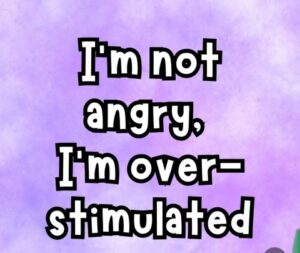
Text image with the words: “I am not angry. I am overstimulated.” Indicates that emotional reactions may reflect overwhelm, not anger.

When Dysregulation Is Treated as Being Intentionally Difficult

I do not seem naturally wired to preserve “harmony” by pretending not to see what I see and not feel what I feel. It is not as if everyone is having roughly the same experience and others make the more agreeable decision to go with the flow while I make the objectionable decision to diverge, which gets me branded not as divergent but deviant. Difficult to govern gets conflated with untrustworthy and unworthy. Not a team player. I simply cannot go with a flow that feels wildly dysregulating. My nervous system picks up and responds to things that either do not hit other people’s radar at all or do not register with anything close to the same intensity. It is not unlike some version of a dog whistle. We can be in the same room, inside the same system, and not be receiving the same input or impact from it. If something barely bothers a person, accommodating it will require little of them—nothing to resist or mask. They can easily carry on, genuinely unaffected. If the same thing is creating unmanageable discomfort in me, going along can leave me completely taxed. My depletion gets read as attitude. And yet the person who can comfortably accommodate is regarded as flexible and cooperative—which may not be untrue. But the converse about me is not necessarily true. Yes, I am less easy. But I don’t think less easy is the same as difficult or deviant. So how much of what I have understood as something wrong with me was actually the branding of a person who could not seamlessly abide without a trace a visible strain?

Read More
Black-and-white cartoon of Wholesome Badass in a jujutsu stance, holding up a glowing shield against dark arrows and scribbles. A speech bubble says, “But here’s what also happened.”

The Power of an Incomplete Truth

In my tagline, I reveal myself as navigating the storm of neurodivergence, trauma, and toxic family systems. For the archetypes with whom I have navigated strife or rupture, I imagine this perspective may feel unwelcome because it adds context to a much simpler explanation: I was just bad. Difficult. Crazy. Selfish. Unreasonable. Context provides nuance that the simpler explanation leaves out. Whatever may have been said or done to diminish me was charged to me: I caused it, deserved it, exaggerated it, or imagined it. The tagline isn’t an attempt to excuse myself, but the closest language I have found for an experience I spent decades unable to articulate. Naming neurodivergence, trauma, and a dysfunctional family system does not make every choice I have ever made harmless, good, or right. It allows nuance into a story where my context was effectively disregarded. And I can’t help but ask, in all earnestness: if my “craziness” was the explanation for every instance of hardship for me, why wasn’t anyone’s response concern, curiosity, or support? What I am chasing is not agreement but a fuller record. More of what actually happened allowed into the room. Other people’s explanations have passed for the complete story, while mine were categorically rejected as inadmissible. If I asked questions, I was manufacturing chaos. If I offered context, I was making excuses. If I remembered something differently, I was rewriting history. I was seeking a clean signal—clarity, cohesion, some way to sew the pieces together for a story that makes sense, even if what emerged was painful or unflattering to me. Apparently, asking clarifying questions seems to threaten the prescribed narrative. Providing context is recieved as equally troublesome. So I am left trying to make sense of a story I was expected to accept, while relevant context was not allowed into consideration. Have you ever realized that what seemed like the only obvious conclusion was actually inaccurate and deeply unfair — once you had a more complete account of the story? One real-life example: I’m in a hurry and stuck behind a man in a posh new Jaguar, stopped in the road and holding up traffic for what I assume is no good reason—just entitled and inconsiderate. Then I SEE he has gotten out of his car to help a disabled elderly person with a heavy package cross the street. Nothing about the stopped car changed. The context did. I feel some of that same aha humbling energy when I think about people like Howard Stern, Monica Lewinsky, Stormy Daniels, Pamela Anderson, and others whom I experienced through a particular public narrative without bothering to question what might have been missing from it. Sometimes the framing was profitable. Sometimes powerful people had an enormous stake in which version prevailed. Either way, I accepted a conclusion before I had much interest in the fuller record. Just saaaaayin.
Read More
Black-and-white illustration of a girl facing a man whose right hand beckons her closer while his left hand signals stop.

The System with No Name

For most of my life, I could see the individual friction points but not the structure they shared. I experienced them as isolated interactions. A misunderstanding. A rupture. A person who was displeased with me (and seemingly intent on making me pay). A relationship I had somehow failed to navigate correctly. I explained. Apologized. Twisted myself. Worked harder. Questioned myself. Tried another approach (but still, tragically, as myself). There was the conviction that if I could just understand what I was missing, I could make myself fit. My life energy was wastefully consumed trying to navigate first my family of origin, then people and patterns that mimicked the dynamic where I was expected to want, feel, and need what I did not– and also agree to matter less. I realize nobody got handed the rules. For mainstream, untraumatized, neurotypical people, it seems to make sense and work. Expressing any version of no or ouch or confusion consistently resulted in friction. This was baffling to me, honestly. I seriously expected support or comfort, or maybe even some genuine interest. Now, after nearly six decades of swinging and missing by miles, I have begun to recognize patterns. Systems. Dynamics. Power imbalance. Coercion. All of it. I see now how easily familiarity masqueraded as normalcy. If a relational structure has been encoded deeply enough, it does not necessarily feel like a structure. It can simply feel like the way things, people, and relationships are—like water to a fish, not something experienced as a condition or even a variable, but simply the world as it is. And when the majority can function comfortably inside it, a person who cannot is what—a traitor, deviant, pariah? The person who does not go with THE FLOW is THE problem. Gosh—-That boxing-with-ghosts fucking energy- it was pure mind fuckery. I kept approaching each interaction as though there must be a successful response available to me. As though enough insight, enough humility, enough explanation, enough effort would eventually make the thing workable. It didn’t. What I am now able to do is name my experience of it—to take something that has remained amorphous and make it legible. Healing has helped me recognize systems that are damaging to me rather than inclusive or supportive, like FOR and not opposed to me. I can choose more carefully where I participate, what I adapt to, and what I no longer agree to organize myself around. Putting it into language demystifies it. Ideally, that helps someone else recognize the structure too—something that may have previously defied articulation andfelt like theirs alone. Like a shared truth. Are you also learning to recognize the systems and people who are for you—and those who are not?

Read More
Black-and-white cartoon of a worried girl handing over a paper labeled “OUCH” while a giant hand stamps it “DEFECTIVE.” Pink text at the top reads “When hurt gets submitted as evidence,” and a small watermark at the bottom says “wholesomebadass.com.”

When Your Sensitivity Is Framed as the Problem

In my family of origin, and then quite unsurprisingly in the marriage I chose, I re-enacted the familiar pattern. I accepted the charge for all discomfort—mine and everybody’s. If only I would’ve just gotten different, as was directed so very many times, we could’ve all been soooo close and comfortable. Your discomfort was my fault; so was my own. My distress was treated as a burden to the people I depended on to care for and guide me, and as proof that I was unreasonable, selfish, ungrateful, dramatic—defective. I lived in a state of perplexity that expressing any version of no or ouch consistently created friction, the very opposite of what a child might anticipate. My best efforts to communicate what I could and could not tolerate were dismissed as negative, dramatic, hysterical, oversensitive. My behavior, existence, personality, and pain were used as evidence against my character and worthiness each time they caused discomfort for one of the archetypes. My discomfort indicted me. Yours also did. I can see now how neurodivergence, scapegoating, and narcissistic family dynamics all fed the same machinery: difference was treated as defect, one person carried the emotional burden for everyone, and any separate reality that disrupted the preferred one became an offense. The opposite of sensitivity is not strength. It is insensitivity. The fact that I am affected does not make me weak, dangerous, or wrong. The way that I exist may be uncomfortable, but it’s not fucking violent or lacking in good character. What was violent, and what I have come to question as a matter of character, was the coercive control deployed in service to THE narrative, system, version of love, care, and peace. Have you ever noticed how people deeply invested in appearing strong can be the least able to, in good faith, directly engage friction?

Read More
Text image with the words: “I am not angry. I am overstimulated.” Indicates that emotional reactions may reflect overwhelm, not anger.

When Dysregulation Is Treated as Being Intentionally Difficult

I do not seem naturally wired to preserve “harmony” by pretending not to see what I see and not feel what I feel. It is not as if everyone is having roughly the same experience and others make the more agreeable decision to go with the flow while I make the objectionable decision to diverge, which gets me branded not as divergent but deviant. Difficult to govern gets conflated with untrustworthy and unworthy. Not a team player. I simply cannot go with a flow that feels wildly dysregulating. My nervous system picks up and responds to things that either do not hit other people’s radar at all or do not register with anything close to the same intensity. It is not unlike some version of a dog whistle. We can be in the same room, inside the same system, and not be receiving the same input or impact from it. If something barely bothers a person, accommodating it will require little of them—nothing to resist or mask. They can easily carry on, genuinely unaffected. If the same thing is creating unmanageable discomfort in me, going along can leave me completely taxed. My depletion gets read as attitude. And yet the person who can comfortably accommodate is regarded as flexible and cooperative—which may not be untrue. But the converse about me is not necessarily true. Yes, I am less easy. But I don’t think less easy is the same as difficult or deviant. So how much of what I have understood as something wrong with me was actually the branding of a person who could not seamlessly abide without a trace a visible strain?

Read More