
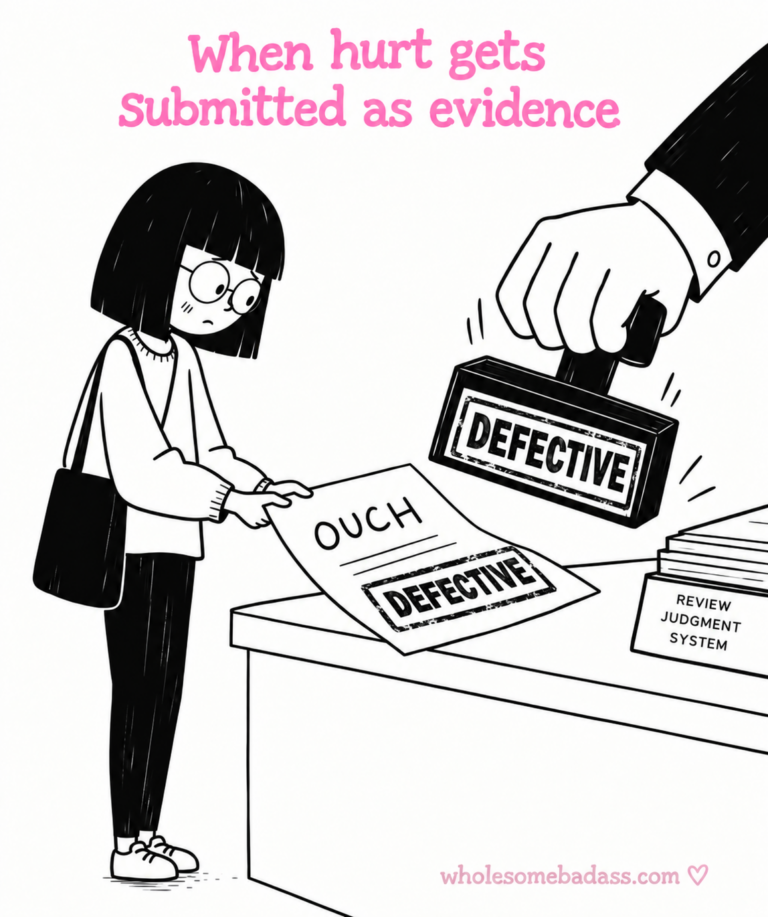
In my family of origin, and then quite unsurprisingly in the marriage I chose, I re-enacted the familiar pattern.
I accepted the charge for all discomfort—mine and everybody’s.
If only I would’ve just gotten different, as was directed so very many times, we could’ve all been soooo close and comfortable.
Your discomfort was my fault; so was my own.
My distress was treated as a burden to the people I depended on to care for and guide me, and as proof that I was unreasonable, selfish, ungrateful, dramatic—defective.
I lived in a state of perplexity that expressing any version of no or ouch consistently created friction, the very opposite of what a child might anticipate. My best efforts to communicate what I could and could not tolerate were dismissed as negative, dramatic, hysterical, oversensitive.
My behavior, existence, personality, and pain were used as evidence against my character and worthiness each time they caused discomfort for one of the archetypes.
My discomfort indicted me. Yours also did.
I can see now how neurodivergence, scapegoating, and narcissistic family dynamics all fed the same machinery: difference was treated as defect, one person carried the emotional burden for everyone, and any separate reality that disrupted the preferred one became an offense.
The opposite of sensitivity is not strength. It is insensitivity.
The fact that I am affected does not make me weak, dangerous, or wrong. The way that I exist may be uncomfortable, but it’s not fucking violent or lacking in good character.
What was violent, and what I have come to question as a matter of character, was the coercive control deployed in service to THE narrative, system, version of love, care, and peace.
Have you ever noticed how people deeply invested in appearing strong can be the least able to, in good faith, directly engage friction?