Wholesome Badass

A Work in Progress — Healing from All the Things​

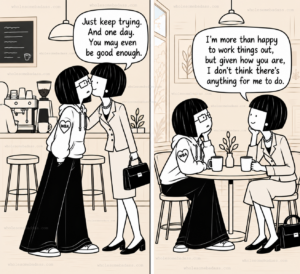
Two-panel illustration showing a woman suggesting someone may eventually be good enough, then claiming she wants reconciliation while insisting the other person is entirely responsible for the conflict.

Maybe One Day You’ll Be Worthy

There’s a deviant cruelty in having it said that you “got what you deserved.” Who even thinks like that? (Clears throat.) When I question the unequal terms of a relationship or ask for mutual consideration, the focus shifts from my concerns to how I’m showing an emotional reaction. My “intensity” is condemned, and my requests for change and repair are dismissed as manufacturing chaos. My credibility is systematically dismantled, while the unequal terms themselves go unexamined. Disqualified. And I am repeatedly (seriously, repeatedly) told, “You are welcome to join, provided you change,” while simultaneously being assured that such change is unlikely. Something astonishing happened when I healed enough to stop providing the convenient distraction of my large emotional reactions: rather than easing the conflict, the pressure intensified. Without my dysregulation to focus on, the very dynamics I had been questioning became difficult to ignore. Requesting mutually healthy terms and finally having enough self-esteem to refuse being disregarded or diminished is characterized as having “opted out.” As though I unilaterally chose to abandon a perfectly good relationship rather than asking whether we could find a way forward that works for us both. The estrangement that follows is framed as the natural consequence of “my choice.” Even hostility is justified as something my supposed deficiencies made necessary. If only I were different, they wouldn’t have to treat me this way. It’s fkn bananas. 🍌
Read More
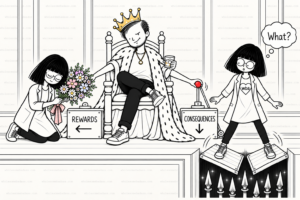
A crowned man sits on a throne, rewarding a favored woman with flowers while directing another woman toward a dangerous trap labeled “Consequences.” The image illustrates favoritism, othering, and emotional violence.

When Discomfort Is Handled as Provocation

I’m recognizing a pattern in the personality type I’ve come to call The Archetype: disproportionate retaliation in response to discomfort. There is a swift intolerance for anything or anyone that appears to interfere with their ideas, preferences, plans, comfort, or agenda. Frustration, inconvenience, disagreement, or a perceived lack of deference is handled as a provocation to be consequenced. They justify their retaliation as a natural consequence of being provoked, while simultaneously denying they had been affected or reacted at all. In this dynamic, labeling someone as troublesome and treating them accordingly takes precedence over acknowledging feeling threatened and dealing with difficult feelings. Something is causing discomfort? Annihilate it.

Read More
Two-panel illustration showing a woman suggesting someone may eventually be good enough, then claiming she wants reconciliation while insisting the other person is entirely responsible for the conflict.

Maybe One Day You’ll Be Worthy

There’s a deviant cruelty in having it said that you “got what you deserved.” Who even thinks like that? (Clears throat.) When I question the unequal terms of a relationship or ask for mutual consideration, the focus shifts from my concerns to how I’m showing an emotional reaction. My “intensity” is condemned, and my requests for change and repair are dismissed as manufacturing chaos. My credibility is systematically dismantled, while the unequal terms themselves go unexamined. Disqualified. And I am repeatedly (seriously, repeatedly) told, “You are welcome to join, provided you change,” while simultaneously being assured that such change is unlikely. Something astonishing happened when I healed enough to stop providing the convenient distraction of my large emotional reactions: rather than easing the conflict, the pressure intensified. Without my dysregulation to focus on, the very dynamics I had been questioning became difficult to ignore. Requesting mutually healthy terms and finally having enough self-esteem to refuse being disregarded or diminished is characterized as having “opted out.” As though I unilaterally chose to abandon a perfectly good relationship rather than asking whether we could find a way forward that works for us both. The estrangement that follows is framed as the natural consequence of “my choice.” Even hostility is justified as something my supposed deficiencies made necessary. If only I were different, they wouldn’t have to treat me this way. It’s fkn bananas. 🍌

Read More
A crowned man sits on a throne, rewarding a favored woman with flowers while directing another woman toward a dangerous trap labeled “Consequences.” The image illustrates favoritism, othering, and emotional violence.

When Discomfort Is Handled as Provocation

I’m recognizing a pattern in the personality type I’ve come to call The Archetype: disproportionate retaliation in response to discomfort. There is a swift intolerance for anything or anyone that appears to interfere with their ideas, preferences, plans, comfort, or agenda. Frustration, inconvenience, disagreement, or a perceived lack of deference is handled as a provocation to be consequenced. They justify their retaliation as a natural consequence of being provoked, while simultaneously denying they had been affected or reacted at all. In this dynamic, labeling someone as troublesome and treating them accordingly takes precedence over acknowledging feeling threatened and dealing with difficult feelings. Something is causing discomfort? Annihilate it.

Read More