Wholesome Badass

A Work in Progress — Healing from All the Things​

In Charge of Rejection

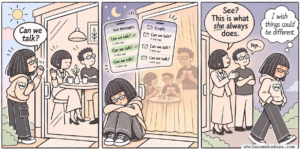
The love I knew was conditional, unpredictable, and readily withheld. I had no template for love that was safe, steady, and kind. I continued to reenact that relational trauma in nearly every relationship. While I am the common variable, so are my template for connection and the personality type it consistently draws me to. For much of my life, I engaged in relationships that diminished me. I tried, with limited understanding and skill, to redeem them. Which seemed impossible, particularly once I stopped agreeing to matter less. I’d try emphatically to understand what was happening between us so we could really connect, navigate our differences, and engage on mutual terms and in good faith. Instead, I was met with defensiveness, denial, and accusations of manufacturing chaos. Eventually, stonewalling. I was seeking connection with people whose behavior, I now see, as prioritizing deference. I didn’t recognize that we weren’t seeking the same thing, or that my attempts to communicate and establish mutuality might be received as defiance. Apparently, I was challenging the terms of a power dynamic I hadn’t even recognized. And when I finally stopped trying, that was unacceptable, too. With profound grief, I have had to acknowledge that the bond is too harmful to continue. The choice to stop chasing connection and approval has been ill-received. And cited only as further evidence of my troublesome, ungrateful, poor character and as the sole cause of our issues. “See? This is what you always do.” “Well, I guess that’s how much it meant to you.” “I thought you said you wanted to work things out.” “And you wonder why things are the way they are.” But isn’t it kind of like a doctor calling the time of death or delivering a diagnosis? The doctor doesn’t speak the death or disease into existence. He simply records it and moves forward accordingly. I’m not claiming to be a doctor. Obviously. I’m just saying, I’m finally able to trust my own experience and recognize the larger pattern without allowing someone else’s explanations, justifications, or occasional good moments to override it. And I can make my decisions based on that pattern rather than its exceptions.

Read More
Black-and-white illustration of a girl facing a man whose right hand beckons her closer while his left hand signals stop.

The System with No Name

For most of my life, I could see the individual friction points but not the structure they shared. I experienced them as isolated interactions. A misunderstanding. A rupture. A person who was displeased with me (and seemingly intent on making me pay). A relationship I had somehow failed to navigate correctly. I explained. Apologized. Twisted myself. Worked harder. Questioned myself. Tried another approach (but still, tragically, as myself). There was the conviction that if I could just understand what I was missing, I could make myself fit. My life energy was wastefully consumed trying to navigate first my family of origin, then people and patterns that mimicked the dynamic where I was expected to want, feel, and need what I did not– and also agree to matter less. I realize nobody got handed the rules. For mainstream, untraumatized, neurotypical people, it seems to make sense and work. Expressing any version of no or ouch or confusion consistently resulted in friction. This was baffling to me, honestly. I seriously expected support or comfort, or maybe even some genuine interest. Now, after nearly six decades of swinging and missing by miles, I have begun to recognize patterns. Systems. Dynamics. Power imbalance. Coercion. All of it. I see now how easily familiarity masqueraded as normalcy. If a relational structure has been encoded deeply enough, it does not necessarily feel like a structure. It can simply feel like the way things, people, and relationships are—like water to a fish, not something experienced as a condition or even a variable, but simply the world as it is. And when the majority can function comfortably inside it, a person who cannot is what—a traitor, deviant, pariah? The person who does not go with THE FLOW is THE problem. Gosh—-That boxing-with-ghosts fucking energy- it was pure mind fuckery. I kept approaching each interaction as though there must be a successful response available to me. As though enough insight, enough humility, enough explanation, enough effort would eventually make the thing workable. It didn’t. What I am now able to do is name my experience of it—to take something that has remained amorphous and make it legible. Healing has helped me recognize systems that are damaging to me rather than inclusive or supportive, like FOR and not opposed to me. I can choose more carefully where I participate, what I adapt to, and what I no longer agree to organize myself around. Putting it into language demystifies it. Ideally, that helps someone else recognize the structure too—something that may have previously defied articulation andfelt like theirs alone. Like a shared truth. Are you also learning to recognize the systems and people who are for you—and those who are not?

Read More
Black-and-white line drawing of two stick figures in a leaking boat. One figure wears a life vest, holds a life preserver, and says, “You need to calm down,” while the other figure looks distressed and bails water out of the boat.

The Advantage of Appearing Unbothered

I am beginning to recognize and more effectively name and navigate familiar systems, patterns, and personalities. In power imbalances, the person with more status or authority can seem even more credible when appearing almost completely unaffected — mildly inconvenienced at most. Beneath a curated exterior — detached, unreadable, even smiling or measured — strategically executed impunity may pass for sovereignty, shielded from challenge by status/rank itself. By contrast, an emotional response to threat or injury can be marked as excessive: evidence of defect, weakness, and wrongness, rendering the account of what happened inadmissible. Once that logic is established, power-over can pass as reasonable and justified. This is where emotional violence can comfortably hide: in the latitude granted by role, status, or perceived legitimacy to diminish, exclude, intimidate, or overpower another person while the resulting distress is treated as further proof that the response was warranted.

Read More
A crowd beside a woman standing alone, illustrating what it feels like when someone more influential controls the narrative and everyone believes their version.

The Power of Controlling the Narrative

Something does not become untrue because somebody more influential tells the story differently. I have spent a lot of my life attempting to reconcile the version of events that prevailed with my lived experience. Influence seems to determine which version is adopted and repeated. A person with more influence can shape or manipulate how events are understood. Their version becomes the more widely accepted narrative. And those under that person’s influence tend to organize around it, as THE truth. It shapes who is protected. Who is believed. Who gets the benefit of the doubt. Who belongs. And sometimes, for one person to remain elevated within that narrative, somebody else has to occupy the lesser position. Less credible. Less valid. Easier to dismiss. Then anything that person shares of what happened gets heard through what has already been established about them—and becomes, at some level, inadmissible. That’s the part—that part right there. You are not only trying to process and overcome what happened. You’re trying to tell it from a position where your credibility has already been diminished. Whatever else may be true, this also happens. A narrative can do more than determine what gets believed. It can determine who remains protected and included—and who becomes increasingly easy to disregard, diminish, and exclude. How much of what we believe about someone comes from what we have actually experienced with them, and how much was already decided for us by the story we were handed?

Read More
Black-and-white illustration of a smiling priest holding someone underwater during a baptism. A crowd admires him while a concerned girl notices the harm.

Perception vs. Reality

There is a scene in Boardwalk Empire in which a priest is standing in a river performing a baptism. He is wearing white robes. He is smiling. He occupies a position of moral authority. He presents as a good man offering salvation. The priest is holding the man beneath the water, while keeping a calmly arranged placid smile on his face, his confidence in plausible deniability. Here is a man cloaked in goodness, purity, and authority, protected by the very role that allows him to publicly and confidently carry out something profoundly sinister. People see the robes, the smile, the holy father offering salvation. His authority goes unchecked because the story has already been written. The role itself pre-decides what is possible to notice. In that way, the people witnessing from the shore become part of the story as well. The disturbance is not confined to the harm itself. It is also the protection, restoration, accommodation, and assumption of goodness that surround it. It is the way the narratives that shape our understanding pre-decide what is possible to notice.

Read More

In Charge of Rejection

The love I knew was conditional, unpredictable, and readily withheld. I had no template for love that was safe, steady, and kind. I continued to reenact that relational trauma in nearly every relationship. While I am the common variable, so are my template for connection and the personality type it consistently draws me to. For much of my life, I engaged in relationships that diminished me. I tried, with limited understanding and skill, to redeem them. Which seemed impossible, particularly once I stopped agreeing to matter less. I’d try emphatically to understand what was happening between us so we could really connect, navigate our differences, and engage on mutual terms and in good faith. Instead, I was met with defensiveness, denial, and accusations of manufacturing chaos. Eventually, stonewalling. I was seeking connection with people whose behavior, I now see, as prioritizing deference. I didn’t recognize that we weren’t seeking the same thing, or that my attempts to communicate and establish mutuality might be received as defiance. Apparently, I was challenging the terms of a power dynamic I hadn’t even recognized. And when I finally stopped trying, that was unacceptable, too. With profound grief, I have had to acknowledge that the bond is too harmful to continue. The choice to stop chasing connection and approval has been ill-received. And cited only as further evidence of my troublesome, ungrateful, poor character and as the sole cause of our issues. “See? This is what you always do.” “Well, I guess that’s how much it meant to you.” “I thought you said you wanted to work things out.” “And you wonder why things are the way they are.” But isn’t it kind of like a doctor calling the time of death or delivering a diagnosis? The doctor doesn’t speak the death or disease into existence. He simply records it and moves forward accordingly. I’m not claiming to be a doctor. Obviously. I’m just saying, I’m finally able to trust my own experience and recognize the larger pattern without allowing someone else’s explanations, justifications, or occasional good moments to override it. And I can make my decisions based on that pattern rather than its exceptions.

Read More
Black-and-white illustration of a girl facing a man whose right hand beckons her closer while his left hand signals stop.

The System with No Name

For most of my life, I could see the individual friction points but not the structure they shared. I experienced them as isolated interactions. A misunderstanding. A rupture. A person who was displeased with me (and seemingly intent on making me pay). A relationship I had somehow failed to navigate correctly. I explained. Apologized. Twisted myself. Worked harder. Questioned myself. Tried another approach (but still, tragically, as myself). There was the conviction that if I could just understand what I was missing, I could make myself fit. My life energy was wastefully consumed trying to navigate first my family of origin, then people and patterns that mimicked the dynamic where I was expected to want, feel, and need what I did not– and also agree to matter less. I realize nobody got handed the rules. For mainstream, untraumatized, neurotypical people, it seems to make sense and work. Expressing any version of no or ouch or confusion consistently resulted in friction. This was baffling to me, honestly. I seriously expected support or comfort, or maybe even some genuine interest. Now, after nearly six decades of swinging and missing by miles, I have begun to recognize patterns. Systems. Dynamics. Power imbalance. Coercion. All of it. I see now how easily familiarity masqueraded as normalcy. If a relational structure has been encoded deeply enough, it does not necessarily feel like a structure. It can simply feel like the way things, people, and relationships are—like water to a fish, not something experienced as a condition or even a variable, but simply the world as it is. And when the majority can function comfortably inside it, a person who cannot is what—a traitor, deviant, pariah? The person who does not go with THE FLOW is THE problem. Gosh—-That boxing-with-ghosts fucking energy- it was pure mind fuckery. I kept approaching each interaction as though there must be a successful response available to me. As though enough insight, enough humility, enough explanation, enough effort would eventually make the thing workable. It didn’t. What I am now able to do is name my experience of it—to take something that has remained amorphous and make it legible. Healing has helped me recognize systems that are damaging to me rather than inclusive or supportive, like FOR and not opposed to me. I can choose more carefully where I participate, what I adapt to, and what I no longer agree to organize myself around. Putting it into language demystifies it. Ideally, that helps someone else recognize the structure too—something that may have previously defied articulation andfelt like theirs alone. Like a shared truth. Are you also learning to recognize the systems and people who are for you—and those who are not?

Read More
Black-and-white line drawing of two stick figures in a leaking boat. One figure wears a life vest, holds a life preserver, and says, “You need to calm down,” while the other figure looks distressed and bails water out of the boat.

The Advantage of Appearing Unbothered

I am beginning to recognize and more effectively name and navigate familiar systems, patterns, and personalities. In power imbalances, the person with more status or authority can seem even more credible when appearing almost completely unaffected — mildly inconvenienced at most. Beneath a curated exterior — detached, unreadable, even smiling or measured — strategically executed impunity may pass for sovereignty, shielded from challenge by status/rank itself. By contrast, an emotional response to threat or injury can be marked as excessive: evidence of defect, weakness, and wrongness, rendering the account of what happened inadmissible. Once that logic is established, power-over can pass as reasonable and justified. This is where emotional violence can comfortably hide: in the latitude granted by role, status, or perceived legitimacy to diminish, exclude, intimidate, or overpower another person while the resulting distress is treated as further proof that the response was warranted.

Read More
A crowd beside a woman standing alone, illustrating what it feels like when someone more influential controls the narrative and everyone believes their version.

The Power of Controlling the Narrative

Something does not become untrue because somebody more influential tells the story differently. I have spent a lot of my life attempting to reconcile the version of events that prevailed with my lived experience. Influence seems to determine which version is adopted and repeated. A person with more influence can shape or manipulate how events are understood. Their version becomes the more widely accepted narrative. And those under that person’s influence tend to organize around it, as THE truth. It shapes who is protected. Who is believed. Who gets the benefit of the doubt. Who belongs. And sometimes, for one person to remain elevated within that narrative, somebody else has to occupy the lesser position. Less credible. Less valid. Easier to dismiss. Then anything that person shares of what happened gets heard through what has already been established about them—and becomes, at some level, inadmissible. That’s the part—that part right there. You are not only trying to process and overcome what happened. You’re trying to tell it from a position where your credibility has already been diminished. Whatever else may be true, this also happens. A narrative can do more than determine what gets believed. It can determine who remains protected and included—and who becomes increasingly easy to disregard, diminish, and exclude. How much of what we believe about someone comes from what we have actually experienced with them, and how much was already decided for us by the story we were handed?

Read More
Black-and-white illustration of a smiling priest holding someone underwater during a baptism. A crowd admires him while a concerned girl notices the harm.

Perception vs. Reality

There is a scene in Boardwalk Empire in which a priest is standing in a river performing a baptism. He is wearing white robes. He is smiling. He occupies a position of moral authority. He presents as a good man offering salvation. The priest is holding the man beneath the water, while keeping a calmly arranged placid smile on his face, his confidence in plausible deniability. Here is a man cloaked in goodness, purity, and authority, protected by the very role that allows him to publicly and confidently carry out something profoundly sinister. People see the robes, the smile, the holy father offering salvation. His authority goes unchecked because the story has already been written. The role itself pre-decides what is possible to notice. In that way, the people witnessing from the shore become part of the story as well. The disturbance is not confined to the harm itself. It is also the protection, restoration, accommodation, and assumption of goodness that surround it. It is the way the narratives that shape our understanding pre-decide what is possible to notice.

Read More