Wholesome Badass

A Work in Progress — Healing from All the Things​

Chopped down tree symbolizing the lasting impact of family betrayal and parental alienation.

How Did We Get Here?

At a very tense Mother’s Day gathering in 2016, I learned that my niece’s graduation was less than four weeks away and on the same night as a concert I had already committed to. The tickets had been a Valentine’s Day gift and the plans had been in place for months. It wasn’t that I chose a concert over her graduation. I simply already had plans by the time I was given the date. With no other way to get my boys to the graduation, and valuing the opportunity for family that being there would give them, I sent them with their dad. Even then, I sensed it could be a fatal choice. Later, my mother told me that while they were at the graduation, plans began for a birthday gathering for my son that would intentionally exclude me. Whatever was happening between the adults, I had directly and repeatedly asked that it stay there, and that we do the work of repair. Something in the fabric of my universe was torn beyond repair. Whatever else may be true, this also happened. I’ve been accused of being negative- always imagining the worst. Maybe I was never imagining the worst. Maybe I’m recognizing and recalling what I have lived. Have you ever been called negative for noticing a pattern that later proved real?

Read More
Goat standing alone on a cliff symbolizing family scapegoating and avoidance of responsibility

The War They Wanted: A Story of Estrangement

My sons learned, by design, to have zero tolerance for their mother. Ordinary acts of parenting—direction, correction, consequences, even simple questions—were rejected and reframed as manipulation or control. I once read a message from their father telling them, “Disregard your mother.” And they did. Their dismissal was not only permitted but modeled, reinforced, and quietly supported by people who positioned themselves as adversaries. During months of medical crisis—unmanaged pain, heavy medication, complications, emotional collapse—I was met with silence. I lost forty pounds. I couldn’t sit, stand, or lie down without pain. Without sleep, I struggled to function. My children showed little response, a kind of learned distance. My medical devastation wasn’t received as a call for care, but seemed to reinforce the narrative they had been taught to hold. Soon after that year of collapse came two heart attacks—more data, more interpretation, more judgment. I can hold compassion for how my children were shaped without accepting mercilessness as something I choose to live near. My healing has required restraint, even when injustice invites engagement. Over time, my options narrowed to two: escalate or collapse. In that narrowing, the structure became clear. Conflict was the point. They wanted a war—because war produces a winner and a loser, and in war, restraint is a liability. There is no framework of love or care in which it is acceptable to erase a parent. Participating in any activity that knowingly divides children from a parent is emotional violence. I continue to learn about the generational dynamics of scapegoating and parental alienation. I recognize myself in the stories of others whose former partners aligned with extended families in campaigns framed as concern—please pray for her, we’re worried—while undermining, diminishing, and dividing.

Read More
A quote on a dark, stormy abstract background that reads: When it comes to abusive behavior, if they know to hide it, they know it's wrong. If they don't do it in front of other people, they know how to control it.

The Price of Disagreeing

Coercive control is a strategic pattern of behavior used to dominate another person and strip away their sense of autonomy. It is not defined by a single violent event, but by a continuous web of intimidation, isolation, and micro-regulation of the victim’s life. When applied to the family unit, this control is often maintained through three primary mechanisms: 1. Scapegoating Scapegoating is the process of blaming one person for the family’s internal problems or the controller’s own failures. The goal: To create a “common enemy.” By making one person—often a child or the other parent—the source of all conflict, the controller deflects accountability and keeps the rest of the family in a state of hyper-vigilance. The result: The victim internalizes the shame, believing they are fundamentally “broken.” 2. Triangulation Triangulation occurs when the controlling person refuses direct communication and instead pulls a third person into the dynamic to create friction or competition. The goal: To divide and conquer. By telling different versions of a story to different people, the controller ensures loyalty while fostering suspicion between others. The result: It prevents victims from forming a united front, leaving the controller as the sole source of “truth.” 3. Parental Alienation In the context of coercive control, parental alienation is the ultimate extension of triangulation. It involves one parent using psychological manipulation to turn a child against the other targeted parent. The goal: To sever the bond between the child and the other parent, effectively erasing that parent’s influence and presence. The result: The child becomes a tool of the controller’s campaign, often resulting in long-term psychological trauma for both the child and the alienated parent. How They Intersect These are not isolated tactics, but interdependent components of a single power dynamic. Coercive control in a family setting operates through a calculated cycle of isolation and psychological pressure. It begins with scapegoating, reinforced through triangulation that manipulates communication and divides family members. These efforts culminate in parental alienation, where the scapegoated parent’s influence is erased, leaving the controller in command of the family’s reality. Coercive control thrives in silence and isolation. Identifying scapegoating, triangulation, and alienation for what they are is essential for protecting your mental health. The confusion you feel is a documented byproduct of the system, not a reflection of your worth as a parent or person.

Read More
Woman with half her face visibly distressed and tearful, the other half covered by a composed mask of her own face, symbolizing emotional masking and how composure is rewarded while distress is invalidated.

When “What Are You So Angry/Upset About?” Isn’t Actually Concern

I’m finally recognizing how validity gets measured not necessarily by the truth of what’s said, but by the composure of the person saying it. My sister recognized this dynamic early on. As someone deeply sensitive and reactive, I was easy to push. She could use subtle, almost invisible cues—like dog whistles—to trigger me. When I reacted, my distress was visible. She soared, by contrast, appearing calm, composed. The comparison was stark: her unaffectedness made her look right, while my emotional presentation made me look wrong. If you’re overwhelmed, overstimulated, or visibly distressed, your words can be dismissed simply because the delivery isn’t “correct.” You’re invalidated—not for what you say, but for failing to mask emotion. Meanwhile, those who appear composed—whether less sensitive, more resilient, or simply checked out—are granted credibility. In conflict, content matters less than presentation. This dynamic is often weaponized. A question like, “What are you so angry about?” masquerades as concern but functions as control, subtly discrediting the other person. In closed systems—family, workplace, or community—the sensitive one easily becomes the scapegoat. Sensitivity is reframed as weakness, instability, or unreliability. Any emotional communication that challenges the status quo is disqualified before it’s even heard, dismissed not for its substance but for the unmasked feelings attached. Composure paraded as proof of virtue; sensitivity condemned as proof of sin.

Read More
Closed interior door with a narrow line of light beneath it, representing the experience of being shut out while continuing to endure, witness, and remain present.

Scapegoating and the Cost of Speaking Up

The Truth That Cannot Be Erased For over a decade, this space has been my witness. For a multitude of reasons, outside of what has been designated as my willfullness and lack of gratitude, I have never been a pleasing or “quiet” victim sufferer. By around age eleven, I understood that my highest goal in life was to become someone else—or to become more palatable while absorbing abuse. I failed equally at both. I sought and gave myself to many similarly toxic situationships, I suppose, in the name of practice and growth in the art of better abuse-getting. The Reality of the Scapegoat As a neurodivergent survivor of childhood trauma and sibling molestation, my so-called “hysteria” was the only language available to me in an environment that protected my abuser and pathologized my pain. My sister was endorsed as the golden child. I was left to navigate the wreckage of her actions alone. She was praised for not being like me and pitied for having to deal with my “drama.” The Refusal to Be Gaslit This blog documents my experience as the family scapegoat—the person who could not believe or pretend that the “flow” was good. I was encouraged to calm down, be positive, grateful, you know- JUST go with the flow, even when that flow was designed to drown me. A Legacy of Resistance My “tantrums” were protests. My “outbursts” were the sound of a person being erased in real time. I write about the dirty and unsurprising alliance between an abusive sister and a similarly narcissistic ex-husband for what it is: a coordinated effort which denied me peace and my children. The Record for My Sons I am not begging for a seat at a table where I am not respected. I keep this record so my children may one day understand that their mother was not “unhinged” simply as a defect. She was unsupported, overstimulated, and being crushed by a system she could not fathom. A Note on My Methods of Survival In earlier chapters, I used my sister’s full name and shared specific accounts of professional and personal abuse, including details she offered as warning shots about how she handles uncooperative others. I did this frantically, without a playbook on navigating coercive abuse or even any idea that coercive abuse was a thing. I did so without a support system. I am not proud of the desperation that shaped those posts. But I am not ashamed of how I reacted to being molested, scapegoated, and erased. I was a person without a net, doing the only that I could—telling my truth- raging against those who harmed and silenced and erased me. In the only space I can.

Read More
Text image reading: “Trauma Bonding can make you terrified of ‘losing’ your abuser. Just keep in mind that you’ll also be losing the gaslighting, the sleepless nights, the knots in your stomach while they were ignoring you, the feeling of being blamed, and the stress of holding onto something that always felt like it was slipping away."

Trauma Bond: Addiction to the Abuser 

Across my closest relationships—mother, sister, husband, children—harm was never something to repair. It wasn’t acknowledged as harm at all, but reframed as my perception, my fault, my failure. Peace was never on offer. If I stayed, there was no peace. If I left, I wasn’t allowed to go in peace either. Departure had to hurt—because how could being without them be permitted to feel better than being with them? Relief was available only through my disappearance or my transformation. A structural issue. This closed system demands erasure or alteration, never mutual change. My pain is not evidence of harm, only inconvenience. I continue to bind myself to systems in which harm is normalized, repair is forbidden, and my full presence threatens the equilibrium. Trauma bonding pulls me in. Scapegoating keeps me in place. I’m recognizing pattern familiarity, not personal defect. “In a narcissistic family system, the scapegoat is forced to carry collective shame, guilt, and dysfunction. The family denies reality, refuses outside help, and isolates the victim, perpetuating the cycle. The result is long-term harm: C-PTSD, anxiety, depression. Leaving feels terrifying, even though staying is destructive, because the bond convinces you that survival depends on the abuser. Under extreme pressure, the scapegoat may break—reactive anger that the family then weaponizes as proof of their narrative: See? They’re crazy.“

Read More
Quote about false narratives created by people who cause harm to avoid accountability for their actions.

The Quiet Logic of Exile

In connecting with other survivors of similar dynamics, I’m recognizing a pattern that seems less personal and more structural. In families and systems which rely on scapegoating, it’s apparently simpler to remove a wounded person than to acknowledge and repair what hurt them. Exile is the tidy solution. Repair would require humility, shared responsibility, and change. Removal does not. Visibility becomes an offense. Directness, sensitivity, and emotional earnestness aren’t acknowledged; instead, the person carrying them is quietly marked as the problem, serving well as a cautionary tale. What’s unsettling is how ordinary this can appear. The cruelty is subtle by design- expressed through concern, whispered warnings, and selective protection that isolates while claiming to care. No clear moment of rupture. Just a reorganization around comfort and protection of the system. Those still inside the system learn—often without being told: alignment is rewarded, and absence is easier to live with than complexity. In time, the person who stands alone, their alienation – is put forward as evidence of “how difficult/unwell they are”. The discomfort is neatly exported. The structure remains intact and protected fiercely by those it serves.

Read More
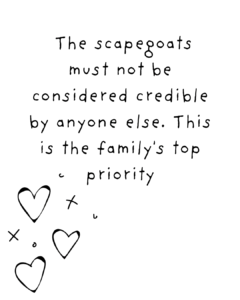
Text image reading: “The scapegoats must not be considered credible by anyone else. This is the family's top priority.” Represents family systems that discredit those who name harm.

When C-PTSD Keeps the Nervous System Braced for Threat

An Ordinary Moment, a Trauma Response My lived experience offered no assurance that I—or anything—would be okay. At a subconscious level, I suspected I might have less trouble if I could just get better at saying no and ouch, because those consistently caused trouble. I was not a discreet or well-adjusted abuse-getter. I was overwhelmed and overstimulated most of the time. The house was loud with fighting, NPR, opera, the stench of lamb and garlic, and the visual chaos of unsightly knickknacks and “art.” Sensory and emotional impact were constant and intense. I am porous, permeable—or as they liked to call it, thin-skinned. And diabolically selfish. I didn’t have a nurturing, protective adult saying any version of: I’ve got this. I’ve got you. It will be okay. Only through 12-Step recovery was I able to parent in those ways—not perfectly, but in ways diametrically opposed to my own experience. And that threatened a system that demanded reverence above all, even above my children’s needs. What was most often punished were my outward reactions to being overwhelmed, diminished, and disregarded. I had every tell of a child experiencing abuse, gaslighting, and scapegoating. I learned maladaptive ways of surviving a home with a protected abuser. To counter my visible anxiety and vigilance, my “family” labeled me paranoid, angry, negative, dramatic, hysterical, oversensitive. Because if I was those things, then I was the problem—not the abuse. What I’m finally coming to understand is that trauma, neurodivergence, and ADHD overlap and live in the nervous system. I’m now accessing the language and support. C-PTSD doesn’t live in my past. It lives in my body. My nervous system. My reactions. It doesn’t take holidays or special occasions off. I don’t choose when I’m triggered. I don’t choose how intense it is. I don’t choose my first reaction. Sometimes the tools help. Sometimes they don’t. A trigger isn’t always big. Sometimes it’s small. A sound. A smell. Light hitting something just right. A few weeks ago at the market—crowded, loud-ish—I was waiting in line. Nothing was happening. Then a well-dressed woman on her hot pink bejeweled speakerphone stood too close. Close enough that I could smell her. My body stiffened without consent. Fight or flee. And this was on a day when I was well-rested, well-fed, not too warm, not rushed, not needing a restroom. Any additional input would have crashed my system. I would have had to leave without checking out. But with some capacity left, I closed my eyes. Counted my breaths. Tapped my fingers. Went through checkout. I made it. And I was spent. Technically, nothing happened. Not if you were watching. And yet the pressure on my CNS might have compared to the stress level a neurotypical person feels during a mortal threat. Intellectually, I knew there was no danger. A dysregulated nervous system is not rational and does not care. I needed the rest of the day to discharge and recover from that energetic overload.
Read More
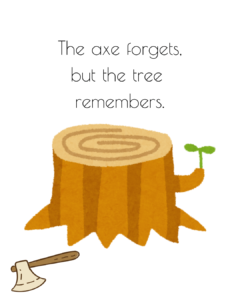
Chopped down tree symbolizing the lasting impact of family betrayal and parental alienation.

How Did We Get Here?

At a very tense Mother’s Day gathering in 2016, I learned that my niece’s graduation was less than four weeks away and on the same night as a concert I had already committed to. The tickets had been a Valentine’s Day gift and the plans had been in place for months. It wasn’t that I chose a concert over her graduation. I simply already had plans by the time I was given the date. With no other way to get my boys to the graduation, and valuing the opportunity for family that being there would give them, I sent them with their dad. Even then, I sensed it could be a fatal choice. Later, my mother told me that while they were at the graduation, plans began for a birthday gathering for my son that would intentionally exclude me. Whatever was happening between the adults, I had directly and repeatedly asked that it stay there, and that we do the work of repair. Something in the fabric of my universe was torn beyond repair. Whatever else may be true, this also happened. I’ve been accused of being negative- always imagining the worst. Maybe I was never imagining the worst. Maybe I’m recognizing and recalling what I have lived. Have you ever been called negative for noticing a pattern that later proved real?

Read More
Goat standing alone on a cliff symbolizing family scapegoating and avoidance of responsibility

The War They Wanted: A Story of Estrangement

My sons learned, by design, to have zero tolerance for their mother. Ordinary acts of parenting—direction, correction, consequences, even simple questions—were rejected and reframed as manipulation or control. I once read a message from their father telling them, “Disregard your mother.” And they did. Their dismissal was not only permitted but modeled, reinforced, and quietly supported by people who positioned themselves as adversaries. During months of medical crisis—unmanaged pain, heavy medication, complications, emotional collapse—I was met with silence. I lost forty pounds. I couldn’t sit, stand, or lie down without pain. Without sleep, I struggled to function. My children showed little response, a kind of learned distance. My medical devastation wasn’t received as a call for care, but seemed to reinforce the narrative they had been taught to hold. Soon after that year of collapse came two heart attacks—more data, more interpretation, more judgment. I can hold compassion for how my children were shaped without accepting mercilessness as something I choose to live near. My healing has required restraint, even when injustice invites engagement. Over time, my options narrowed to two: escalate or collapse. In that narrowing, the structure became clear. Conflict was the point. They wanted a war—because war produces a winner and a loser, and in war, restraint is a liability. There is no framework of love or care in which it is acceptable to erase a parent. Participating in any activity that knowingly divides children from a parent is emotional violence. I continue to learn about the generational dynamics of scapegoating and parental alienation. I recognize myself in the stories of others whose former partners aligned with extended families in campaigns framed as concern—please pray for her, we’re worried—while undermining, diminishing, and dividing.

Read More
A quote on a dark, stormy abstract background that reads: When it comes to abusive behavior, if they know to hide it, they know it's wrong. If they don't do it in front of other people, they know how to control it.

The Price of Disagreeing

Coercive control is a strategic pattern of behavior used to dominate another person and strip away their sense of autonomy. It is not defined by a single violent event, but by a continuous web of intimidation, isolation, and micro-regulation of the victim’s life. When applied to the family unit, this control is often maintained through three primary mechanisms: 1. Scapegoating Scapegoating is the process of blaming one person for the family’s internal problems or the controller’s own failures. The goal: To create a “common enemy.” By making one person—often a child or the other parent—the source of all conflict, the controller deflects accountability and keeps the rest of the family in a state of hyper-vigilance. The result: The victim internalizes the shame, believing they are fundamentally “broken.” 2. Triangulation Triangulation occurs when the controlling person refuses direct communication and instead pulls a third person into the dynamic to create friction or competition. The goal: To divide and conquer. By telling different versions of a story to different people, the controller ensures loyalty while fostering suspicion between others. The result: It prevents victims from forming a united front, leaving the controller as the sole source of “truth.” 3. Parental Alienation In the context of coercive control, parental alienation is the ultimate extension of triangulation. It involves one parent using psychological manipulation to turn a child against the other targeted parent. The goal: To sever the bond between the child and the other parent, effectively erasing that parent’s influence and presence. The result: The child becomes a tool of the controller’s campaign, often resulting in long-term psychological trauma for both the child and the alienated parent. How They Intersect These are not isolated tactics, but interdependent components of a single power dynamic. Coercive control in a family setting operates through a calculated cycle of isolation and psychological pressure. It begins with scapegoating, reinforced through triangulation that manipulates communication and divides family members. These efforts culminate in parental alienation, where the scapegoated parent’s influence is erased, leaving the controller in command of the family’s reality. Coercive control thrives in silence and isolation. Identifying scapegoating, triangulation, and alienation for what they are is essential for protecting your mental health. The confusion you feel is a documented byproduct of the system, not a reflection of your worth as a parent or person.

Read More
Woman with half her face visibly distressed and tearful, the other half covered by a composed mask of her own face, symbolizing emotional masking and how composure is rewarded while distress is invalidated.

When “What Are You So Angry/Upset About?” Isn’t Actually Concern

I’m finally recognizing how validity gets measured not necessarily by the truth of what’s said, but by the composure of the person saying it. My sister recognized this dynamic early on. As someone deeply sensitive and reactive, I was easy to push. She could use subtle, almost invisible cues—like dog whistles—to trigger me. When I reacted, my distress was visible. She soared, by contrast, appearing calm, composed. The comparison was stark: her unaffectedness made her look right, while my emotional presentation made me look wrong. If you’re overwhelmed, overstimulated, or visibly distressed, your words can be dismissed simply because the delivery isn’t “correct.” You’re invalidated—not for what you say, but for failing to mask emotion. Meanwhile, those who appear composed—whether less sensitive, more resilient, or simply checked out—are granted credibility. In conflict, content matters less than presentation. This dynamic is often weaponized. A question like, “What are you so angry about?” masquerades as concern but functions as control, subtly discrediting the other person. In closed systems—family, workplace, or community—the sensitive one easily becomes the scapegoat. Sensitivity is reframed as weakness, instability, or unreliability. Any emotional communication that challenges the status quo is disqualified before it’s even heard, dismissed not for its substance but for the unmasked feelings attached. Composure paraded as proof of virtue; sensitivity condemned as proof of sin.

Read More
Closed interior door with a narrow line of light beneath it, representing the experience of being shut out while continuing to endure, witness, and remain present.

Scapegoating and the Cost of Speaking Up

The Truth That Cannot Be Erased For over a decade, this space has been my witness. For a multitude of reasons, outside of what has been designated as my willfullness and lack of gratitude, I have never been a pleasing or “quiet” victim sufferer. By around age eleven, I understood that my highest goal in life was to become someone else—or to become more palatable while absorbing abuse. I failed equally at both. I sought and gave myself to many similarly toxic situationships, I suppose, in the name of practice and growth in the art of better abuse-getting. The Reality of the Scapegoat As a neurodivergent survivor of childhood trauma and sibling molestation, my so-called “hysteria” was the only language available to me in an environment that protected my abuser and pathologized my pain. My sister was endorsed as the golden child. I was left to navigate the wreckage of her actions alone. She was praised for not being like me and pitied for having to deal with my “drama.” The Refusal to Be Gaslit This blog documents my experience as the family scapegoat—the person who could not believe or pretend that the “flow” was good. I was encouraged to calm down, be positive, grateful, you know- JUST go with the flow, even when that flow was designed to drown me. A Legacy of Resistance My “tantrums” were protests. My “outbursts” were the sound of a person being erased in real time. I write about the dirty and unsurprising alliance between an abusive sister and a similarly narcissistic ex-husband for what it is: a coordinated effort which denied me peace and my children. The Record for My Sons I am not begging for a seat at a table where I am not respected. I keep this record so my children may one day understand that their mother was not “unhinged” simply as a defect. She was unsupported, overstimulated, and being crushed by a system she could not fathom. A Note on My Methods of Survival In earlier chapters, I used my sister’s full name and shared specific accounts of professional and personal abuse, including details she offered as warning shots about how she handles uncooperative others. I did this frantically, without a playbook on navigating coercive abuse or even any idea that coercive abuse was a thing. I did so without a support system. I am not proud of the desperation that shaped those posts. But I am not ashamed of how I reacted to being molested, scapegoated, and erased. I was a person without a net, doing the only that I could—telling my truth- raging against those who harmed and silenced and erased me. In the only space I can.

Read More
Text image reading: “Trauma Bonding can make you terrified of ‘losing’ your abuser. Just keep in mind that you’ll also be losing the gaslighting, the sleepless nights, the knots in your stomach while they were ignoring you, the feeling of being blamed, and the stress of holding onto something that always felt like it was slipping away."

Trauma Bond: Addiction to the Abuser 

Across my closest relationships—mother, sister, husband, children—harm was never something to repair. It wasn’t acknowledged as harm at all, but reframed as my perception, my fault, my failure. Peace was never on offer. If I stayed, there was no peace. If I left, I wasn’t allowed to go in peace either. Departure had to hurt—because how could being without them be permitted to feel better than being with them? Relief was available only through my disappearance or my transformation. A structural issue. This closed system demands erasure or alteration, never mutual change. My pain is not evidence of harm, only inconvenience. I continue to bind myself to systems in which harm is normalized, repair is forbidden, and my full presence threatens the equilibrium. Trauma bonding pulls me in. Scapegoating keeps me in place. I’m recognizing pattern familiarity, not personal defect. “In a narcissistic family system, the scapegoat is forced to carry collective shame, guilt, and dysfunction. The family denies reality, refuses outside help, and isolates the victim, perpetuating the cycle. The result is long-term harm: C-PTSD, anxiety, depression. Leaving feels terrifying, even though staying is destructive, because the bond convinces you that survival depends on the abuser. Under extreme pressure, the scapegoat may break—reactive anger that the family then weaponizes as proof of their narrative: See? They’re crazy.“

Read More
Quote about false narratives created by people who cause harm to avoid accountability for their actions.

The Quiet Logic of Exile

In connecting with other survivors of similar dynamics, I’m recognizing a pattern that seems less personal and more structural. In families and systems which rely on scapegoating, it’s apparently simpler to remove a wounded person than to acknowledge and repair what hurt them. Exile is the tidy solution. Repair would require humility, shared responsibility, and change. Removal does not. Visibility becomes an offense. Directness, sensitivity, and emotional earnestness aren’t acknowledged; instead, the person carrying them is quietly marked as the problem, serving well as a cautionary tale. What’s unsettling is how ordinary this can appear. The cruelty is subtle by design- expressed through concern, whispered warnings, and selective protection that isolates while claiming to care. No clear moment of rupture. Just a reorganization around comfort and protection of the system. Those still inside the system learn—often without being told: alignment is rewarded, and absence is easier to live with than complexity. In time, the person who stands alone, their alienation – is put forward as evidence of “how difficult/unwell they are”. The discomfort is neatly exported. The structure remains intact and protected fiercely by those it serves.

Read More
Text image reading: “The scapegoats must not be considered credible by anyone else. This is the family's top priority.” Represents family systems that discredit those who name harm.

When C-PTSD Keeps the Nervous System Braced for Threat

An Ordinary Moment, a Trauma Response My lived experience offered no assurance that I—or anything—would be okay. At a subconscious level, I suspected I might have less trouble if I could just get better at saying no and ouch, because those consistently caused trouble. I was not a discreet or well-adjusted abuse-getter. I was overwhelmed and overstimulated most of the time. The house was loud with fighting, NPR, opera, the stench of lamb and garlic, and the visual chaos of unsightly knickknacks and “art.” Sensory and emotional impact were constant and intense. I am porous, permeable—or as they liked to call it, thin-skinned. And diabolically selfish. I didn’t have a nurturing, protective adult saying any version of: I’ve got this. I’ve got you. It will be okay. Only through 12-Step recovery was I able to parent in those ways—not perfectly, but in ways diametrically opposed to my own experience. And that threatened a system that demanded reverence above all, even above my children’s needs. What was most often punished were my outward reactions to being overwhelmed, diminished, and disregarded. I had every tell of a child experiencing abuse, gaslighting, and scapegoating. I learned maladaptive ways of surviving a home with a protected abuser. To counter my visible anxiety and vigilance, my “family” labeled me paranoid, angry, negative, dramatic, hysterical, oversensitive. Because if I was those things, then I was the problem—not the abuse. What I’m finally coming to understand is that trauma, neurodivergence, and ADHD overlap and live in the nervous system. I’m now accessing the language and support. C-PTSD doesn’t live in my past. It lives in my body. My nervous system. My reactions. It doesn’t take holidays or special occasions off. I don’t choose when I’m triggered. I don’t choose how intense it is. I don’t choose my first reaction. Sometimes the tools help. Sometimes they don’t. A trigger isn’t always big. Sometimes it’s small. A sound. A smell. Light hitting something just right. A few weeks ago at the market—crowded, loud-ish—I was waiting in line. Nothing was happening. Then a well-dressed woman on her hot pink bejeweled speakerphone stood too close. Close enough that I could smell her. My body stiffened without consent. Fight or flee. And this was on a day when I was well-rested, well-fed, not too warm, not rushed, not needing a restroom. Any additional input would have crashed my system. I would have had to leave without checking out. But with some capacity left, I closed my eyes. Counted my breaths. Tapped my fingers. Went through checkout. I made it. And I was spent. Technically, nothing happened. Not if you were watching. And yet the pressure on my CNS might have compared to the stress level a neurotypical person feels during a mortal threat. Intellectually, I knew there was no danger. A dysregulated nervous system is not rational and does not care. I needed the rest of the day to discharge and recover from that energetic overload.

Read More