Wholesome Badass

A Work in Progress — Healing from All the Things​

Black-and-white cartoon of Wholesome Badass in a jujutsu stance, holding up a glowing shield against dark arrows and scribbles. A speech bubble says, “But here’s what also happened.”

The Power of an Incomplete Truth

In my tagline, I reveal myself as navigating the storm of neurodivergence, trauma, and toxic family systems. For the archetypes with whom I have navigated strife or rupture, I imagine this perspective may feel unwelcome because it adds context to a much simpler explanation: I was just bad. Difficult. Crazy. Selfish. Unreasonable. Context provides nuance that the simpler explanation leaves out. Whatever may have been said or done to diminish me was charged to me: I caused it, deserved it, exaggerated it, or imagined it. The tagline isn’t an attempt to excuse myself, but the closest language I have found for an experience I spent decades unable to articulate. Naming neurodivergence, trauma, and a dysfunctional family system does not make every choice I have ever made harmless, good, or right. It allows nuance into a story where my context was effectively disregarded. And I can’t help but ask, in all earnestness: if my “craziness” was the explanation for every instance of hardship for me, why wasn’t anyone’s response concern, curiosity, or support? What I am chasing is not agreement but a fuller record. More of what actually happened allowed into the room. Other people’s explanations have passed for the complete story, while mine were categorically rejected as inadmissible. If I asked questions, I was manufacturing chaos. If I offered context, I was making excuses. If I remembered something differently, I was rewriting history. I was seeking a clean signal—clarity, cohesion, some way to sew the pieces together for a story that makes sense, even if what emerged was painful or unflattering to me. Apparently, asking clarifying questions seems to threaten the prescribed narrative. Providing context is recieved as equally troublesome. So I am left trying to make sense of a story I was expected to accept, while relevant context was not allowed into consideration. Have you ever realized that what seemed like the only obvious conclusion was actually inaccurate and deeply unfair — once you had a more complete account of the story? One real-life example: I’m in a hurry and stuck behind a man in a posh new Jaguar, stopped in the road and holding up traffic for what I assume is no good reason—just entitled and inconsiderate. Then I SEE he has gotten out of his car to help a disabled elderly person with a heavy package cross the street. Nothing about the stopped car changed. The context did. I feel some of that same aha humbling energy when I think about people like Howard Stern, Monica Lewinsky, Stormy Daniels, Pamela Anderson, and others whom I experienced through a particular public narrative without bothering to question what might have been missing from it. Sometimes the framing was profitable. Sometimes powerful people had an enormous stake in which version prevailed. Either way, I accepted a conclusion before I had much interest in the fuller record. Just saaaaayin.

Read More
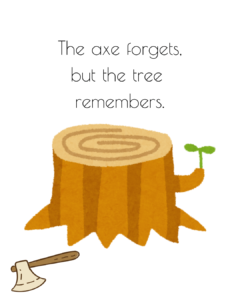
Chopped down tree symbolizing the lasting impact of family betrayal and parental alienation.

When Family Betrayal Pulls Young Children Into the Middle

At a very tense Mother’s Day gathering in 2016, I learned that my niece’s graduation was less than four weeks away and on the same night as a concert I had already committed to. The tickets had been a Valentine’s Day gift and the plans had been in place for months. It wasn’t that I chose a concert over her graduation. I simply already had plans by the time I was given the date. With no other way to get my boys to the graduation, and valuing the opportunity for family that being there would give them, I sent them with their dad. Even then, I sensed it could be a fatal choice. Later, my mother told me that while they were at the graduation, plans began for a birthday gathering for my son that would intentionally exclude me. Whatever was happening between the adults, I had directly and repeatedly asked that it stay there, and that we do the work of repair. Something in the fabric of my universe was torn beyond repair. Whatever else may be true, this also happened. I’ve been accused of being negative- always imagining the worst. Maybe I was never imagining the worst. Maybe I’m recognizing and recalling what I have lived. Have you ever been called negative for noticing a pattern that later proved real?

Read More
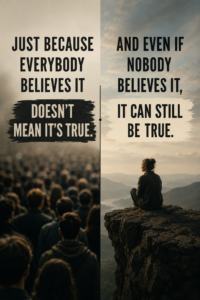
A crowd beside a woman standing alone, illustrating what it feels like when someone more influential controls the narrative and everyone believes their version.

The Power of Controlling the Narrative

Something does not become untrue because somebody more influential tells the story differently. I have spent a lot of my life attempting to reconcile the version of events that prevailed with my lived experience. Influence seems to determine which version is adopted and repeated. A person with more influence can shape or manipulate how events are understood. Their version becomes the more widely accepted narrative. And those under that person’s influence tend to organize around it, as THE truth. It shapes who is protected. Who is believed. Who gets the benefit of the doubt. Who belongs. And sometimes, for one person to remain elevated within that narrative, somebody else has to occupy the lesser position. Less credible. Less valid. Easier to dismiss. Then anything that person shares of what happened gets heard through what has already been established about them—and becomes, at some level, inadmissible. That’s the part—that part right there. You are not only trying to process and overcome what happened. You’re trying to tell it from a position where your credibility has already been diminished. Whatever else may be true, this also happens. A narrative can do more than determine what gets believed. It can determine who remains protected and included—and who becomes increasingly easy to disregard, diminish, and exclude. How much of what we believe about someone comes from what we have actually experienced with them, and how much was already decided for us by the story we were handed?

Read More
Illustration of two one woman sharing details of someone else's private struggle. And being praised for kind thoughtfulness. The woman they are discussing sits nearby, unaware.

The Irony of Weaponized Concern

The Reality of Gossip Discussing the details of someone else’s life—their hardships, their choices, or how they live—is a fundamentally unwholesome practice. Gossip happens, and we can be honest about that and not pretend that engaging in it is useful, considerate, or kind.  The “Concerned” Persona So it is fascinating to witness someone who is known for not being particularly fond of a person take an openly concerned stance in sharing the depth of their worry for that person’s wellness, stability, and functionality. The energy attempt:  “I’m only saying this because I care…” Engineered Destabilization It is a stunning social loophole. Cloaking gossip with empathy, is an attempt to engineer a kind of social undermining while seeking praise for thoughtfulness. If I knew how to do emojis from my Mac- Barfing emoji for sure right fkn here. The Blind Spot What is confusing, is how easily bystanders buy the act. How does a person or group look at someone with an obvious grudge or bias, listen to them trade in the unfavorable assessment of another person’s private life, and see a caring soul instead of an invasive, scheming act? Skull and Crossbones emoji here. The Performance vs. Real Consideration Genuine care and consideration tend to be quiet and direct and require no recognition. They check in and ask what they can do to help. They honor respect and privacy with discernement and intention. When the “concern” is instead passed around from person to person, it isn’t support—it’s unwholesome gossip disguised as  goodness. It makes you ask “how does a sound person buy into the performance?” Insert Comedy Tragedy mask emoji here. Whatever else may be true, this also happened.

Read More
Text graphic that reads: "Conflict is not the enemy of connection, avoidance is.

The Fragile Structure of Happiness

I’ve been sitting with a word that has always troubled me, a state of “being” that feels out of reach: happiness. There seems to be so little capacity out there to make space for those of us whose life experiences haven’t exactly been a gifted accumulation of things that make you say, yeah, this is good, I want to keep doing it. Perhaps the hardest truth to accept is that my upbringing never provided the raw materials or the architecture required to build or even envision a lasting happiness. The Problem with Toxic Positivity Interesting how frustrated or put out people can get when they run into what they view as unhappy “negative energy” that they cannot relate to, correct or ignore. The toxic positivity crowd seems fragile, openly displeased when things are not exactly their way. Looking closely, it feels like happiness isn’t an organic state of being. A construct built on top of an essential foundation of peace and security. It demands safety and structure to exist at all. Or perhaps the blessed state resilience of a careferee disposition. Expecting happiness to materialize out of nowhere after a foundation has been fractured by neglect and abuse is like demanding a roof when there are no walls. Unhappiness, by that same token, is just the weight of things that tear at that security. Why I Am Wired for Joy And yet, somehow, I am wired for joy. I delight easily. But joy and delight don’t care about a curated stack of ease or good fortunes. They live entirely in the immediate moment of being present and vulnerable. Happiness feels like it requires a whole history and a guaranteed future, but joy requires only the now, a sudden, fertile space which presents itself in the middle of whatever reality actually is. Happiness relies on a world that goes right, while joy only requires the willingness to stay open enough to notice a single, fleeting second of presence, belonging entirely to the moment, independent of a foundation beneath it which may be whole or broken. The Requirement of Happiness I recently learned that in the Mennonite tradition, there is a core insistence that suffering must never be done alone. It stopped me in my tracks. It made me wonder: what is the word for the exact opposite of that? Because the relationships that shaped me and then chosen out of habit—the ones that faithfully mirror my family of origin—operate on a completely different framework. In that world, the unwritten rule is that suffering doesn’t exist for the right kind of people. If it does, it must be masked, suppressed, blamed, and cast away– if you can’t manage it as prescribed. It’s an energy that says suffering is for losers, an energy that promises, “I’ll give you something to cry about.” The Autocracy of the Untroubled Growing up, happiness seemed a strict requirement. Yet, there was zero consideration for the lower levels of security—no foundational, protective caretaking that could flow into actual happiness. Instead, my sensitivities/struggles were used as evidence against me in a sort of autocratic system. Those who are not troubled or taxed with more than they can handle believe their peace is a birthright they earned and shall not be troubled by anyone lesser. By that same insulting logic, they identify most anyone hit by things consistently they cannot get back up from as deserving of the fall. Looking back, I wonder how my “care givers” believed it possible for me to be happy when I was chronically overwhelmed, without a steady support or floor beneath me. Sitting in Darkness: Ten Minutes a Day I listened to a podcast recently with Kate Bowler, a survivor of stage four cancer at a surprisingly young age. She talked about how many people really just do not want to know the truth of a difficult reality. In the season in which she thought she was months away from death, parting her from aloving family, husband and young son, a co-worker asked how she was doing, and she gave a brilliantly genuine answer: “I’m doing mostly okay, except for about ten minutes every day.” He didn’t say, “Well, at least it’s only ten minutes”. He didn’t offer a dismissive holow reassurance or pivot away from discomfort. Instead, he looked her in the eyes and said, “Will you tell me about those ten minutes?” It was a glaring, beautiful contrast to the standard script. No toxic positivity, no rushing to fix or minimize it, no turning away. Genuine inquiry – a quiet, compassionate presence willing to sit in the dark with someone else’s ten minutes. Kate wrote a piece in one of her books that captures that rare posture perfectly: Blessing for the Ones Who Stay Blessed are you who stay. Who sit beside pain that cannot be fixed. Who choose presence over platitudes, and silence over shallow comfort. Blessed are you who ask hard questions without rushing toward answers. Who bear witness to the kind of grief that rearranges the world. You who try. Try to imagine. Try to listen. Try to love in the absence of tidy outcomes. May your staying be its own kind of balm. Because it says: your pain matters. You matter. And may you feel, even now, that this, too, is holy. To stay. To try. To say yes to life in all of its complexity. And to love each other all the way through. The Courage to Stay It takes courage—and intentional humility—to stay present with someone whose reality is grim. Why is that so rare? Entitled people often behave as though the suffering are the fragile ones. But couldn’t fragility be more accurately defined as the inability to acknowledge, engage with, or endure difficulty? I am many things, but I am not fucking fragile. Those who judge me most harshly would crumble after a mile in my shoes. And then, with absolute conviction, they’d insist that if I were a better person, I’d have better shoes. What’s interesting is how comfortable—if not confident—these folks seem with speaking and doing harm while banking on their target being too ashamed to acknowledge the harm done. It’s a kind of meritocracy bullshit: if you’re suffering, you must have earned it; if you’re struggling, it must be a character flaw. That belief conveniently absolves them of any responsibility for the damage they cause.

Read More

Good Grief

I cannot help but feel charmed when I hear people in utter exasperation calmly say “Good Grief”.  It is so completely wholesome(benevolent) and old school. While grief, may not be good, it is essential, and a natural part of life.  We all deserve to grieve and heal from heartbreak.  My sons’ deserve a healed and whole mother. As an adult with choices, recovery of my spirit takes priority over my seat at “the family table”.    My first choice is to recover with my family of origin.  The alternative is to recover on my own.  It has been collectively declared that “There is nothing to heal from, just move on, Already, goddammit”.  My sister’s locking onto my ex-husband(any excuse at all to fawn and connect(gag)) has troubled us as co-parents, as well as divided me from our confused and aging mother.  I have nearly quit judging that behavior, but still, I REFUSE to dine with abusers of my sons’ parents.  The idea of sharing a meal is sickening.  Our next genetic gathering will be for a death.  While the passing of any family member will be unfortunate, the death itself, will not erase or stop the damage.  I will pray for the grace to show up only as a mourner for the passing of whomever it is.  The service will not pose as a union or a re-union.  Just a memorial  for the deceased; a ceremony dedicated to those who need to grieve the passing of a loved one.  I respect and honor the need to grieve.   For me, it will be a day of exercising courage, humility, and compassion–100% wholesome and badass.

Read More

You Spot It–You Got It

You spot it, you got it…. I was thinking of how I am most irritated by subtle little behaviors in which I assume to know the motivation…so arrogant.   And the flip side of that coin is that I am deeply touched by small gestures and behaviors that I assume to know the motivation. The truth of this is, if I recognize a behavior as having meaning, it is because it is familiar and I relate, whether it is good or bad. When I see the good in people, that is the good in me that I am connecting with. When I judge people, that is my judgment for my own attitudes and behaviors that need work. My sister, who is desperate to be in charge of my destiny, is always pointing out whom she believes to be gay, needing a man, angry, needy, or overly sensitive. She illuminates these things as if she is a brilliant soothsayer and well above being possessing any of those dreadful things.  I wonder if wearing all white every day and cringing at the idea of sex with your husband makes you feel as if you are a lady, full of grace.  I love wearing black and having sex with my boyfriend!!  what does that make me?  Self-actualization is my only real goal and so far, my greatest achievement. I notice with her, that anytime she is preparing for a night out or an event, she sends me pics asking if she looks like a weird desperate dyke….no joke. I finally just reduced it to WDD. Now I suspect her greatest need is to appear normal, not needing, and straight. I love rolling up to dinners in a cammo jacket with greasy pixie and no make up to announce I am rockin’ the WDD. Though I am straight, I would, just to be subversive, be thrilled to announce that I was an unashamed lesbian. Anyway, You spot it, you got it—

Read More
Black-and-white cartoon of Wholesome Badass in a jujutsu stance, holding up a glowing shield against dark arrows and scribbles. A speech bubble says, “But here’s what also happened.”

The Power of an Incomplete Truth

In my tagline, I reveal myself as navigating the storm of neurodivergence, trauma, and toxic family systems. For the archetypes with whom I have navigated strife or rupture, I imagine this perspective may feel unwelcome because it adds context to a much simpler explanation: I was just bad. Difficult. Crazy. Selfish. Unreasonable. Context provides nuance that the simpler explanation leaves out. Whatever may have been said or done to diminish me was charged to me: I caused it, deserved it, exaggerated it, or imagined it. The tagline isn’t an attempt to excuse myself, but the closest language I have found for an experience I spent decades unable to articulate. Naming neurodivergence, trauma, and a dysfunctional family system does not make every choice I have ever made harmless, good, or right. It allows nuance into a story where my context was effectively disregarded. And I can’t help but ask, in all earnestness: if my “craziness” was the explanation for every instance of hardship for me, why wasn’t anyone’s response concern, curiosity, or support? What I am chasing is not agreement but a fuller record. More of what actually happened allowed into the room. Other people’s explanations have passed for the complete story, while mine were categorically rejected as inadmissible. If I asked questions, I was manufacturing chaos. If I offered context, I was making excuses. If I remembered something differently, I was rewriting history. I was seeking a clean signal—clarity, cohesion, some way to sew the pieces together for a story that makes sense, even if what emerged was painful or unflattering to me. Apparently, asking clarifying questions seems to threaten the prescribed narrative. Providing context is recieved as equally troublesome. So I am left trying to make sense of a story I was expected to accept, while relevant context was not allowed into consideration. Have you ever realized that what seemed like the only obvious conclusion was actually inaccurate and deeply unfair — once you had a more complete account of the story? One real-life example: I’m in a hurry and stuck behind a man in a posh new Jaguar, stopped in the road and holding up traffic for what I assume is no good reason—just entitled and inconsiderate. Then I SEE he has gotten out of his car to help a disabled elderly person with a heavy package cross the street. Nothing about the stopped car changed. The context did. I feel some of that same aha humbling energy when I think about people like Howard Stern, Monica Lewinsky, Stormy Daniels, Pamela Anderson, and others whom I experienced through a particular public narrative without bothering to question what might have been missing from it. Sometimes the framing was profitable. Sometimes powerful people had an enormous stake in which version prevailed. Either way, I accepted a conclusion before I had much interest in the fuller record. Just saaaaayin.

Read More
Chopped down tree symbolizing the lasting impact of family betrayal and parental alienation.

When Family Betrayal Pulls Young Children Into the Middle

At a very tense Mother’s Day gathering in 2016, I learned that my niece’s graduation was less than four weeks away and on the same night as a concert I had already committed to. The tickets had been a Valentine’s Day gift and the plans had been in place for months. It wasn’t that I chose a concert over her graduation. I simply already had plans by the time I was given the date. With no other way to get my boys to the graduation, and valuing the opportunity for family that being there would give them, I sent them with their dad. Even then, I sensed it could be a fatal choice. Later, my mother told me that while they were at the graduation, plans began for a birthday gathering for my son that would intentionally exclude me. Whatever was happening between the adults, I had directly and repeatedly asked that it stay there, and that we do the work of repair. Something in the fabric of my universe was torn beyond repair. Whatever else may be true, this also happened. I’ve been accused of being negative- always imagining the worst. Maybe I was never imagining the worst. Maybe I’m recognizing and recalling what I have lived. Have you ever been called negative for noticing a pattern that later proved real?

Read More
A crowd beside a woman standing alone, illustrating what it feels like when someone more influential controls the narrative and everyone believes their version.

The Power of Controlling the Narrative

Something does not become untrue because somebody more influential tells the story differently. I have spent a lot of my life attempting to reconcile the version of events that prevailed with my lived experience. Influence seems to determine which version is adopted and repeated. A person with more influence can shape or manipulate how events are understood. Their version becomes the more widely accepted narrative. And those under that person’s influence tend to organize around it, as THE truth. It shapes who is protected. Who is believed. Who gets the benefit of the doubt. Who belongs. And sometimes, for one person to remain elevated within that narrative, somebody else has to occupy the lesser position. Less credible. Less valid. Easier to dismiss. Then anything that person shares of what happened gets heard through what has already been established about them—and becomes, at some level, inadmissible. That’s the part—that part right there. You are not only trying to process and overcome what happened. You’re trying to tell it from a position where your credibility has already been diminished. Whatever else may be true, this also happens. A narrative can do more than determine what gets believed. It can determine who remains protected and included—and who becomes increasingly easy to disregard, diminish, and exclude. How much of what we believe about someone comes from what we have actually experienced with them, and how much was already decided for us by the story we were handed?

Read More
Illustration of two one woman sharing details of someone else's private struggle. And being praised for kind thoughtfulness. The woman they are discussing sits nearby, unaware.

The Irony of Weaponized Concern

The Reality of Gossip Discussing the details of someone else’s life—their hardships, their choices, or how they live—is a fundamentally unwholesome practice. Gossip happens, and we can be honest about that and not pretend that engaging in it is useful, considerate, or kind.  The “Concerned” Persona So it is fascinating to witness someone who is known for not being particularly fond of a person take an openly concerned stance in sharing the depth of their worry for that person’s wellness, stability, and functionality. The energy attempt:  “I’m only saying this because I care…” Engineered Destabilization It is a stunning social loophole. Cloaking gossip with empathy, is an attempt to engineer a kind of social undermining while seeking praise for thoughtfulness. If I knew how to do emojis from my Mac- Barfing emoji for sure right fkn here. The Blind Spot What is confusing, is how easily bystanders buy the act. How does a person or group look at someone with an obvious grudge or bias, listen to them trade in the unfavorable assessment of another person’s private life, and see a caring soul instead of an invasive, scheming act? Skull and Crossbones emoji here. The Performance vs. Real Consideration Genuine care and consideration tend to be quiet and direct and require no recognition. They check in and ask what they can do to help. They honor respect and privacy with discernement and intention. When the “concern” is instead passed around from person to person, it isn’t support—it’s unwholesome gossip disguised as  goodness. It makes you ask “how does a sound person buy into the performance?” Insert Comedy Tragedy mask emoji here. Whatever else may be true, this also happened.

Read More
Text graphic that reads: "Conflict is not the enemy of connection, avoidance is.

The Fragile Structure of Happiness

I’ve been sitting with a word that has always troubled me, a state of “being” that feels out of reach: happiness. There seems to be so little capacity out there to make space for those of us whose life experiences haven’t exactly been a gifted accumulation of things that make you say, yeah, this is good, I want to keep doing it. Perhaps the hardest truth to accept is that my upbringing never provided the raw materials or the architecture required to build or even envision a lasting happiness. The Problem with Toxic Positivity Interesting how frustrated or put out people can get when they run into what they view as unhappy “negative energy” that they cannot relate to, correct or ignore. The toxic positivity crowd seems fragile, openly displeased when things are not exactly their way. Looking closely, it feels like happiness isn’t an organic state of being. A construct built on top of an essential foundation of peace and security. It demands safety and structure to exist at all. Or perhaps the blessed state resilience of a careferee disposition. Expecting happiness to materialize out of nowhere after a foundation has been fractured by neglect and abuse is like demanding a roof when there are no walls. Unhappiness, by that same token, is just the weight of things that tear at that security. Why I Am Wired for Joy And yet, somehow, I am wired for joy. I delight easily. But joy and delight don’t care about a curated stack of ease or good fortunes. They live entirely in the immediate moment of being present and vulnerable. Happiness feels like it requires a whole history and a guaranteed future, but joy requires only the now, a sudden, fertile space which presents itself in the middle of whatever reality actually is. Happiness relies on a world that goes right, while joy only requires the willingness to stay open enough to notice a single, fleeting second of presence, belonging entirely to the moment, independent of a foundation beneath it which may be whole or broken. The Requirement of Happiness I recently learned that in the Mennonite tradition, there is a core insistence that suffering must never be done alone. It stopped me in my tracks. It made me wonder: what is the word for the exact opposite of that? Because the relationships that shaped me and then chosen out of habit—the ones that faithfully mirror my family of origin—operate on a completely different framework. In that world, the unwritten rule is that suffering doesn’t exist for the right kind of people. If it does, it must be masked, suppressed, blamed, and cast away– if you can’t manage it as prescribed. It’s an energy that says suffering is for losers, an energy that promises, “I’ll give you something to cry about.” The Autocracy of the Untroubled Growing up, happiness seemed a strict requirement. Yet, there was zero consideration for the lower levels of security—no foundational, protective caretaking that could flow into actual happiness. Instead, my sensitivities/struggles were used as evidence against me in a sort of autocratic system. Those who are not troubled or taxed with more than they can handle believe their peace is a birthright they earned and shall not be troubled by anyone lesser. By that same insulting logic, they identify most anyone hit by things consistently they cannot get back up from as deserving of the fall. Looking back, I wonder how my “care givers” believed it possible for me to be happy when I was chronically overwhelmed, without a steady support or floor beneath me. Sitting in Darkness: Ten Minutes a Day I listened to a podcast recently with Kate Bowler, a survivor of stage four cancer at a surprisingly young age. She talked about how many people really just do not want to know the truth of a difficult reality. In the season in which she thought she was months away from death, parting her from aloving family, husband and young son, a co-worker asked how she was doing, and she gave a brilliantly genuine answer: “I’m doing mostly okay, except for about ten minutes every day.” He didn’t say, “Well, at least it’s only ten minutes”. He didn’t offer a dismissive holow reassurance or pivot away from discomfort. Instead, he looked her in the eyes and said, “Will you tell me about those ten minutes?” It was a glaring, beautiful contrast to the standard script. No toxic positivity, no rushing to fix or minimize it, no turning away. Genuine inquiry – a quiet, compassionate presence willing to sit in the dark with someone else’s ten minutes. Kate wrote a piece in one of her books that captures that rare posture perfectly: Blessing for the Ones Who Stay Blessed are you who stay. Who sit beside pain that cannot be fixed. Who choose presence over platitudes, and silence over shallow comfort. Blessed are you who ask hard questions without rushing toward answers. Who bear witness to the kind of grief that rearranges the world. You who try. Try to imagine. Try to listen. Try to love in the absence of tidy outcomes. May your staying be its own kind of balm. Because it says: your pain matters. You matter. And may you feel, even now, that this, too, is holy. To stay. To try. To say yes to life in all of its complexity. And to love each other all the way through. The Courage to Stay It takes courage—and intentional humility—to stay present with someone whose reality is grim. Why is that so rare? Entitled people often behave as though the suffering are the fragile ones. But couldn’t fragility be more accurately defined as the inability to acknowledge, engage with, or endure difficulty? I am many things, but I am not fucking fragile. Those who judge me most harshly would crumble after a mile in my shoes. And then, with absolute conviction, they’d insist that if I were a better person, I’d have better shoes. What’s interesting is how comfortable—if not confident—these folks seem with speaking and doing harm while banking on their target being too ashamed to acknowledge the harm done. It’s a kind of meritocracy bullshit: if you’re suffering, you must have earned it; if you’re struggling, it must be a character flaw. That belief conveniently absolves them of any responsibility for the damage they cause.
Read More

Good Grief

I cannot help but feel charmed when I hear people in utter exasperation calmly say “Good Grief”.  It is so completely wholesome(benevolent) and old school. While grief, may not be good, it is essential, and a natural part of life.  We all deserve to grieve and heal from heartbreak.  My sons’ deserve a healed and whole mother. As an adult with choices, recovery of my spirit takes priority over my seat at “the family table”.    My first choice is to recover with my family of origin.  The alternative is to recover on my own.  It has been collectively declared that “There is nothing to heal from, just move on, Already, goddammit”.  My sister’s locking onto my ex-husband(any excuse at all to fawn and connect(gag)) has troubled us as co-parents, as well as divided me from our confused and aging mother.  I have nearly quit judging that behavior, but still, I REFUSE to dine with abusers of my sons’ parents.  The idea of sharing a meal is sickening.  Our next genetic gathering will be for a death.  While the passing of any family member will be unfortunate, the death itself, will not erase or stop the damage.  I will pray for the grace to show up only as a mourner for the passing of whomever it is.  The service will not pose as a union or a re-union.  Just a memorial  for the deceased; a ceremony dedicated to those who need to grieve the passing of a loved one.  I respect and honor the need to grieve.   For me, it will be a day of exercising courage, humility, and compassion–100% wholesome and badass.

Read More

You Spot It–You Got It

You spot it, you got it…. I was thinking of how I am most irritated by subtle little behaviors in which I assume to know the motivation…so arrogant.   And the flip side of that coin is that I am deeply touched by small gestures and behaviors that I assume to know the motivation. The truth of this is, if I recognize a behavior as having meaning, it is because it is familiar and I relate, whether it is good or bad. When I see the good in people, that is the good in me that I am connecting with. When I judge people, that is my judgment for my own attitudes and behaviors that need work. My sister, who is desperate to be in charge of my destiny, is always pointing out whom she believes to be gay, needing a man, angry, needy, or overly sensitive. She illuminates these things as if she is a brilliant soothsayer and well above being possessing any of those dreadful things.  I wonder if wearing all white every day and cringing at the idea of sex with your husband makes you feel as if you are a lady, full of grace.  I love wearing black and having sex with my boyfriend!!  what does that make me?  Self-actualization is my only real goal and so far, my greatest achievement. I notice with her, that anytime she is preparing for a night out or an event, she sends me pics asking if she looks like a weird desperate dyke….no joke. I finally just reduced it to WDD. Now I suspect her greatest need is to appear normal, not needing, and straight. I love rolling up to dinners in a cammo jacket with greasy pixie and no make up to announce I am rockin’ the WDD. Though I am straight, I would, just to be subversive, be thrilled to announce that I was an unashamed lesbian. Anyway, You spot it, you got it—

Read More