Wholesome Badass

A Work in Progress — Healing from All the Things​

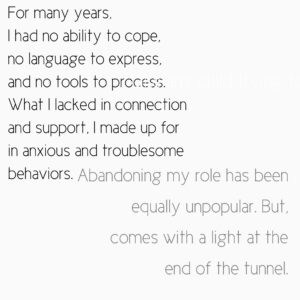
A minimalist graphic with white text on a solid, neutral background. The text reads: "I had no ability to cope, no language to express, and no tools to process. What I lacked in connection, I made up for in anxious behaviors. It was a costly way to exist—paying with myself just for proximity. Abandoning my role has been equally unpopular. But, it comes with a light at the end of the tunnel."⁠

When Victory Demands Wreckage

The Architecture of Binary Victory I have intentionally been studying a particular archetype whose sense of rightness often seems to depend on projecting wrongness onto someone else. The Perceived Victimization The archetype appears to operate under a specific system of binary beliefs: the conviction that winning and “being right” at all costs remains the ultimate proof of goodness, and that causing another to struggle is a valid tool to establish who is in the wrong. Under this framework, if someone in anyway interferes with what the archetype feels entitled to, it is experienced as a personal victimization. To restore the power imbalance, the system demands the plight of the person who deviated from the script. The Circular Trap of Blame Within this structure, a peaceful disagreement, ending or exit is out of the question; the archetype often requires visible social, financial, or professional struggle. Resulting pain is regarded not as a wound in need of care, but as proof of a deserving loser. The narrative becomes circular: the imposed hardship(which they rationalize as natural consequences–but natural consequences by definition are not imposed) is held up as evidence of “bad choices” and a “bad personality,” while the behaviors that contributed to the struggle are casually dismissed. Claiming the Third Way The fixed mindset of the archetype fights hard against a third way—a reality where someone can step away, choose peace, and quietly build a life outside of those win-loss columns.

Read More
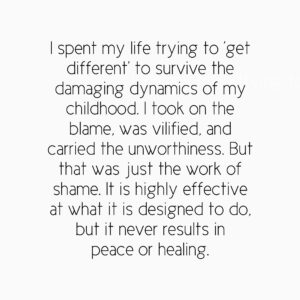
Unpacking the exhausting cycle of trying to "get different" to survive childhood dynamics, and why shame never produces the goodness we are looking for.⁠

The Cost of Challenging Toxic Systems

The Sovereignty Tax (My Refusal to Bleed) I am 57 years old, and I am only just now learning the practices of sovereignty and radical neutrality. Until recently, no one who has known me would have thought me even remotely sovereign or neutral- as I was NOT at all. And in a dedicated quest to actually live my life, to inhabit my own actual space, I have poked a few hornets’ nests. Different nests, but always an insidious sting. Me thinks me see a pattern. The Posture of Royalty Throughout my life—my family of origin, my marriage, historical friendships, and recently a neighbor—I have navigated people who try to assume a posture of royalty. For now, I will apply the term archetype to this personality. The archetype’s need for elevated status seems heavily reliant on a network of enablers propping them up—people who are either dependent, impressed, or intimidated by them in some way. I think there may be confsuion around those, as proxies for respect. With fragility of said crown, there is no such thing as safe, neutral ground(autonomy). If you aren’t actively prioritizing- propping them up (keeping them rightfully pleased), they perceive a traitor- actively trying to reduce or defy them. “You are either blindly for me or you are against me.” In each instance in which I have attempted to inhabit my space with an upright posture, I find myself squarely in the crosshairs of the archetype—and therefore, the crosshairs of the enablers. In psychology, there is a term “flying monkeys”. The Weaponized Concern Once inside the crosshairs, the campaign begins—wrapped in the soft language of concern. They don’t attack openly or directly check in. Instead, they whisper to friends, neighbors, managers, family, and peers: “Oh my gosh, I’m just worried about her. She seems so overwhelmed. She seems frantic. Confused.” It is a brilliant, insidious strategy to strip away validity and leave you vulnerable. By painting you as “frantic” or “struggling,” they accomplish three things at once: 1. They position themselves as THE “compassionate, stable” ones. 2. They pre-emptively compromise your credibility and validity. When you question the impact of their behavior, the script flips back to said problematic personality, perception, sensitivity, or struggles. The initiatives contributing negative impact are not acknowledged. In calling them out, you are accused of speaking problems into existence that don’t exist and creating drama. Abuse did not cause drama. Not quietly absorbing it did. 3. They set the trap. If you react, defend yourself, express discomfort, they get to sigh, throw up their hands, and say, “See? I told you she was unstable.” They get to confirm the very narrative they artfully spun and spread about you. When you dare to sit or stand upright to claim your own space and they can’t knock you down directly (because that would be questionable behavior), they set promptly to working to dissolve the ground beneath you. The Science of the Shark It is basic science that if you are bleeding in the water, you will attract sharks. That is just biology. I see the role I was cast in and have played with dedication. When you are born to sharks, you neeeeed the sharks! To be clear, I don’t make people behave sharkishly. I dont force or imagine them to behave as predators, and I didn’t knowingly choose to bleed out for a lifetime. It’s a dynamic, a well documented and studied pattern. Those who choose the comforting lie that “anything is possible if you just make the right choices” would love to hang this on me—to suggest that my bleeding was my own doing,earning, or imangining since clearly, I was “such a bloody mess.” But the truth is, a shark was always going to do the sharky things. For a long time, it seems my only clear option was to keep offering up the blood—to keep them close, because their attention—even when violent—felt safer than being entirely abandoned. Often, I attempted to mimic shark behavior that never fit my soul. Now, adopting the practices of radical neutrality has changed the water. The Unwelcome Healing When bleeding supply is curtailed, the sharks are disoriented. Because if I am not chumming the waters for them, how will they establish their mighty sharkiness? As if I must have forgotten how powerful and dangerous they are. “Don’t you know who you are dealing with?“ So, the system responds to my autonomy(my intentional choice to nurture and protect my most basic needs and limits) as an attack. The system functions smoothly as long as I agree to stay broken and matter less. The archetype—and enablers—respond with a highly specific theater of terror aimed at diminishing me, clawing at my peace- to prove they possess the power to make me flinch. I think there may be more favorable powers than this. I recall, with chilling clarity, my sister boasting about doing this thing to a woman at work. She literally glowed as she reported, “I know exactly how to make her cook her own goose,” simply because the woman carried herself in a way that made my sister feel non elevated and non- revered. The Third Way I am no authority on anyone else’s family or relationships. I am simply learning to recognize the cost of quietly claiming my right to peaceful ground. I have chosen to pay the heavy price of refusing to kiss the ring. Stepping away from my assigned script and choosing a third way—neither escalation nor collapse—has unsettled the system around me. There is a cost to no longer playing the role others expect you to play. It is a steep tax. But for the first time in my life, I am paying that price for my dignity instead of surrendering it to maintain unsafe contact and no connection. I am not proud of many things. But I feel deeply proud of my courage.
Read More
Split image showing a smiling “good witch” labeled as how narcissistic personalities present publicly, contrasted with an angry “wicked witch” labeled as how they behave privately in close relationships.

The Binary: Invisible or a Spectacle

Post-therapy processing. I keep noticing a painful pattern. When I speak directly—calmly, clearly, logically—it’s often received as aggression. Meanwhile, dishonesty softened with politeness, or harm delivered with a smile, is protected, even rewarded. In the past, I would escalate or collapse, distracting from the issue with my reaction. I don’t do that anymore, but the outcome is no better. My existence itself starts to feel like the problem. I’ve been labeled “demanding” or “confrontational” simply for asking direct questions or naming inconsistencies. Clarity seems threatening to those who rely on ambiguity. Without wiggle room, there’s no easy exit, so instead of engaging with the issue, the focus shifts to me for raising it. Clarity isn’t manipulation—it’s an attempt to understand what’s real. Passive aggression works differently. It dismisses boundaries, contradicts itself, or withdraws without owning the impact. If I react, my reaction becomes the headline. The harm vanishes, replaced by concern about my tone, my intensity, my feelings. That’s where the punishable feeling comes from—not because I’m wrong, but because I’m visible. This is especially common for people like me: highly sensitive, neurodivergent, earnest. In systems that prize politeness over honesty, directness breaks the spell. Accountability is reframed as hostility. Repair is avoided. The story becomes that the person naming the problem is the problem. My choices narrow: stay invisible, or be made into a spectacle. Neither feels safe or healthy. I’m not interested in winning arguments or proving anyone wrong. I want movement, repair, the question: what can we do to make this better? Yet again and again, I meet people who want only rightness—debates about tone, form, correctness—because once rightness is established, nothing more is required. I’m still healing from how often my nervous system has been punished for my inability to play along. I’m learning not to disappear or become a spectacle. I keep seeking a third way. I want to believe that in healthy systems, directness doesn’t equal war, disrespect, or danger. That standing without shame or silence isn’t audacious—or punishable.

Read More
A minimalist graphic with white text on a solid, neutral background. The text reads: "I had no ability to cope, no language to express, and no tools to process. What I lacked in connection, I made up for in anxious behaviors. It was a costly way to exist—paying with myself just for proximity. Abandoning my role has been equally unpopular. But, it comes with a light at the end of the tunnel."⁠

When Victory Demands Wreckage

The Architecture of Binary Victory I have intentionally been studying a particular archetype whose sense of rightness often seems to depend on projecting wrongness onto someone else. The Perceived Victimization The archetype appears to operate under a specific system of binary beliefs: the conviction that winning and “being right” at all costs remains the ultimate proof of goodness, and that causing another to struggle is a valid tool to establish who is in the wrong. Under this framework, if someone in anyway interferes with what the archetype feels entitled to, it is experienced as a personal victimization. To restore the power imbalance, the system demands the plight of the person who deviated from the script. The Circular Trap of Blame Within this structure, a peaceful disagreement, ending or exit is out of the question; the archetype often requires visible social, financial, or professional struggle. Resulting pain is regarded not as a wound in need of care, but as proof of a deserving loser. The narrative becomes circular: the imposed hardship(which they rationalize as natural consequences–but natural consequences by definition are not imposed) is held up as evidence of “bad choices” and a “bad personality,” while the behaviors that contributed to the struggle are casually dismissed. Claiming the Third Way The fixed mindset of the archetype fights hard against a third way—a reality where someone can step away, choose peace, and quietly build a life outside of those win-loss columns.

Read More
Unpacking the exhausting cycle of trying to "get different" to survive childhood dynamics, and why shame never produces the goodness we are looking for.⁠

The Cost of Challenging Toxic Systems

The Sovereignty Tax (My Refusal to Bleed) I am 57 years old, and I am only just now learning the practices of sovereignty and radical neutrality. Until recently, no one who has known me would have thought me even remotely sovereign or neutral- as I was NOT at all. And in a dedicated quest to actually live my life, to inhabit my own actual space, I have poked a few hornets’ nests. Different nests, but always an insidious sting. Me thinks me see a pattern. The Posture of Royalty Throughout my life—my family of origin, my marriage, historical friendships, and recently a neighbor—I have navigated people who try to assume a posture of royalty. For now, I will apply the term archetype to this personality. The archetype’s need for elevated status seems heavily reliant on a network of enablers propping them up—people who are either dependent, impressed, or intimidated by them in some way. I think there may be confsuion around those, as proxies for respect. With fragility of said crown, there is no such thing as safe, neutral ground(autonomy). If you aren’t actively prioritizing- propping them up (keeping them rightfully pleased), they perceive a traitor- actively trying to reduce or defy them. “You are either blindly for me or you are against me.” In each instance in which I have attempted to inhabit my space with an upright posture, I find myself squarely in the crosshairs of the archetype—and therefore, the crosshairs of the enablers. In psychology, there is a term “flying monkeys”. The Weaponized Concern Once inside the crosshairs, the campaign begins—wrapped in the soft language of concern. They don’t attack openly or directly check in. Instead, they whisper to friends, neighbors, managers, family, and peers: “Oh my gosh, I’m just worried about her. She seems so overwhelmed. She seems frantic. Confused.” It is a brilliant, insidious strategy to strip away validity and leave you vulnerable. By painting you as “frantic” or “struggling,” they accomplish three things at once: 1. They position themselves as THE “compassionate, stable” ones. 2. They pre-emptively compromise your credibility and validity. When you question the impact of their behavior, the script flips back to said problematic personality, perception, sensitivity, or struggles. The initiatives contributing negative impact are not acknowledged. In calling them out, you are accused of speaking problems into existence that don’t exist and creating drama. Abuse did not cause drama. Not quietly absorbing it did. 3. They set the trap. If you react, defend yourself, express discomfort, they get to sigh, throw up their hands, and say, “See? I told you she was unstable.” They get to confirm the very narrative they artfully spun and spread about you. When you dare to sit or stand upright to claim your own space and they can’t knock you down directly (because that would be questionable behavior), they set promptly to working to dissolve the ground beneath you. The Science of the Shark It is basic science that if you are bleeding in the water, you will attract sharks. That is just biology. I see the role I was cast in and have played with dedication. When you are born to sharks, you neeeeed the sharks! To be clear, I don’t make people behave sharkishly. I dont force or imagine them to behave as predators, and I didn’t knowingly choose to bleed out for a lifetime. It’s a dynamic, a well documented and studied pattern. Those who choose the comforting lie that “anything is possible if you just make the right choices” would love to hang this on me—to suggest that my bleeding was my own doing,earning, or imangining since clearly, I was “such a bloody mess.” But the truth is, a shark was always going to do the sharky things. For a long time, it seems my only clear option was to keep offering up the blood—to keep them close, because their attention—even when violent—felt safer than being entirely abandoned. Often, I attempted to mimic shark behavior that never fit my soul. Now, adopting the practices of radical neutrality has changed the water. The Unwelcome Healing When bleeding supply is curtailed, the sharks are disoriented. Because if I am not chumming the waters for them, how will they establish their mighty sharkiness? As if I must have forgotten how powerful and dangerous they are. “Don’t you know who you are dealing with?“ So, the system responds to my autonomy(my intentional choice to nurture and protect my most basic needs and limits) as an attack. The system functions smoothly as long as I agree to stay broken and matter less. The archetype—and enablers—respond with a highly specific theater of terror aimed at diminishing me, clawing at my peace- to prove they possess the power to make me flinch. I think there may be more favorable powers than this. I recall, with chilling clarity, my sister boasting about doing this thing to a woman at work. She literally glowed as she reported, “I know exactly how to make her cook her own goose,” simply because the woman carried herself in a way that made my sister feel non elevated and non- revered. The Third Way I am no authority on anyone else’s family or relationships. I am simply learning to recognize the cost of quietly claiming my right to peaceful ground. I have chosen to pay the heavy price of refusing to kiss the ring. Stepping away from my assigned script and choosing a third way—neither escalation nor collapse—has unsettled the system around me. There is a cost to no longer playing the role others expect you to play. It is a steep tax. But for the first time in my life, I am paying that price for my dignity instead of surrendering it to maintain unsafe contact and no connection. I am not proud of many things. But I feel deeply proud of my courage.
Read More
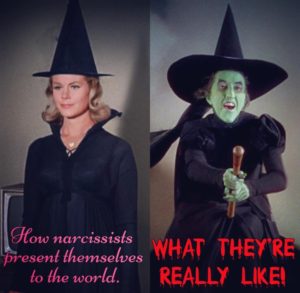
Split image showing a smiling “good witch” labeled as how narcissistic personalities present publicly, contrasted with an angry “wicked witch” labeled as how they behave privately in close relationships.

The Binary: Invisible or a Spectacle

Post-therapy processing. I keep noticing a painful pattern. When I speak directly—calmly, clearly, logically—it’s often received as aggression. Meanwhile, dishonesty softened with politeness, or harm delivered with a smile, is protected, even rewarded. In the past, I would escalate or collapse, distracting from the issue with my reaction. I don’t do that anymore, but the outcome is no better. My existence itself starts to feel like the problem. I’ve been labeled “demanding” or “confrontational” simply for asking direct questions or naming inconsistencies. Clarity seems threatening to those who rely on ambiguity. Without wiggle room, there’s no easy exit, so instead of engaging with the issue, the focus shifts to me for raising it. Clarity isn’t manipulation—it’s an attempt to understand what’s real. Passive aggression works differently. It dismisses boundaries, contradicts itself, or withdraws without owning the impact. If I react, my reaction becomes the headline. The harm vanishes, replaced by concern about my tone, my intensity, my feelings. That’s where the punishable feeling comes from—not because I’m wrong, but because I’m visible. This is especially common for people like me: highly sensitive, neurodivergent, earnest. In systems that prize politeness over honesty, directness breaks the spell. Accountability is reframed as hostility. Repair is avoided. The story becomes that the person naming the problem is the problem. My choices narrow: stay invisible, or be made into a spectacle. Neither feels safe or healthy. I’m not interested in winning arguments or proving anyone wrong. I want movement, repair, the question: what can we do to make this better? Yet again and again, I meet people who want only rightness—debates about tone, form, correctness—because once rightness is established, nothing more is required. I’m still healing from how often my nervous system has been punished for my inability to play along. I’m learning not to disappear or become a spectacle. I keep seeking a third way. I want to believe that in healthy systems, directness doesn’t equal war, disrespect, or danger. That standing without shame or silence isn’t audacious—or punishable.

Read More