Wholesome Badass

A Work in Progress — Healing from All the Things​

The Narcissist’s Prayer showing six statements that progress from denial and minimization to blame-shifting, beside an image of a cracked mask.

Gaslighting, Blame-Shifting, and the Absence of Repair

A person can know something experientially long before they can articulate it. They might know, for example, “After X is upset with me, I end up confused. I initiate communication thinking I had a legitimate concern, and somehow I leave apologizing and wondering whether I caused everything.” They don’t necessarily have words or concepts to process what happened. Once someone learns concepts like blame-shifting, triangulation, invalidation, stonewalling, double standards, DARVO, conditional approval, or refusal of repair, those concepts can provide handles for examining an interaction: Wait—was I actually heard? Did we each consider or examine our contributions? Was disagreement permitted? Did responsibility somehow become entirely mine? And importantly, language doesn’t have to supply the verdict. It can supply questions. That may be especially valuable for someone who’s been raised inside a particular relational system, because whatever happened repeatedly can simply register as this is how relationships work. Conflict is information, not a trial where somebody has to be found guilty. You can finish a disagreement still thinking, I was right about the original issue, and nevertheless learn: I interrupted you. I got defensive. I misunderstood what you meant. I didn’t realize that mattered so much to you. Or: I still disagree, but now I understand your reasoning. Or my most favorite of all: I think I understtand but I still do not agree. And the other person can do the same. Someone can be displeased with you without their displeasure becoming evidence that you’re bad. They can misunderstand you without their interpretation replacing your knowledge of yourself. And you can discover something uncomfortable about your own behavior without having to collapse into therefore I am the problem. In a healthy rupture, both people have something to metabolize. Not necessarily equal blame—sometimes one person really did behave badly—but both people still have an encounter to process. What happened? What did I do? What did you experience? What did I misunderstand? What does this change between us? What is needed for repair? In the archetypal dynamic, one person effectively exempts themselves from that process. Their internal work stops at: I was right to do or say X because of what you did. Everything downstream gets assigned to the other person. But the person on the receiving end doesn’t get to bypass metabolizing the rupture. They can end up metabolizing too much. They process the original conflict, the accusation, the other person’s certainty, the withdrawal, their own behavior, their memory, their motives, what they could have done differently, whether they’re actually the problem—and they do it without the other person’s participation. Then contact resumes without repair. All of that processing has nowhere relational to land. It can instead become adaptation: anxiety, self-doubt, vigilance, accommodation, rehearsing, overexplaining, trying harder, monitoring tone, becoming increasingly careful. The rupture isn’t unprocessed. The processing is asymmetrical. One person preserves their existing understanding of themselves. The other person is left reorganizing themselves around the unresolved rupture. Repair brings the information back into the relationship, where both people can examine it instead of one person having to carry and interpret the whole thing alone. One person is trying to understand what happened. The archetype is operating from the position that nothing happened that requires understanding. One person is asking, What happened between us? How did we get here? What needs to be repaired? And the answer—explicitly or through behavior—is essentially: There is nothing between us to repair. The problem is that you’re confused, anxious, sensitive, difficult, or unable to let things go. So the effect of the interaction gets reassigned as a characteristic of the recipient. The anxiety created by unresolved rupture becomes evidence that you’re “anxious.” The confusion created by contradictory interactions becomes evidence that you’re “confused.” Your attempts to get resolution become evidence that you “can’t let things go.” Your attempts to clarify what happened become evidence that you’re “overthinking.” The interaction disappears from the explanation. Then when ordinary contact resumes without acknowledgment, one person can experience that as moving on, while the other person is still carrying an unresolved event that supposedly never happened. There can be no repair when only one person is able to acknowledge that there was a rupture. You can say, “Something you did didn’t land well with me,” and get: Nothing happened. You’re misinterpreting me. You’re too sensitive. Or you can notice distance and say, “Something seems different between us. Did something happen?” and get: Nothing’s different. You’re imagining things. Why do you always do this? If you name an impact, you’re creating a problem. If you notice an impact, you’re creating a problem. If you ask about a rupture, you’re creating a problem. If you remain unsettled because there was no repair, that becomes the problem. The recipient isn’t just processing a conflict alone. They’re being asked to process a conflict whose existence has been denied. There isn’t even an agreed-upon event to work with. Something happened between us. I can observe the change. I’m experiencing the consequences. But I’m being told there is nothing here to discuss. Which may be why “nothing happened” is so consequential. It doesn’t merely refuse repair. It removes the shared reality from which repair would have been possible. Nothing happened. Nothing’s wrong. There is nothing to discuss. But then there’s silence. Distance. Withdrawal. Maybe coldness. You’re left alone with whatever the fuck just happened. That’s the contradiction. You’re experiencing the consequences of a rupture while being denied the existence of the rupture itself. Whatever else may be true, this is a defining structure within the archetypal dynamic.

Read More
Woman surrounded by flames with the words, “Don’t set yourself on fire to keep others warm.”

When Accountability Flows in Only One Direction

For more than 40 years, I didn’t really know how to exist inside a relationship unless I was the broken one, bowing in reliance to anyone gracious enough to let me hang around, no matter the quality of treatment. Could you stay with me? Could you help me? What have I done to be so lucky to have someone strong and knowing and right like you? Barf. Fangirl, fawning, degrading shit. I knew how to engage only that way. What I’m learning now is something different. I don’t want to have to be broken to belong. I am going off script. This is wildly unpopular with the patterned archetypes I have gone barreling toward at every opportunity. I no longer agree to that—to matter less so that a relationship may continue. I cannot abandon what I know and adopt someone else’s perspective in place of my lived experience. That is me gaslighting myself. I cannot accept someone else’s explanation of my motives when it isn’t mine. I can be wrong. I can fuck up. I can apologize. I can change. But I have to remain a whole person while I do it. And the relationships that have cost me the most have not been the ones where people hurt me or got things wrong. They have been the ones where somehow there was always something for me to examine, own, apologize for or change, and nothing on the other side of the relationship was ever available for the same examination. I welcome the responsibility to own my part. I cannot own yours too. My hunger for connection has kept me engaged in things long after I knew they weren’t feeding me. Hunger will do that. But if my body is asking for fiber and what’s being offered is refined sugar, eating it because I’m hungry doesn’t nourish me. It’s not nothing. But it’s not neutral either. I won’t keep feeding myself the opposite of what I’m hungry for and then wonder why I feel poisoned. And feel shame for my resulting condition. So yes. Some relationships may cost too much to keep. Not because they don’t matter to me. Because I finally matter too. Have you ever been tangled up with someone like this? Someone where every attempt to address a conflict somehow ends with you being the only person under examination? They didn’t misunderstand. They didn’t contribute. They didn’t hurt you. They didn’t get anything wrong. You did. Every fucking time….Whatever else may be true, this also happened.

Read More
Illustration of two one woman sharing details of someone else's private struggle. And being praised for kind thoughtfulness. The woman they are discussing sits nearby, unaware.

The Irony of Weaponized Concern

The Reality of Gossip Discussing the details of someone else’s life—their hardships, their choices, or how they live—is a fundamentally unwholesome practice. Gossip happens, and we can be honest about that and not pretend that engaging in it is useful, considerate, or kind.  The “Concerned” Persona So it is fascinating to witness someone who is known for not being particularly fond of a person take an openly concerned stance in sharing the depth of their worry for that person’s wellness, stability, and functionality. The energy attempt:  “I’m only saying this because I care…” Engineered Destabilization It is a stunning social loophole. Cloaking gossip with empathy, is an attempt to engineer a kind of social undermining while seeking praise for thoughtfulness. If I knew how to do emojis from my Mac- Barfing emoji for sure right fkn here. The Blind Spot What is confusing, is how easily bystanders buy the act. How does a person or group look at someone with an obvious grudge or bias, listen to them trade in the unfavorable assessment of another person’s private life, and see a caring soul instead of an invasive, scheming act? Skull and Crossbones emoji here. The Performance vs. Real Consideration Genuine care and consideration tend to be quiet and direct and require no recognition. They check in and ask what they can do to help. They honor respect and privacy with discernement and intention. When the “concern” is instead passed around from person to person, it isn’t support—it’s unwholesome gossip disguised as  goodness. It makes you ask “how does a sound person buy into the performance?” Insert Comedy Tragedy mask emoji here. Whatever else may be true, this also happened.

Read More
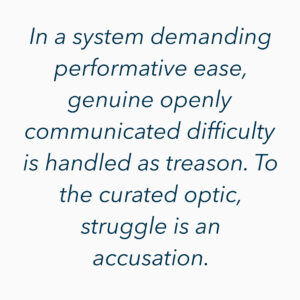
Text graphic quote: In a system demanding performative ease, genuine openly communicated difficulty is handled as treason. To the curated optic, struggle is an accusation.

Beneath the Paper Crown and the Carefully Arranged Face

The Binary The archetypes seem to move through life inside a rigid binary: winners and losers, heroes and villains, right and wrong. In their accounting for outcomes, there seems a lacking awareness for the possibility of their own poor decisions, regrettable reactions, or personal shortcomings.  Ironically, those are my favorite parts of any story. They are where humility lives and where connection is deepened.  To present as innocent, infallible, or heroic, someone else must always carry the shadow. When the archetype FAILs to achieve something, the explanation is rarely capability, circumstance, or choice. Instead, someone else must have been unfair, jealous, dishonest, or unjust. But the standard changes when hardship belongs to someone outside their circle of favor. Then the loss is framed as deserved.  Proof of poor character.  Evidence of defectiveness. Similar outcomes get narrated through two entirely different lenses, depending on who it happened to. The Meritocracy There seems a profound reliance on meritocracy as a reason for nearly every outcome. Success as proof of virtue.  Failure as proof that the game was rigged—at least when it happens to the archetype. And stories are shared with performative ease. Becuase struggle and dis-ease are marks of unworthiness and defect. Cue smiling emoji. A casual “lol.” “No worries.” “Perfect” The performance broadcast says, I’m completely unbothered. The pulsing tension whispers otherwise. Beneath the carefully arranged face seems a deep fear of losing status, admiration, or control. This must never happen. And there is an unspoken truth that if the archetype is worried, everyone else should be worried too. When your worth depends on always appearing victorious, peace becomes impossible. Protecting the delusion illusion is more important than connection or truth. In a system demanding performative ease, genuine and openly communicated difficulty is handled as treason. To the curated optic, struggle is an accusation. Whatever else may be true, this also happens.

Read More
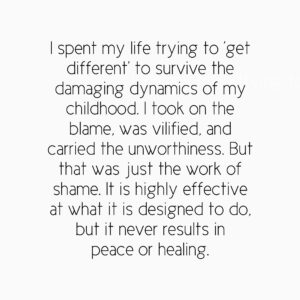
Unpacking the exhausting cycle of trying to "get different" to survive childhood dynamics, and why shame never produces the goodness we are looking for.⁠

The Cost of Challenging Toxic Systems

The Sovereignty Tax (My Refusal to Bleed) I am 57 years old, and I am only just now learning the practices of sovereignty and radical neutrality. Until recently, no one who has known me would have thought me even remotely sovereign or neutral- as I was NOT at all. And in a dedicated quest to actually live my life, to inhabit my own actual space, I have poked a few hornets’ nests. Different nests, but always an insidious sting. Me thinks me see a pattern. The Posture of Royalty Throughout my life—my family of origin, my marriage, historical friendships, and recently a neighbor—I have navigated people who try to assume a posture of royalty. For now, I will apply the term archetype to this personality. The archetype’s need for elevated status seems heavily reliant on a network of enablers propping them up—people who are either dependent, impressed, or intimidated by them in some way. I think there may be confsuion around those, as proxies for respect. With fragility of said crown, there is no such thing as safe, neutral ground(autonomy). If you aren’t actively prioritizing- propping them up (keeping them rightfully pleased), they perceive a traitor- actively trying to reduce or defy them. “You are either blindly for me or you are against me.” In each instance in which I have attempted to inhabit my space with an upright posture, I find myself squarely in the crosshairs of the archetype—and therefore, the crosshairs of the enablers. In psychology, there is a term “flying monkeys”. The Weaponized Concern Once inside the crosshairs, the campaign begins—wrapped in the soft language of concern. They don’t attack openly or directly check in. Instead, they whisper to friends, neighbors, managers, family, and peers: “Oh my gosh, I’m just worried about her. She seems so overwhelmed. She seems frantic. Confused.” It is a brilliant, insidious strategy to strip away validity and leave you vulnerable. By painting you as “frantic” or “struggling,” they accomplish three things at once: 1. They position themselves as THE “compassionate, stable” ones. 2. They pre-emptively compromise your credibility and validity. When you question the impact of their behavior, the script flips back to said problematic personality, perception, sensitivity, or struggles. The initiatives contributing negative impact are not acknowledged. In calling them out, you are accused of speaking problems into existence that don’t exist and creating drama. Abuse did not cause drama. Not quietly absorbing it did. 3. They set the trap. If you react, defend yourself, express discomfort, they get to sigh, throw up their hands, and say, “See? I told you she was unstable.” They get to confirm the very narrative they artfully spun and spread about you. When you dare to sit or stand upright to claim your own space and they can’t knock you down directly (because that would be questionable behavior), they set promptly to working to dissolve the ground beneath you. The Science of the Shark It is basic science that if you are bleeding in the water, you will attract sharks. That is just biology. I see the role I was cast in and have played with dedication. When you are born to sharks, you neeeeed the sharks! To be clear, I don’t make people behave sharkishly. I dont force or imagine them to behave as predators, and I didn’t knowingly choose to bleed out for a lifetime. It’s a dynamic, a well documented and studied pattern. Those who choose the comforting lie that “anything is possible if you just make the right choices” would love to hang this on me—to suggest that my bleeding was my own doing,earning, or imangining since clearly, I was “such a bloody mess.” But the truth is, a shark was always going to do the sharky things. For a long time, it seems my only clear option was to keep offering up the blood—to keep them close, because their attention—even when violent—felt safer than being entirely abandoned. Often, I attempted to mimic shark behavior that never fit my soul. Now, adopting the practices of radical neutrality has changed the water. The Unwelcome Healing When bleeding supply is curtailed, the sharks are disoriented. Because if I am not chumming the waters for them, how will they establish their mighty sharkiness? As if I must have forgotten how powerful and dangerous they are. “Don’t you know who you are dealing with?“ So, the system responds to my autonomy(my intentional choice to nurture and protect my most basic needs and limits) as an attack. The system functions smoothly as long as I agree to stay broken and matter less. The archetype—and enablers—respond with a highly specific theater of terror aimed at diminishing me, clawing at my peace- to prove they possess the power to make me flinch. I think there may be more favorable powers than this. I recall, with chilling clarity, my sister boasting about doing this thing to a woman at work. She literally glowed as she reported, “I know exactly how to make her cook her own goose,” simply because the woman carried herself in a way that made my sister feel non elevated and non- revered. The Third Way I am no authority on anyone else’s family or relationships. I am simply learning to recognize the cost of quietly claiming my right to peaceful ground. I have chosen to pay the heavy price of refusing to kiss the ring. Stepping away from my assigned script and choosing a third way—neither escalation nor collapse—has unsettled the system around me. There is a cost to no longer playing the role others expect you to play. It is a steep tax. But for the first time in my life, I am paying that price for my dignity instead of surrendering it to maintain unsafe contact and no connection. I am not proud of many things. But I feel deeply proud of my courage.

Read More
The Narcissist’s Prayer showing six statements that progress from denial and minimization to blame-shifting, beside an image of a cracked mask.

Gaslighting, Blame-Shifting, and the Absence of Repair

A person can know something experientially long before they can articulate it. They might know, for example, “After X is upset with me, I end up confused. I initiate communication thinking I had a legitimate concern, and somehow I leave apologizing and wondering whether I caused everything.” They don’t necessarily have words or concepts to process what happened. Once someone learns concepts like blame-shifting, triangulation, invalidation, stonewalling, double standards, DARVO, conditional approval, or refusal of repair, those concepts can provide handles for examining an interaction: Wait—was I actually heard? Did we each consider or examine our contributions? Was disagreement permitted? Did responsibility somehow become entirely mine? And importantly, language doesn’t have to supply the verdict. It can supply questions. That may be especially valuable for someone who’s been raised inside a particular relational system, because whatever happened repeatedly can simply register as this is how relationships work. Conflict is information, not a trial where somebody has to be found guilty. You can finish a disagreement still thinking, I was right about the original issue, and nevertheless learn: I interrupted you. I got defensive. I misunderstood what you meant. I didn’t realize that mattered so much to you. Or: I still disagree, but now I understand your reasoning. Or my most favorite of all: I think I understtand but I still do not agree. And the other person can do the same. Someone can be displeased with you without their displeasure becoming evidence that you’re bad. They can misunderstand you without their interpretation replacing your knowledge of yourself. And you can discover something uncomfortable about your own behavior without having to collapse into therefore I am the problem. In a healthy rupture, both people have something to metabolize. Not necessarily equal blame—sometimes one person really did behave badly—but both people still have an encounter to process. What happened? What did I do? What did you experience? What did I misunderstand? What does this change between us? What is needed for repair? In the archetypal dynamic, one person effectively exempts themselves from that process. Their internal work stops at: I was right to do or say X because of what you did. Everything downstream gets assigned to the other person. But the person on the receiving end doesn’t get to bypass metabolizing the rupture. They can end up metabolizing too much. They process the original conflict, the accusation, the other person’s certainty, the withdrawal, their own behavior, their memory, their motives, what they could have done differently, whether they’re actually the problem—and they do it without the other person’s participation. Then contact resumes without repair. All of that processing has nowhere relational to land. It can instead become adaptation: anxiety, self-doubt, vigilance, accommodation, rehearsing, overexplaining, trying harder, monitoring tone, becoming increasingly careful. The rupture isn’t unprocessed. The processing is asymmetrical. One person preserves their existing understanding of themselves. The other person is left reorganizing themselves around the unresolved rupture. Repair brings the information back into the relationship, where both people can examine it instead of one person having to carry and interpret the whole thing alone. One person is trying to understand what happened. The archetype is operating from the position that nothing happened that requires understanding. One person is asking, What happened between us? How did we get here? What needs to be repaired? And the answer—explicitly or through behavior—is essentially: There is nothing between us to repair. The problem is that you’re confused, anxious, sensitive, difficult, or unable to let things go. So the effect of the interaction gets reassigned as a characteristic of the recipient. The anxiety created by unresolved rupture becomes evidence that you’re “anxious.” The confusion created by contradictory interactions becomes evidence that you’re “confused.” Your attempts to get resolution become evidence that you “can’t let things go.” Your attempts to clarify what happened become evidence that you’re “overthinking.” The interaction disappears from the explanation. Then when ordinary contact resumes without acknowledgment, one person can experience that as moving on, while the other person is still carrying an unresolved event that supposedly never happened. There can be no repair when only one person is able to acknowledge that there was a rupture. You can say, “Something you did didn’t land well with me,” and get: Nothing happened. You’re misinterpreting me. You’re too sensitive. Or you can notice distance and say, “Something seems different between us. Did something happen?” and get: Nothing’s different. You’re imagining things. Why do you always do this? If you name an impact, you’re creating a problem. If you notice an impact, you’re creating a problem. If you ask about a rupture, you’re creating a problem. If you remain unsettled because there was no repair, that becomes the problem. The recipient isn’t just processing a conflict alone. They’re being asked to process a conflict whose existence has been denied. There isn’t even an agreed-upon event to work with. Something happened between us. I can observe the change. I’m experiencing the consequences. But I’m being told there is nothing here to discuss. Which may be why “nothing happened” is so consequential. It doesn’t merely refuse repair. It removes the shared reality from which repair would have been possible. Nothing happened. Nothing’s wrong. There is nothing to discuss. But then there’s silence. Distance. Withdrawal. Maybe coldness. You’re left alone with whatever the fuck just happened. That’s the contradiction. You’re experiencing the consequences of a rupture while being denied the existence of the rupture itself. Whatever else may be true, this is a defining structure within the archetypal dynamic.
Read More
Woman surrounded by flames with the words, “Don’t set yourself on fire to keep others warm.”

When Accountability Flows in Only One Direction

For more than 40 years, I didn’t really know how to exist inside a relationship unless I was the broken one, bowing in reliance to anyone gracious enough to let me hang around, no matter the quality of treatment. Could you stay with me? Could you help me? What have I done to be so lucky to have someone strong and knowing and right like you? Barf. Fangirl, fawning, degrading shit. I knew how to engage only that way. What I’m learning now is something different. I don’t want to have to be broken to belong. I am going off script. This is wildly unpopular with the patterned archetypes I have gone barreling toward at every opportunity. I no longer agree to that—to matter less so that a relationship may continue. I cannot abandon what I know and adopt someone else’s perspective in place of my lived experience. That is me gaslighting myself. I cannot accept someone else’s explanation of my motives when it isn’t mine. I can be wrong. I can fuck up. I can apologize. I can change. But I have to remain a whole person while I do it. And the relationships that have cost me the most have not been the ones where people hurt me or got things wrong. They have been the ones where somehow there was always something for me to examine, own, apologize for or change, and nothing on the other side of the relationship was ever available for the same examination. I welcome the responsibility to own my part. I cannot own yours too. My hunger for connection has kept me engaged in things long after I knew they weren’t feeding me. Hunger will do that. But if my body is asking for fiber and what’s being offered is refined sugar, eating it because I’m hungry doesn’t nourish me. It’s not nothing. But it’s not neutral either. I won’t keep feeding myself the opposite of what I’m hungry for and then wonder why I feel poisoned. And feel shame for my resulting condition. So yes. Some relationships may cost too much to keep. Not because they don’t matter to me. Because I finally matter too. Have you ever been tangled up with someone like this? Someone where every attempt to address a conflict somehow ends with you being the only person under examination? They didn’t misunderstand. They didn’t contribute. They didn’t hurt you. They didn’t get anything wrong. You did. Every fucking time….Whatever else may be true, this also happened.

Read More
Illustration of two one woman sharing details of someone else's private struggle. And being praised for kind thoughtfulness. The woman they are discussing sits nearby, unaware.

The Irony of Weaponized Concern

The Reality of Gossip Discussing the details of someone else’s life—their hardships, their choices, or how they live—is a fundamentally unwholesome practice. Gossip happens, and we can be honest about that and not pretend that engaging in it is useful, considerate, or kind.  The “Concerned” Persona So it is fascinating to witness someone who is known for not being particularly fond of a person take an openly concerned stance in sharing the depth of their worry for that person’s wellness, stability, and functionality. The energy attempt:  “I’m only saying this because I care…” Engineered Destabilization It is a stunning social loophole. Cloaking gossip with empathy, is an attempt to engineer a kind of social undermining while seeking praise for thoughtfulness. If I knew how to do emojis from my Mac- Barfing emoji for sure right fkn here. The Blind Spot What is confusing, is how easily bystanders buy the act. How does a person or group look at someone with an obvious grudge or bias, listen to them trade in the unfavorable assessment of another person’s private life, and see a caring soul instead of an invasive, scheming act? Skull and Crossbones emoji here. The Performance vs. Real Consideration Genuine care and consideration tend to be quiet and direct and require no recognition. They check in and ask what they can do to help. They honor respect and privacy with discernement and intention. When the “concern” is instead passed around from person to person, it isn’t support—it’s unwholesome gossip disguised as  goodness. It makes you ask “how does a sound person buy into the performance?” Insert Comedy Tragedy mask emoji here. Whatever else may be true, this also happened.

Read More
Text graphic quote: In a system demanding performative ease, genuine openly communicated difficulty is handled as treason. To the curated optic, struggle is an accusation.

Beneath the Paper Crown and the Carefully Arranged Face

The Binary The archetypes seem to move through life inside a rigid binary: winners and losers, heroes and villains, right and wrong. In their accounting for outcomes, there seems a lacking awareness for the possibility of their own poor decisions, regrettable reactions, or personal shortcomings.  Ironically, those are my favorite parts of any story. They are where humility lives and where connection is deepened.  To present as innocent, infallible, or heroic, someone else must always carry the shadow. When the archetype FAILs to achieve something, the explanation is rarely capability, circumstance, or choice. Instead, someone else must have been unfair, jealous, dishonest, or unjust. But the standard changes when hardship belongs to someone outside their circle of favor. Then the loss is framed as deserved.  Proof of poor character.  Evidence of defectiveness. Similar outcomes get narrated through two entirely different lenses, depending on who it happened to. The Meritocracy There seems a profound reliance on meritocracy as a reason for nearly every outcome. Success as proof of virtue.  Failure as proof that the game was rigged—at least when it happens to the archetype. And stories are shared with performative ease. Becuase struggle and dis-ease are marks of unworthiness and defect. Cue smiling emoji. A casual “lol.” “No worries.” “Perfect” The performance broadcast says, I’m completely unbothered. The pulsing tension whispers otherwise. Beneath the carefully arranged face seems a deep fear of losing status, admiration, or control. This must never happen. And there is an unspoken truth that if the archetype is worried, everyone else should be worried too. When your worth depends on always appearing victorious, peace becomes impossible. Protecting the delusion illusion is more important than connection or truth. In a system demanding performative ease, genuine and openly communicated difficulty is handled as treason. To the curated optic, struggle is an accusation. Whatever else may be true, this also happens.

Read More
Unpacking the exhausting cycle of trying to "get different" to survive childhood dynamics, and why shame never produces the goodness we are looking for.⁠

The Cost of Challenging Toxic Systems

The Sovereignty Tax (My Refusal to Bleed) I am 57 years old, and I am only just now learning the practices of sovereignty and radical neutrality. Until recently, no one who has known me would have thought me even remotely sovereign or neutral- as I was NOT at all. And in a dedicated quest to actually live my life, to inhabit my own actual space, I have poked a few hornets’ nests. Different nests, but always an insidious sting. Me thinks me see a pattern. The Posture of Royalty Throughout my life—my family of origin, my marriage, historical friendships, and recently a neighbor—I have navigated people who try to assume a posture of royalty. For now, I will apply the term archetype to this personality. The archetype’s need for elevated status seems heavily reliant on a network of enablers propping them up—people who are either dependent, impressed, or intimidated by them in some way. I think there may be confsuion around those, as proxies for respect. With fragility of said crown, there is no such thing as safe, neutral ground(autonomy). If you aren’t actively prioritizing- propping them up (keeping them rightfully pleased), they perceive a traitor- actively trying to reduce or defy them. “You are either blindly for me or you are against me.” In each instance in which I have attempted to inhabit my space with an upright posture, I find myself squarely in the crosshairs of the archetype—and therefore, the crosshairs of the enablers. In psychology, there is a term “flying monkeys”. The Weaponized Concern Once inside the crosshairs, the campaign begins—wrapped in the soft language of concern. They don’t attack openly or directly check in. Instead, they whisper to friends, neighbors, managers, family, and peers: “Oh my gosh, I’m just worried about her. She seems so overwhelmed. She seems frantic. Confused.” It is a brilliant, insidious strategy to strip away validity and leave you vulnerable. By painting you as “frantic” or “struggling,” they accomplish three things at once: 1. They position themselves as THE “compassionate, stable” ones. 2. They pre-emptively compromise your credibility and validity. When you question the impact of their behavior, the script flips back to said problematic personality, perception, sensitivity, or struggles. The initiatives contributing negative impact are not acknowledged. In calling them out, you are accused of speaking problems into existence that don’t exist and creating drama. Abuse did not cause drama. Not quietly absorbing it did. 3. They set the trap. If you react, defend yourself, express discomfort, they get to sigh, throw up their hands, and say, “See? I told you she was unstable.” They get to confirm the very narrative they artfully spun and spread about you. When you dare to sit or stand upright to claim your own space and they can’t knock you down directly (because that would be questionable behavior), they set promptly to working to dissolve the ground beneath you. The Science of the Shark It is basic science that if you are bleeding in the water, you will attract sharks. That is just biology. I see the role I was cast in and have played with dedication. When you are born to sharks, you neeeeed the sharks! To be clear, I don’t make people behave sharkishly. I dont force or imagine them to behave as predators, and I didn’t knowingly choose to bleed out for a lifetime. It’s a dynamic, a well documented and studied pattern. Those who choose the comforting lie that “anything is possible if you just make the right choices” would love to hang this on me—to suggest that my bleeding was my own doing,earning, or imangining since clearly, I was “such a bloody mess.” But the truth is, a shark was always going to do the sharky things. For a long time, it seems my only clear option was to keep offering up the blood—to keep them close, because their attention—even when violent—felt safer than being entirely abandoned. Often, I attempted to mimic shark behavior that never fit my soul. Now, adopting the practices of radical neutrality has changed the water. The Unwelcome Healing When bleeding supply is curtailed, the sharks are disoriented. Because if I am not chumming the waters for them, how will they establish their mighty sharkiness? As if I must have forgotten how powerful and dangerous they are. “Don’t you know who you are dealing with?“ So, the system responds to my autonomy(my intentional choice to nurture and protect my most basic needs and limits) as an attack. The system functions smoothly as long as I agree to stay broken and matter less. The archetype—and enablers—respond with a highly specific theater of terror aimed at diminishing me, clawing at my peace- to prove they possess the power to make me flinch. I think there may be more favorable powers than this. I recall, with chilling clarity, my sister boasting about doing this thing to a woman at work. She literally glowed as she reported, “I know exactly how to make her cook her own goose,” simply because the woman carried herself in a way that made my sister feel non elevated and non- revered. The Third Way I am no authority on anyone else’s family or relationships. I am simply learning to recognize the cost of quietly claiming my right to peaceful ground. I have chosen to pay the heavy price of refusing to kiss the ring. Stepping away from my assigned script and choosing a third way—neither escalation nor collapse—has unsettled the system around me. There is a cost to no longer playing the role others expect you to play. It is a steep tax. But for the first time in my life, I am paying that price for my dignity instead of surrendering it to maintain unsafe contact and no connection. I am not proud of many things. But I feel deeply proud of my courage.

Read More