
Wholesome Badass

A Work in Progress — Healing from All the Things​

Toxic and Nurturing Relationship Data

For most of my life, I didn’t even recognize healthy and unhealthy connection as distinct possibilities. Like a fish unaware of the water it’s swimming in, I understood relationships through the only environment I’d ever known. I had learned distorted definitions of love, safety, trust, and connection. What if the most important measure of love isn’t how much someone loves a person, but what happens in the experience of being loved by them? Family ties, intensity, chemistry, and intermittently good experiences aren’t evidence of a healthy relationship. I’m recognizing how toxicity can exist in the way a relationship functions—the architecture of the bond—not simply in either person. Someone may have an entirely different experience with a person than I did, particularly when admiration, usefulness, or reliance shapes how that person relates to them. When someone says, “I’ve never experienced them that way,” I recognize that may be true. What’s hurtful and inappropriate, is when their experience is intended to invalidate mine. Their experience doesn’t disprove mine, any more than mine disproves theirs. I’m describing the relationship I experienced, not issuing a verdict on every relationship that person has. I’m going to place my trust in the prevailing patterns over the peak moments and occasional exceptions. ♡ Feelings I Associate with Nourishing Love ♡ ☠ Feelings I Associate with Harmful Relationship Dynamics ☠ Healing ♡ Alienation-Division Soothing ♡ Diminished-Disregarded Safety ♡ Confused Growth ♡ Silenced Exploration ♡ Frightened Self-expression ♡ Power-imbalance Expansion ♡ Contracted Yes, I am the common denominator in all my relationships—as are we all. So is the relational template I carried into them. It influenced not only the relationships I entered, but what I helped create and sustain within them. That template shaped: I recognize my contribution to my relational patterns without taking ANY esponsibility for another person’s behavior.
Read More
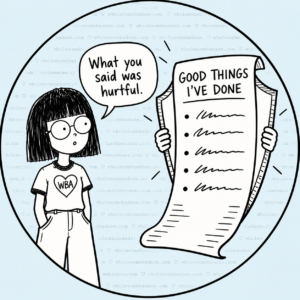
Black-and-white illustration of a girl saying, “What you said was hurtful,” facing a large shield covered by a receipt titled “Good Things I've Done.”

After All I’ve Done for You.

May I Remind You? Different people. Different circumstances. Continued familiar patterns. A few months ago, I said to my neighbor, “Hey, when you said X, it hurt my feelings.” Her response? “May I remind you…” followed by a list of ways she’d been helpful to me. I still don’t know why her response stunned me. It was entirely consistent with a familiar archetype: the person who expects things to automatically go their way and has no tolerance for frustration, disappointment, or anything that challenges their preferred version of themselves. And 100% of the time, with this archetype, my direct expression of hurt is received not as information about my experience or how our connection has been affected, but as an accusation to defend against or a claim to debate. I never responded. Interesting, though. We’d each been generous and helpful to one another. But I’d never considered my generosity protection against accountability. I’ve read about rejection sensitivity and narcissistic traits, particularly the need to be right, entitlement to having things their way, and the insistence on a narrative in which they can only be the hero or the victim. I’m increasingly interested in recognizing and understanding the patterns rather than proving anything about specific people. Since when does being helpful mean you can’t also have been hurtful? Both can be true. And similarly—Have you ever known someone who would only say “No” to a request along side listing all of the things they’d done for others or everything they “had” to do? Or who offered a reluctant yes or vague maybe when they already knew the answer was no?But with no thoguthful pause to genuinely ask, “Can we figure out a time that works for both of us?”Also, I do not discount that going to the gym and getting your hair done are legitimate needs. I find the long narrative that presents them as both the heroically generous and the overburdened victim to be unwholesome.

Read More

Toxic and Nurturing Relationship Data

For most of my life, I didn’t even recognize healthy and unhealthy connection as distinct possibilities. Like a fish unaware of the water it’s swimming in, I understood relationships through the only environment I’d ever known. I had learned distorted definitions of love, safety, trust, and connection. What if the most important measure of love isn’t how much someone loves a person, but what happens in the experience of being loved by them? Family ties, intensity, chemistry, and intermittently good experiences aren’t evidence of a healthy relationship. I’m recognizing how toxicity can exist in the way a relationship functions—the architecture of the bond—not simply in either person. Someone may have an entirely different experience with a person than I did, particularly when admiration, usefulness, or reliance shapes how that person relates to them. When someone says, “I’ve never experienced them that way,” I recognize that may be true. What’s hurtful and inappropriate, is when their experience is intended to invalidate mine. Their experience doesn’t disprove mine, any more than mine disproves theirs. I’m describing the relationship I experienced, not issuing a verdict on every relationship that person has. I’m going to place my trust in the prevailing patterns over the peak moments and occasional exceptions. ♡ Feelings I Associate with Nourishing Love ♡ ☠ Feelings I Associate with Harmful Relationship Dynamics ☠ Healing ♡ Alienation-Division Soothing ♡ Diminished-Disregarded Safety ♡ Confused Growth ♡ Silenced Exploration ♡ Frightened Self-expression ♡ Power-imbalance Expansion ♡ Contracted Yes, I am the common denominator in all my relationships—as are we all. So is the relational template I carried into them. It influenced not only the relationships I entered, but what I helped create and sustain within them. That template shaped: I recognize my contribution to my relational patterns without taking ANY esponsibility for another person’s behavior.

Read More
Black-and-white illustration of a girl saying, “What you said was hurtful,” facing a large shield covered by a receipt titled “Good Things I've Done.”

After All I’ve Done for You.

May I Remind You? Different people. Different circumstances. Continued familiar patterns. A few months ago, I said to my neighbor, “Hey, when you said X, it hurt my feelings.” Her response? “May I remind you…” followed by a list of ways she’d been helpful to me. I still don’t know why her response stunned me. It was entirely consistent with a familiar archetype: the person who expects things to automatically go their way and has no tolerance for frustration, disappointment, or anything that challenges their preferred version of themselves. And 100% of the time, with this archetype, my direct expression of hurt is received not as information about my experience or how our connection has been affected, but as an accusation to defend against or a claim to debate. I never responded. Interesting, though. We’d each been generous and helpful to one another. But I’d never considered my generosity protection against accountability. I’ve read about rejection sensitivity and narcissistic traits, particularly the need to be right, entitlement to having things their way, and the insistence on a narrative in which they can only be the hero or the victim. I’m increasingly interested in recognizing and understanding the patterns rather than proving anything about specific people. Since when does being helpful mean you can’t also have been hurtful? Both can be true. And similarly—Have you ever known someone who would only say “No” to a request along side listing all of the things they’d done for others or everything they “had” to do? Or who offered a reluctant yes or vague maybe when they already knew the answer was no?But with no thoguthful pause to genuinely ask, “Can we figure out a time that works for both of us?”Also, I do not discount that going to the gym and getting your hair done are legitimate needs. I find the long narrative that presents them as both the heroically generous and the overburdened victim to be unwholesome.

Read More