Wholesome Badass

A Work in Progress — Healing from All the Things​

In Charge of Rejection

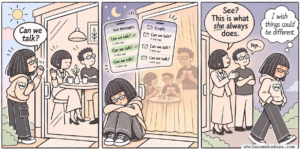
The love I knew was conditional, unpredictable, and readily withheld. I had no template for love that was safe, steady, and kind. I continued to reenact that relational trauma in nearly every relationship. While I am the common variable, so are my template for connection and the personality type it consistently draws me to. For much of my life, I engaged in relationships that diminished me. I tried, with limited understanding and skill, to redeem them. Which seemed impossible, particularly once I stopped agreeing to matter less. I’d try emphatically to understand what was happening between us so we could really connect, navigate our differences, and engage on mutual terms and in good faith. Instead, I was met with defensiveness, denial, and accusations of manufacturing chaos. Eventually, stonewalling. I was seeking connection with people whose behavior, I now see, as prioritizing deference. I didn’t recognize that we weren’t seeking the same thing, or that my attempts to communicate and establish mutuality might be received as defiance. Apparently, I was challenging the terms of a power dynamic I hadn’t even recognized. And when I finally stopped trying, that was unacceptable, too. With profound grief, I have had to acknowledge that the bond is too harmful to continue. The choice to stop chasing connection and approval has been ill-received. And cited only as further evidence of my troublesome, ungrateful, poor character and as the sole cause of our issues. “See? This is what you always do.” “Well, I guess that’s how much it meant to you.” “I thought you said you wanted to work things out.” “And you wonder why things are the way they are.” But isn’t it kind of like a doctor calling the time of death or delivering a diagnosis? The doctor doesn’t speak the death or disease into existence. He simply records it and moves forward accordingly. I’m not claiming to be a doctor. Obviously. I’m just saying, I’m finally able to trust my own experience and recognize the larger pattern without allowing someone else’s explanations, justifications, or occasional good moments to override it. And I can make my decisions based on that pattern rather than its exceptions.

Read More
Wholesome Badass girl draws a new relational blueprint based on nurturing, honest communication, accountability, and trust, while discarding an old blueprint of scapegoating, manipulation, and emotional neglect.

The Caller Was Inside the House

The people I relied on for protection were the same people I needed protection from. They were also the ones teaching lil baby Magda about herself, relationships, and the world. And so she gravitated toward relational patterns imprinted on her lil nervous system long before she could recognize or question them. Always reaching for the emotionally inaccessible archetype… She loved these people and wanted their approval, affection, and inclusion. They were her models for love, conflict, emotional regulation, and accountability. She mimicked some of their harmful behaviors, too. For how could she reject a model she hadn’t yet learned to recognize? I can share how Lil Baby Magda was harmed without asserting I, Big Magda, never caused harm. I own my unwholesome and misguided contributions without accepting responsibility for how others behaved. My first blueprint of the world was emotional instability, chaotic relationships, and illegible, amorphous rules and codes. My internal blueprint developed in response: my lens for perception, beliefs, vigilance, expectations, sense of worth, and capacity to care for myself, regulate my emotions and live with intention and dignity. Life might have been confusing even in a nurturing, steady family system. I might always have required more clarity, consistency, patience, and support. I lost decades tangled up in what the fuck had just happened and why, while forecasting what else would go wrong. What did I do? What did they mean? What did I miss? How do I keep it from happening again? Even when nothing was happening, I was still agonizing over things said and done years earlier. All that attention and energy spent trying to understand and prevent harm left no bandwidth to experience my own life. How much of what I’ve believed about my personality, character, worthiness, and lovability came from the people who taught me how to be a person? What might I have achieved if I hadn’t spent my life trying to figure out what was wrong with me? The messaging was consistent, collective, and insidious: Get different or be erased. If I was the designated problem and couldn’t correct myself, what was left? I couldn’t get different. I couldn’t get gone. I failed at both. And now I’m beginning to see a third way. Finally, I am getting different—not by correcting myself to fit the original blueprint, but by rejecting it.

Read More
Cartoon-style black-and-white drawing on a soft green background of a girl feeding papers labeled trauma, confusion, misinformation, doubt, and shame into a machine labeled “Processing Through Writing.” Papers coming out say agency, discernment, and intention. Her bag has a small WBA heart logo, and the image is watermarked with wholesomebadass.com.

The Shit Before the Shift

No Dimmer Switch I feel everything the most amount—the good and the unpleasant—constantly. Everything in high definition. I am a deep feeler, or as the archetype likes to say: thin-skinned, overly sensitive. Not a crime. Not a defect. But not an easy way to be in the world. From my tiniest days, I recall feeling inconsolably rattled, navigating my tightly wound nervous system and sensitive disposition with no guidance, knowledge, language, or skill set for any of it. I cannot recall another version of myself underneath it all – who ever felt secure, grounded, safe, and not overwhelmed. That has been my baseline. It is not a great point of departure. Billed to Me I was raised to believe that other people’s harsh behavior spoke directly to the quality of my person, my character, and my worth. Which was terribly confusing, because I was also often scolded for asking if a person was upset with me, “Not everything is about you.” And yet other people’s unfavorable moods and behaviors were consistently billed to me or altogether denied. So… difficult moods and feelings—mine and theirs—were my responsibility. And no clue how to manage that. Painfully aware: I was constantly and undeniably failing. While nobody taught or encouraged me to know, soothe, value, or care for myself, I was expected to read, anticipate, prevent, and manage other people’s difficult feelings. So many times, blood relatives would demand in a menacing tone, “What are you so angry about?” But it was not a genuine inquiry. It was a callout: look at you, with that massive chink in your armor. Feel ashamed and pipe down or else. There is real sadness in looking back and realizing how much unmanaged, daily compounded stress was attributed exclusively to my “poor character.” I spent more than forty years trying to do the impossible thing of getting different and becoming someone else. My only ambition. What a tragic fucken waste. Stripped of any potential to self-actualize. The Familiar And having been been handled like a piece of literal shit—a poopy diaper—I did not instinctively seek nourishing and affirming relationships. I had learned that love looked like people who genuinely were not FOR me—unless and only when I was useful to them. This explains so much. At many levels, I believe the only thing I shared in common with my family of origin was that we all held me in the lowest regard. That is hard to reconcile. And tragically, my only direction was toward the familiar. Ooof. Decades of trying to feel better, by any means possible, without really knowing what I was trying to feel better from. From being a shiftless piece of shit?? There is literally no relief from that. I mistook random positive intermittent reinforcement for kindness and brought that out into the world with me as the love I sought. And sometimes the love I gave. I hate that. Better Information I am proud to have interrupted that cycle, that I did not hand that poison directly to my sons. No matter what is said about me, it cannot be denied that I rode faithfully for my children. Without exception. Maybe not perfectly or without pain to them, but with fierce loyalty and constant sacrifice. In learning about trauma and nervous systems. Neglect. Generational abuse. Coercive abuse. Scapegoating. Triangulation. Attachment, fear, compulsion. I recognize how I confused what was recognizable with what was safe and acceptable. For and from myself. Agency With better information now, I get to experience something that for so long eluded me: agency—where I carefully consider who, what, how, and when to engage, and whether engagement is even required or prudent. Writing helps me recognize and organize all of the me’s inside of me—with no intent to prosecute my past or acquit any of my me’s. I work tirelessly to untangle my myths and misconceptions about myself, love, connection, and kindness. It is a true miracle to have grown into the loving, honest, dependable, funny, compassionate, and loyal woman I am. And this is also true: I have not always known how to move in these ways—or how to move with people who equally value them. First the unlearning. The shit before the shift, I guess. What were you led to believe about yourself because of the way someone else treated you? And do you still belive it?

Read More
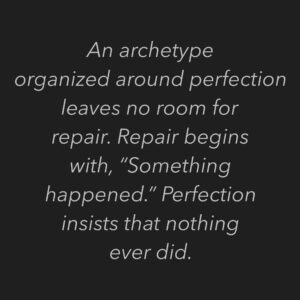
Black-and-white typography graphic with a quote about how relationships require acknowledgment of ruptures in order to repair, and how perfectionism can prevent emotional repair and trust.

When Relationships Stop Evolving

I’ve spent a lot of time thinking about the c-word….”conflict ” and also–avoidance and repair. The archetype, to whom I have gravitated to like a moth to a flame, seems to have little room for either. Being non-pleased feels unacceptable. Causing displeasure feels unacceptable. Being imperfect feels unacceptable. So concerns don’t get raised directly. They leak out sideways through passive aggression, distance, stonewalling, or the preTENSE that everything is fine. The script for that: All good. Everything is fine. No worries. Of course. Perfect. No problem. Good vibes only. smile emoji lol And if someone does directly bring up a concern, the conversation can quickly shift to intentions, perceptions, or disproving any negative impact in the first place. I’ve lived inside enough of those relationships to recognize a clear pattern. One conversation with Sweet Greg from years ago–went differently. I brought up something that would have been disruptive to just about anyone. And he began his reply by explaining his intentions and my perceptions. I finally said, “If the only version of this conversation is the one where everything supports that you had no negative impact, our season has ended. Not because that issue was dramatic or catastrophic but because that manner of communication after conflict is one I’m too familiar with.” That changed the conversation. We stopped trying to establish innocence. We started talking about the impact, which is unmitagted by intention. Neither of us had to be the bad guy. Neither of us had to abandon our dignity. After that, we spent the next six years intentionally getting better at repair. Not because we had constant conflict. Because neither of us had to wonder. If something landed wrong, we said it. If one of us missed the mark, we talked about it. If an apology was needed, it wasn’t treated like a character indictment. Those moments were not dramatic. Most of them were like paper cuts, as far as gravity. But a thousand paper cuts can finally erupt by with irreperable injury. Left alone, “paper cuts” have a way of becoming stories that the cutty tells themselves about how little they matter. Addressed early, they become moments of understanding. Maybe that’s what repair has felt like to me. Not the absence of conflict. The absence of guessing and ruminating. The freedom to ask, “Did something happen?” without fearing the question itself. The freedom to hear, “That landed differently than you intended,” without feeling like either person has to lose. It became natural to laugh at ourselves, own our blind spots, and keep moving toward each other instead of away from each other. That kind of repair didn’t make either of us perfect. It made us close. I’ve only experienced that kind of relationship a handful of times. I think I understand something now that I didn’t then. For me, relationships no longer end because of conflict or a fight. For me, the season has concluded when evolving and expanding have stopped. When there’s not room to speak truth, make an adjustment, extend grace, laugh at ourselves, or discover a better way of loving each other. Or maybe the season just ends, but not because of a fight. And nobody is left to wonder, what did I do or what is going on? Whatever else may be true, this is my experience.

Read More
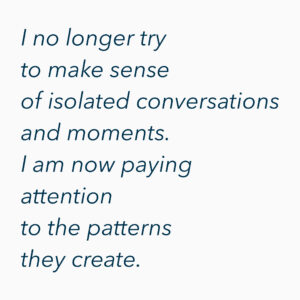
A minimalist quote graphic that reads, "I no longer try to make sense of isolated conversations or moments. I pay attention to the patterns they create." The image reflects themes of self-trust, relationship patterns, emotional healing, and personal growth.

If There Had Been a Fly on the Wall

Memory Memory can be unreliable. Interpretation certainly is. Two people can experience the same interaction and leave with very different narratives about what happened. What feels more meaningful to me now is paying attention to patterns that could have been observed by someone with no emotional investment. A quiet witness. A fly on the wall. Not someone deciding who was right. Just someone noticing what happened. Here are some of the things I believe that fly on the wall would have witnessed. -concerns met with defensive explanations more often than curiosity -hurt followed by rebuttal instead of repair -long conversations devoted to why my experience was inaccurate, exaggerated, unfair, or incomplete, while the original concern quietly disappeared -accountability flow much more comfortably in one direction than the other -apologies followed by explanations that softened or erased accountability -requests for change become deep dives into my shortcomings -a basic conflict become a courtroom instead of a collaboration They would have seen me trying harder. Communicating more carefully. Choosing my words more precisely. Waiting for better timing. Trying different approaches. Apologizing for trying so hard. Hoping that one more adjustment on my part would finally create the relationship I longed for and believed possible. They would have seen moments of warmth. Humor. Affection. Thoughtfulness. Hope. Those moments were real. They were also unpredictable. And they were enough to keep me believing things could be different. But they would have also seen those moments disappear without much explanation, leaving me searching for what had changed and what I needed to do differently to bring them back. They would have seen important conversations postponed until they quietly disappeared. Promises made in emotional moments but rarely translated into lasting change. They would have seen responsibilities become negotiable when they belonged to him and urgent when they belonged to me. They would have seen me begin monitoring his mood before bringing up difficult subjects. Editing my feelings before sharing them. Trying to predict which version of him I would be speaking to that day. Eventually, the fly on the wall would have noticed something else. The conversations were not reflective of two people trying to solve a problem together. But conversations about whether I had the right to have the problem in the first place. Over time, that changed me. I began wondering whether my expectations were too high. Whether my memory was inaccurate. Whether my nervous system was defective. Whether my needs were simply too much. Looking back, I no longer think any single interaction tells the story. The story is the repetition. Not because repetition proves someone’s intentions. It doesn’t. But repetition reveals the emotional climate a relationship creates. I don’t know why another person behaved the way they did. I no longer spend much time trying to answer that question. The question that matters to me now is much simpler. Who was I becoming and what was I agreeing to while I was trying so hard to make sense of it? Whatever else may be true, this is my experience.

Read More

In Charge of Rejection

The love I knew was conditional, unpredictable, and readily withheld. I had no template for love that was safe, steady, and kind. I continued to reenact that relational trauma in nearly every relationship. While I am the common variable, so are my template for connection and the personality type it consistently draws me to. For much of my life, I engaged in relationships that diminished me. I tried, with limited understanding and skill, to redeem them. Which seemed impossible, particularly once I stopped agreeing to matter less. I’d try emphatically to understand what was happening between us so we could really connect, navigate our differences, and engage on mutual terms and in good faith. Instead, I was met with defensiveness, denial, and accusations of manufacturing chaos. Eventually, stonewalling. I was seeking connection with people whose behavior, I now see, as prioritizing deference. I didn’t recognize that we weren’t seeking the same thing, or that my attempts to communicate and establish mutuality might be received as defiance. Apparently, I was challenging the terms of a power dynamic I hadn’t even recognized. And when I finally stopped trying, that was unacceptable, too. With profound grief, I have had to acknowledge that the bond is too harmful to continue. The choice to stop chasing connection and approval has been ill-received. And cited only as further evidence of my troublesome, ungrateful, poor character and as the sole cause of our issues. “See? This is what you always do.” “Well, I guess that’s how much it meant to you.” “I thought you said you wanted to work things out.” “And you wonder why things are the way they are.” But isn’t it kind of like a doctor calling the time of death or delivering a diagnosis? The doctor doesn’t speak the death or disease into existence. He simply records it and moves forward accordingly. I’m not claiming to be a doctor. Obviously. I’m just saying, I’m finally able to trust my own experience and recognize the larger pattern without allowing someone else’s explanations, justifications, or occasional good moments to override it. And I can make my decisions based on that pattern rather than its exceptions.
Read More
Wholesome Badass girl draws a new relational blueprint based on nurturing, honest communication, accountability, and trust, while discarding an old blueprint of scapegoating, manipulation, and emotional neglect.

The Caller Was Inside the House

The people I relied on for protection were the same people I needed protection from. They were also the ones teaching lil baby Magda about herself, relationships, and the world. And so she gravitated toward relational patterns imprinted on her lil nervous system long before she could recognize or question them. Always reaching for the emotionally inaccessible archetype… She loved these people and wanted their approval, affection, and inclusion. They were her models for love, conflict, emotional regulation, and accountability. She mimicked some of their harmful behaviors, too. For how could she reject a model she hadn’t yet learned to recognize? I can share how Lil Baby Magda was harmed without asserting I, Big Magda, never caused harm. I own my unwholesome and misguided contributions without accepting responsibility for how others behaved. My first blueprint of the world was emotional instability, chaotic relationships, and illegible, amorphous rules and codes. My internal blueprint developed in response: my lens for perception, beliefs, vigilance, expectations, sense of worth, and capacity to care for myself, regulate my emotions and live with intention and dignity. Life might have been confusing even in a nurturing, steady family system. I might always have required more clarity, consistency, patience, and support. I lost decades tangled up in what the fuck had just happened and why, while forecasting what else would go wrong. What did I do? What did they mean? What did I miss? How do I keep it from happening again? Even when nothing was happening, I was still agonizing over things said and done years earlier. All that attention and energy spent trying to understand and prevent harm left no bandwidth to experience my own life. How much of what I’ve believed about my personality, character, worthiness, and lovability came from the people who taught me how to be a person? What might I have achieved if I hadn’t spent my life trying to figure out what was wrong with me? The messaging was consistent, collective, and insidious: Get different or be erased. If I was the designated problem and couldn’t correct myself, what was left? I couldn’t get different. I couldn’t get gone. I failed at both. And now I’m beginning to see a third way. Finally, I am getting different—not by correcting myself to fit the original blueprint, but by rejecting it.

Read More
Cartoon-style black-and-white drawing on a soft green background of a girl feeding papers labeled trauma, confusion, misinformation, doubt, and shame into a machine labeled “Processing Through Writing.” Papers coming out say agency, discernment, and intention. Her bag has a small WBA heart logo, and the image is watermarked with wholesomebadass.com.

The Shit Before the Shift

No Dimmer Switch I feel everything the most amount—the good and the unpleasant—constantly. Everything in high definition. I am a deep feeler, or as the archetype likes to say: thin-skinned, overly sensitive. Not a crime. Not a defect. But not an easy way to be in the world. From my tiniest days, I recall feeling inconsolably rattled, navigating my tightly wound nervous system and sensitive disposition with no guidance, knowledge, language, or skill set for any of it. I cannot recall another version of myself underneath it all – who ever felt secure, grounded, safe, and not overwhelmed. That has been my baseline. It is not a great point of departure. Billed to Me I was raised to believe that other people’s harsh behavior spoke directly to the quality of my person, my character, and my worth. Which was terribly confusing, because I was also often scolded for asking if a person was upset with me, “Not everything is about you.” And yet other people’s unfavorable moods and behaviors were consistently billed to me or altogether denied. So… difficult moods and feelings—mine and theirs—were my responsibility. And no clue how to manage that. Painfully aware: I was constantly and undeniably failing. While nobody taught or encouraged me to know, soothe, value, or care for myself, I was expected to read, anticipate, prevent, and manage other people’s difficult feelings. So many times, blood relatives would demand in a menacing tone, “What are you so angry about?” But it was not a genuine inquiry. It was a callout: look at you, with that massive chink in your armor. Feel ashamed and pipe down or else. There is real sadness in looking back and realizing how much unmanaged, daily compounded stress was attributed exclusively to my “poor character.” I spent more than forty years trying to do the impossible thing of getting different and becoming someone else. My only ambition. What a tragic fucken waste. Stripped of any potential to self-actualize. The Familiar And having been been handled like a piece of literal shit—a poopy diaper—I did not instinctively seek nourishing and affirming relationships. I had learned that love looked like people who genuinely were not FOR me—unless and only when I was useful to them. This explains so much. At many levels, I believe the only thing I shared in common with my family of origin was that we all held me in the lowest regard. That is hard to reconcile. And tragically, my only direction was toward the familiar. Ooof. Decades of trying to feel better, by any means possible, without really knowing what I was trying to feel better from. From being a shiftless piece of shit?? There is literally no relief from that. I mistook random positive intermittent reinforcement for kindness and brought that out into the world with me as the love I sought. And sometimes the love I gave. I hate that. Better Information I am proud to have interrupted that cycle, that I did not hand that poison directly to my sons. No matter what is said about me, it cannot be denied that I rode faithfully for my children. Without exception. Maybe not perfectly or without pain to them, but with fierce loyalty and constant sacrifice. In learning about trauma and nervous systems. Neglect. Generational abuse. Coercive abuse. Scapegoating. Triangulation. Attachment, fear, compulsion. I recognize how I confused what was recognizable with what was safe and acceptable. For and from myself. Agency With better information now, I get to experience something that for so long eluded me: agency—where I carefully consider who, what, how, and when to engage, and whether engagement is even required or prudent. Writing helps me recognize and organize all of the me’s inside of me—with no intent to prosecute my past or acquit any of my me’s. I work tirelessly to untangle my myths and misconceptions about myself, love, connection, and kindness. It is a true miracle to have grown into the loving, honest, dependable, funny, compassionate, and loyal woman I am. And this is also true: I have not always known how to move in these ways—or how to move with people who equally value them. First the unlearning. The shit before the shift, I guess. What were you led to believe about yourself because of the way someone else treated you? And do you still belive it?

Read More
Black-and-white typography graphic with a quote about how relationships require acknowledgment of ruptures in order to repair, and how perfectionism can prevent emotional repair and trust.

When Relationships Stop Evolving

I’ve spent a lot of time thinking about the c-word….”conflict ” and also–avoidance and repair. The archetype, to whom I have gravitated to like a moth to a flame, seems to have little room for either. Being non-pleased feels unacceptable. Causing displeasure feels unacceptable. Being imperfect feels unacceptable. So concerns don’t get raised directly. They leak out sideways through passive aggression, distance, stonewalling, or the preTENSE that everything is fine. The script for that: All good. Everything is fine. No worries. Of course. Perfect. No problem. Good vibes only. smile emoji lol And if someone does directly bring up a concern, the conversation can quickly shift to intentions, perceptions, or disproving any negative impact in the first place. I’ve lived inside enough of those relationships to recognize a clear pattern. One conversation with Sweet Greg from years ago–went differently. I brought up something that would have been disruptive to just about anyone. And he began his reply by explaining his intentions and my perceptions. I finally said, “If the only version of this conversation is the one where everything supports that you had no negative impact, our season has ended. Not because that issue was dramatic or catastrophic but because that manner of communication after conflict is one I’m too familiar with.” That changed the conversation. We stopped trying to establish innocence. We started talking about the impact, which is unmitagted by intention. Neither of us had to be the bad guy. Neither of us had to abandon our dignity. After that, we spent the next six years intentionally getting better at repair. Not because we had constant conflict. Because neither of us had to wonder. If something landed wrong, we said it. If one of us missed the mark, we talked about it. If an apology was needed, it wasn’t treated like a character indictment. Those moments were not dramatic. Most of them were like paper cuts, as far as gravity. But a thousand paper cuts can finally erupt by with irreperable injury. Left alone, “paper cuts” have a way of becoming stories that the cutty tells themselves about how little they matter. Addressed early, they become moments of understanding. Maybe that’s what repair has felt like to me. Not the absence of conflict. The absence of guessing and ruminating. The freedom to ask, “Did something happen?” without fearing the question itself. The freedom to hear, “That landed differently than you intended,” without feeling like either person has to lose. It became natural to laugh at ourselves, own our blind spots, and keep moving toward each other instead of away from each other. That kind of repair didn’t make either of us perfect. It made us close. I’ve only experienced that kind of relationship a handful of times. I think I understand something now that I didn’t then. For me, relationships no longer end because of conflict or a fight. For me, the season has concluded when evolving and expanding have stopped. When there’s not room to speak truth, make an adjustment, extend grace, laugh at ourselves, or discover a better way of loving each other. Or maybe the season just ends, but not because of a fight. And nobody is left to wonder, what did I do or what is going on? Whatever else may be true, this is my experience.

Read More
A minimalist quote graphic that reads, "I no longer try to make sense of isolated conversations or moments. I pay attention to the patterns they create." The image reflects themes of self-trust, relationship patterns, emotional healing, and personal growth.

If There Had Been a Fly on the Wall

Memory Memory can be unreliable. Interpretation certainly is. Two people can experience the same interaction and leave with very different narratives about what happened. What feels more meaningful to me now is paying attention to patterns that could have been observed by someone with no emotional investment. A quiet witness. A fly on the wall. Not someone deciding who was right. Just someone noticing what happened. Here are some of the things I believe that fly on the wall would have witnessed. -concerns met with defensive explanations more often than curiosity -hurt followed by rebuttal instead of repair -long conversations devoted to why my experience was inaccurate, exaggerated, unfair, or incomplete, while the original concern quietly disappeared -accountability flow much more comfortably in one direction than the other -apologies followed by explanations that softened or erased accountability -requests for change become deep dives into my shortcomings -a basic conflict become a courtroom instead of a collaboration They would have seen me trying harder. Communicating more carefully. Choosing my words more precisely. Waiting for better timing. Trying different approaches. Apologizing for trying so hard. Hoping that one more adjustment on my part would finally create the relationship I longed for and believed possible. They would have seen moments of warmth. Humor. Affection. Thoughtfulness. Hope. Those moments were real. They were also unpredictable. And they were enough to keep me believing things could be different. But they would have also seen those moments disappear without much explanation, leaving me searching for what had changed and what I needed to do differently to bring them back. They would have seen important conversations postponed until they quietly disappeared. Promises made in emotional moments but rarely translated into lasting change. They would have seen responsibilities become negotiable when they belonged to him and urgent when they belonged to me. They would have seen me begin monitoring his mood before bringing up difficult subjects. Editing my feelings before sharing them. Trying to predict which version of him I would be speaking to that day. Eventually, the fly on the wall would have noticed something else. The conversations were not reflective of two people trying to solve a problem together. But conversations about whether I had the right to have the problem in the first place. Over time, that changed me. I began wondering whether my expectations were too high. Whether my memory was inaccurate. Whether my nervous system was defective. Whether my needs were simply too much. Looking back, I no longer think any single interaction tells the story. The story is the repetition. Not because repetition proves someone’s intentions. It doesn’t. But repetition reveals the emotional climate a relationship creates. I don’t know why another person behaved the way they did. I no longer spend much time trying to answer that question. The question that matters to me now is much simpler. Who was I becoming and what was I agreeing to while I was trying so hard to make sense of it? Whatever else may be true, this is my experience.

Read More