Wholesome Badass

A Work in Progress — Healing from All the Things​

Rattlesnake wearing a party hat on a pink unicorn bed, symbolizing hidden danger in plain sight.

The Curated Impression

How a Narrative Protects Predatory Behavior The Branding Becomes the Lens I am recognizing something in real time: the story about someone can matter more than what they actually say and do. When someone is characterized unfavorably by a person of greater status or influence, the language is often directed toward creating a shared lens through which others understand them. That version can serve as the starting assumption. Hierarchy gives it weight. This is the branding. The packaging. And it matters who establishes it. From there, a trajectory takes shape. The branding creates two outcomes at once: one person is invalidated while the other is insulated and immune to scrutiny. The branding calls the person to defense, then uses that defense as evidence that the characterization was right. Distress is recast as instability, attempts at clarity as difficulty, withdrawal as withholding, and any strong response as confirmation. Evidence to the contrary is inadmissible. It does not weaken the characterization. This is what makes the role difficult to escape. The arrangement is zero-sum: for one person to remain credible and protected, the other has to remain discredited. This is not a self-fulfilling prophecy in the usual sense because the premise does not originate with the branded one. It is imposed from “above,” then used to interpret everything that follows. Reality gets outranked by narrative. A response can be disproportionate, messy, or wrong without making the underlying experience unreal. Someone can be difficult or unpopular and still have been treated poorly. But the formula reigns: When the conduct of the protected archetype is questioned: Well, I only acted this way because of who and how YOU/THEY are. Have you been in a relationship in which another person’s missteps, poor choices, words, or conduct were repeatedly assigned to something supposedly wrong with you? WTAF? As in: If I behave like an asshole, it is only because you suck.

Read More
Flames burning a bridge, symbolizing narcissistic family conflict and broken relationships.

Family Betrayal in Plain Sight (repost from 2017)

In 2008, I visited North Carolina for a therapy session with my mother and sister. It went poorly. Tragically. Since, we each showed up with the intent to assess only my behaviors and personality. I miscarried. And that was the least of the devastation. For obvious reasons, I was unable to rally for a neighborhood trick-or-treat parade with my sister and her family. I needed time and space to rest and grieve the tragedy of that session, my family, and the loss of a pregnancy while nursing and caring for my 10-month-old. And was accused of denying my nieces access to their cousin. My 10-year-old niece and I had been emailing and enjoying each other regularly. I would have liked seeing her and her sister under different circumstances. Rather than facing our issues directly, my sister sent a birthday gift addressed to my one-year-old son with a typed note inside telling me not to interact with her girls until we had worked things out as a family. I found it years later while purging for an upcoming move. A declaration of war, not an invitation to peace. The standard response to a boundary or me trying to inhabit my own space. NOTE: The alliance between my sister and my ex was not left over from when we were married. There was no contact or connection while married—we lived on opposite coasts and were estranged. An alliance formed while he and I were struggling as divorced co-parents after what had been a hard-won improvement following our high-conflict divorce. She tried to erase me while accusing me of abandoning family. She divided nieces from their aunt, my mother from me, and increasingly inserted herself into the relationship between my ex-husband and me. My sons witnessed the escalating tension between their mother and father involving her. What they wanted more than anything was the possibility that Mom and Dad could work together and sit together at a meal or occasion. Instead, she fanned the flames of division…… the pattern. All inthe name of her brand of love. I could not pretend. And I cleanly, clearly, and repeatedly presented myself for healing and repair. It was easy to convince me that it was my imagination or my fault without the written record. I do not earn, cause, deserve, or imagine the horror of having been her younger sister. Whatever else may be true, this is my experience.

Read More
Chopped down tree symbolizing the lasting impact of family betrayal and parental alienation.

How Did We Get Here?

At a very tense Mother’s Day gathering in 2016, I learned that my niece’s graduation was less than four weeks away and on the same night as a concert I had already committed to. The tickets had been a Valentine’s Day gift and the plans had been in place for months. It wasn’t that I chose a concert over her graduation. I simply already had plans by the time I was given the date. With no other way to get my boys to the graduation, and valuing the opportunity for family that being there would give them, I sent them with their dad. Even then, I sensed it could be a fatal choice. Later, my mother told me that while they were at the graduation, plans began for a birthday gathering for my son that would intentionally exclude me. Whatever was happening between the adults, I had directly and repeatedly asked that it stay there, and that we do the work of repair. Something in the fabric of my universe was torn beyond repair. Whatever else may be true, this also happened. I’ve been accused of being negative- always imagining the worst. Maybe I was never imagining the worst. Maybe I’m recognizing and recalling what I have lived. Have you ever been called negative for noticing a pattern that later proved real?

Read More
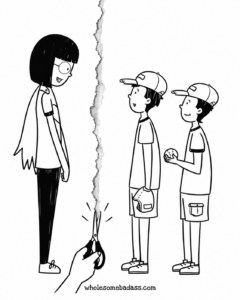
Black-and-white illustration of a mother separated from her two sons by a torn divide, while a hand with scissors cuts between them, symbolizing triangulation and parental alienation.

Paranoia or Pattern Recognition?

Sometimes the most disturbing part of a pattern isn’t what eventually happens. It’s remembering how clearly you could see it taking shape. The small exclusions. The shifting alliances. The selective sharing of information. The quiet rearranging of relationships until someone who once belonged is increasingly treated as an outsider. Each incident, on its own, can be explained away. Questioning the pattern can become a bigger offense than the pattern itself. And when children are involved, I find that especially troubling. I cannot imagine how children benefit from arrangements in which belonging to one relationship gradually comes at the expense of another. What happens when choosing sides becomes so familiar that it no longer feels like choosing? And then there’s the accusation of paranoia. As though recognizing something that has happened repeatedly is the same as inventing something that hasn’t happened at all. How many times does something have to happen before recognizing it is no longer treated as imagining the worst? Or being negative? I remember being asked why I always imagined the worst. I wasn’t imagining. I was recalling. There is a difference between expecting the worst and recognizing something you’ve already lived. And sometimes, years later, you come across something that reminds you just how early you recognized it. Years later, I came across a video I recorded on the morning of my mother’s funeral, after receiving less than 24 hours’ notice of her death and the service. Even then, I was describing what I feared was taking shape and what it might eventually ask of my children. Whatever else may be true, this is what I was seeing, experiencing, and fearing at the time. A recording from that morning.  

Read More
Rattlesnake wearing a party hat on a pink unicorn bed, symbolizing hidden danger in plain sight.

The Curated Impression

How a Narrative Protects Predatory Behavior The Branding Becomes the Lens I am recognizing something in real time: the story about someone can matter more than what they actually say and do. When someone is characterized unfavorably by a person of greater status or influence, the language is often directed toward creating a shared lens through which others understand them. That version can serve as the starting assumption. Hierarchy gives it weight. This is the branding. The packaging. And it matters who establishes it. From there, a trajectory takes shape. The branding creates two outcomes at once: one person is invalidated while the other is insulated and immune to scrutiny. The branding calls the person to defense, then uses that defense as evidence that the characterization was right. Distress is recast as instability, attempts at clarity as difficulty, withdrawal as withholding, and any strong response as confirmation. Evidence to the contrary is inadmissible. It does not weaken the characterization. This is what makes the role difficult to escape. The arrangement is zero-sum: for one person to remain credible and protected, the other has to remain discredited. This is not a self-fulfilling prophecy in the usual sense because the premise does not originate with the branded one. It is imposed from “above,” then used to interpret everything that follows. Reality gets outranked by narrative. A response can be disproportionate, messy, or wrong without making the underlying experience unreal. Someone can be difficult or unpopular and still have been treated poorly. But the formula reigns: When the conduct of the protected archetype is questioned: Well, I only acted this way because of who and how YOU/THEY are. Have you been in a relationship in which another person’s missteps, poor choices, words, or conduct were repeatedly assigned to something supposedly wrong with you? WTAF? As in: If I behave like an asshole, it is only because you suck.
Read More
Flames burning a bridge, symbolizing narcissistic family conflict and broken relationships.

Family Betrayal in Plain Sight (repost from 2017)

In 2008, I visited North Carolina for a therapy session with my mother and sister. It went poorly. Tragically. Since, we each showed up with the intent to assess only my behaviors and personality. I miscarried. And that was the least of the devastation. For obvious reasons, I was unable to rally for a neighborhood trick-or-treat parade with my sister and her family. I needed time and space to rest and grieve the tragedy of that session, my family, and the loss of a pregnancy while nursing and caring for my 10-month-old. And was accused of denying my nieces access to their cousin. My 10-year-old niece and I had been emailing and enjoying each other regularly. I would have liked seeing her and her sister under different circumstances. Rather than facing our issues directly, my sister sent a birthday gift addressed to my one-year-old son with a typed note inside telling me not to interact with her girls until we had worked things out as a family. I found it years later while purging for an upcoming move. A declaration of war, not an invitation to peace. The standard response to a boundary or me trying to inhabit my own space. NOTE: The alliance between my sister and my ex was not left over from when we were married. There was no contact or connection while married—we lived on opposite coasts and were estranged. An alliance formed while he and I were struggling as divorced co-parents after what had been a hard-won improvement following our high-conflict divorce. She tried to erase me while accusing me of abandoning family. She divided nieces from their aunt, my mother from me, and increasingly inserted herself into the relationship between my ex-husband and me. My sons witnessed the escalating tension between their mother and father involving her. What they wanted more than anything was the possibility that Mom and Dad could work together and sit together at a meal or occasion. Instead, she fanned the flames of division…… the pattern. All inthe name of her brand of love. I could not pretend. And I cleanly, clearly, and repeatedly presented myself for healing and repair. It was easy to convince me that it was my imagination or my fault without the written record. I do not earn, cause, deserve, or imagine the horror of having been her younger sister. Whatever else may be true, this is my experience.

Read More
Chopped down tree symbolizing the lasting impact of family betrayal and parental alienation.

How Did We Get Here?

At a very tense Mother’s Day gathering in 2016, I learned that my niece’s graduation was less than four weeks away and on the same night as a concert I had already committed to. The tickets had been a Valentine’s Day gift and the plans had been in place for months. It wasn’t that I chose a concert over her graduation. I simply already had plans by the time I was given the date. With no other way to get my boys to the graduation, and valuing the opportunity for family that being there would give them, I sent them with their dad. Even then, I sensed it could be a fatal choice. Later, my mother told me that while they were at the graduation, plans began for a birthday gathering for my son that would intentionally exclude me. Whatever was happening between the adults, I had directly and repeatedly asked that it stay there, and that we do the work of repair. Something in the fabric of my universe was torn beyond repair. Whatever else may be true, this also happened. I’ve been accused of being negative- always imagining the worst. Maybe I was never imagining the worst. Maybe I’m recognizing and recalling what I have lived. Have you ever been called negative for noticing a pattern that later proved real?

Read More
Black-and-white illustration of a mother separated from her two sons by a torn divide, while a hand with scissors cuts between them, symbolizing triangulation and parental alienation.

Paranoia or Pattern Recognition?

Sometimes the most disturbing part of a pattern isn’t what eventually happens. It’s remembering how clearly you could see it taking shape. The small exclusions. The shifting alliances. The selective sharing of information. The quiet rearranging of relationships until someone who once belonged is increasingly treated as an outsider. Each incident, on its own, can be explained away. Questioning the pattern can become a bigger offense than the pattern itself. And when children are involved, I find that especially troubling. I cannot imagine how children benefit from arrangements in which belonging to one relationship gradually comes at the expense of another. What happens when choosing sides becomes so familiar that it no longer feels like choosing? And then there’s the accusation of paranoia. As though recognizing something that has happened repeatedly is the same as inventing something that hasn’t happened at all. How many times does something have to happen before recognizing it is no longer treated as imagining the worst? Or being negative? I remember being asked why I always imagined the worst. I wasn’t imagining. I was recalling. There is a difference between expecting the worst and recognizing something you’ve already lived. And sometimes, years later, you come across something that reminds you just how early you recognized it. Years later, I came across a video I recorded on the morning of my mother’s funeral, after receiving less than 24 hours’ notice of her death and the service. Even then, I was describing what I feared was taking shape and what it might eventually ask of my children. Whatever else may be true, this is what I was seeing, experiencing, and fearing at the time. A recording from that morning.  

Read More