Wholesome Badass

A Work in Progress — Healing from All the Things​

Black-and-white cartoon of a worried girl handing over a paper labeled “OUCH” while a giant hand stamps it “DEFECTIVE.” Pink text at the top reads “When hurt gets submitted as evidence,” and a small watermark at the bottom says “wholesomebadass.com.”

When Your Sensitivity Is Framed as the Problem

In my family of origin, and then quite unsurprisingly in the marriage I chose, I re-enacted the familiar pattern. I accepted the charge for all discomfort—mine and everybody’s. If only I would’ve just gotten different, as was directed so very many times, we could’ve all been soooo close and comfortable. Your discomfort was my fault; so was my own. My distress was treated as a burden to the people I depended on to care for and guide me, and as proof that I was unreasonable, selfish, ungrateful, dramatic—defective. I lived in a state of perplexity that expressing any version of no or ouch consistently created friction, the very opposite of what a child might anticipate. My best efforts to communicate what I could and could not tolerate were dismissed as negative, dramatic, hysterical, oversensitive. My behavior, existence, personality, and pain were used as evidence against my character and worthiness each time they caused discomfort for one of the archetypes. My discomfort indicted me. Yours also did. I can see now how neurodivergence, scapegoating, and narcissistic family dynamics all fed the same machinery: difference was treated as defect, one person carried the emotional burden for everyone, and any separate reality that disrupted the preferred one became an offense. The opposite of sensitivity is not strength. It is insensitivity. The fact that I am affected does not make me weak, dangerous, or wrong. The way that I exist may be uncomfortable, but it’s not fucking violent or lacking in good character. What was violent, and what I have come to question as a matter of character, was the coercive control deployed in service to THE narrative, system, version of love, care, and peace. Have you ever noticed how people deeply invested in appearing strong can be the least able to, in good faith, directly engage friction?
Read More
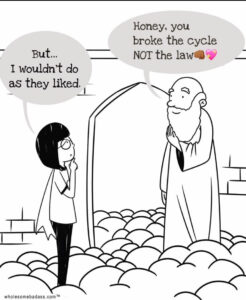
Alt text: Wholesome Badass girl speaking with Saint Peter. She says, “But I would not do as they liked,” and he replies, “You broke the cycle, not the law.”

Your Behavior Defines You – Not Me

Somewhere along the way, a practice took hold: metabolizing what other people believed, said, or did as information about me rather than data about them. Today, that data gets classified more appropriately. It may hurt deeply and alter what a relationship means. But it will no longer serve to indict me. In its crudest form: their hurtful behavior was somehow treated as a reasonable response to the fact of my existence. That premise no longer holds. Recognizing this has brought with it the gifts of self-esteem and dignity. There is something clarifying in reflecting on how consistently I attempted to engage difficult moments in good faith, even when the same was not afforded to me. Repeatedly presenting opportunities for course correction and repair—for people to respond responsibly, nobly, and peacefully—was also part of that good-faith engagement. Whether they did or did not is information about them. Were you ever asked to interpret someone else’s damaging behavior as information about you?  Like the people who do not hesitate to drag you through the mud and then ask you why you are so muddy, or better yet, ask others why you are like that? fkrz

Read More
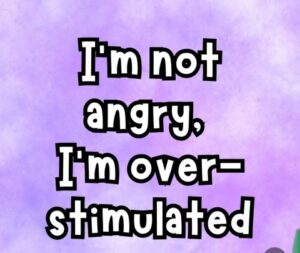
Text image with the words: “I am not angry. I am overstimulated.” Indicates that emotional reactions may reflect overwhelm, not anger.

When Dysregulation Is Treated as Being Intentionally Difficult

I do not seem naturally wired to preserve “harmony” by pretending not to see what I see and not feel what I feel. It is not as if everyone is having roughly the same experience and others make the more agreeable decision to go with the flow while I make the objectionable decision to diverge, which gets me branded not as divergent but deviant. Difficult to govern gets conflated with untrustworthy and unworthy. Not a team player. I simply cannot go with a flow that feels wildly dysregulating. My nervous system picks up and responds to things that either do not hit other people’s radar at all or do not register with anything close to the same intensity. It is not unlike some version of a dog whistle. We can be in the same room, inside the same system, and not be receiving the same input or impact from it. If something barely bothers a person, accommodating it will require little of them—nothing to resist or mask. They can easily carry on, genuinely unaffected. If the same thing is creating unmanageable discomfort in me, going along can leave me completely taxed. My depletion gets read as attitude. And yet the person who can comfortably accommodate is regarded as flexible and cooperative—which may not be untrue. But the converse about me is not necessarily true. Yes, I am less easy. But I don’t think less easy is the same as difficult or deviant. So how much of what I have understood as something wrong with me was actually the branding of a person who could not seamlessly abide without a trace a visible strain?

Read More
Black-and-white cartoon of a worried girl handing over a paper labeled “OUCH” while a giant hand stamps it “DEFECTIVE.” Pink text at the top reads “When hurt gets submitted as evidence,” and a small watermark at the bottom says “wholesomebadass.com.”

When Your Sensitivity Is Framed as the Problem

In my family of origin, and then quite unsurprisingly in the marriage I chose, I re-enacted the familiar pattern. I accepted the charge for all discomfort—mine and everybody’s. If only I would’ve just gotten different, as was directed so very many times, we could’ve all been soooo close and comfortable. Your discomfort was my fault; so was my own. My distress was treated as a burden to the people I depended on to care for and guide me, and as proof that I was unreasonable, selfish, ungrateful, dramatic—defective. I lived in a state of perplexity that expressing any version of no or ouch consistently created friction, the very opposite of what a child might anticipate. My best efforts to communicate what I could and could not tolerate were dismissed as negative, dramatic, hysterical, oversensitive. My behavior, existence, personality, and pain were used as evidence against my character and worthiness each time they caused discomfort for one of the archetypes. My discomfort indicted me. Yours also did. I can see now how neurodivergence, scapegoating, and narcissistic family dynamics all fed the same machinery: difference was treated as defect, one person carried the emotional burden for everyone, and any separate reality that disrupted the preferred one became an offense. The opposite of sensitivity is not strength. It is insensitivity. The fact that I am affected does not make me weak, dangerous, or wrong. The way that I exist may be uncomfortable, but it’s not fucking violent or lacking in good character. What was violent, and what I have come to question as a matter of character, was the coercive control deployed in service to THE narrative, system, version of love, care, and peace. Have you ever noticed how people deeply invested in appearing strong can be the least able to, in good faith, directly engage friction?

Read More
Alt text: Wholesome Badass girl speaking with Saint Peter. She says, “But I would not do as they liked,” and he replies, “You broke the cycle, not the law.”

Your Behavior Defines You – Not Me

Somewhere along the way, a practice took hold: metabolizing what other people believed, said, or did as information about me rather than data about them. Today, that data gets classified more appropriately. It may hurt deeply and alter what a relationship means. But it will no longer serve to indict me. In its crudest form: their hurtful behavior was somehow treated as a reasonable response to the fact of my existence. That premise no longer holds. Recognizing this has brought with it the gifts of self-esteem and dignity. There is something clarifying in reflecting on how consistently I attempted to engage difficult moments in good faith, even when the same was not afforded to me. Repeatedly presenting opportunities for course correction and repair—for people to respond responsibly, nobly, and peacefully—was also part of that good-faith engagement. Whether they did or did not is information about them. Were you ever asked to interpret someone else’s damaging behavior as information about you?  Like the people who do not hesitate to drag you through the mud and then ask you why you are so muddy, or better yet, ask others why you are like that? fkrz

Read More
Text image with the words: “I am not angry. I am overstimulated.” Indicates that emotional reactions may reflect overwhelm, not anger.

When Dysregulation Is Treated as Being Intentionally Difficult

I do not seem naturally wired to preserve “harmony” by pretending not to see what I see and not feel what I feel. It is not as if everyone is having roughly the same experience and others make the more agreeable decision to go with the flow while I make the objectionable decision to diverge, which gets me branded not as divergent but deviant. Difficult to govern gets conflated with untrustworthy and unworthy. Not a team player. I simply cannot go with a flow that feels wildly dysregulating. My nervous system picks up and responds to things that either do not hit other people’s radar at all or do not register with anything close to the same intensity. It is not unlike some version of a dog whistle. We can be in the same room, inside the same system, and not be receiving the same input or impact from it. If something barely bothers a person, accommodating it will require little of them—nothing to resist or mask. They can easily carry on, genuinely unaffected. If the same thing is creating unmanageable discomfort in me, going along can leave me completely taxed. My depletion gets read as attitude. And yet the person who can comfortably accommodate is regarded as flexible and cooperative—which may not be untrue. But the converse about me is not necessarily true. Yes, I am less easy. But I don’t think less easy is the same as difficult or deviant. So how much of what I have understood as something wrong with me was actually the branding of a person who could not seamlessly abide without a trace a visible strain?

Read More