Wholesome Badass

A Work in Progress — Healing from All the Things​

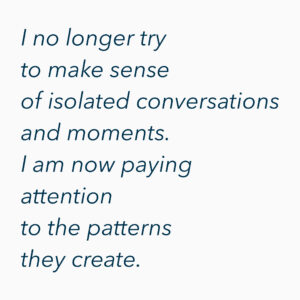
A minimalist quote graphic that reads, "I no longer try to make sense of isolated conversations or moments. I pay attention to the patterns they create." The image reflects themes of self-trust, relationship patterns, emotional healing, and personal growth.

If There Had Been a Fly on the Wall

Memory Memory can be unreliable. Interpretation certainly is. Two people can experience the same interaction and leave with very different narratives about what happened. What feels more meaningful to me now is paying attention to patterns that could have been observed by someone with no emotional investment. A quiet witness. A fly on the wall. Not someone deciding who was right. Just someone noticing what happened. Here are some of the things I believe that fly on the wall would have witnessed. -concerns met with defensive explanations more often than curiosity -hurt followed by rebuttal instead of repair -long conversations devoted to why my experience was inaccurate, exaggerated, unfair, or incomplete, while the original concern quietly disappeared -accountability flow much more comfortably in one direction than the other -apologies followed by explanations that softened or erased accountability -requests for change become deep dives into my shortcomings -a basic conflict become a courtroom instead of a collaboration They would have seen me trying harder. Communicating more carefully. Choosing my words more precisely. Waiting for better timing. Trying different approaches. Apologizing for trying so hard. Hoping that one more adjustment on my part would finally create the relationship I longed for and believed possible. They would have seen moments of warmth. Humor. Affection. Thoughtfulness. Hope. Those moments were real. They were also unpredictable. And they were enough to keep me believing things could be different. But they would have also seen those moments disappear without much explanation, leaving me searching for what had changed and what I needed to do differently to bring them back. They would have seen important conversations postponed until they quietly disappeared. Promises made in emotional moments but rarely translated into lasting change. They would have seen responsibilities become negotiable when they belonged to him and urgent when they belonged to me. They would have seen me begin monitoring his mood before bringing up difficult subjects. Editing my feelings before sharing them. Trying to predict which version of him I would be speaking to that day. Eventually, the fly on the wall would have noticed something else. The conversations were not reflective of two people trying to solve a problem together. But conversations about whether I had the right to have the problem in the first place. Over time, that changed me. I began wondering whether my expectations were too high. Whether my memory was inaccurate. Whether my nervous system was defective. Whether my needs were simply too much. Looking back, I no longer think any single interaction tells the story. The story is the repetition. Not because repetition proves someone’s intentions. It doesn’t. But repetition reveals the emotional climate a relationship creates. I don’t know why another person behaved the way they did. I no longer spend much time trying to answer that question. The question that matters to me now is much simpler. Who was I becoming and what was I agreeing to while I was trying so hard to make sense of it? Whatever else may be true, this is my experience.

Read More
Illustration of two one woman sharing details of someone else's private struggle. And being praised for kind thoughtfulness. The woman they are discussing sits nearby, unaware.

The Irony of Weaponized Concern

The Reality of Gossip Discussing the details of someone else’s life—their hardships, their choices, or how they live—is a fundamentally unwholesome practice. Gossip happens, and we can be honest about that and not pretend that engaging in it is useful, considerate, or kind.  The “Concerned” Persona So it is fascinating to witness someone who is known for not being particularly fond of a person take an openly concerned stance in sharing the depth of their worry for that person’s wellness, stability, and functionality. The energy attempt:  “I’m only saying this because I care…” Engineered Destabilization It is a stunning social loophole. Cloaking gossip with empathy, is an attempt to engineer a kind of social undermining while seeking praise for thoughtfulness. If I knew how to do emojis from my Mac- Barfing emoji for sure right fkn here. The Blind Spot What is confusing, is how easily bystanders buy the act. How does a person or group look at someone with an obvious grudge or bias, listen to them trade in the unfavorable assessment of another person’s private life, and see a caring soul instead of an invasive, scheming act? Skull and Crossbones emoji here. The Performance vs. Real Consideration Genuine care and consideration tend to be quiet and direct and require no recognition. They check in and ask what they can do to help. They honor respect and privacy with discernement and intention. When the “concern” is instead passed around from person to person, it isn’t support—it’s unwholesome gossip disguised as  goodness. It makes you ask “how does a sound person buy into the performance?” Insert Comedy Tragedy mask emoji here. Whatever else may be true, this also happened.

Read More
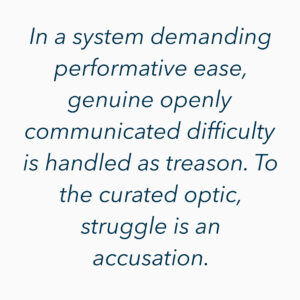
Text graphic quote: In a system demanding performative ease, genuine openly communicated difficulty is handled as treason. To the curated optic, struggle is an accusation.

Holding Court, Keeping the Crown Straight

The Binary The archetypes seem to move through life inside a rigid binary: winners and losers, heroes and villains, right and wrong. In their accounting for outcomes, there seems a lacking awareness for the possibility of their own poor decisions, regrettable reactions, or personal shortcomings.  Ironically, those are my favorite parts of any story. They are where humility lives and where connection is deepened.  To present as innocent, infallible, or heroic, someone else must always carry the shadow. When the archetype FAILs to achieve something, the explanation is rarely capability, circumstance, or choice. Instead, someone else must have been unfair, jealous, dishonest, or unjust. But the standard changes when hardship belongs to someone outside their circle of favor. Then the loss is framed as deserved.  Proof of poor character.  Evidence of defectiveness. Similar outcomes get narrated through two entirely different lenses, depending on who it happened to. The Meritocracy There seems a profound reliance on meritocracy as a reason for nearly every outcome. Success as proof of virtue.  Failure as proof that the game was rigged—at least when it happens to the archetype. And stories are shared with performative ease. Becuase struggle and dis-ease are marks of unworthiness and defect. Cue smiling emoji. A casual “lol.” “No worries.” “Perfect” The performance broadcast says, I’m completely unbothered. The pulsing tension whispers otherwise. Beneath the carefully arranged face seems a deep fear of losing status, admiration, or control. This must never happen. And there is an unspoken truth that if the archetype is worried, everyone else should be worried too. When your worth depends on always appearing victorious, peace becomes impossible. Protecting the delusion illusion is more important than connection or truth. In a system demanding performative ease, genuine and openly communicated difficulty is handled as treason. To the curated optic, struggle is an accusation. Whatever else may be true, this also happens.

Read More
A clean, minimalist square graphic with clear text on a solid, neutral background. The text reads: "There is no greater injury than being told that what you are seeing and feeling is not real. — Glennon Doyle"

A Systemic Disregard

Someone once told me that the cruelest thing you can do to another human being is to label their suspicions as false when you know them to be true. It would be impossible to count the instances where my questioning led to the same responses: You’re crazy. You made that up. Stop trying to manufacture chaos.  It’s in your head. I don’t know what you’re talking about. Something inside of me shattered each time these sentiments were hurled at me. My self-esteem, confidence, and sense of self were deeply compromised- crushing to my spirit. The continued touching of me left me confused, unwanted contact in place of connection- resulting in lifelong emotional deprivation, self-doubt, fear, disordered sleeping, disordered eating, and trust issues that defy articulation. When I threatened to tell on her, she laughed- boasting how nobody would believe me. She made sure of it. Since I’m Not Gay, I Couldn’t Have Done That She spent a fair amount of talking to me about friends of hers who were or seemed gay or butchy, and how repulsive it felt to her, while simultaneously feeling generous that she was friends with them. Like always trying to convince me she wasn’t gay—because in that logic, if she wasn’t gay, she couldn’t possibly have done what she did repeatedly. But being gay does not make someone a predator. She dedicated her life to making me feel crazy and afraid, while simultaneously offering intermittent reinforcement as my heroine—the only person who could understand or protect me. She made it clear that she would be in charge of my relief and my punishment. Like any child looking to assign reasons to that which they cannot control, I blamed myself and spent my life trying to get worthy or at least pretend to. Identity Theft My personhood was snatched–erased. I could not count on myself to know what I felt or wanted, what I needed, and what was true. Whether it was my favorite color, or if I was hungry, tired, or cold, these things were either criticized or treated as debatable. I lost touch with my ability and confidence to know what was true, important, and real. The Fast Track to Addiction It makes sense to me now why I started so early using alcohol, food, drugs, shoplifting, sex—literally anything to alter my brain chemistry for even a brief respite. To feel better. To feel different. To feel nothing. There was never enough. Addiction, impulsive, and compulsive behaviors. A lifetime of instability, insecurity, and unsafety at a cellular level. A systemic disregard for my well-being. I had so many self-help books, so much therapy, 12-step programs, journaling, and any kind of exercise to try to unlock the secrets of how to just fucken be—or maybe even just how to pretend to be better than I actually am. How Are You? For more than forty years, the question “How are you?” has felt like a trick. I always answer “Super duper.” I would say that if I won the lottery or if I crashed my car, because legit nobody actually cared, but also—how am I? How should I know?  Hold on let me check with those who have a monopoly on my truth. As I look back, realizing that I can only remember what I remember how I remember it, I was in no way groomed for success, self-mastery, or even self-sufficiency. In fact, the opposite- I was dismantled. And then I was judged for the exact outcome that was engineered for me. Constant messaging: “You are fundamentally different, and nobody has any interest in building a bridge to where you are.”

Read More
A minimalist quote graphic that reads, "I no longer try to make sense of isolated conversations or moments. I pay attention to the patterns they create." The image reflects themes of self-trust, relationship patterns, emotional healing, and personal growth.

If There Had Been a Fly on the Wall

Memory Memory can be unreliable. Interpretation certainly is. Two people can experience the same interaction and leave with very different narratives about what happened. What feels more meaningful to me now is paying attention to patterns that could have been observed by someone with no emotional investment. A quiet witness. A fly on the wall. Not someone deciding who was right. Just someone noticing what happened. Here are some of the things I believe that fly on the wall would have witnessed. -concerns met with defensive explanations more often than curiosity -hurt followed by rebuttal instead of repair -long conversations devoted to why my experience was inaccurate, exaggerated, unfair, or incomplete, while the original concern quietly disappeared -accountability flow much more comfortably in one direction than the other -apologies followed by explanations that softened or erased accountability -requests for change become deep dives into my shortcomings -a basic conflict become a courtroom instead of a collaboration They would have seen me trying harder. Communicating more carefully. Choosing my words more precisely. Waiting for better timing. Trying different approaches. Apologizing for trying so hard. Hoping that one more adjustment on my part would finally create the relationship I longed for and believed possible. They would have seen moments of warmth. Humor. Affection. Thoughtfulness. Hope. Those moments were real. They were also unpredictable. And they were enough to keep me believing things could be different. But they would have also seen those moments disappear without much explanation, leaving me searching for what had changed and what I needed to do differently to bring them back. They would have seen important conversations postponed until they quietly disappeared. Promises made in emotional moments but rarely translated into lasting change. They would have seen responsibilities become negotiable when they belonged to him and urgent when they belonged to me. They would have seen me begin monitoring his mood before bringing up difficult subjects. Editing my feelings before sharing them. Trying to predict which version of him I would be speaking to that day. Eventually, the fly on the wall would have noticed something else. The conversations were not reflective of two people trying to solve a problem together. But conversations about whether I had the right to have the problem in the first place. Over time, that changed me. I began wondering whether my expectations were too high. Whether my memory was inaccurate. Whether my nervous system was defective. Whether my needs were simply too much. Looking back, I no longer think any single interaction tells the story. The story is the repetition. Not because repetition proves someone’s intentions. It doesn’t. But repetition reveals the emotional climate a relationship creates. I don’t know why another person behaved the way they did. I no longer spend much time trying to answer that question. The question that matters to me now is much simpler. Who was I becoming and what was I agreeing to while I was trying so hard to make sense of it? Whatever else may be true, this is my experience.
Read More
Illustration of two one woman sharing details of someone else's private struggle. And being praised for kind thoughtfulness. The woman they are discussing sits nearby, unaware.

The Irony of Weaponized Concern

The Reality of Gossip Discussing the details of someone else’s life—their hardships, their choices, or how they live—is a fundamentally unwholesome practice. Gossip happens, and we can be honest about that and not pretend that engaging in it is useful, considerate, or kind.  The “Concerned” Persona So it is fascinating to witness someone who is known for not being particularly fond of a person take an openly concerned stance in sharing the depth of their worry for that person’s wellness, stability, and functionality. The energy attempt:  “I’m only saying this because I care…” Engineered Destabilization It is a stunning social loophole. Cloaking gossip with empathy, is an attempt to engineer a kind of social undermining while seeking praise for thoughtfulness. If I knew how to do emojis from my Mac- Barfing emoji for sure right fkn here. The Blind Spot What is confusing, is how easily bystanders buy the act. How does a person or group look at someone with an obvious grudge or bias, listen to them trade in the unfavorable assessment of another person’s private life, and see a caring soul instead of an invasive, scheming act? Skull and Crossbones emoji here. The Performance vs. Real Consideration Genuine care and consideration tend to be quiet and direct and require no recognition. They check in and ask what they can do to help. They honor respect and privacy with discernement and intention. When the “concern” is instead passed around from person to person, it isn’t support—it’s unwholesome gossip disguised as  goodness. It makes you ask “how does a sound person buy into the performance?” Insert Comedy Tragedy mask emoji here. Whatever else may be true, this also happened.

Read More
Text graphic quote: In a system demanding performative ease, genuine openly communicated difficulty is handled as treason. To the curated optic, struggle is an accusation.

Holding Court, Keeping the Crown Straight

The Binary The archetypes seem to move through life inside a rigid binary: winners and losers, heroes and villains, right and wrong. In their accounting for outcomes, there seems a lacking awareness for the possibility of their own poor decisions, regrettable reactions, or personal shortcomings.  Ironically, those are my favorite parts of any story. They are where humility lives and where connection is deepened.  To present as innocent, infallible, or heroic, someone else must always carry the shadow. When the archetype FAILs to achieve something, the explanation is rarely capability, circumstance, or choice. Instead, someone else must have been unfair, jealous, dishonest, or unjust. But the standard changes when hardship belongs to someone outside their circle of favor. Then the loss is framed as deserved.  Proof of poor character.  Evidence of defectiveness. Similar outcomes get narrated through two entirely different lenses, depending on who it happened to. The Meritocracy There seems a profound reliance on meritocracy as a reason for nearly every outcome. Success as proof of virtue.  Failure as proof that the game was rigged—at least when it happens to the archetype. And stories are shared with performative ease. Becuase struggle and dis-ease are marks of unworthiness and defect. Cue smiling emoji. A casual “lol.” “No worries.” “Perfect” The performance broadcast says, I’m completely unbothered. The pulsing tension whispers otherwise. Beneath the carefully arranged face seems a deep fear of losing status, admiration, or control. This must never happen. And there is an unspoken truth that if the archetype is worried, everyone else should be worried too. When your worth depends on always appearing victorious, peace becomes impossible. Protecting the delusion illusion is more important than connection or truth. In a system demanding performative ease, genuine and openly communicated difficulty is handled as treason. To the curated optic, struggle is an accusation. Whatever else may be true, this also happens.

Read More
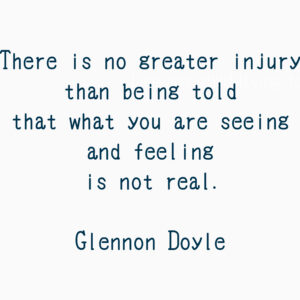
A clean, minimalist square graphic with clear text on a solid, neutral background. The text reads: "There is no greater injury than being told that what you are seeing and feeling is not real. — Glennon Doyle"

A Systemic Disregard

Someone once told me that the cruelest thing you can do to another human being is to label their suspicions as false when you know them to be true. It would be impossible to count the instances where my questioning led to the same responses: You’re crazy. You made that up. Stop trying to manufacture chaos.  It’s in your head. I don’t know what you’re talking about. Something inside of me shattered each time these sentiments were hurled at me. My self-esteem, confidence, and sense of self were deeply compromised- crushing to my spirit. The continued touching of me left me confused, unwanted contact in place of connection- resulting in lifelong emotional deprivation, self-doubt, fear, disordered sleeping, disordered eating, and trust issues that defy articulation. When I threatened to tell on her, she laughed- boasting how nobody would believe me. She made sure of it. Since I’m Not Gay, I Couldn’t Have Done That She spent a fair amount of talking to me about friends of hers who were or seemed gay or butchy, and how repulsive it felt to her, while simultaneously feeling generous that she was friends with them. Like always trying to convince me she wasn’t gay—because in that logic, if she wasn’t gay, she couldn’t possibly have done what she did repeatedly. But being gay does not make someone a predator. She dedicated her life to making me feel crazy and afraid, while simultaneously offering intermittent reinforcement as my heroine—the only person who could understand or protect me. She made it clear that she would be in charge of my relief and my punishment. Like any child looking to assign reasons to that which they cannot control, I blamed myself and spent my life trying to get worthy or at least pretend to. Identity Theft My personhood was snatched–erased. I could not count on myself to know what I felt or wanted, what I needed, and what was true. Whether it was my favorite color, or if I was hungry, tired, or cold, these things were either criticized or treated as debatable. I lost touch with my ability and confidence to know what was true, important, and real. The Fast Track to Addiction It makes sense to me now why I started so early using alcohol, food, drugs, shoplifting, sex—literally anything to alter my brain chemistry for even a brief respite. To feel better. To feel different. To feel nothing. There was never enough. Addiction, impulsive, and compulsive behaviors. A lifetime of instability, insecurity, and unsafety at a cellular level. A systemic disregard for my well-being. I had so many self-help books, so much therapy, 12-step programs, journaling, and any kind of exercise to try to unlock the secrets of how to just fucken be—or maybe even just how to pretend to be better than I actually am. How Are You? For more than forty years, the question “How are you?” has felt like a trick. I always answer “Super duper.” I would say that if I won the lottery or if I crashed my car, because legit nobody actually cared, but also—how am I? How should I know?  Hold on let me check with those who have a monopoly on my truth. As I look back, realizing that I can only remember what I remember how I remember it, I was in no way groomed for success, self-mastery, or even self-sufficiency. In fact, the opposite- I was dismantled. And then I was judged for the exact outcome that was engineered for me. Constant messaging: “You are fundamentally different, and nobody has any interest in building a bridge to where you are.”

Read More