Wholesome Badass

A Work in Progress — Healing from All the Things​

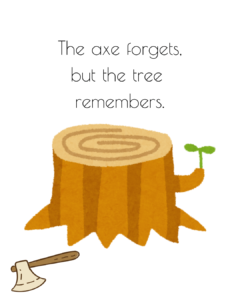
Chopped down tree symbolizing the lasting impact of family betrayal and parental alienation.

How Did We Get Here?

At a very tense Mother’s Day gathering in 2016, I learned that my niece’s graduation was less than four weeks away and on the same night as a concert I had already committed to. The tickets had been a Valentine’s Day gift and the plans had been in place for months. It wasn’t that I chose a concert over her graduation. I simply already had plans by the time I was given the date. With no other way to get my boys to the graduation, and valuing the opportunity for family that being there would give them, I sent them with their dad. Even then, I sensed it could be a fatal choice. Later, my mother told me that while they were at the graduation, plans began for a birthday gathering for my son that would intentionally exclude me. Whatever was happening between the adults, I had directly and repeatedly asked that it stay there, and that we do the work of repair. Something in the fabric of my universe was torn beyond repair. Whatever else may be true, this also happened. I’ve been accused of being negative- always imagining the worst. Maybe I was never imagining the worst. Maybe I’m recognizing and recalling what I have lived. Have you ever been called negative for noticing a pattern that later proved real?

Read More
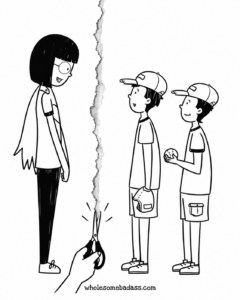
Black-and-white illustration of a mother separated from her two sons by a torn divide, while a hand with scissors cuts between them, symbolizing triangulation and parental alienation.

Paranoia or Pattern Recognition?

Sometimes the most disturbing part of a pattern isn’t what eventually happens. It’s remembering how clearly you could see it taking shape. The small exclusions. The shifting alliances. The selective sharing of information. The quiet rearranging of relationships until someone who once belonged is increasingly treated as an outsider. Each incident, on its own, can be explained away. Questioning the pattern can become a bigger offense than the pattern itself. And when children are involved, I find that especially troubling. I cannot imagine how children benefit from arrangements in which belonging to one relationship gradually comes at the expense of another. What happens when choosing sides becomes so familiar that it no longer feels like choosing? And then there’s the accusation of paranoia. As though recognizing something that has happened repeatedly is the same as inventing something that hasn’t happened at all. How many times does something have to happen before recognizing it is no longer treated as imagining the worst? Or being negative? I remember being asked why I always imagined the worst. I wasn’t imagining. I was recalling. There is a difference between expecting the worst and recognizing something you’ve already lived. And sometimes, years later, you come across something that reminds you just how early you recognized it. Years later, I came across a video I recorded on the morning of my mother’s funeral, after receiving less than 24 hours’ notice of her death and the service. Even then, I was describing what I feared was taking shape and what it might eventually ask of my children. Whatever else may be true, this is what I was seeing, experiencing, and fearing at the time. A recording from that morning.  

Read More
A crowd beside a woman standing alone, illustrating what it feels like when someone more influential controls the narrative and everyone believes their version.

The Power of Controlling the Narrative

Something does not become untrue because somebody more influential tells the story differently. I have spent a lot of my life attempting to reconcile the version of events that prevailed with my lived experience. Influence seems to determine which version is adopted and repeated. A person with more influence can shape or manipulate how events are understood. Their version becomes the more widely accepted narrative. And those under that person’s influence tend to organize around it, as THE truth. It shapes who is protected. Who is believed. Who gets the benefit of the doubt. Who belongs. And sometimes, for one person to remain elevated within that narrative, somebody else has to occupy the lesser position. Less credible. Less valid. Easier to dismiss. Then anything that person shares of what happened gets heard through what has already been established about them—and becomes, at some level, inadmissible. That’s the part—that part right there. You are not only trying to process and overcome what happened. You’re trying to tell it from a position where your credibility has already been diminished. Whatever else may be true, this also happens. A narrative can do more than determine what gets believed. It can determine who remains protected and included—and who becomes increasingly easy to disregard, diminish, and exclude. How much of what we believe about someone comes from what we have actually experienced with them, and how much was already decided for us by the story we were handed?

Read More
The Narcissist’s Prayer showing six statements that progress from denial and minimization to blame-shifting, beside an image of a cracked mask.

Gaslighting, Blame-Shifting, and the Absence of Repair

A person can know something experientially long before they can articulate it. They might know, for example, “After X is upset with me, I end up confused. I initiate communication thinking I had a legitimate concern, and somehow I leave apologizing and wondering whether I caused everything.” They don’t necessarily have words or concepts to process what happened. Once someone learns concepts like blame-shifting, triangulation, invalidation, stonewalling, double standards, DARVO, conditional approval, or refusal of repair, those concepts can provide handles for examining an interaction: Wait—was I actually heard? Did we each consider or examine our contributions? Was disagreement permitted? Did responsibility somehow become entirely mine? And importantly, language doesn’t have to supply the verdict. It can supply questions. That may be especially valuable for someone who’s been raised inside a particular relational system, because whatever happened repeatedly can simply register as this is how relationships work. Conflict is information, not a trial where somebody has to be found guilty. You can finish a disagreement still thinking, I was right about the original issue, and nevertheless learn: I interrupted you. I got defensive. I misunderstood what you meant. I didn’t realize that mattered so much to you. Or: I still disagree, but now I understand your reasoning. Or my most favorite of all: I think I understtand but I still do not agree. And the other person can do the same. Someone can be displeased with you without their displeasure becoming evidence that you’re bad. They can misunderstand you without their interpretation replacing your knowledge of yourself. And you can discover something uncomfortable about your own behavior without having to collapse into therefore I am the problem. In a healthy rupture, both people have something to metabolize. Not necessarily equal blame—sometimes one person really did behave badly—but both people still have an encounter to process. What happened? What did I do? What did you experience? What did I misunderstand? What does this change between us? What is needed for repair? In the archetypal dynamic, one person effectively exempts themselves from that process. Their internal work stops at: I was right to do or say X because of what you did. Everything downstream gets assigned to the other person. But the person on the receiving end doesn’t get to bypass metabolizing the rupture. They can end up metabolizing too much. They process the original conflict, the accusation, the other person’s certainty, the withdrawal, their own behavior, their memory, their motives, what they could have done differently, whether they’re actually the problem—and they do it without the other person’s participation. Then contact resumes without repair. All of that processing has nowhere relational to land. It can instead become adaptation: anxiety, self-doubt, vigilance, accommodation, rehearsing, overexplaining, trying harder, monitoring tone, becoming increasingly careful. The rupture isn’t unprocessed. The processing is asymmetrical. One person preserves their existing understanding of themselves. The other person is left reorganizing themselves around the unresolved rupture. Repair brings the information back into the relationship, where both people can examine it instead of one person having to carry and interpret the whole thing alone. One person is trying to understand what happened. The archetype is operating from the position that nothing happened that requires understanding. One person is asking, What happened between us? How did we get here? What needs to be repaired? And the answer—explicitly or through behavior—is essentially: There is nothing between us to repair. The problem is that you’re confused, anxious, sensitive, difficult, or unable to let things go. So the effect of the interaction gets reassigned as a characteristic of the recipient. The anxiety created by unresolved rupture becomes evidence that you’re “anxious.” The confusion created by contradictory interactions becomes evidence that you’re “confused.” Your attempts to get resolution become evidence that you “can’t let things go.” Your attempts to clarify what happened become evidence that you’re “overthinking.” The interaction disappears from the explanation. Then when ordinary contact resumes without acknowledgment, one person can experience that as moving on, while the other person is still carrying an unresolved event that supposedly never happened. There can be no repair when only one person is able to acknowledge that there was a rupture. You can say, “Something you did didn’t land well with me,” and get: Nothing happened. You’re misinterpreting me. You’re too sensitive. Or you can notice distance and say, “Something seems different between us. Did something happen?” and get: Nothing’s different. You’re imagining things. Why do you always do this? If you name an impact, you’re creating a problem. If you notice an impact, you’re creating a problem. If you ask about a rupture, you’re creating a problem. If you remain unsettled because there was no repair, that becomes the problem. The recipient isn’t just processing a conflict alone. They’re being asked to process a conflict whose existence has been denied. There isn’t even an agreed-upon event to work with. Something happened between us. I can observe the change. I’m experiencing the consequences. But I’m being told there is nothing here to discuss. Which may be why “nothing happened” is so consequential. It doesn’t merely refuse repair. It removes the shared reality from which repair would have been possible. Nothing happened. Nothing’s wrong. There is nothing to discuss. But then there’s silence. Distance. Withdrawal. Maybe coldness. You’re left alone with whatever the fuck just happened. That’s the contradiction. You’re experiencing the consequences of a rupture while being denied the existence of the rupture itself. Whatever else may be true, this is a defining structure within the archetypal dynamic.
Read More
Woman surrounded by flames with the words, “Don’t set yourself on fire to keep others warm.”

Are We Playing by the Same Rules?

For more than 40 years, I didn’t really know how to exist inside a relationship unless I was the broken one, bowing in reliance to anyone gracious enough to let me hang around, no matter the quality of treatment. Could you stay with me? Could you help me? What have I done to be so lucky to have someone strong and knowing and right like you? Barf. Fangirl, fawning, degrading shit. I knew how to engage only that way. What I’m learning now is something different. I don’t want to have to be broken to belong. I am going off script. This is wildly unpopular with the patterned archetypes I have gone barreling toward at every opportunity. I no longer agree to that—to matter less so that a relationship may continue. I cannot abandon what I know and adopt someone else’s perspective in place of my lived experience. That is me gaslighting myself. I cannot accept someone else’s explanation of my motives when it isn’t mine. I can be wrong. I can fuck up. I can apologize. I can change. But I have to remain a whole person while I do it. And the relationships that have cost me the most have not been the ones where people hurt me or got things wrong. They have been the ones where somehow there was always something for me to examine, own, apologize for or change, and nothing on the other side of the relationship was ever available for the same examination. I welcome the responsibility to own my part. I cannot own yours too. My hunger for connection has kept me engaged in things long after I knew they weren’t feeding me. Hunger will do that. But if my body is asking for fiber and what’s being offered is refined sugar, eating it because I’m hungry doesn’t nourish me. It’s not nothing. But it’s not neutral either. I won’t keep feeding myself the opposite of what I’m hungry for and then wonder why I feel poisoned. And feel shame for my resulting condition. So yes. Some relationships may cost too much to keep. Not because they don’t matter to me. Because I finally matter too. Have you ever been tangled up with someone like this? Someone where every attempt to address a conflict somehow ends with you being the only person under examination? They didn’t misunderstand. They didn’t contribute. They didn’t hurt you. They didn’t get anything wrong. You did. Every fucking time….Whatever else may be true, this also happened.

Read More
An empty courtroom with light shining across the judge's bench and the words, "When the aggressor occupies the protected position ..." superimposed over the image.

The Protected Position

Something began when I was four years old, and it was reinforced, repeated, normalized, and sustained over the course of decades. The injury wasn’t only the abuse itself. It was also the fact that the person who harmed me was favored, protected, believed, accommodated, and repeatedly restored to a position of legitimacy while I was not. Something bad happened, and the person who did it continued to occupy a protected position while my reality (moments of distress) was judged, minimized, and dismissed. When that happens over and over again, year after year, it makes sense that I began to feel as though my validity, agency, credibility, and even my right to define my own experience had been stripped away. For a very long time, I located the center of gravity in my mother. Now I am considering the possibility that my sister occupied a much more influential position than I had been able to discern. Six and a half years older than me, she was the first grandchild, the first niece, and the favored child. Then came Magda, the last grandchild: highly sensitive, tightly wound, easily activated, and in need of inconvenient soothing. My sensitivity was dismissed as performance. “Quit performing. Stop being dramatic, hysterical, manipulative. Stop trying to get attention.” Nobody taught me how to cope with difficulty, tolerate discomfort, or regulate my nervous system. I think my sister learned that there was power in being able to suck it up and may even have come to feel martyred by it. By keeping me dysregulated through taunting, provocation, and unwanted touching, she gained traction through the contrast in presentation. She appeared composed while I appeared reactive, and ours was a family with very little capacity for visible, observable, unhidable struggle. As I continue to heal, I find myself repeatedly encountering variations of this same pattern. There is a certain kind of personality that seems to require constant elevation, admiration, accommodation, and preferential treatment, and there is a predictable response to anyone whose presence threatens to divert attention from that arrangement. The archetype itself is hardly new. If only authority were evidence of integrity and virtue. If only age, status, confidence, accomplishment, popularity, or proximity to power guaranteed goodness. I was placed on this trajectory at the age of four, and now I am doing the work required to change direction. I am learning to recognize the pattern that I know so well and, without vigilance, continue to mistake for love, safety, familiarity, and home. The familiarity calls to me. Like an old glove, it simply fits. I recognize now that familiarity and safety are not the same thing. Whatever else may be true, this also happened.

Read More
One healthy green tree standing in the middle of a forest of dead trees beneath the quote, “A peak is a moment. A pattern is information.”

The Truth Is in the Pattern

Sheesh. How many more times will I have to navigate this particular circuit before I have learned everything I can from it? The turth is in the pattern, not the explanation. It almost feels as though I have been given a false map. There are things people say that, if I allow them to guide me, will take me completely off course because they don’t align with reality, their actions, or my lived experience. I am starting to recognize that the real story lives inside the patterns. Words do matter. Conversations matter. Moments matter. But patterns persist regardless of what is said. Sometimes there is an incongruency or lack of alignment between words, the suggested intent of those words, and actions. Sometimes things are not communicated directly at all, and yet they are communicated clearly through repeated behaviors. I am intentionally allowing patterns to inform me more than peak moments, conversations, or exchanges. If there is a pleasurable moment in a relationship, I can no longer hold onto that moment as though it represents restoration or the relationship as a whole. I will not waste energy trying to figure out how to get back to that place, as though I have somehow lost the thread. Perhaps it was the exception. Possibly, it was simply a moment. The information is in the pattern. That doesn’t necessarily tell me what is true in some absolute sense, but it does tell me what is real. And when I allow patterns to inform what I say or do next, I am able to remain aligned with my quest for sovereignty and radical neutrality. A thing has happened. I don’t get to change it, reinterpret it, or spin it into something else. I don’t have to lose myself reacting or trying to understand it from every possible angle. I don’t have to overexplain my experience or convince anyone else of it. I can simply acknowledge what is and decide what my actual options are, keeping in alignment with my North Star. Whatever else may be true, this also happened.

Read More
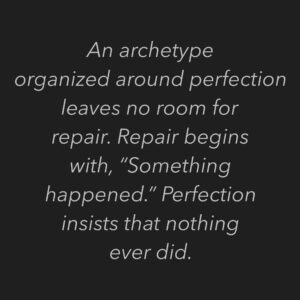
Black-and-white typography graphic with a quote about how relationships require acknowledgment of ruptures in order to repair, and how perfectionism can prevent emotional repair and trust.

Growing or Outgrowing?

I’ve spent a lot of time thinking about the c-word….”conflict ” and also–avoidance and repair. The archetype, to whom I have gravitated to like a moth to a flame, seems to have little room for either. Being non-pleased feels unacceptable. Causing displeasure feels unacceptable. Being imperfect feels unacceptable. So concerns don’t get raised directly. They leak out sideways through passive aggression, distance, stonewalling, or the preTENSE that everything is fine. The script for that: All good. Everything is fine. No worries. Of course. Perfect. No problem. Good vibes only. smile emoji lol And if someone does directly bring up a concern, the conversation can quickly shift to intentions, perceptions, or disproving any negative impact in the first place. I’ve lived inside enough of those relationships to recognize a clear pattern. One conversation with Sweet Greg from years ago–went differently. I brought up something that would have been disruptive to just about anyone. And he began his reply by explaining his intentions and my perceptions. I finally said, “If the only version of this conversation is the one where everything supports that you had no negative impact, our season has ended. Not because that issue was dramatic or catastrophic but because that manner of communication after conflict is one I’m too familiar with.” That changed the conversation. We stopped trying to establish innocence. We started talking about the impact, which is unmitagted by intention. Neither of us had to be the bad guy. Neither of us had to abandon our dignity. After that, we spent the next six years intentionally getting better at repair. Not because we had constant conflict. Because neither of us had to wonder. If something landed wrong, we said it. If one of us missed the mark, we talked about it. If an apology was needed, it wasn’t treated like a character indictment. Those moments were not dramatic. Most of them were like paper cuts, as far as gravity. But a thousand paper cuts can finally erupt by with irreperable injury. Left alone, “paper cuts” have a way of becoming stories that the cutty tells themselves about how little they matter. Addressed early, they become moments of understanding. Maybe that’s what repair has felt like to me. Not the absence of conflict. The absence of guessing and ruminating. The freedom to ask, “Did something happen?” without fearing the question itself. The freedom to hear, “That landed differently than you intended,” without feeling like either person has to lose. It became natural to laugh at ourselves, own our blind spots, and keep moving toward each other instead of away from each other. That kind of repair didn’t make either of us perfect. It made us close. I’ve only experienced that kind of relationship a handful of times. I think I understand something now that I didn’t then. For me, relationships no longer end because of conflict or a fight. For me, the season has concluded when evolving and expanding have stopped. When there’s not room to speak truth, make an adjustment, extend grace, laugh at ourselves, or discover a better way of loving each other. Or maybe the season just ends, but not because of a fight. And nobody is left to wonder, what did I do or what is going on? Whatever else may be true, this is my experience.

Read More
Chopped down tree symbolizing the lasting impact of family betrayal and parental alienation.

How Did We Get Here?

At a very tense Mother’s Day gathering in 2016, I learned that my niece’s graduation was less than four weeks away and on the same night as a concert I had already committed to. The tickets had been a Valentine’s Day gift and the plans had been in place for months. It wasn’t that I chose a concert over her graduation. I simply already had plans by the time I was given the date. With no other way to get my boys to the graduation, and valuing the opportunity for family that being there would give them, I sent them with their dad. Even then, I sensed it could be a fatal choice. Later, my mother told me that while they were at the graduation, plans began for a birthday gathering for my son that would intentionally exclude me. Whatever was happening between the adults, I had directly and repeatedly asked that it stay there, and that we do the work of repair. Something in the fabric of my universe was torn beyond repair. Whatever else may be true, this also happened. I’ve been accused of being negative- always imagining the worst. Maybe I was never imagining the worst. Maybe I’m recognizing and recalling what I have lived. Have you ever been called negative for noticing a pattern that later proved real?

Read More
Black-and-white illustration of a mother separated from her two sons by a torn divide, while a hand with scissors cuts between them, symbolizing triangulation and parental alienation.

Paranoia or Pattern Recognition?

Sometimes the most disturbing part of a pattern isn’t what eventually happens. It’s remembering how clearly you could see it taking shape. The small exclusions. The shifting alliances. The selective sharing of information. The quiet rearranging of relationships until someone who once belonged is increasingly treated as an outsider. Each incident, on its own, can be explained away. Questioning the pattern can become a bigger offense than the pattern itself. And when children are involved, I find that especially troubling. I cannot imagine how children benefit from arrangements in which belonging to one relationship gradually comes at the expense of another. What happens when choosing sides becomes so familiar that it no longer feels like choosing? And then there’s the accusation of paranoia. As though recognizing something that has happened repeatedly is the same as inventing something that hasn’t happened at all. How many times does something have to happen before recognizing it is no longer treated as imagining the worst? Or being negative? I remember being asked why I always imagined the worst. I wasn’t imagining. I was recalling. There is a difference between expecting the worst and recognizing something you’ve already lived. And sometimes, years later, you come across something that reminds you just how early you recognized it. Years later, I came across a video I recorded on the morning of my mother’s funeral, after receiving less than 24 hours’ notice of her death and the service. Even then, I was describing what I feared was taking shape and what it might eventually ask of my children. Whatever else may be true, this is what I was seeing, experiencing, and fearing at the time. A recording from that morning.  

Read More
A crowd beside a woman standing alone, illustrating what it feels like when someone more influential controls the narrative and everyone believes their version.

The Power of Controlling the Narrative

Something does not become untrue because somebody more influential tells the story differently. I have spent a lot of my life attempting to reconcile the version of events that prevailed with my lived experience. Influence seems to determine which version is adopted and repeated. A person with more influence can shape or manipulate how events are understood. Their version becomes the more widely accepted narrative. And those under that person’s influence tend to organize around it, as THE truth. It shapes who is protected. Who is believed. Who gets the benefit of the doubt. Who belongs. And sometimes, for one person to remain elevated within that narrative, somebody else has to occupy the lesser position. Less credible. Less valid. Easier to dismiss. Then anything that person shares of what happened gets heard through what has already been established about them—and becomes, at some level, inadmissible. That’s the part—that part right there. You are not only trying to process and overcome what happened. You’re trying to tell it from a position where your credibility has already been diminished. Whatever else may be true, this also happens. A narrative can do more than determine what gets believed. It can determine who remains protected and included—and who becomes increasingly easy to disregard, diminish, and exclude. How much of what we believe about someone comes from what we have actually experienced with them, and how much was already decided for us by the story we were handed?

Read More
The Narcissist’s Prayer showing six statements that progress from denial and minimization to blame-shifting, beside an image of a cracked mask.

Gaslighting, Blame-Shifting, and the Absence of Repair

A person can know something experientially long before they can articulate it. They might know, for example, “After X is upset with me, I end up confused. I initiate communication thinking I had a legitimate concern, and somehow I leave apologizing and wondering whether I caused everything.” They don’t necessarily have words or concepts to process what happened. Once someone learns concepts like blame-shifting, triangulation, invalidation, stonewalling, double standards, DARVO, conditional approval, or refusal of repair, those concepts can provide handles for examining an interaction: Wait—was I actually heard? Did we each consider or examine our contributions? Was disagreement permitted? Did responsibility somehow become entirely mine? And importantly, language doesn’t have to supply the verdict. It can supply questions. That may be especially valuable for someone who’s been raised inside a particular relational system, because whatever happened repeatedly can simply register as this is how relationships work. Conflict is information, not a trial where somebody has to be found guilty. You can finish a disagreement still thinking, I was right about the original issue, and nevertheless learn: I interrupted you. I got defensive. I misunderstood what you meant. I didn’t realize that mattered so much to you. Or: I still disagree, but now I understand your reasoning. Or my most favorite of all: I think I understtand but I still do not agree. And the other person can do the same. Someone can be displeased with you without their displeasure becoming evidence that you’re bad. They can misunderstand you without their interpretation replacing your knowledge of yourself. And you can discover something uncomfortable about your own behavior without having to collapse into therefore I am the problem. In a healthy rupture, both people have something to metabolize. Not necessarily equal blame—sometimes one person really did behave badly—but both people still have an encounter to process. What happened? What did I do? What did you experience? What did I misunderstand? What does this change between us? What is needed for repair? In the archetypal dynamic, one person effectively exempts themselves from that process. Their internal work stops at: I was right to do or say X because of what you did. Everything downstream gets assigned to the other person. But the person on the receiving end doesn’t get to bypass metabolizing the rupture. They can end up metabolizing too much. They process the original conflict, the accusation, the other person’s certainty, the withdrawal, their own behavior, their memory, their motives, what they could have done differently, whether they’re actually the problem—and they do it without the other person’s participation. Then contact resumes without repair. All of that processing has nowhere relational to land. It can instead become adaptation: anxiety, self-doubt, vigilance, accommodation, rehearsing, overexplaining, trying harder, monitoring tone, becoming increasingly careful. The rupture isn’t unprocessed. The processing is asymmetrical. One person preserves their existing understanding of themselves. The other person is left reorganizing themselves around the unresolved rupture. Repair brings the information back into the relationship, where both people can examine it instead of one person having to carry and interpret the whole thing alone. One person is trying to understand what happened. The archetype is operating from the position that nothing happened that requires understanding. One person is asking, What happened between us? How did we get here? What needs to be repaired? And the answer—explicitly or through behavior—is essentially: There is nothing between us to repair. The problem is that you’re confused, anxious, sensitive, difficult, or unable to let things go. So the effect of the interaction gets reassigned as a characteristic of the recipient. The anxiety created by unresolved rupture becomes evidence that you’re “anxious.” The confusion created by contradictory interactions becomes evidence that you’re “confused.” Your attempts to get resolution become evidence that you “can’t let things go.” Your attempts to clarify what happened become evidence that you’re “overthinking.” The interaction disappears from the explanation. Then when ordinary contact resumes without acknowledgment, one person can experience that as moving on, while the other person is still carrying an unresolved event that supposedly never happened. There can be no repair when only one person is able to acknowledge that there was a rupture. You can say, “Something you did didn’t land well with me,” and get: Nothing happened. You’re misinterpreting me. You’re too sensitive. Or you can notice distance and say, “Something seems different between us. Did something happen?” and get: Nothing’s different. You’re imagining things. Why do you always do this? If you name an impact, you’re creating a problem. If you notice an impact, you’re creating a problem. If you ask about a rupture, you’re creating a problem. If you remain unsettled because there was no repair, that becomes the problem. The recipient isn’t just processing a conflict alone. They’re being asked to process a conflict whose existence has been denied. There isn’t even an agreed-upon event to work with. Something happened between us. I can observe the change. I’m experiencing the consequences. But I’m being told there is nothing here to discuss. Which may be why “nothing happened” is so consequential. It doesn’t merely refuse repair. It removes the shared reality from which repair would have been possible. Nothing happened. Nothing’s wrong. There is nothing to discuss. But then there’s silence. Distance. Withdrawal. Maybe coldness. You’re left alone with whatever the fuck just happened. That’s the contradiction. You’re experiencing the consequences of a rupture while being denied the existence of the rupture itself. Whatever else may be true, this is a defining structure within the archetypal dynamic.

Read More
Woman surrounded by flames with the words, “Don’t set yourself on fire to keep others warm.”

Are We Playing by the Same Rules?

For more than 40 years, I didn’t really know how to exist inside a relationship unless I was the broken one, bowing in reliance to anyone gracious enough to let me hang around, no matter the quality of treatment. Could you stay with me? Could you help me? What have I done to be so lucky to have someone strong and knowing and right like you? Barf. Fangirl, fawning, degrading shit. I knew how to engage only that way. What I’m learning now is something different. I don’t want to have to be broken to belong. I am going off script. This is wildly unpopular with the patterned archetypes I have gone barreling toward at every opportunity. I no longer agree to that—to matter less so that a relationship may continue. I cannot abandon what I know and adopt someone else’s perspective in place of my lived experience. That is me gaslighting myself. I cannot accept someone else’s explanation of my motives when it isn’t mine. I can be wrong. I can fuck up. I can apologize. I can change. But I have to remain a whole person while I do it. And the relationships that have cost me the most have not been the ones where people hurt me or got things wrong. They have been the ones where somehow there was always something for me to examine, own, apologize for or change, and nothing on the other side of the relationship was ever available for the same examination. I welcome the responsibility to own my part. I cannot own yours too. My hunger for connection has kept me engaged in things long after I knew they weren’t feeding me. Hunger will do that. But if my body is asking for fiber and what’s being offered is refined sugar, eating it because I’m hungry doesn’t nourish me. It’s not nothing. But it’s not neutral either. I won’t keep feeding myself the opposite of what I’m hungry for and then wonder why I feel poisoned. And feel shame for my resulting condition. So yes. Some relationships may cost too much to keep. Not because they don’t matter to me. Because I finally matter too. Have you ever been tangled up with someone like this? Someone where every attempt to address a conflict somehow ends with you being the only person under examination? They didn’t misunderstand. They didn’t contribute. They didn’t hurt you. They didn’t get anything wrong. You did. Every fucking time….Whatever else may be true, this also happened.

Read More
An empty courtroom with light shining across the judge's bench and the words, "When the aggressor occupies the protected position ..." superimposed over the image.

The Protected Position

Something began when I was four years old, and it was reinforced, repeated, normalized, and sustained over the course of decades. The injury wasn’t only the abuse itself. It was also the fact that the person who harmed me was favored, protected, believed, accommodated, and repeatedly restored to a position of legitimacy while I was not. Something bad happened, and the person who did it continued to occupy a protected position while my reality (moments of distress) was judged, minimized, and dismissed. When that happens over and over again, year after year, it makes sense that I began to feel as though my validity, agency, credibility, and even my right to define my own experience had been stripped away. For a very long time, I located the center of gravity in my mother. Now I am considering the possibility that my sister occupied a much more influential position than I had been able to discern. Six and a half years older than me, she was the first grandchild, the first niece, and the favored child. Then came Magda, the last grandchild: highly sensitive, tightly wound, easily activated, and in need of inconvenient soothing. My sensitivity was dismissed as performance. “Quit performing. Stop being dramatic, hysterical, manipulative. Stop trying to get attention.” Nobody taught me how to cope with difficulty, tolerate discomfort, or regulate my nervous system. I think my sister learned that there was power in being able to suck it up and may even have come to feel martyred by it. By keeping me dysregulated through taunting, provocation, and unwanted touching, she gained traction through the contrast in presentation. She appeared composed while I appeared reactive, and ours was a family with very little capacity for visible, observable, unhidable struggle. As I continue to heal, I find myself repeatedly encountering variations of this same pattern. There is a certain kind of personality that seems to require constant elevation, admiration, accommodation, and preferential treatment, and there is a predictable response to anyone whose presence threatens to divert attention from that arrangement. The archetype itself is hardly new. If only authority were evidence of integrity and virtue. If only age, status, confidence, accomplishment, popularity, or proximity to power guaranteed goodness. I was placed on this trajectory at the age of four, and now I am doing the work required to change direction. I am learning to recognize the pattern that I know so well and, without vigilance, continue to mistake for love, safety, familiarity, and home. The familiarity calls to me. Like an old glove, it simply fits. I recognize now that familiarity and safety are not the same thing. Whatever else may be true, this also happened.

Read More
One healthy green tree standing in the middle of a forest of dead trees beneath the quote, “A peak is a moment. A pattern is information.”

The Truth Is in the Pattern

Sheesh. How many more times will I have to navigate this particular circuit before I have learned everything I can from it? The turth is in the pattern, not the explanation. It almost feels as though I have been given a false map. There are things people say that, if I allow them to guide me, will take me completely off course because they don’t align with reality, their actions, or my lived experience. I am starting to recognize that the real story lives inside the patterns. Words do matter. Conversations matter. Moments matter. But patterns persist regardless of what is said. Sometimes there is an incongruency or lack of alignment between words, the suggested intent of those words, and actions. Sometimes things are not communicated directly at all, and yet they are communicated clearly through repeated behaviors. I am intentionally allowing patterns to inform me more than peak moments, conversations, or exchanges. If there is a pleasurable moment in a relationship, I can no longer hold onto that moment as though it represents restoration or the relationship as a whole. I will not waste energy trying to figure out how to get back to that place, as though I have somehow lost the thread. Perhaps it was the exception. Possibly, it was simply a moment. The information is in the pattern. That doesn’t necessarily tell me what is true in some absolute sense, but it does tell me what is real. And when I allow patterns to inform what I say or do next, I am able to remain aligned with my quest for sovereignty and radical neutrality. A thing has happened. I don’t get to change it, reinterpret it, or spin it into something else. I don’t have to lose myself reacting or trying to understand it from every possible angle. I don’t have to overexplain my experience or convince anyone else of it. I can simply acknowledge what is and decide what my actual options are, keeping in alignment with my North Star. Whatever else may be true, this also happened.

Read More
Black-and-white typography graphic with a quote about how relationships require acknowledgment of ruptures in order to repair, and how perfectionism can prevent emotional repair and trust.

Growing or Outgrowing?

I’ve spent a lot of time thinking about the c-word….”conflict ” and also–avoidance and repair. The archetype, to whom I have gravitated to like a moth to a flame, seems to have little room for either. Being non-pleased feels unacceptable. Causing displeasure feels unacceptable. Being imperfect feels unacceptable. So concerns don’t get raised directly. They leak out sideways through passive aggression, distance, stonewalling, or the preTENSE that everything is fine. The script for that: All good. Everything is fine. No worries. Of course. Perfect. No problem. Good vibes only. smile emoji lol And if someone does directly bring up a concern, the conversation can quickly shift to intentions, perceptions, or disproving any negative impact in the first place. I’ve lived inside enough of those relationships to recognize a clear pattern. One conversation with Sweet Greg from years ago–went differently. I brought up something that would have been disruptive to just about anyone. And he began his reply by explaining his intentions and my perceptions. I finally said, “If the only version of this conversation is the one where everything supports that you had no negative impact, our season has ended. Not because that issue was dramatic or catastrophic but because that manner of communication after conflict is one I’m too familiar with.” That changed the conversation. We stopped trying to establish innocence. We started talking about the impact, which is unmitagted by intention. Neither of us had to be the bad guy. Neither of us had to abandon our dignity. After that, we spent the next six years intentionally getting better at repair. Not because we had constant conflict. Because neither of us had to wonder. If something landed wrong, we said it. If one of us missed the mark, we talked about it. If an apology was needed, it wasn’t treated like a character indictment. Those moments were not dramatic. Most of them were like paper cuts, as far as gravity. But a thousand paper cuts can finally erupt by with irreperable injury. Left alone, “paper cuts” have a way of becoming stories that the cutty tells themselves about how little they matter. Addressed early, they become moments of understanding. Maybe that’s what repair has felt like to me. Not the absence of conflict. The absence of guessing and ruminating. The freedom to ask, “Did something happen?” without fearing the question itself. The freedom to hear, “That landed differently than you intended,” without feeling like either person has to lose. It became natural to laugh at ourselves, own our blind spots, and keep moving toward each other instead of away from each other. That kind of repair didn’t make either of us perfect. It made us close. I’ve only experienced that kind of relationship a handful of times. I think I understand something now that I didn’t then. For me, relationships no longer end because of conflict or a fight. For me, the season has concluded when evolving and expanding have stopped. When there’s not room to speak truth, make an adjustment, extend grace, laugh at ourselves, or discover a better way of loving each other. Or maybe the season just ends, but not because of a fight. And nobody is left to wonder, what did I do or what is going on? Whatever else may be true, this is my experience.

Read More