Wholesome Badass

A Work in Progress — Healing from All the Things​

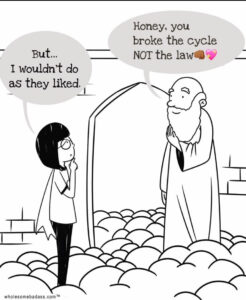
Alt text: Wholesome Badass girl speaking with Saint Peter. She says, “But I would not do as they liked,” and he replies, “You broke the cycle, not the law.”

Your Behavior Defines You – Not Me

Somewhere along the way, a practice took hold: metabolizing what other people believed, said, or did as information about me rather than data about them. Today, that data gets classified more appropriately. It may hurt deeply and alter what a relationship means. But it will no longer serve to indict me. In its crudest form: their hurtful behavior was somehow treated as a reasonable response to the fact of my existence. That premise no longer holds. Recognizing this has brought with it the gifts of self-esteem and dignity. There is something clarifying in reflecting on how consistently I attempted to engage difficult moments in good faith, even when the same was not afforded to me. Repeatedly presenting opportunities for course correction and repair—for people to respond responsibly, nobly, and peacefully—was also part of that good-faith engagement. Whether they did or did not is information about them. Were you ever asked to interpret someone else’s damaging behavior as information about you?  Like the people who do not hesitate to drag you through the mud and then ask you why you are so muddy, or better yet, ask others why you are like that? fkrz


Read More
Rattlesnake wearing a party hat on a pink unicorn bed, symbolizing hidden danger in plain sight.

When Influence Obscures The Facts

How a Narrative Protects Predatory Behavior The Branding Becomes the Lens I am recognizing something in real time: the story about someone can matter more than what they actually say and do. When someone is characterized unfavorably by a person of greater status or influence, the language is often directed toward creating a shared lens through which others understand them. That version can serve as the starting assumption. Hierarchy gives it weight. This is the branding. The packaging. And it matters who establishes it. From there, a trajectory takes shape. The branding creates two outcomes at once: one person is invalidated while the other is insulated and immune to scrutiny. The branding calls the person to defense, then uses that defense as evidence that the characterization was right. Distress is recast as instability, attempts at clarity as difficulty, withdrawal as withholding, and any strong response as confirmation. Evidence to the contrary is inadmissible. It does not weaken the characterization. This is what makes the role difficult to escape. The arrangement is zero-sum: for one person to remain credible and protected, the other has to remain discredited. This is not a self-fulfilling prophecy in the usual sense because the premise does not originate with the branded one. It is imposed from “above,” then used to interpret everything that follows. Reality gets outranked by narrative. A response can be disproportionate, messy, or wrong without making the underlying experience unreal. Someone can be difficult or unpopular and still have been treated poorly. But the formula reigns: When the conduct of the protected archetype is questioned: Well, I only acted this way because of who and how YOU/THEY are. Have you been in a relationship in which another person’s missteps, poor choices, words, or conduct were repeatedly assigned to something supposedly wrong with you? WTAF? As in: If I behave like an asshole, it is only because you suck.

Read More
A crowd beside a woman standing alone, illustrating what it feels like when someone more influential controls the narrative and everyone believes their version.

The Power of Controlling the Narrative

Something does not become untrue because somebody more influential tells the story differently. I have spent a lot of my life attempting to reconcile the version of events that prevailed with my lived experience. Influence seems to determine which version is adopted and repeated. A person with more influence can shape or manipulate how events are understood. Their version becomes the more widely accepted narrative. And those under that person’s influence tend to organize around it, as THE truth. It shapes who is protected. Who is believed. Who gets the benefit of the doubt. Who belongs. And sometimes, for one person to remain elevated within that narrative, somebody else has to occupy the lesser position. Less credible. Less valid. Easier to dismiss. Then anything that person shares of what happened gets heard through what has already been established about them—and becomes, at some level, inadmissible. That’s the part—that part right there. You are not only trying to process and overcome what happened. You’re trying to tell it from a position where your credibility has already been diminished. Whatever else may be true, this also happens. A narrative can do more than determine what gets believed. It can determine who remains protected and included—and who becomes increasingly easy to disregard, diminish, and exclude. How much of what we believe about someone comes from what we have actually experienced with them, and how much was already decided for us by the story we were handed?

Read More
Black-and-white illustration of a woman isolated behind a wall as family members reinforce the divide, symbolizing triangulation and parental alienation.

Your Enemy’s Enemy Is Your Friend

Being publicly told “you’re welcome to join” by people who openly disregard and disrespect me is hardly evidence of genuine inclusion. The invitation is presented as evidence of goodwill, while my condition of repair before returning is presented as proof that I’m choosing to separate myself from the family. No contact was a tragic last resort. There’s something particularly cruel about weaponizing my decision to protect myself from further harm. Years after a loveless, volatile marriage and unnecessarily contentious divorce, my estranged sister and ex-husband established an alliance of their own. I had married a man whose emotional patterns mirrored my sister’s, recreating the same relational dynamic. Given their shared, longstanding patterns of divisive behavior, their alliance was hardly surprising. They began gathering with my children while excluding me, despite my repeated requests that my sister stop. The resulting division extended beyond my relationships with either of them, affecting my children, our co-parenting relationship, and my already strained relationship with my mother. As my mother liked to say, “Your enemy’s enemy is your friend.” Whatever their intentions or explanations, their words and actions hurt our family. That harm was not mitigated by context or justification.

Read More
Alt text: Wholesome Badass girl speaking with Saint Peter. She says, “But I would not do as they liked,” and he replies, “You broke the cycle, not the law.”

Your Behavior Defines You – Not Me

Somewhere along the way, a practice took hold: metabolizing what other people believed, said, or did as information about me rather than data about them. Today, that data gets classified more appropriately. It may hurt deeply and alter what a relationship means. But it will no longer serve to indict me. In its crudest form: their hurtful behavior was somehow treated as a reasonable response to the fact of my existence. That premise no longer holds. Recognizing this has brought with it the gifts of self-esteem and dignity. There is something clarifying in reflecting on how consistently I attempted to engage difficult moments in good faith, even when the same was not afforded to me. Repeatedly presenting opportunities for course correction and repair—for people to respond responsibly, nobly, and peacefully—was also part of that good-faith engagement. Whether they did or did not is information about them. Were you ever asked to interpret someone else’s damaging behavior as information about you?  Like the people who do not hesitate to drag you through the mud and then ask you why you are so muddy, or better yet, ask others why you are like that? fkrz

Read More
Rattlesnake wearing a party hat on a pink unicorn bed, symbolizing hidden danger in plain sight.

When Influence Obscures The Facts

How a Narrative Protects Predatory Behavior The Branding Becomes the Lens I am recognizing something in real time: the story about someone can matter more than what they actually say and do. When someone is characterized unfavorably by a person of greater status or influence, the language is often directed toward creating a shared lens through which others understand them. That version can serve as the starting assumption. Hierarchy gives it weight. This is the branding. The packaging. And it matters who establishes it. From there, a trajectory takes shape. The branding creates two outcomes at once: one person is invalidated while the other is insulated and immune to scrutiny. The branding calls the person to defense, then uses that defense as evidence that the characterization was right. Distress is recast as instability, attempts at clarity as difficulty, withdrawal as withholding, and any strong response as confirmation. Evidence to the contrary is inadmissible. It does not weaken the characterization. This is what makes the role difficult to escape. The arrangement is zero-sum: for one person to remain credible and protected, the other has to remain discredited. This is not a self-fulfilling prophecy in the usual sense because the premise does not originate with the branded one. It is imposed from “above,” then used to interpret everything that follows. Reality gets outranked by narrative. A response can be disproportionate, messy, or wrong without making the underlying experience unreal. Someone can be difficult or unpopular and still have been treated poorly. But the formula reigns: When the conduct of the protected archetype is questioned: Well, I only acted this way because of who and how YOU/THEY are. Have you been in a relationship in which another person’s missteps, poor choices, words, or conduct were repeatedly assigned to something supposedly wrong with you? WTAF? As in: If I behave like an asshole, it is only because you suck.

Read More
A crowd beside a woman standing alone, illustrating what it feels like when someone more influential controls the narrative and everyone believes their version.

The Power of Controlling the Narrative

Something does not become untrue because somebody more influential tells the story differently. I have spent a lot of my life attempting to reconcile the version of events that prevailed with my lived experience. Influence seems to determine which version is adopted and repeated. A person with more influence can shape or manipulate how events are understood. Their version becomes the more widely accepted narrative. And those under that person’s influence tend to organize around it, as THE truth. It shapes who is protected. Who is believed. Who gets the benefit of the doubt. Who belongs. And sometimes, for one person to remain elevated within that narrative, somebody else has to occupy the lesser position. Less credible. Less valid. Easier to dismiss. Then anything that person shares of what happened gets heard through what has already been established about them—and becomes, at some level, inadmissible. That’s the part—that part right there. You are not only trying to process and overcome what happened. You’re trying to tell it from a position where your credibility has already been diminished. Whatever else may be true, this also happens. A narrative can do more than determine what gets believed. It can determine who remains protected and included—and who becomes increasingly easy to disregard, diminish, and exclude. How much of what we believe about someone comes from what we have actually experienced with them, and how much was already decided for us by the story we were handed?

Read More
Black-and-white illustration of a woman isolated behind a wall as family members reinforce the divide, symbolizing triangulation and parental alienation.

Your Enemy’s Enemy Is Your Friend

Being publicly told “you’re welcome to join” by people who openly disregard and disrespect me is hardly evidence of genuine inclusion. The invitation is presented as evidence of goodwill, while my condition of repair before returning is presented as proof that I’m choosing to separate myself from the family. No contact was a tragic last resort. There’s something particularly cruel about weaponizing my decision to protect myself from further harm. Years after a loveless, volatile marriage and unnecessarily contentious divorce, my estranged sister and ex-husband established an alliance of their own. I had married a man whose emotional patterns mirrored my sister’s, recreating the same relational dynamic. Given their shared, longstanding patterns of divisive behavior, their alliance was hardly surprising. They began gathering with my children while excluding me, despite my repeated requests that my sister stop. The resulting division extended beyond my relationships with either of them, affecting my children, our co-parenting relationship, and my already strained relationship with my mother. As my mother liked to say, “Your enemy’s enemy is your friend.” Whatever their intentions or explanations, their words and actions hurt our family. That harm was not mitigated by context or justification.

Read More