Wholesome Badass

A Work in Progress — Healing from All the Things​

Wholesome Badass girl draws a new relational blueprint based on nurturing, honest communication, accountability, and trust, while discarding an old blueprint of scapegoating, manipulation, and emotional neglect.

The Caller Was Inside the House

The people I relied on for protection were the same people I needed protection from. They were also the ones teaching lil baby Magda about herself, relationships, and the world. And so she gravitated toward relational patterns imprinted on her lil nervous system long before she could recognize or question them. Always reaching for the emotionally inaccessible archetype… She loved these people and wanted their approval, affection, and inclusion. They were her models for love, conflict, emotional regulation, and accountability. She mimicked some of their harmful behaviors, too. For how could she reject a model she hadn’t yet learned to recognize? I can share how Lil Baby Magda was harmed without asserting I, Big Magda, never caused harm. I own my unwholesome and misguided contributions without accepting responsibility for how others behaved. My first blueprint of the world was emotional instability, chaotic relationships, and illegible, amorphous rules and codes. My internal blueprint developed in response: my lens for perception, beliefs, vigilance, expectations, sense of worth, and capacity to care for myself, regulate my emotions and live with intention and dignity. Life might have been confusing even in a nurturing, steady family system. I might always have required more clarity, consistency, patience, and support. I lost decades tangled up in what the fuck had just happened and why, while forecasting what else would go wrong. What did I do? What did they mean? What did I miss? How do I keep it from happening again? Even when nothing was happening, I was still agonizing over things said and done years earlier. All that attention and energy spent trying to understand and prevent harm left no bandwidth to experience my own life. How much of what I’ve believed about my personality, character, worthiness, and lovability came from the people who taught me how to be a person? What might I have achieved if I hadn’t spent my life trying to figure out what was wrong with me? The messaging was consistent, collective, and insidious: Get different or be erased. If I was the designated problem and couldn’t correct myself, what was left? I couldn’t get different. I couldn’t get gone. I failed at both. And now I’m beginning to see a third way. Finally, I am getting different—not by correcting myself to fit the original blueprint, but by rejecting it.

Read More
Woman surrounded by flames with the words, “Don’t set yourself on fire to keep others warm.”

Are We Playing by the Same Rules?

For more than 40 years, I didn’t really know how to exist inside a relationship unless I was the broken one, bowing in reliance to anyone gracious enough to let me hang around, no matter the quality of treatment. Could you stay with me? Could you help me? What have I done to be so lucky to have someone strong and knowing and right like you? Barf. Fangirl, fawning, degrading shit. I knew how to engage only that way. What I’m learning now is something different. I don’t want to have to be broken to belong. I am going off script. This is wildly unpopular with the patterned archetypes I have gone barreling toward at every opportunity. I no longer agree to that—to matter less so that a relationship may continue. I cannot abandon what I know and adopt someone else’s perspective in place of my lived experience. That is me gaslighting myself. I cannot accept someone else’s explanation of my motives when it isn’t mine. I can be wrong. I can fuck up. I can apologize. I can change. But I have to remain a whole person while I do it. And the relationships that have cost me the most have not been the ones where people hurt me or got things wrong. They have been the ones where somehow there was always something for me to examine, own, apologize for or change, and nothing on the other side of the relationship was ever available for the same examination. I welcome the responsibility to own my part. I cannot own yours too. My hunger for connection has kept me engaged in things long after I knew they weren’t feeding me. Hunger will do that. But if my body is asking for fiber and what’s being offered is refined sugar, eating it because I’m hungry doesn’t nourish me. It’s not nothing. But it’s not neutral either. I won’t keep feeding myself the opposite of what I’m hungry for and then wonder why I feel poisoned. And feel shame for my resulting condition. So yes. Some relationships may cost too much to keep. Not because they don’t matter to me. Because I finally matter too. Have you ever been tangled up with someone like this? Someone where every attempt to address a conflict somehow ends with you being the only person under examination? They didn’t misunderstand. They didn’t contribute. They didn’t hurt you. They didn’t get anything wrong. You did. Every fucking time….Whatever else may be true, this also happened.

Read More
Text graphic that reads: "Conflict is not the enemy of connection, avoidance is.

The Fragile Structure of Happiness

I’ve been sitting with a word that has always troubled me, a state of “being” that feels out of reach: happiness. There seems to be so little capacity out there to make space for those of us whose life experiences haven’t exactly been a gifted accumulation of things that make you say, yeah, this is good, I want to keep doing it. Perhaps the hardest truth to accept is that my upbringing never provided the raw materials or the architecture required to build or even envision a lasting happiness. The Problem with Toxic Positivity Interesting how frustrated or put out people can get when they run into what they view as unhappy “negative energy” that they cannot relate to, correct or ignore. The toxic positivity crowd seems fragile, openly displeased when things are not exactly their way. Looking closely, it feels like happiness isn’t an organic state of being. A construct built on top of an essential foundation of peace and security. It demands safety and structure to exist at all. Or perhaps the blessed state resilience of a careferee disposition. Expecting happiness to materialize out of nowhere after a foundation has been fractured by neglect and abuse is like demanding a roof when there are no walls. Unhappiness, by that same token, is just the weight of things that tear at that security. Why I Am Wired for Joy And yet, somehow, I am wired for joy. I delight easily. But joy and delight don’t care about a curated stack of ease or good fortunes. They live entirely in the immediate moment of being present and vulnerable. Happiness feels like it requires a whole history and a guaranteed future, but joy requires only the now, a sudden, fertile space which presents itself in the middle of whatever reality actually is. Happiness relies on a world that goes right, while joy only requires the willingness to stay open enough to notice a single, fleeting second of presence, belonging entirely to the moment, independent of a foundation beneath it which may be whole or broken. The Requirement of Happiness I recently learned that in the Mennonite tradition, there is a core insistence that suffering must never be done alone. It stopped me in my tracks. It made me wonder: what is the word for the exact opposite of that? Because the relationships that shaped me and then chosen out of habit—the ones that faithfully mirror my family of origin—operate on a completely different framework. In that world, the unwritten rule is that suffering doesn’t exist for the right kind of people. If it does, it must be masked, suppressed, blamed, and cast away– if you can’t manage it as prescribed. It’s an energy that says suffering is for losers, an energy that promises, “I’ll give you something to cry about.” The Autocracy of the Untroubled Growing up, happiness seemed a strict requirement. Yet, there was zero consideration for the lower levels of security—no foundational, protective caretaking that could flow into actual happiness. Instead, my sensitivities/struggles were used as evidence against me in a sort of autocratic system. Those who are not troubled or taxed with more than they can handle believe their peace is a birthright they earned and shall not be troubled by anyone lesser. By that same insulting logic, they identify most anyone hit by things consistently they cannot get back up from as deserving of the fall. Looking back, I wonder how my “care givers” believed it possible for me to be happy when I was chronically overwhelmed, without a steady support or floor beneath me. Sitting in Darkness: Ten Minutes a Day I listened to a podcast recently with Kate Bowler, a survivor of stage four cancer at a surprisingly young age. She talked about how many people really just do not want to know the truth of a difficult reality. In the season in which she thought she was months away from death, parting her from aloving family, husband and young son, a co-worker asked how she was doing, and she gave a brilliantly genuine answer: “I’m doing mostly okay, except for about ten minutes every day.” He didn’t say, “Well, at least it’s only ten minutes”. He didn’t offer a dismissive holow reassurance or pivot away from discomfort. Instead, he looked her in the eyes and said, “Will you tell me about those ten minutes?” It was a glaring, beautiful contrast to the standard script. No toxic positivity, no rushing to fix or minimize it, no turning away. Genuine inquiry – a quiet, compassionate presence willing to sit in the dark with someone else’s ten minutes. Kate wrote a piece in one of her books that captures that rare posture perfectly: Blessing for the Ones Who Stay Blessed are you who stay. Who sit beside pain that cannot be fixed. Who choose presence over platitudes, and silence over shallow comfort. Blessed are you who ask hard questions without rushing toward answers. Who bear witness to the kind of grief that rearranges the world. You who try. Try to imagine. Try to listen. Try to love in the absence of tidy outcomes. May your staying be its own kind of balm. Because it says: your pain matters. You matter. And may you feel, even now, that this, too, is holy. To stay. To try. To say yes to life in all of its complexity. And to love each other all the way through. The Courage to Stay It takes courage—and intentional humility—to stay present with someone whose reality is grim. Why is that so rare? Entitled people often behave as though the suffering are the fragile ones. But couldn’t fragility be more accurately defined as the inability to acknowledge, engage with, or endure difficulty? I am many things, but I am not fucking fragile. Those who judge me most harshly would crumble after a mile in my shoes. And then, with absolute conviction, they’d insist that if I were a better person, I’d have better shoes. What’s interesting is how comfortable—if not confident—these folks seem with speaking and doing harm while banking on their target being too ashamed to acknowledge the harm done. It’s a kind of meritocracy bullshit: if you’re suffering, you must have earned it; if you’re struggling, it must be a character flaw. That belief conveniently absolves them of any responsibility for the damage they cause.


Read More
Text image of Winston Churchill quote: “An appeaser is one who feeds a crocodile, hoping it will eat him last,” representing appeasement, coercive control, trauma bonding, and survival in toxic family systems and emotionally abusive relationships.

Healing From Narcissistic Family Systems

I’ve been reflecting on how, in my family—and unironically, in the family of the man I had children with—belonging was not rooted in mutual care, nuance, or individuality. It was rooted in alignment with the people who had decided, and been supported in believing, that they mattered more. Agreement equaled safety. Divergence tracked as threat. There was no space for statements like, “I see it differently,” or “I’m hurt,” or “I need something else,” or even the simple, honest, “This doesn’t work for me.” For everyone but the person who positioned themselves at the center, those weren’t treated as communication but as defection. And once a thing was regarded as defection, the goal was not understanding but eradicating the instability. Restoring an illusion of unity. That meant conforming, suppressing, or being cast as the problem itself. There was no option to simply and safely be—without signaling allegiance. You were either reinforcing the prescribed doctrine or destabilizing it. In systems built on reverence for the ones who’ve assumed the right to define reality and whose comfort functions as law, there is no middle ground. You’re either with me or against me. That system did not simply banish me. It smeared me, discarded me, and snatches at my children, insisting I “forfeited” them by being different crazy — which, in that arrangement, meant nothing more than refusing to agree to matter less. I cannot abide. I won’t.

Read More
James Baldwin quote about facing truth overlaid on a minimalist image symbolizing emotional clarity, reflection, and the cost of acknowledgment.

The Limits of One-Sided Repair

Letting Go Each day, I live with the ache that I may not see my children again. We may not have another real conversation or moment of closeness. That may be the outcome when children grow in a system that teaches them to diminish me, and when they have no outside support to question that story. I can see how neatly the story lands if I’m “too much,” or if I “opted out.” But I didn’t opt out of love. I opted out of interactions that diminished me, and out of being judged for the pain I carried in response to that. When my older son stopped by this week to pick up some belongings, he said, “OK then, I guess I’ll just keep working on myself.” The tone was pure “seeyuh.” Calm. Clean. Detached. His dad would be impressed. It wasn’t confrontation. It wasn’t repair. It was distance dressed up as resolution. It created a sense of closure without anything actually being closed. His lack of genuine interest made it clear that the decision had already been made somewhere else. When I imagine the worst‑case scenarios — illness, death, finality — I feel no guilt for what I’ve said or done. My choices have always reflected prioritizing them. I feel no shame. I cannot bridge a gap that was created by design, by people frustrated with my lack of reverence and submission. And bridging that gap requires mutual engagement. The cycle begs to repeat. I don’t feel I have amends to make. I continue working on myself because I am here to grow, heal, and love. I know I have been truthful, kind, loyal, and wholesome as a mother. Not perfect, but great in the years before the triangulation that crushed me. My greatest regret is how much exposure they had to my pain, and how my reactions shaped their experience of me. It robbed them of access to parts of me that existed outside suffering. But I didn’t choose the pain. I did the best I could while living inside it. I am neither proud nor ashamed. I accept what was. I accept what is. And I accept that we may not find our way back to each other in this lifetime. As I once said to my family of origin: My first choice is to heal with you. My second is to just heal. I never stopped trying. And- I no longer accept the old belief that I should be grateful for whatever version of connection I’m handed. I’m choosing peace that doesn’t require self‑erasure. No more entanglement with anyone of the mindset that their peace and comfort matter more than others.

Read More
Goat standing alone on a cliff symbolizing family scapegoating and avoidance of responsibility

The War They Wanted: A Story of Estrangement

My sons learned, by design, to have zero tolerance for their mother. Ordinary acts of parenting—direction, correction, consequences, even simple questions—were rejected and reframed as manipulation or control. I once read a message from their father telling them, “Disregard your mother.” And they did. Their dismissal was not only permitted but modeled, reinforced, and quietly supported by people who positioned themselves as adversaries. During months of medical crisis—unmanaged pain, heavy medication, complications, emotional collapse—I was met with silence. I lost forty pounds. I couldn’t sit, stand, or lie down without pain. Without sleep, I struggled to function. My children showed little response, a kind of learned distance. My medical devastation wasn’t received as a call for care, but seemed to reinforce the narrative they had been taught to hold. Soon after that year of collapse came two heart attacks—more data, more interpretation, more judgment. I can hold compassion for how my children were shaped without accepting mercilessness as something I choose to live near. My healing has required restraint, even when injustice invites engagement. Over time, my options narrowed to two: escalate or collapse. In that narrowing, the structure became clear. Conflict was the point. They wanted a war—because war produces a winner and a loser, and in war, restraint is a liability. There is no framework of love or care in which it is acceptable to erase a parent. Participating in any activity that knowingly divides children from a parent is emotional violence. I continue to learn about the generational dynamics of scapegoating and parental alienation. I recognize myself in the stories of others whose former partners aligned with extended families in campaigns framed as concern—please pray for her, we’re worried—while undermining, diminishing, and dividing.

Read More
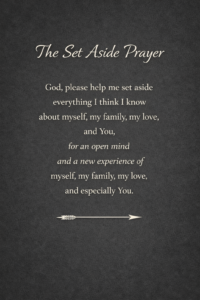
Minimalist graphic displaying the Set Aside Prayer about letting go of assumptions to allow openness, healing, and alignment

The Logic of Familiarity

Looking back, I notice how often I gravitated toward people who couldn’t tolerate my pain but expected the world to organize itself around their pleasure. When they were uncomfortable, everyone rushed to soothe them. What’s especially painful is this: humanity was withdrawn from me when I was small and needed it most. There was a kind of protected harm at work. Each time I struggled, my sister’s standing rose, and my mother’s case against me grew. Anyone could see how that drove beliefs about worth and entitlement—how my suffering had been useful to my sister. She was not only pitied and comforted when I suffered, but rewarded for not being me. It has been like this since my first breath. And I repeated this dynamic in which I consent to mattering less, in almost every relationship I chose. There were exceptions. Sweet Greg. The love bomber, obviously. And the sweetheart I’m seeing now—kind, present, generous, not looking for a reason to deny my comfort or my reality. Still, nothing replaces a family that shelters you—parents, a big sister, your own children. I remember when we moved here and my mother and sister swooned over how sweet my boys were, what a good mother I was. Even that disrupted the familiar roles. Me forming a family of my own threatened a long-standing narrative: one child – the problem, another elevated in contrast, and a mother sustained by sympathy for having such a difficult child. Looking back, it’s devastating to see how carefully that arrangement was preserved. The measures I go to in order to heal, recover, and live, seems diametrically opposed to those to whom I’m genetically linked. I read this the other day: “The way is the goal.” It captures it perfectly. It reminds me of the Set Aside Prayer—and of one of my favorite tattoos: the word –align– inside of an arrow.

Read More
A quote on a dark, stormy abstract background that reads: When it comes to abusive behavior, if they know to hide it, they know it's wrong. If they don't do it in front of other people, they know how to control it.

The Price of Disagreeing

Coercive control is a strategic pattern of behavior used to dominate another person and strip away their sense of autonomy. It is not defined by a single violent event, but by a continuous web of intimidation, isolation, and micro-regulation of the victim’s life. When applied to the family unit, this control is often maintained through three primary mechanisms: 1. Scapegoating Scapegoating is the process of blaming one person for the family’s internal problems or the controller’s own failures. The goal: To create a “common enemy.” By making one person—often a child or the other parent—the source of all conflict, the controller deflects accountability and keeps the rest of the family in a state of hyper-vigilance. The result: The victim internalizes the shame, believing they are fundamentally “broken.” 2. Triangulation Triangulation occurs when the controlling person refuses direct communication and instead pulls a third person into the dynamic to create friction or competition. The goal: To divide and conquer. By telling different versions of a story to different people, the controller ensures loyalty while fostering suspicion between others. The result: It prevents victims from forming a united front, leaving the controller as the sole source of “truth.” 3. Parental Alienation In the context of coercive control, parental alienation is the ultimate extension of triangulation. It involves one parent using psychological manipulation to turn a child against the other targeted parent. The goal: To sever the bond between the child and the other parent, effectively erasing that parent’s influence and presence. The result: The child becomes a tool of the controller’s campaign, often resulting in long-term psychological trauma for both the child and the alienated parent. How They Intersect These are not isolated tactics, but interdependent components of a single power dynamic. Coercive control in a family setting operates through a calculated cycle of isolation and psychological pressure. It begins with scapegoating, reinforced through triangulation that manipulates communication and divides family members. These efforts culminate in parental alienation, where the scapegoated parent’s influence is erased, leaving the controller in command of the family’s reality. Coercive control thrives in silence and isolation. Identifying scapegoating, triangulation, and alienation for what they are is essential for protecting your mental health. The confusion you feel is a documented byproduct of the system, not a reflection of your worth as a parent or person.

Read More
Wholesome Badass girl draws a new relational blueprint based on nurturing, honest communication, accountability, and trust, while discarding an old blueprint of scapegoating, manipulation, and emotional neglect.

The Caller Was Inside the House

The people I relied on for protection were the same people I needed protection from. They were also the ones teaching lil baby Magda about herself, relationships, and the world. And so she gravitated toward relational patterns imprinted on her lil nervous system long before she could recognize or question them. Always reaching for the emotionally inaccessible archetype… She loved these people and wanted their approval, affection, and inclusion. They were her models for love, conflict, emotional regulation, and accountability. She mimicked some of their harmful behaviors, too. For how could she reject a model she hadn’t yet learned to recognize? I can share how Lil Baby Magda was harmed without asserting I, Big Magda, never caused harm. I own my unwholesome and misguided contributions without accepting responsibility for how others behaved. My first blueprint of the world was emotional instability, chaotic relationships, and illegible, amorphous rules and codes. My internal blueprint developed in response: my lens for perception, beliefs, vigilance, expectations, sense of worth, and capacity to care for myself, regulate my emotions and live with intention and dignity. Life might have been confusing even in a nurturing, steady family system. I might always have required more clarity, consistency, patience, and support. I lost decades tangled up in what the fuck had just happened and why, while forecasting what else would go wrong. What did I do? What did they mean? What did I miss? How do I keep it from happening again? Even when nothing was happening, I was still agonizing over things said and done years earlier. All that attention and energy spent trying to understand and prevent harm left no bandwidth to experience my own life. How much of what I’ve believed about my personality, character, worthiness, and lovability came from the people who taught me how to be a person? What might I have achieved if I hadn’t spent my life trying to figure out what was wrong with me? The messaging was consistent, collective, and insidious: Get different or be erased. If I was the designated problem and couldn’t correct myself, what was left? I couldn’t get different. I couldn’t get gone. I failed at both. And now I’m beginning to see a third way. Finally, I am getting different—not by correcting myself to fit the original blueprint, but by rejecting it.

Read More
Woman surrounded by flames with the words, “Don’t set yourself on fire to keep others warm.”

Are We Playing by the Same Rules?

For more than 40 years, I didn’t really know how to exist inside a relationship unless I was the broken one, bowing in reliance to anyone gracious enough to let me hang around, no matter the quality of treatment. Could you stay with me? Could you help me? What have I done to be so lucky to have someone strong and knowing and right like you? Barf. Fangirl, fawning, degrading shit. I knew how to engage only that way. What I’m learning now is something different. I don’t want to have to be broken to belong. I am going off script. This is wildly unpopular with the patterned archetypes I have gone barreling toward at every opportunity. I no longer agree to that—to matter less so that a relationship may continue. I cannot abandon what I know and adopt someone else’s perspective in place of my lived experience. That is me gaslighting myself. I cannot accept someone else’s explanation of my motives when it isn’t mine. I can be wrong. I can fuck up. I can apologize. I can change. But I have to remain a whole person while I do it. And the relationships that have cost me the most have not been the ones where people hurt me or got things wrong. They have been the ones where somehow there was always something for me to examine, own, apologize for or change, and nothing on the other side of the relationship was ever available for the same examination. I welcome the responsibility to own my part. I cannot own yours too. My hunger for connection has kept me engaged in things long after I knew they weren’t feeding me. Hunger will do that. But if my body is asking for fiber and what’s being offered is refined sugar, eating it because I’m hungry doesn’t nourish me. It’s not nothing. But it’s not neutral either. I won’t keep feeding myself the opposite of what I’m hungry for and then wonder why I feel poisoned. And feel shame for my resulting condition. So yes. Some relationships may cost too much to keep. Not because they don’t matter to me. Because I finally matter too. Have you ever been tangled up with someone like this? Someone where every attempt to address a conflict somehow ends with you being the only person under examination? They didn’t misunderstand. They didn’t contribute. They didn’t hurt you. They didn’t get anything wrong. You did. Every fucking time….Whatever else may be true, this also happened.

Read More
Text graphic that reads: "Conflict is not the enemy of connection, avoidance is.

The Fragile Structure of Happiness

I’ve been sitting with a word that has always troubled me, a state of “being” that feels out of reach: happiness. There seems to be so little capacity out there to make space for those of us whose life experiences haven’t exactly been a gifted accumulation of things that make you say, yeah, this is good, I want to keep doing it. Perhaps the hardest truth to accept is that my upbringing never provided the raw materials or the architecture required to build or even envision a lasting happiness. The Problem with Toxic Positivity Interesting how frustrated or put out people can get when they run into what they view as unhappy “negative energy” that they cannot relate to, correct or ignore. The toxic positivity crowd seems fragile, openly displeased when things are not exactly their way. Looking closely, it feels like happiness isn’t an organic state of being. A construct built on top of an essential foundation of peace and security. It demands safety and structure to exist at all. Or perhaps the blessed state resilience of a careferee disposition. Expecting happiness to materialize out of nowhere after a foundation has been fractured by neglect and abuse is like demanding a roof when there are no walls. Unhappiness, by that same token, is just the weight of things that tear at that security. Why I Am Wired for Joy And yet, somehow, I am wired for joy. I delight easily. But joy and delight don’t care about a curated stack of ease or good fortunes. They live entirely in the immediate moment of being present and vulnerable. Happiness feels like it requires a whole history and a guaranteed future, but joy requires only the now, a sudden, fertile space which presents itself in the middle of whatever reality actually is. Happiness relies on a world that goes right, while joy only requires the willingness to stay open enough to notice a single, fleeting second of presence, belonging entirely to the moment, independent of a foundation beneath it which may be whole or broken. The Requirement of Happiness I recently learned that in the Mennonite tradition, there is a core insistence that suffering must never be done alone. It stopped me in my tracks. It made me wonder: what is the word for the exact opposite of that? Because the relationships that shaped me and then chosen out of habit—the ones that faithfully mirror my family of origin—operate on a completely different framework. In that world, the unwritten rule is that suffering doesn’t exist for the right kind of people. If it does, it must be masked, suppressed, blamed, and cast away– if you can’t manage it as prescribed. It’s an energy that says suffering is for losers, an energy that promises, “I’ll give you something to cry about.” The Autocracy of the Untroubled Growing up, happiness seemed a strict requirement. Yet, there was zero consideration for the lower levels of security—no foundational, protective caretaking that could flow into actual happiness. Instead, my sensitivities/struggles were used as evidence against me in a sort of autocratic system. Those who are not troubled or taxed with more than they can handle believe their peace is a birthright they earned and shall not be troubled by anyone lesser. By that same insulting logic, they identify most anyone hit by things consistently they cannot get back up from as deserving of the fall. Looking back, I wonder how my “care givers” believed it possible for me to be happy when I was chronically overwhelmed, without a steady support or floor beneath me. Sitting in Darkness: Ten Minutes a Day I listened to a podcast recently with Kate Bowler, a survivor of stage four cancer at a surprisingly young age. She talked about how many people really just do not want to know the truth of a difficult reality. In the season in which she thought she was months away from death, parting her from aloving family, husband and young son, a co-worker asked how she was doing, and she gave a brilliantly genuine answer: “I’m doing mostly okay, except for about ten minutes every day.” He didn’t say, “Well, at least it’s only ten minutes”. He didn’t offer a dismissive holow reassurance or pivot away from discomfort. Instead, he looked her in the eyes and said, “Will you tell me about those ten minutes?” It was a glaring, beautiful contrast to the standard script. No toxic positivity, no rushing to fix or minimize it, no turning away. Genuine inquiry – a quiet, compassionate presence willing to sit in the dark with someone else’s ten minutes. Kate wrote a piece in one of her books that captures that rare posture perfectly: Blessing for the Ones Who Stay Blessed are you who stay. Who sit beside pain that cannot be fixed. Who choose presence over platitudes, and silence over shallow comfort. Blessed are you who ask hard questions without rushing toward answers. Who bear witness to the kind of grief that rearranges the world. You who try. Try to imagine. Try to listen. Try to love in the absence of tidy outcomes. May your staying be its own kind of balm. Because it says: your pain matters. You matter. And may you feel, even now, that this, too, is holy. To stay. To try. To say yes to life in all of its complexity. And to love each other all the way through. The Courage to Stay It takes courage—and intentional humility—to stay present with someone whose reality is grim. Why is that so rare? Entitled people often behave as though the suffering are the fragile ones. But couldn’t fragility be more accurately defined as the inability to acknowledge, engage with, or endure difficulty? I am many things, but I am not fucking fragile. Those who judge me most harshly would crumble after a mile in my shoes. And then, with absolute conviction, they’d insist that if I were a better person, I’d have better shoes. What’s interesting is how comfortable—if not confident—these folks seem with speaking and doing harm while banking on their target being too ashamed to acknowledge the harm done. It’s a kind of meritocracy bullshit: if you’re suffering, you must have earned it; if you’re struggling, it must be a character flaw. That belief conveniently absolves them of any responsibility for the damage they cause.

Read More
Text image of Winston Churchill quote: “An appeaser is one who feeds a crocodile, hoping it will eat him last,” representing appeasement, coercive control, trauma bonding, and survival in toxic family systems and emotionally abusive relationships.

Healing From Narcissistic Family Systems

I’ve been reflecting on how, in my family—and unironically, in the family of the man I had children with—belonging was not rooted in mutual care, nuance, or individuality. It was rooted in alignment with the people who had decided, and been supported in believing, that they mattered more. Agreement equaled safety. Divergence tracked as threat. There was no space for statements like, “I see it differently,” or “I’m hurt,” or “I need something else,” or even the simple, honest, “This doesn’t work for me.” For everyone but the person who positioned themselves at the center, those weren’t treated as communication but as defection. And once a thing was regarded as defection, the goal was not understanding but eradicating the instability. Restoring an illusion of unity. That meant conforming, suppressing, or being cast as the problem itself. There was no option to simply and safely be—without signaling allegiance. You were either reinforcing the prescribed doctrine or destabilizing it. In systems built on reverence for the ones who’ve assumed the right to define reality and whose comfort functions as law, there is no middle ground. You’re either with me or against me. That system did not simply banish me. It smeared me, discarded me, and snatches at my children, insisting I “forfeited” them by being different crazy — which, in that arrangement, meant nothing more than refusing to agree to matter less. I cannot abide. I won’t.

Read More
James Baldwin quote about facing truth overlaid on a minimalist image symbolizing emotional clarity, reflection, and the cost of acknowledgment.

The Limits of One-Sided Repair

Letting Go Each day, I live with the ache that I may not see my children again. We may not have another real conversation or moment of closeness. That may be the outcome when children grow in a system that teaches them to diminish me, and when they have no outside support to question that story. I can see how neatly the story lands if I’m “too much,” or if I “opted out.” But I didn’t opt out of love. I opted out of interactions that diminished me, and out of being judged for the pain I carried in response to that. When my older son stopped by this week to pick up some belongings, he said, “OK then, I guess I’ll just keep working on myself.” The tone was pure “seeyuh.” Calm. Clean. Detached. His dad would be impressed. It wasn’t confrontation. It wasn’t repair. It was distance dressed up as resolution. It created a sense of closure without anything actually being closed. His lack of genuine interest made it clear that the decision had already been made somewhere else. When I imagine the worst‑case scenarios — illness, death, finality — I feel no guilt for what I’ve said or done. My choices have always reflected prioritizing them. I feel no shame. I cannot bridge a gap that was created by design, by people frustrated with my lack of reverence and submission. And bridging that gap requires mutual engagement. The cycle begs to repeat. I don’t feel I have amends to make. I continue working on myself because I am here to grow, heal, and love. I know I have been truthful, kind, loyal, and wholesome as a mother. Not perfect, but great in the years before the triangulation that crushed me. My greatest regret is how much exposure they had to my pain, and how my reactions shaped their experience of me. It robbed them of access to parts of me that existed outside suffering. But I didn’t choose the pain. I did the best I could while living inside it. I am neither proud nor ashamed. I accept what was. I accept what is. And I accept that we may not find our way back to each other in this lifetime. As I once said to my family of origin: My first choice is to heal with you. My second is to just heal. I never stopped trying. And- I no longer accept the old belief that I should be grateful for whatever version of connection I’m handed. I’m choosing peace that doesn’t require self‑erasure. No more entanglement with anyone of the mindset that their peace and comfort matter more than others.

Read More
Goat standing alone on a cliff symbolizing family scapegoating and avoidance of responsibility

The War They Wanted: A Story of Estrangement

My sons learned, by design, to have zero tolerance for their mother. Ordinary acts of parenting—direction, correction, consequences, even simple questions—were rejected and reframed as manipulation or control. I once read a message from their father telling them, “Disregard your mother.” And they did. Their dismissal was not only permitted but modeled, reinforced, and quietly supported by people who positioned themselves as adversaries. During months of medical crisis—unmanaged pain, heavy medication, complications, emotional collapse—I was met with silence. I lost forty pounds. I couldn’t sit, stand, or lie down without pain. Without sleep, I struggled to function. My children showed little response, a kind of learned distance. My medical devastation wasn’t received as a call for care, but seemed to reinforce the narrative they had been taught to hold. Soon after that year of collapse came two heart attacks—more data, more interpretation, more judgment. I can hold compassion for how my children were shaped without accepting mercilessness as something I choose to live near. My healing has required restraint, even when injustice invites engagement. Over time, my options narrowed to two: escalate or collapse. In that narrowing, the structure became clear. Conflict was the point. They wanted a war—because war produces a winner and a loser, and in war, restraint is a liability. There is no framework of love or care in which it is acceptable to erase a parent. Participating in any activity that knowingly divides children from a parent is emotional violence. I continue to learn about the generational dynamics of scapegoating and parental alienation. I recognize myself in the stories of others whose former partners aligned with extended families in campaigns framed as concern—please pray for her, we’re worried—while undermining, diminishing, and dividing.

Read More
Minimalist graphic displaying the Set Aside Prayer about letting go of assumptions to allow openness, healing, and alignment

The Logic of Familiarity

Looking back, I notice how often I gravitated toward people who couldn’t tolerate my pain but expected the world to organize itself around their pleasure. When they were uncomfortable, everyone rushed to soothe them. What’s especially painful is this: humanity was withdrawn from me when I was small and needed it most. There was a kind of protected harm at work. Each time I struggled, my sister’s standing rose, and my mother’s case against me grew. Anyone could see how that drove beliefs about worth and entitlement—how my suffering had been useful to my sister. She was not only pitied and comforted when I suffered, but rewarded for not being me. It has been like this since my first breath. And I repeated this dynamic in which I consent to mattering less, in almost every relationship I chose. There were exceptions. Sweet Greg. The love bomber, obviously. And the sweetheart I’m seeing now—kind, present, generous, not looking for a reason to deny my comfort or my reality. Still, nothing replaces a family that shelters you—parents, a big sister, your own children. I remember when we moved here and my mother and sister swooned over how sweet my boys were, what a good mother I was. Even that disrupted the familiar roles. Me forming a family of my own threatened a long-standing narrative: one child – the problem, another elevated in contrast, and a mother sustained by sympathy for having such a difficult child. Looking back, it’s devastating to see how carefully that arrangement was preserved. The measures I go to in order to heal, recover, and live, seems diametrically opposed to those to whom I’m genetically linked. I read this the other day: “The way is the goal.” It captures it perfectly. It reminds me of the Set Aside Prayer—and of one of my favorite tattoos: the word –align– inside of an arrow.

Read More
A quote on a dark, stormy abstract background that reads: When it comes to abusive behavior, if they know to hide it, they know it's wrong. If they don't do it in front of other people, they know how to control it.

The Price of Disagreeing

Coercive control is a strategic pattern of behavior used to dominate another person and strip away their sense of autonomy. It is not defined by a single violent event, but by a continuous web of intimidation, isolation, and micro-regulation of the victim’s life. When applied to the family unit, this control is often maintained through three primary mechanisms: 1. Scapegoating Scapegoating is the process of blaming one person for the family’s internal problems or the controller’s own failures. The goal: To create a “common enemy.” By making one person—often a child or the other parent—the source of all conflict, the controller deflects accountability and keeps the rest of the family in a state of hyper-vigilance. The result: The victim internalizes the shame, believing they are fundamentally “broken.” 2. Triangulation Triangulation occurs when the controlling person refuses direct communication and instead pulls a third person into the dynamic to create friction or competition. The goal: To divide and conquer. By telling different versions of a story to different people, the controller ensures loyalty while fostering suspicion between others. The result: It prevents victims from forming a united front, leaving the controller as the sole source of “truth.” 3. Parental Alienation In the context of coercive control, parental alienation is the ultimate extension of triangulation. It involves one parent using psychological manipulation to turn a child against the other targeted parent. The goal: To sever the bond between the child and the other parent, effectively erasing that parent’s influence and presence. The result: The child becomes a tool of the controller’s campaign, often resulting in long-term psychological trauma for both the child and the alienated parent. How They Intersect These are not isolated tactics, but interdependent components of a single power dynamic. Coercive control in a family setting operates through a calculated cycle of isolation and psychological pressure. It begins with scapegoating, reinforced through triangulation that manipulates communication and divides family members. These efforts culminate in parental alienation, where the scapegoated parent’s influence is erased, leaving the controller in command of the family’s reality. Coercive control thrives in silence and isolation. Identifying scapegoating, triangulation, and alienation for what they are is essential for protecting your mental health. The confusion you feel is a documented byproduct of the system, not a reflection of your worth as a parent or person.

Read More