
Wholesome Badass

A Work in Progress — Healing from All the Things​

Toxic and Nurturing Relationship Data

For most of my life, I didn’t even recognize healthy and unhealthy connection as distinct possibilities. Like a fish unaware of the water it’s swimming in, I understood relationships through the only environment I’d ever known. I had learned distorted definitions of love, safety, trust, and connection. What if the most important measure of love isn’t how much someone loves a person, but what happens in the experience of being loved by them? Family ties, intensity, chemistry, and intermittently good experiences aren’t evidence of a healthy relationship. I’m recognizing how toxicity can exist in the way a relationship functions—the architecture of the bond—not simply in either person. Someone may have an entirely different experience with a person than I did, particularly when admiration, usefulness, or reliance shapes how that person relates to them. When someone says, “I’ve never experienced them that way,” I recognize that may be true. What’s hurtful and inappropriate, is when their experience is intended to invalidate mine. Their experience doesn’t disprove mine, any more than mine disproves theirs. I’m describing the relationship I experienced, not issuing a verdict on every relationship that person has. I’m going to place my trust in the prevailing patterns over the peak moments and occasional exceptions. ♡ Feelings I Associate with Nourishing Love ♡ ☠ Feelings I Associate with Harmful Relationship Dynamics ☠ Healing ♡ Alienation-Division Soothing ♡ Diminished-Disregarded Safety ♡ Confused Growth ♡ Silenced Exploration ♡ Frightened Self-expression ♡ Power-imbalance Expansion ♡ Contracted Yes, I am the common denominator in all my relationships—as are we all. So is the relational template I carried into them. It influenced not only the relationships I entered, but what I helped create and sustain within them. That template shaped: I recognize my contribution to my relational patterns without taking ANY esponsibility for another person’s behavior.
Read More
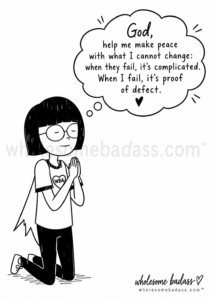
Black-and-white Wholesome Badass illustration of a woman kneeling in prayer with a thought bubble about making peace with unequal standards around failure.

Ordinary Failure

The archetypal persona seems to move through every telling of their own life with access to explanations they do not extend to anyone else. When they prevail, it reflects strength, intelligence, resilience, discernment, character. When they do not, the result still has to preserve something essential about who they are. Win or lose, the story protects against one ordinary possibility: that they simply did not have what the moment called for, or failed to handle it superbly. I continue, almost obsessively, returning to these archetypes, patterns, and systems because I am trying to identify the structure beneath them, with the hope that naming the whole may eventually matter more than cataloging its parts. Have you ever felt reduced to a flaw by someone who is never wrong, while every one of their own failures comes with a full explanation- like either the hero or the victim of circumstances, but never simply a person who dropped the ball? It is exhausting for someone like me.

Read More
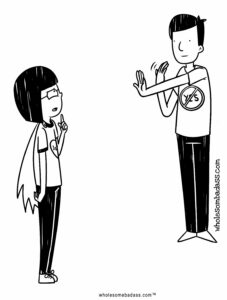
Black-and-white illustration of a girl facing a man whose right hand beckons her closer while his left hand signals stop.

The System with No Name

For most of my life, I could see the individual friction points but not the structure they shared. I experienced them as isolated interactions. A misunderstanding. A rupture. A person who was displeased with me (and seemingly intent on making me pay). A relationship I had somehow failed to navigate correctly. I explained. Apologized. Twisted myself. Worked harder. Questioned myself. Tried another approach (but still, tragically, as myself). There was the conviction that if I could just understand what I was missing, I could make myself fit. My life energy was wastefully consumed trying to navigate first my family of origin, then people and patterns that mimicked the dynamic where I was expected to want, feel, and need what I did not– and also agree to matter less. I realize nobody got handed the rules. For mainstream, untraumatized, neurotypical people, it seems to make sense and work. Expressing any version of no or ouch or confusion consistently resulted in friction. This was baffling to me, honestly. I seriously expected support or comfort, or maybe even some genuine interest. Now, after nearly six decades of swinging and missing by miles, I have begun to recognize patterns. Systems. Dynamics. Power imbalance. Coercion. All of it. I see now how easily familiarity masqueraded as normalcy. If a relational structure has been encoded deeply enough, it does not necessarily feel like a structure. It can simply feel like the way things, people, and relationships are—like water to a fish, not something experienced as a condition or even a variable, but simply the world as it is. And when the majority can function comfortably inside it, a person who cannot is what—a traitor, deviant, pariah? The person who does not go with THE FLOW is THE problem. Gosh—-That boxing-with-ghosts fucking energy- it was pure mind fuckery. I kept approaching each interaction as though there must be a successful response available to me. As though enough insight, enough humility, enough explanation, enough effort would eventually make the thing workable. It didn’t. What I am now able to do is name my experience of it—to take something that has remained amorphous and make it legible. Healing has helped me recognize systems that are damaging to me rather than inclusive or supportive, like FOR and not opposed to me. I can choose more carefully where I participate, what I adapt to, and what I no longer agree to organize myself around. Putting it into language demystifies it. Ideally, that helps someone else recognize the structure too—something that may have previously defied articulation andfelt like theirs alone. Like a shared truth. Are you also learning to recognize the systems and people who are for you—and those who are not?

Read More
Black-and-white line drawing of one person subtly tipping a bicyclist off balance while shrugging and thinking, “sheesh...always so dramatic.”

Rattle the Cage, Judge the Reaction

If I can rattle your cage and then stand beside your reaction looking calm and reasonable, I can create a defining contrast: you unstable; me credible. Your distress is excellent leverage. I get to have my way with you and come out looking better for it. Have you ever known someone with the kind of energy that would steal your wallet, watch you become rightfully upset, be the first to publicly comfort you and help search for it—and then somehow be the one to find it and hand it back? It is a hell of a trick to create friction, then step forward as the hero for managing the fallout. Have you ever experienced a situation where the focus immediately pivots from what happened to how you reacted—as if composure is evidence of innocence, reasonableness, or rightness?

Read More

Toxic and Nurturing Relationship Data

For most of my life, I didn’t even recognize healthy and unhealthy connection as distinct possibilities. Like a fish unaware of the water it’s swimming in, I understood relationships through the only environment I’d ever known. I had learned distorted definitions of love, safety, trust, and connection. What if the most important measure of love isn’t how much someone loves a person, but what happens in the experience of being loved by them? Family ties, intensity, chemistry, and intermittently good experiences aren’t evidence of a healthy relationship. I’m recognizing how toxicity can exist in the way a relationship functions—the architecture of the bond—not simply in either person. Someone may have an entirely different experience with a person than I did, particularly when admiration, usefulness, or reliance shapes how that person relates to them. When someone says, “I’ve never experienced them that way,” I recognize that may be true. What’s hurtful and inappropriate, is when their experience is intended to invalidate mine. Their experience doesn’t disprove mine, any more than mine disproves theirs. I’m describing the relationship I experienced, not issuing a verdict on every relationship that person has. I’m going to place my trust in the prevailing patterns over the peak moments and occasional exceptions. ♡ Feelings I Associate with Nourishing Love ♡ ☠ Feelings I Associate with Harmful Relationship Dynamics ☠ Healing ♡ Alienation-Division Soothing ♡ Diminished-Disregarded Safety ♡ Confused Growth ♡ Silenced Exploration ♡ Frightened Self-expression ♡ Power-imbalance Expansion ♡ Contracted Yes, I am the common denominator in all my relationships—as are we all. So is the relational template I carried into them. It influenced not only the relationships I entered, but what I helped create and sustain within them. That template shaped: I recognize my contribution to my relational patterns without taking ANY esponsibility for another person’s behavior.

Read More
Black-and-white Wholesome Badass illustration of a woman kneeling in prayer with a thought bubble about making peace with unequal standards around failure.

Ordinary Failure

The archetypal persona seems to move through every telling of their own life with access to explanations they do not extend to anyone else. When they prevail, it reflects strength, intelligence, resilience, discernment, character. When they do not, the result still has to preserve something essential about who they are. Win or lose, the story protects against one ordinary possibility: that they simply did not have what the moment called for, or failed to handle it superbly. I continue, almost obsessively, returning to these archetypes, patterns, and systems because I am trying to identify the structure beneath them, with the hope that naming the whole may eventually matter more than cataloging its parts. Have you ever felt reduced to a flaw by someone who is never wrong, while every one of their own failures comes with a full explanation- like either the hero or the victim of circumstances, but never simply a person who dropped the ball? It is exhausting for someone like me.

Read More
Black-and-white illustration of a girl facing a man whose right hand beckons her closer while his left hand signals stop.

The System with No Name

For most of my life, I could see the individual friction points but not the structure they shared. I experienced them as isolated interactions. A misunderstanding. A rupture. A person who was displeased with me (and seemingly intent on making me pay). A relationship I had somehow failed to navigate correctly. I explained. Apologized. Twisted myself. Worked harder. Questioned myself. Tried another approach (but still, tragically, as myself). There was the conviction that if I could just understand what I was missing, I could make myself fit. My life energy was wastefully consumed trying to navigate first my family of origin, then people and patterns that mimicked the dynamic where I was expected to want, feel, and need what I did not– and also agree to matter less. I realize nobody got handed the rules. For mainstream, untraumatized, neurotypical people, it seems to make sense and work. Expressing any version of no or ouch or confusion consistently resulted in friction. This was baffling to me, honestly. I seriously expected support or comfort, or maybe even some genuine interest. Now, after nearly six decades of swinging and missing by miles, I have begun to recognize patterns. Systems. Dynamics. Power imbalance. Coercion. All of it. I see now how easily familiarity masqueraded as normalcy. If a relational structure has been encoded deeply enough, it does not necessarily feel like a structure. It can simply feel like the way things, people, and relationships are—like water to a fish, not something experienced as a condition or even a variable, but simply the world as it is. And when the majority can function comfortably inside it, a person who cannot is what—a traitor, deviant, pariah? The person who does not go with THE FLOW is THE problem. Gosh—-That boxing-with-ghosts fucking energy- it was pure mind fuckery. I kept approaching each interaction as though there must be a successful response available to me. As though enough insight, enough humility, enough explanation, enough effort would eventually make the thing workable. It didn’t. What I am now able to do is name my experience of it—to take something that has remained amorphous and make it legible. Healing has helped me recognize systems that are damaging to me rather than inclusive or supportive, like FOR and not opposed to me. I can choose more carefully where I participate, what I adapt to, and what I no longer agree to organize myself around. Putting it into language demystifies it. Ideally, that helps someone else recognize the structure too—something that may have previously defied articulation andfelt like theirs alone. Like a shared truth. Are you also learning to recognize the systems and people who are for you—and those who are not?

Read More
Black-and-white line drawing of one person subtly tipping a bicyclist off balance while shrugging and thinking, “sheesh...always so dramatic.”

Rattle the Cage, Judge the Reaction

If I can rattle your cage and then stand beside your reaction looking calm and reasonable, I can create a defining contrast: you unstable; me credible. Your distress is excellent leverage. I get to have my way with you and come out looking better for it. Have you ever known someone with the kind of energy that would steal your wallet, watch you become rightfully upset, be the first to publicly comfort you and help search for it—and then somehow be the one to find it and hand it back? It is a hell of a trick to create friction, then step forward as the hero for managing the fallout. Have you ever experienced a situation where the focus immediately pivots from what happened to how you reacted—as if composure is evidence of innocence, reasonableness, or rightness?

Read More