Wholesome Badass

A Work in Progress — Healing from All the Things​

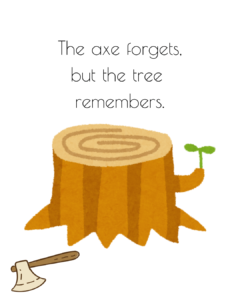
Chopped down tree symbolizing the lasting impact of family betrayal and parental alienation.

When Family Betrayal Pulls Young Children Into the Middle

At a very tense Mother’s Day gathering in 2016, I learned that my niece’s graduation was less than four weeks away and on the same night as a concert I had already committed to. The tickets had been a Valentine’s Day gift and the plans had been in place for months. It wasn’t that I chose a concert over her graduation. I simply already had plans by the time I was given the date. With no other way to get my boys to the graduation, and valuing the opportunity for family that being there would give them, I sent them with their dad. Even then, I sensed it could be a fatal choice. Later, my mother told me that while they were at the graduation, plans began for a birthday gathering for my son that would intentionally exclude me. Whatever was happening between the adults, I had directly and repeatedly asked that it stay there, and that we do the work of repair. Something in the fabric of my universe was torn beyond repair. Whatever else may be true, this also happened. I’ve been accused of being negative- always imagining the worst. Maybe I was never imagining the worst. Maybe I’m recognizing and recalling what I have lived. Have you ever been called negative for noticing a pattern that later proved real?
Read More
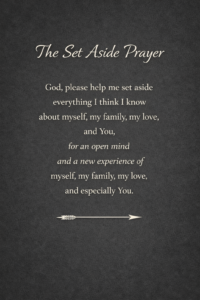
Minimalist graphic displaying the Set Aside Prayer about letting go of assumptions to allow openness, healing, and alignment

The Logic of Familiarity

Looking back, I notice how often I gravitated toward people who couldn’t tolerate my pain but expected the world to organize itself around their pleasure. When they were uncomfortable, everyone rushed to soothe them. What’s especially painful is this: humanity was withdrawn from me when I was small and needed it most. There was a kind of protected harm at work. Each time I struggled, my sister’s standing rose, and my mother’s case against me grew. Anyone could see how that drove beliefs about worth and entitlement—how my suffering had been useful to my sister. She was not only pitied and comforted when I suffered, but rewarded for not being me. It has been like this since my first breath. And I repeated this dynamic in which I consent to mattering less, in almost every relationship I chose. There were exceptions. Sweet Greg. The love bomber, obviously. And the sweetheart I’m seeing now—kind, present, generous, not looking for a reason to deny my comfort or my reality. Still, nothing replaces a family that shelters you—parents, a big sister, your own children. I remember when we moved here and my mother and sister swooned over how sweet my boys were, what a good mother I was. Even that disrupted the familiar roles. Me forming a family of my own threatened a long-standing narrative: one child – the problem, another elevated in contrast, and a mother sustained by sympathy for having such a difficult child. Looking back, it’s devastating to see how carefully that arrangement was preserved. The measures I go to in order to heal, recover, and live, seems diametrically opposed to those to whom I’m genetically linked. I read this the other day: “The way is the goal.” It captures it perfectly. It reminds me of the Set Aside Prayer—and of one of my favorite tattoos: the word –align– inside of an arrow.

Read More
Thomas Merton quote about abundance and deprivation, reflecting themes of emotional neglect, trauma, and inherited power dynamics

My Trajectory- The Matthew Effect

The Path that Formed Me I didn’t “pick bad people.” I picked familiar nervous systems—people whose emotional vacancy felt like home, because that’s what I learned from the people I loved and needed most. I’m tracing a path laid out long before I understood it. Neurodivergent, highly sensing, physically and emotionally reactive to things others barely notice. My discomfort didn’t fit the acceptable range. It wasn’t seen as different, but as wrong. And the fear of consequences for that discomfort made every moment fretful. My mother couldn’t tolerate the burden of learning how to comfort, nurture, and shelter me. So I was cast as “too sensitive,” “dramatic,” “manipulative,” “too much,” and later, “crazy.” Once she offloaded the responsibility of soothing me by turning it into judgment—impossible, ungrateful—others eagerly joined in: her mother, her brother, then my sister. Any sign of pain, need, or boundary was met with distance, disgust, silence, shunning. Instead of bridging me to support, she ostracized me—building a wall around me. I see now the water I was swimming in. And my boys were bathed in it too. “For unto every one that hath shall be given, and he shall have abundance: but from him that hath not shall be taken away even that which he hath.”—Thomas Merton

Read More
Woman with half her face visibly distressed and tearful, the other half covered by a composed mask of her own face, symbolizing emotional masking and how composure is rewarded while distress is invalidated.

When “What Are You So Angry/Upset About?” Isn’t Actually Concern

I’m finally recognizing how validity gets measured not necessarily by the truth of what’s said, but by the composure of the person saying it. My sister recognized this dynamic early on. As someone deeply sensitive and reactive, I was easy to push. She could use subtle, almost invisible cues—like dog whistles—to trigger me. When I reacted, my distress was visible. She soared, by contrast, appearing calm, composed. The comparison was stark: her unaffectedness made her look right, while my emotional presentation made me look wrong. If you’re overwhelmed, overstimulated, or visibly distressed, your words can be dismissed simply because the delivery isn’t “correct.” You’re invalidated—not for what you say, but for failing to mask emotion. Meanwhile, those who appear composed—whether less sensitive, more resilient, or simply checked out—are granted credibility. In conflict, content matters less than presentation. This dynamic is often weaponized. A question like, “What are you so angry about?” masquerades as concern but functions as control, subtly discrediting the other person. In closed systems—family, workplace, or community—the sensitive one easily becomes the scapegoat. Sensitivity is reframed as weakness, instability, or unreliability. Any emotional communication that challenges the status quo is disqualified before it’s even heard, dismissed not for its substance but for the unmasked feelings attached. Composure paraded as proof of virtue; sensitivity condemned as proof of sin.

Read More
Closed interior door with a narrow line of light beneath it, representing the experience of being shut out while continuing to endure, witness, and remain present.

Scapegoating and the Cost of Speaking Up

The Truth That Cannot Be Erased For over a decade, this space has been my witness. For a multitude of reasons, outside of what has been designated as my willfullness and lack of gratitude, I have never been a pleasing or “quiet” victim sufferer. By around age eleven, I understood that my highest goal in life was to become someone else—or to become more palatable while absorbing abuse. I failed equally at both. I sought and gave myself to many similarly toxic situationships, I suppose, in the name of practice and growth in the art of better abuse-getting. The Reality of the Scapegoat As a neurodivergent survivor of childhood trauma and sibling molestation, my so-called “hysteria” was the only language available to me in an environment that protected my abuser and pathologized my pain. My sister was endorsed as the golden child. I was left to navigate the wreckage of her actions alone. She was praised for not being like me and pitied for having to deal with my “drama.” The Refusal to Be Gaslit This blog documents my experience as the family scapegoat—the person who could not believe or pretend that the “flow” was good. I was encouraged to calm down, be positive, grateful, you know- JUST go with the flow, even when that flow was designed to drown me. A Legacy of Resistance My “tantrums” were protests. My “outbursts” were the sound of a person being erased in real time. I write about the dirty and unsurprising alliance between an abusive sister and a similarly narcissistic ex-husband for what it is: a coordinated effort which denied me peace and my children. The Record for My Sons I am not begging for a seat at a table where I am not respected. I keep this record so my children may one day understand that their mother was not “unhinged” simply as a defect. She was unsupported, overstimulated, and being crushed by a system she could not fathom. A Note on My Methods of Survival In earlier chapters, I used my sister’s full name and shared specific accounts of professional and personal abuse, including details she offered as warning shots about how she handles uncooperative others. I did this frantically, without a playbook on navigating coercive abuse or even any idea that coercive abuse was a thing. I did so without a support system. I am not proud of the desperation that shaped those posts. But I am not ashamed of how I reacted to being molested, scapegoated, and erased. I was a person without a net, doing the only that I could—telling my truth- raging against those who harmed and silenced and erased me. In the only space I can.

Read More
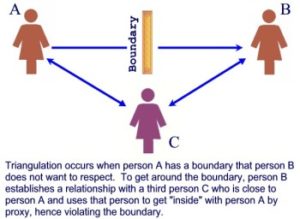
Diagram explaining triangulation, showing how indirect communication through a third party creates division, misalignment, and power imbalance in relationships.

The Quiet Damage of Triangulation

Over the years, my children’s father, my mother, and my sister communicated and met without me. This alliance was formed in the shadows. There was no pre‑existing relationship between my mother or sister and the man I divorced. These gatherings included my children and happened during a period of high conflict with their father. Repeated triangulation and exclusion carried their own message. Exclusion normalized the idea that my voice was optional and my value as a parent was nil. Without instruction or explanation, my children learned—through behavior, not words—that distancing from their mother was acceptable. Disregard was modeled in many ways. Repeatedly. What followed was cumulative. Indoctrination. This is not an assessment of intent. It is an account of what occurred and the impact. I’m fairly certain there’s no coming back from this. I will either die trying or not trying. I see this pattern at home and at work. It’s everywhere: a with‑me‑or‑against‑me logic where the desire for control or reverence outweighs repair, image eclipses truth, and those who question—even in good faith—are made to pay.

Read More
Black-and-white illustration of a woman isolated behind a wall as family members reinforce the divide, symbolizing triangulation and parental alienation.

Your Enemy’s Enemy Is Your Friend

Being publicly told “you’re welcome to join” by people who openly disregard and disrespect me is hardly evidence of genuine inclusion. The invitation is presented as evidence of goodwill, while my condition of repair before returning is presented as proof that I’m choosing to separate myself from the family. No contact was a tragic last resort. There’s something particularly cruel about weaponizing my decision to protect myself from further harm. Years after a loveless, volatile marriage and unnecessarily contentious divorce, my estranged sister and ex-husband established an alliance of their own. I had married a man whose emotional patterns mirrored my sister’s, recreating the same relational dynamic. Given their shared, longstanding patterns of divisive behavior, their alliance was hardly surprising. They began gathering with my children while excluding me, despite my repeated requests that my sister stop. The resulting division extended beyond my relationships with either of them, affecting my children, our co-parenting relationship, and my already strained relationship with my mother. As my mother liked to say, “Your enemy’s enemy is your friend.” Whatever their intentions or explanations, their words and actions hurt our family. That harm was not mitigated by context or justification.

Read More

Letter to Mother and Sister

I will assume your silence means you need more space at this time.  I look forward to a time where we may each communicate openly and kindly.  I would like to try, when we are all ready.  My willingness to heal and recover any level of trust and connection remains.  I can be patient and without being oblivious to the reality of the ticking clock and the passing days which feel daunting, and change nothing. I hope you are all well and hope that I will be notified otherwise. Always, M(and the boys):  WE are here. This is pretty standard content for my emails.  The standard response is silence or condemnation.  I send these emails to affirm for myself that if my mother passes without further or healed contact and connection with me, it is absolutely not due to a lack of effort or willingness from my end.  Acceptance.  Acceptance.  Acceptance.  My sister’s shaming character assassination, uncontested by cc-d  family members, in addition to  my ex’s family, following her dinner which was kept secret from me, is something I forgive but do not accept as something that is ok or deserved.  Neutrality at this point is not an option.  Any effort will either de-escalate or intensify the situation.  My mother is recovering from health issues at age 84 and I moved cross country 2 years ago to be here-for her.  I still want that, free from abuse and shaming. Acceptance is for badasses and totally wholesome.  I re-commit by the minute to the acceptance of the fact that I am powerless to make things be different.  These are my most wholesome efforts.  It is my belief that what has passed between us demands an honest reckoning.  I will wait.  ♥

Read More
Chopped down tree symbolizing the lasting impact of family betrayal and parental alienation.

When Family Betrayal Pulls Young Children Into the Middle

At a very tense Mother’s Day gathering in 2016, I learned that my niece’s graduation was less than four weeks away and on the same night as a concert I had already committed to. The tickets had been a Valentine’s Day gift and the plans had been in place for months. It wasn’t that I chose a concert over her graduation. I simply already had plans by the time I was given the date. With no other way to get my boys to the graduation, and valuing the opportunity for family that being there would give them, I sent them with their dad. Even then, I sensed it could be a fatal choice. Later, my mother told me that while they were at the graduation, plans began for a birthday gathering for my son that would intentionally exclude me. Whatever was happening between the adults, I had directly and repeatedly asked that it stay there, and that we do the work of repair. Something in the fabric of my universe was torn beyond repair. Whatever else may be true, this also happened. I’ve been accused of being negative- always imagining the worst. Maybe I was never imagining the worst. Maybe I’m recognizing and recalling what I have lived. Have you ever been called negative for noticing a pattern that later proved real?

Read More
Minimalist graphic displaying the Set Aside Prayer about letting go of assumptions to allow openness, healing, and alignment

The Logic of Familiarity

Looking back, I notice how often I gravitated toward people who couldn’t tolerate my pain but expected the world to organize itself around their pleasure. When they were uncomfortable, everyone rushed to soothe them. What’s especially painful is this: humanity was withdrawn from me when I was small and needed it most. There was a kind of protected harm at work. Each time I struggled, my sister’s standing rose, and my mother’s case against me grew. Anyone could see how that drove beliefs about worth and entitlement—how my suffering had been useful to my sister. She was not only pitied and comforted when I suffered, but rewarded for not being me. It has been like this since my first breath. And I repeated this dynamic in which I consent to mattering less, in almost every relationship I chose. There were exceptions. Sweet Greg. The love bomber, obviously. And the sweetheart I’m seeing now—kind, present, generous, not looking for a reason to deny my comfort or my reality. Still, nothing replaces a family that shelters you—parents, a big sister, your own children. I remember when we moved here and my mother and sister swooned over how sweet my boys were, what a good mother I was. Even that disrupted the familiar roles. Me forming a family of my own threatened a long-standing narrative: one child – the problem, another elevated in contrast, and a mother sustained by sympathy for having such a difficult child. Looking back, it’s devastating to see how carefully that arrangement was preserved. The measures I go to in order to heal, recover, and live, seems diametrically opposed to those to whom I’m genetically linked. I read this the other day: “The way is the goal.” It captures it perfectly. It reminds me of the Set Aside Prayer—and of one of my favorite tattoos: the word –align– inside of an arrow.

Read More
Thomas Merton quote about abundance and deprivation, reflecting themes of emotional neglect, trauma, and inherited power dynamics

My Trajectory- The Matthew Effect

The Path that Formed Me I didn’t “pick bad people.” I picked familiar nervous systems—people whose emotional vacancy felt like home, because that’s what I learned from the people I loved and needed most. I’m tracing a path laid out long before I understood it. Neurodivergent, highly sensing, physically and emotionally reactive to things others barely notice. My discomfort didn’t fit the acceptable range. It wasn’t seen as different, but as wrong. And the fear of consequences for that discomfort made every moment fretful. My mother couldn’t tolerate the burden of learning how to comfort, nurture, and shelter me. So I was cast as “too sensitive,” “dramatic,” “manipulative,” “too much,” and later, “crazy.” Once she offloaded the responsibility of soothing me by turning it into judgment—impossible, ungrateful—others eagerly joined in: her mother, her brother, then my sister. Any sign of pain, need, or boundary was met with distance, disgust, silence, shunning. Instead of bridging me to support, she ostracized me—building a wall around me. I see now the water I was swimming in. And my boys were bathed in it too. “For unto every one that hath shall be given, and he shall have abundance: but from him that hath not shall be taken away even that which he hath.”—Thomas Merton

Read More
Woman with half her face visibly distressed and tearful, the other half covered by a composed mask of her own face, symbolizing emotional masking and how composure is rewarded while distress is invalidated.

When “What Are You So Angry/Upset About?” Isn’t Actually Concern

I’m finally recognizing how validity gets measured not necessarily by the truth of what’s said, but by the composure of the person saying it. My sister recognized this dynamic early on. As someone deeply sensitive and reactive, I was easy to push. She could use subtle, almost invisible cues—like dog whistles—to trigger me. When I reacted, my distress was visible. She soared, by contrast, appearing calm, composed. The comparison was stark: her unaffectedness made her look right, while my emotional presentation made me look wrong. If you’re overwhelmed, overstimulated, or visibly distressed, your words can be dismissed simply because the delivery isn’t “correct.” You’re invalidated—not for what you say, but for failing to mask emotion. Meanwhile, those who appear composed—whether less sensitive, more resilient, or simply checked out—are granted credibility. In conflict, content matters less than presentation. This dynamic is often weaponized. A question like, “What are you so angry about?” masquerades as concern but functions as control, subtly discrediting the other person. In closed systems—family, workplace, or community—the sensitive one easily becomes the scapegoat. Sensitivity is reframed as weakness, instability, or unreliability. Any emotional communication that challenges the status quo is disqualified before it’s even heard, dismissed not for its substance but for the unmasked feelings attached. Composure paraded as proof of virtue; sensitivity condemned as proof of sin.

Read More
Closed interior door with a narrow line of light beneath it, representing the experience of being shut out while continuing to endure, witness, and remain present.

Scapegoating and the Cost of Speaking Up

The Truth That Cannot Be Erased For over a decade, this space has been my witness. For a multitude of reasons, outside of what has been designated as my willfullness and lack of gratitude, I have never been a pleasing or “quiet” victim sufferer. By around age eleven, I understood that my highest goal in life was to become someone else—or to become more palatable while absorbing abuse. I failed equally at both. I sought and gave myself to many similarly toxic situationships, I suppose, in the name of practice and growth in the art of better abuse-getting. The Reality of the Scapegoat As a neurodivergent survivor of childhood trauma and sibling molestation, my so-called “hysteria” was the only language available to me in an environment that protected my abuser and pathologized my pain. My sister was endorsed as the golden child. I was left to navigate the wreckage of her actions alone. She was praised for not being like me and pitied for having to deal with my “drama.” The Refusal to Be Gaslit This blog documents my experience as the family scapegoat—the person who could not believe or pretend that the “flow” was good. I was encouraged to calm down, be positive, grateful, you know- JUST go with the flow, even when that flow was designed to drown me. A Legacy of Resistance My “tantrums” were protests. My “outbursts” were the sound of a person being erased in real time. I write about the dirty and unsurprising alliance between an abusive sister and a similarly narcissistic ex-husband for what it is: a coordinated effort which denied me peace and my children. The Record for My Sons I am not begging for a seat at a table where I am not respected. I keep this record so my children may one day understand that their mother was not “unhinged” simply as a defect. She was unsupported, overstimulated, and being crushed by a system she could not fathom. A Note on My Methods of Survival In earlier chapters, I used my sister’s full name and shared specific accounts of professional and personal abuse, including details she offered as warning shots about how she handles uncooperative others. I did this frantically, without a playbook on navigating coercive abuse or even any idea that coercive abuse was a thing. I did so without a support system. I am not proud of the desperation that shaped those posts. But I am not ashamed of how I reacted to being molested, scapegoated, and erased. I was a person without a net, doing the only that I could—telling my truth- raging against those who harmed and silenced and erased me. In the only space I can.

Read More
Diagram explaining triangulation, showing how indirect communication through a third party creates division, misalignment, and power imbalance in relationships.

The Quiet Damage of Triangulation

Over the years, my children’s father, my mother, and my sister communicated and met without me. This alliance was formed in the shadows. There was no pre‑existing relationship between my mother or sister and the man I divorced. These gatherings included my children and happened during a period of high conflict with their father. Repeated triangulation and exclusion carried their own message. Exclusion normalized the idea that my voice was optional and my value as a parent was nil. Without instruction or explanation, my children learned—through behavior, not words—that distancing from their mother was acceptable. Disregard was modeled in many ways. Repeatedly. What followed was cumulative. Indoctrination. This is not an assessment of intent. It is an account of what occurred and the impact. I’m fairly certain there’s no coming back from this. I will either die trying or not trying. I see this pattern at home and at work. It’s everywhere: a with‑me‑or‑against‑me logic where the desire for control or reverence outweighs repair, image eclipses truth, and those who question—even in good faith—are made to pay.

Read More
Black-and-white illustration of a woman isolated behind a wall as family members reinforce the divide, symbolizing triangulation and parental alienation.

Your Enemy’s Enemy Is Your Friend

Being publicly told “you’re welcome to join” by people who openly disregard and disrespect me is hardly evidence of genuine inclusion. The invitation is presented as evidence of goodwill, while my condition of repair before returning is presented as proof that I’m choosing to separate myself from the family. No contact was a tragic last resort. There’s something particularly cruel about weaponizing my decision to protect myself from further harm. Years after a loveless, volatile marriage and unnecessarily contentious divorce, my estranged sister and ex-husband established an alliance of their own. I had married a man whose emotional patterns mirrored my sister’s, recreating the same relational dynamic. Given their shared, longstanding patterns of divisive behavior, their alliance was hardly surprising. They began gathering with my children while excluding me, despite my repeated requests that my sister stop. The resulting division extended beyond my relationships with either of them, affecting my children, our co-parenting relationship, and my already strained relationship with my mother. As my mother liked to say, “Your enemy’s enemy is your friend.” Whatever their intentions or explanations, their words and actions hurt our family. That harm was not mitigated by context or justification.

Read More

Letter to Mother and Sister

I will assume your silence means you need more space at this time.  I look forward to a time where we may each communicate openly and kindly.  I would like to try, when we are all ready.  My willingness to heal and recover any level of trust and connection remains.  I can be patient and without being oblivious to the reality of the ticking clock and the passing days which feel daunting, and change nothing. I hope you are all well and hope that I will be notified otherwise. Always, M(and the boys):  WE are here. This is pretty standard content for my emails.  The standard response is silence or condemnation.  I send these emails to affirm for myself that if my mother passes without further or healed contact and connection with me, it is absolutely not due to a lack of effort or willingness from my end.  Acceptance.  Acceptance.  Acceptance.  My sister’s shaming character assassination, uncontested by cc-d  family members, in addition to  my ex’s family, following her dinner which was kept secret from me, is something I forgive but do not accept as something that is ok or deserved.  Neutrality at this point is not an option.  Any effort will either de-escalate or intensify the situation.  My mother is recovering from health issues at age 84 and I moved cross country 2 years ago to be here-for her.  I still want that, free from abuse and shaming. Acceptance is for badasses and totally wholesome.  I re-commit by the minute to the acceptance of the fact that I am powerless to make things be different.  These are my most wholesome efforts.  It is my belief that what has passed between us demands an honest reckoning.  I will wait.  ♥

Read More