Wholesome Badass

A Work in Progress — Healing from All the Things​

Black-and-white cartoon of Wholesome Badass in a jujutsu stance, holding up a glowing shield against dark arrows and scribbles. A speech bubble says, “But here’s what also happened.”

The Power of an Incomplete Truth

In my tagline, I reveal myself as navigating the storm of neurodivergence, trauma, and toxic family systems. For the archetypes with whom I have navigated strife or rupture, I imagine this perspective may feel unwelcome because it adds context to a much simpler explanation: I was just bad. Difficult. Crazy. Selfish. Unreasonable. Context provides nuance that the simpler explanation leaves out. Whatever may have been said or done to diminish me was charged to me: I caused it, deserved it, exaggerated it, or imagined it. The tagline isn’t an attempt to excuse myself, but the closest language I have found for an experience I spent decades unable to articulate. Naming neurodivergence, trauma, and a dysfunctional family system does not make every choice I have ever made harmless, good, or right. It allows nuance into a story where my context was effectively disregarded. And I can’t help but ask, in all earnestness: if my “craziness” was the explanation for every instance of hardship for me, why wasn’t anyone’s response concern, curiosity, or support? What I am chasing is not agreement but a fuller record. More of what actually happened allowed into the room. Other people’s explanations have passed for the complete story, while mine were categorically rejected as inadmissible. If I asked questions, I was manufacturing chaos. If I offered context, I was making excuses. If I remembered something differently, I was rewriting history. I was seeking a clean signal—clarity, cohesion, some way to sew the pieces together for a story that makes sense, even if what emerged was painful or unflattering to me. Apparently, asking clarifying questions seems to threaten the prescribed narrative. Providing context is recieved as equally troublesome. So I am left trying to make sense of a story I was expected to accept, while relevant context was not allowed into consideration. Have you ever realized that what seemed like the only obvious conclusion was actually inaccurate and deeply unfair — once you had a more complete account of the story? One real-life example: I’m in a hurry and stuck behind a man in a posh new Jaguar, stopped in the road and holding up traffic for what I assume is no good reason—just entitled and inconsiderate. Then I SEE he has gotten out of his car to help a disabled elderly person with a heavy package cross the street. Nothing about the stopped car changed. The context did. I feel some of that same aha humbling energy when I think about people like Howard Stern, Monica Lewinsky, Stormy Daniels, Pamela Anderson, and others whom I experienced through a particular public narrative without bothering to question what might have been missing from it. Sometimes the framing was profitable. Sometimes powerful people had an enormous stake in which version prevailed. Either way, I accepted a conclusion before I had much interest in the fuller record. Just saaaaayin.

Read More
Black-and-white cartoon of a woman asking if something is wrong. Another woman denies it, then meets privately with two others to discuss a folder labeled “The Problem With Her.”

When the Narrative Outranks What Happened

The Alchemy of the Unexitable Loop: Someone behaves toward you in bullying, degrading, diminishing, or disruptive ways, then denies it or explains it as a consequence of who you are. Literally: they turn their own behavior into evidence against you. I am wired to sense shifts in energy. I don’t mean that in some mystical way, and I don’t mean that I am being paranoid. I am attuned at a sensory and emotional level to things other people may have the luxury of not noticing. Cold, detached silence. Avoidant eye contact. Being ignored. A change in tone. The almost imperceptible shift from being in connection with someone to being very clearly outside of it. And because nothing had been indicated, I would ask. What’s wrong? Nothing. And the coldness intensified. Naturally I would ask again. So fkn earnest. And now the inquiry itself was the only issue. Suddenly there was something concrete to point to: my questioning. My inability to leave it alone. My insistence that something was wrong when I had been clearly told there wasn’t. And there is the loop. I experienced the tension. I inquired directly. My asking was labeled as escalation. The heightened tension was then used to explain the tension I had originally asked about. Therefore, apparently, I had imagined it. Or caused it. Or manufactured chaos where none had existed. And now my behavior could justify whatever came next. There was no direct confrontation. No, “I’m angry with you.” No, “I didn’t love that.” No, “Can we talk about what happened?” No good-faith request to understand. Not even a simple statement of displeasure. At least not to me. The displeasure was expressed elsewhere, to others. So while insisting that nothing was wrong, an entirely different conversation could be unfolding outside of my participation. Because gossip and triangulation are somehow more dignified and “peace-keeping” than openly addressing friction? There was no opportunity to acknowledge the discord, clarify anything, take responsibility for what was actually mine, or repair the relationship. Instead, the grievance traveled laterally. Triangulation. Gossip. Division. And if it eventually did come directly to me, it wasn’t offered as information that might help us understand each other. It came with teeth, delivered for maximum injury. Not: Here is what landed poorly for me. More: Here is what is wrong with you. There was a negative space where repair should have happened, while a narrative developed without me. By then, the equation was complete. I had detected something I wasn’t supposed to detect. I had asked about something I was told wasn’t happening. My asking was cast as evidence that I had created the problem. And having created the problem, I had apparently earned whatever harmful thing followed. Another person’s harmful reaction gets explained entirely by my character. That’s the alchemy. Have you ever been in a relationship with someone whose coldness you could feel, but when you asked what was wrong, you were told nothing? And asking only made things worse. Whatever happened next was regarded only as the thing you had coming to you. For being this way. Literally: their behavior gets reassigned to your character.

Read More
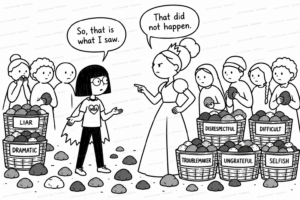
Black-and-white cartoon of a girl describing what she witnessed while a stern woman denies it. Villagers hold baskets of stones labeled liar, dramatic, selfish, ungrateful, and disrespectful, illustrating gaslighting and scapegoating.

When Harm Wears a Virtuous Mask

Whatever is said or believed about me does not change what was said and done. I keep coming back to the possibility that the golden child can occupy the position of a protected abuser. So much of my childhood was lost in the shadow of what happened with my female sibling, older than me by 7 years. Decades later, she came for my children. I am only beginning to recognize the correlation between the two. Not identical acts. A familiar code. She acts. I object. My objection is treated as the offense. My experience is displaced. Her version is granted authority. Others are drawn in. Her position remains protected. Mine grows increasingly difficult to hold without defending myself. She was afforded the identity and cover of “good,” while I was named a menace for directly objecting and emotionally reacting to behavior that was, in fact, objectionable by almost any standard. She was able to compromise me in plain sight from behind the protective shield of who everyone believed her to be. It was never-ending. From the outside, it must have looked as if I were crazy—boxing with ghosts. People could see my distress. They could not see the quiet dog whistles, unwanted touching, exclusions, implications, and positioning I was responding to. And I can say now that I was fucking crazed by what was happening—not only because it was harmful, but because the harm was denied and protected. The asymmetry was brutal: one person retained the cover of goodness while my visible distress was treated as if it had appeared out of nowhere- a thing I elected to do. My reaction was indeed spectacular. What preceded it remained invisible. Maybe that is part of what I am processing now. For decades, people must have thought, Yikes. What is wrong with her? I have spent years interrogating that question too. Only recently have I become more interested in a different question: What happened to her, to lil Magda? Why is it easier to ask what is wrong with someone than to ask what happened to them? The first question leaves the existing narrative intact. The second invites examination. It is a fascinating pattern: harm can be easily masked by a role, a reputation, even an act that looks virtuous from across the room. A person can be doing harm while being protected by the belief that they are good. Years later, I would be profoundly affected by a pastor whose attention felt like the most extraordinary care. I can see now how I had been groomed to mistrust my own perception, particularly when harm came through someone occupying a role presumed to be protective—a shepherd, someone understood to be good, trustworthy, and morally authoritative. I keep thinking of the line, “Not all villains wear black.” There is an almost absurd irony in that for me: I tend to dress mostly in black, while my female sibling favors white. hmmmm…. I don’t think clothing color informs us of character, of course. Have you ever watched harmful behavior happen in plain sight while others showed and spoke no objection – maybe because of the status, influence, or authority of the person doing it, or the lesser status of the person being harmed—so that neutrality itself functioned as permission? What is that even called? It reminds me of that scene in Boardwalk Empire where a priest appears to be baptizing a man in front of the entire church. What everyone else sees is a sacred ritual performed by someone occupying one of the most trusted positions in the room. What is actually happening is murder.

Read More
Flames burning a bridge, symbolizing narcissistic family conflict and broken relationships.

Family Betrayal in Plain Sight (repost from 2017)

In 2008, I visited North Carolina for a therapy session with my mother and sister. It went poorly. Tragically. Since, we each showed up with the intent to assess only my behaviors and personality. I miscarried. And that was the least of the devastation. For obvious reasons, I was unable to rally for a neighborhood trick-or-treat parade with my sister and her family. I needed time and space to rest and grieve the tragedy of that session, my family, and the loss of a pregnancy while nursing and caring for my 10-month-old. And was accused of denying my nieces access to their cousin. My 10-year-old niece and I had been emailing and enjoying each other regularly. I would have liked seeing her and her sister under different circumstances. Rather than facing our issues directly, my sister sent a birthday gift addressed to my one-year-old son with a typed note inside telling me not to interact with her girls until we had worked things out as a family. I found it years later while purging for an upcoming move. A declaration of war, not an invitation to peace. The standard response to a boundary or me trying to inhabit my own space. NOTE: The alliance between my sister and my ex was not left over from when we were married. There was no contact or connection while married—we lived on opposite coasts and were estranged. An alliance formed while he and I were struggling as divorced co-parents after what had been a hard-won improvement following our high-conflict divorce. She tried to erase me while accusing me of abandoning family. She divided nieces from their aunt, my mother from me, and increasingly inserted herself into the relationship between my ex-husband and me. My sons witnessed the escalating tension between their mother and father involving her. What they wanted more than anything was the possibility that Mom and Dad could work together and sit together at a meal or occasion. Instead, she fanned the flames of division…… the pattern. All inthe name of her brand of love. I could not pretend. And I cleanly, clearly, and repeatedly presented myself for healing and repair. It was easy to convince me that it was my imagination or my fault without the written record. I do not earn, cause, deserve, or imagine the horror of having been her younger sister. Whatever else may be true, this is my experience.

Read More
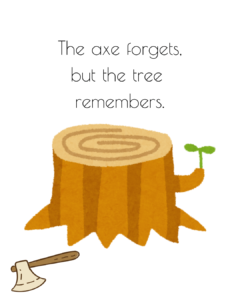
Chopped down tree symbolizing the lasting impact of family betrayal and parental alienation.

When Family Betrayal Pulls Young Children Into the Middle

At a very tense Mother’s Day gathering in 2016, I learned that my niece’s graduation was less than four weeks away and on the same night as a concert I had already committed to. The tickets had been a Valentine’s Day gift and the plans had been in place for months. It wasn’t that I chose a concert over her graduation. I simply already had plans by the time I was given the date. With no other way to get my boys to the graduation, and valuing the opportunity for family that being there would give them, I sent them with their dad. Even then, I sensed it could be a fatal choice. Later, my mother told me that while they were at the graduation, plans began for a birthday gathering for my son that would intentionally exclude me. Whatever was happening between the adults, I had directly and repeatedly asked that it stay there, and that we do the work of repair. Something in the fabric of my universe was torn beyond repair. Whatever else may be true, this also happened. I’ve been accused of being negative- always imagining the worst. Maybe I was never imagining the worst. Maybe I’m recognizing and recalling what I have lived. Have you ever been called negative for noticing a pattern that later proved real?

Read More
A crowd beside a woman standing alone, illustrating what it feels like when someone more influential controls the narrative and everyone believes their version.

The Power of Controlling the Narrative

Something does not become untrue because somebody more influential tells the story differently. I have spent a lot of my life attempting to reconcile the version of events that prevailed with my lived experience. Influence seems to determine which version is adopted and repeated. A person with more influence can shape or manipulate how events are understood. Their version becomes the more widely accepted narrative. And those under that person’s influence tend to organize around it, as THE truth. It shapes who is protected. Who is believed. Who gets the benefit of the doubt. Who belongs. And sometimes, for one person to remain elevated within that narrative, somebody else has to occupy the lesser position. Less credible. Less valid. Easier to dismiss. Then anything that person shares of what happened gets heard through what has already been established about them—and becomes, at some level, inadmissible. That’s the part—that part right there. You are not only trying to process and overcome what happened. You’re trying to tell it from a position where your credibility has already been diminished. Whatever else may be true, this also happens. A narrative can do more than determine what gets believed. It can determine who remains protected and included—and who becomes increasingly easy to disregard, diminish, and exclude. How much of what we believe about someone comes from what we have actually experienced with them, and how much was already decided for us by the story we were handed?

Read More
An empty courtroom with light shining across the judge's bench and the words, "When the aggressor occupies the protected position ..." superimposed over the image.

The Protected Position

Something began when I was four years old, and it was reinforced, repeated, normalized, and sustained over the course of decades. The injury wasn’t only the abuse itself. It was also the fact that the person who harmed me was favored, protected, believed, accommodated, and repeatedly restored to a position of legitimacy while I was not. Something bad happened, and the person who did it continued to occupy a protected position while my reality (moments of distress) was judged, minimized, and dismissed. When that happens over and over again, year after year, it makes sense that I began to feel as though my validity, agency, credibility, and even my right to define my own experience had been stripped away. For a very long time, I located the center of gravity in my mother. Now I am considering the possibility that my sister occupied a much more influential position than I had been able to discern. Six and a half years older than me, she was the first grandchild, the first niece, and the favored child. Then came Magda, the last grandchild: highly sensitive, tightly wound, easily activated, and in need of inconvenient soothing. My sensitivity was dismissed as performance. “Quit performing. Stop being dramatic, hysterical, manipulative. Stop trying to get attention.” Nobody taught me how to cope with difficulty, tolerate discomfort, or regulate my nervous system. I think my sister learned that there was power in being able to suck it up and may even have come to feel martyred by it. By keeping me dysregulated through taunting, provocation, and unwanted touching, she gained traction through the contrast in presentation. She appeared composed while I appeared reactive, and ours was a family with very little capacity for visible, observable, unhidable struggle. As I continue to heal, I find myself repeatedly encountering variations of this same pattern. There is a certain kind of personality that seems to require constant elevation, admiration, accommodation, and preferential treatment, and there is a predictable response to anyone whose presence threatens to divert attention from that arrangement. The archetype itself is hardly new. If only authority were evidence of integrity and virtue. If only age, status, confidence, accomplishment, popularity, or proximity to power guaranteed goodness. I was placed on this trajectory at the age of four, and now I am doing the work required to change direction. I am learning to recognize the pattern that I know so well and, without vigilance, continue to mistake for love, safety, familiarity, and home. The familiarity calls to me. Like an old glove, it simply fits. I recognize now that familiarity and safety are not the same thing. Whatever else may be true, this also happened.

Read More
Illustration of two one woman sharing details of someone else's private struggle. And being praised for kind thoughtfulness. The woman they are discussing sits nearby, unaware.

The Irony of Weaponized Concern

The Reality of Gossip Discussing the details of someone else’s life—their hardships, their choices, or how they live—is a fundamentally unwholesome practice. Gossip happens, and we can be honest about that and not pretend that engaging in it is useful, considerate, or kind.  The “Concerned” Persona So it is fascinating to witness someone who is known for not being particularly fond of a person take an openly concerned stance in sharing the depth of their worry for that person’s wellness, stability, and functionality. The energy attempt:  “I’m only saying this because I care…” Engineered Destabilization It is a stunning social loophole. Cloaking gossip with empathy, is an attempt to engineer a kind of social undermining while seeking praise for thoughtfulness. If I knew how to do emojis from my Mac- Barfing emoji for sure right fkn here. The Blind Spot What is confusing, is how easily bystanders buy the act. How does a person or group look at someone with an obvious grudge or bias, listen to them trade in the unfavorable assessment of another person’s private life, and see a caring soul instead of an invasive, scheming act? Skull and Crossbones emoji here. The Performance vs. Real Consideration Genuine care and consideration tend to be quiet and direct and require no recognition. They check in and ask what they can do to help. They honor respect and privacy with discernement and intention. When the “concern” is instead passed around from person to person, it isn’t support—it’s unwholesome gossip disguised as  goodness. It makes you ask “how does a sound person buy into the performance?” Insert Comedy Tragedy mask emoji here. Whatever else may be true, this also happened.

Read More
Black-and-white cartoon of Wholesome Badass in a jujutsu stance, holding up a glowing shield against dark arrows and scribbles. A speech bubble says, “But here’s what also happened.”

The Power of an Incomplete Truth

In my tagline, I reveal myself as navigating the storm of neurodivergence, trauma, and toxic family systems. For the archetypes with whom I have navigated strife or rupture, I imagine this perspective may feel unwelcome because it adds context to a much simpler explanation: I was just bad. Difficult. Crazy. Selfish. Unreasonable. Context provides nuance that the simpler explanation leaves out. Whatever may have been said or done to diminish me was charged to me: I caused it, deserved it, exaggerated it, or imagined it. The tagline isn’t an attempt to excuse myself, but the closest language I have found for an experience I spent decades unable to articulate. Naming neurodivergence, trauma, and a dysfunctional family system does not make every choice I have ever made harmless, good, or right. It allows nuance into a story where my context was effectively disregarded. And I can’t help but ask, in all earnestness: if my “craziness” was the explanation for every instance of hardship for me, why wasn’t anyone’s response concern, curiosity, or support? What I am chasing is not agreement but a fuller record. More of what actually happened allowed into the room. Other people’s explanations have passed for the complete story, while mine were categorically rejected as inadmissible. If I asked questions, I was manufacturing chaos. If I offered context, I was making excuses. If I remembered something differently, I was rewriting history. I was seeking a clean signal—clarity, cohesion, some way to sew the pieces together for a story that makes sense, even if what emerged was painful or unflattering to me. Apparently, asking clarifying questions seems to threaten the prescribed narrative. Providing context is recieved as equally troublesome. So I am left trying to make sense of a story I was expected to accept, while relevant context was not allowed into consideration. Have you ever realized that what seemed like the only obvious conclusion was actually inaccurate and deeply unfair — once you had a more complete account of the story? One real-life example: I’m in a hurry and stuck behind a man in a posh new Jaguar, stopped in the road and holding up traffic for what I assume is no good reason—just entitled and inconsiderate. Then I SEE he has gotten out of his car to help a disabled elderly person with a heavy package cross the street. Nothing about the stopped car changed. The context did. I feel some of that same aha humbling energy when I think about people like Howard Stern, Monica Lewinsky, Stormy Daniels, Pamela Anderson, and others whom I experienced through a particular public narrative without bothering to question what might have been missing from it. Sometimes the framing was profitable. Sometimes powerful people had an enormous stake in which version prevailed. Either way, I accepted a conclusion before I had much interest in the fuller record. Just saaaaayin.

Read More
Black-and-white cartoon of a woman asking if something is wrong. Another woman denies it, then meets privately with two others to discuss a folder labeled “The Problem With Her.”

When the Narrative Outranks What Happened

The Alchemy of the Unexitable Loop: Someone behaves toward you in bullying, degrading, diminishing, or disruptive ways, then denies it or explains it as a consequence of who you are. Literally: they turn their own behavior into evidence against you. I am wired to sense shifts in energy. I don’t mean that in some mystical way, and I don’t mean that I am being paranoid. I am attuned at a sensory and emotional level to things other people may have the luxury of not noticing. Cold, detached silence. Avoidant eye contact. Being ignored. A change in tone. The almost imperceptible shift from being in connection with someone to being very clearly outside of it. And because nothing had been indicated, I would ask. What’s wrong? Nothing. And the coldness intensified. Naturally I would ask again. So fkn earnest. And now the inquiry itself was the only issue. Suddenly there was something concrete to point to: my questioning. My inability to leave it alone. My insistence that something was wrong when I had been clearly told there wasn’t. And there is the loop. I experienced the tension. I inquired directly. My asking was labeled as escalation. The heightened tension was then used to explain the tension I had originally asked about. Therefore, apparently, I had imagined it. Or caused it. Or manufactured chaos where none had existed. And now my behavior could justify whatever came next. There was no direct confrontation. No, “I’m angry with you.” No, “I didn’t love that.” No, “Can we talk about what happened?” No good-faith request to understand. Not even a simple statement of displeasure. At least not to me. The displeasure was expressed elsewhere, to others. So while insisting that nothing was wrong, an entirely different conversation could be unfolding outside of my participation. Because gossip and triangulation are somehow more dignified and “peace-keeping” than openly addressing friction? There was no opportunity to acknowledge the discord, clarify anything, take responsibility for what was actually mine, or repair the relationship. Instead, the grievance traveled laterally. Triangulation. Gossip. Division. And if it eventually did come directly to me, it wasn’t offered as information that might help us understand each other. It came with teeth, delivered for maximum injury. Not: Here is what landed poorly for me. More: Here is what is wrong with you. There was a negative space where repair should have happened, while a narrative developed without me. By then, the equation was complete. I had detected something I wasn’t supposed to detect. I had asked about something I was told wasn’t happening. My asking was cast as evidence that I had created the problem. And having created the problem, I had apparently earned whatever harmful thing followed. Another person’s harmful reaction gets explained entirely by my character. That’s the alchemy. Have you ever been in a relationship with someone whose coldness you could feel, but when you asked what was wrong, you were told nothing? And asking only made things worse. Whatever happened next was regarded only as the thing you had coming to you. For being this way. Literally: their behavior gets reassigned to your character.

Read More
Black-and-white cartoon of a girl describing what she witnessed while a stern woman denies it. Villagers hold baskets of stones labeled liar, dramatic, selfish, ungrateful, and disrespectful, illustrating gaslighting and scapegoating.

When Harm Wears a Virtuous Mask

Whatever is said or believed about me does not change what was said and done. I keep coming back to the possibility that the golden child can occupy the position of a protected abuser. So much of my childhood was lost in the shadow of what happened with my female sibling, older than me by 7 years. Decades later, she came for my children. I am only beginning to recognize the correlation between the two. Not identical acts. A familiar code. She acts. I object. My objection is treated as the offense. My experience is displaced. Her version is granted authority. Others are drawn in. Her position remains protected. Mine grows increasingly difficult to hold without defending myself. She was afforded the identity and cover of “good,” while I was named a menace for directly objecting and emotionally reacting to behavior that was, in fact, objectionable by almost any standard. She was able to compromise me in plain sight from behind the protective shield of who everyone believed her to be. It was never-ending. From the outside, it must have looked as if I were crazy—boxing with ghosts. People could see my distress. They could not see the quiet dog whistles, unwanted touching, exclusions, implications, and positioning I was responding to. And I can say now that I was fucking crazed by what was happening—not only because it was harmful, but because the harm was denied and protected. The asymmetry was brutal: one person retained the cover of goodness while my visible distress was treated as if it had appeared out of nowhere- a thing I elected to do. My reaction was indeed spectacular. What preceded it remained invisible. Maybe that is part of what I am processing now. For decades, people must have thought, Yikes. What is wrong with her? I have spent years interrogating that question too. Only recently have I become more interested in a different question: What happened to her, to lil Magda? Why is it easier to ask what is wrong with someone than to ask what happened to them? The first question leaves the existing narrative intact. The second invites examination. It is a fascinating pattern: harm can be easily masked by a role, a reputation, even an act that looks virtuous from across the room. A person can be doing harm while being protected by the belief that they are good. Years later, I would be profoundly affected by a pastor whose attention felt like the most extraordinary care. I can see now how I had been groomed to mistrust my own perception, particularly when harm came through someone occupying a role presumed to be protective—a shepherd, someone understood to be good, trustworthy, and morally authoritative. I keep thinking of the line, “Not all villains wear black.” There is an almost absurd irony in that for me: I tend to dress mostly in black, while my female sibling favors white. hmmmm…. I don’t think clothing color informs us of character, of course. Have you ever watched harmful behavior happen in plain sight while others showed and spoke no objection – maybe because of the status, influence, or authority of the person doing it, or the lesser status of the person being harmed—so that neutrality itself functioned as permission? What is that even called? It reminds me of that scene in Boardwalk Empire where a priest appears to be baptizing a man in front of the entire church. What everyone else sees is a sacred ritual performed by someone occupying one of the most trusted positions in the room. What is actually happening is murder.

Read More
Flames burning a bridge, symbolizing narcissistic family conflict and broken relationships.

Family Betrayal in Plain Sight (repost from 2017)

In 2008, I visited North Carolina for a therapy session with my mother and sister. It went poorly. Tragically. Since, we each showed up with the intent to assess only my behaviors and personality. I miscarried. And that was the least of the devastation. For obvious reasons, I was unable to rally for a neighborhood trick-or-treat parade with my sister and her family. I needed time and space to rest and grieve the tragedy of that session, my family, and the loss of a pregnancy while nursing and caring for my 10-month-old. And was accused of denying my nieces access to their cousin. My 10-year-old niece and I had been emailing and enjoying each other regularly. I would have liked seeing her and her sister under different circumstances. Rather than facing our issues directly, my sister sent a birthday gift addressed to my one-year-old son with a typed note inside telling me not to interact with her girls until we had worked things out as a family. I found it years later while purging for an upcoming move. A declaration of war, not an invitation to peace. The standard response to a boundary or me trying to inhabit my own space. NOTE: The alliance between my sister and my ex was not left over from when we were married. There was no contact or connection while married—we lived on opposite coasts and were estranged. An alliance formed while he and I were struggling as divorced co-parents after what had been a hard-won improvement following our high-conflict divorce. She tried to erase me while accusing me of abandoning family. She divided nieces from their aunt, my mother from me, and increasingly inserted herself into the relationship between my ex-husband and me. My sons witnessed the escalating tension between their mother and father involving her. What they wanted more than anything was the possibility that Mom and Dad could work together and sit together at a meal or occasion. Instead, she fanned the flames of division…… the pattern. All inthe name of her brand of love. I could not pretend. And I cleanly, clearly, and repeatedly presented myself for healing and repair. It was easy to convince me that it was my imagination or my fault without the written record. I do not earn, cause, deserve, or imagine the horror of having been her younger sister. Whatever else may be true, this is my experience.

Read More
Chopped down tree symbolizing the lasting impact of family betrayal and parental alienation.

When Family Betrayal Pulls Young Children Into the Middle

At a very tense Mother’s Day gathering in 2016, I learned that my niece’s graduation was less than four weeks away and on the same night as a concert I had already committed to. The tickets had been a Valentine’s Day gift and the plans had been in place for months. It wasn’t that I chose a concert over her graduation. I simply already had plans by the time I was given the date. With no other way to get my boys to the graduation, and valuing the opportunity for family that being there would give them, I sent them with their dad. Even then, I sensed it could be a fatal choice. Later, my mother told me that while they were at the graduation, plans began for a birthday gathering for my son that would intentionally exclude me. Whatever was happening between the adults, I had directly and repeatedly asked that it stay there, and that we do the work of repair. Something in the fabric of my universe was torn beyond repair. Whatever else may be true, this also happened. I’ve been accused of being negative- always imagining the worst. Maybe I was never imagining the worst. Maybe I’m recognizing and recalling what I have lived. Have you ever been called negative for noticing a pattern that later proved real?

Read More
A crowd beside a woman standing alone, illustrating what it feels like when someone more influential controls the narrative and everyone believes their version.

The Power of Controlling the Narrative

Something does not become untrue because somebody more influential tells the story differently. I have spent a lot of my life attempting to reconcile the version of events that prevailed with my lived experience. Influence seems to determine which version is adopted and repeated. A person with more influence can shape or manipulate how events are understood. Their version becomes the more widely accepted narrative. And those under that person’s influence tend to organize around it, as THE truth. It shapes who is protected. Who is believed. Who gets the benefit of the doubt. Who belongs. And sometimes, for one person to remain elevated within that narrative, somebody else has to occupy the lesser position. Less credible. Less valid. Easier to dismiss. Then anything that person shares of what happened gets heard through what has already been established about them—and becomes, at some level, inadmissible. That’s the part—that part right there. You are not only trying to process and overcome what happened. You’re trying to tell it from a position where your credibility has already been diminished. Whatever else may be true, this also happens. A narrative can do more than determine what gets believed. It can determine who remains protected and included—and who becomes increasingly easy to disregard, diminish, and exclude. How much of what we believe about someone comes from what we have actually experienced with them, and how much was already decided for us by the story we were handed?

Read More
An empty courtroom with light shining across the judge's bench and the words, "When the aggressor occupies the protected position ..." superimposed over the image.

The Protected Position

Something began when I was four years old, and it was reinforced, repeated, normalized, and sustained over the course of decades. The injury wasn’t only the abuse itself. It was also the fact that the person who harmed me was favored, protected, believed, accommodated, and repeatedly restored to a position of legitimacy while I was not. Something bad happened, and the person who did it continued to occupy a protected position while my reality (moments of distress) was judged, minimized, and dismissed. When that happens over and over again, year after year, it makes sense that I began to feel as though my validity, agency, credibility, and even my right to define my own experience had been stripped away. For a very long time, I located the center of gravity in my mother. Now I am considering the possibility that my sister occupied a much more influential position than I had been able to discern. Six and a half years older than me, she was the first grandchild, the first niece, and the favored child. Then came Magda, the last grandchild: highly sensitive, tightly wound, easily activated, and in need of inconvenient soothing. My sensitivity was dismissed as performance. “Quit performing. Stop being dramatic, hysterical, manipulative. Stop trying to get attention.” Nobody taught me how to cope with difficulty, tolerate discomfort, or regulate my nervous system. I think my sister learned that there was power in being able to suck it up and may even have come to feel martyred by it. By keeping me dysregulated through taunting, provocation, and unwanted touching, she gained traction through the contrast in presentation. She appeared composed while I appeared reactive, and ours was a family with very little capacity for visible, observable, unhidable struggle. As I continue to heal, I find myself repeatedly encountering variations of this same pattern. There is a certain kind of personality that seems to require constant elevation, admiration, accommodation, and preferential treatment, and there is a predictable response to anyone whose presence threatens to divert attention from that arrangement. The archetype itself is hardly new. If only authority were evidence of integrity and virtue. If only age, status, confidence, accomplishment, popularity, or proximity to power guaranteed goodness. I was placed on this trajectory at the age of four, and now I am doing the work required to change direction. I am learning to recognize the pattern that I know so well and, without vigilance, continue to mistake for love, safety, familiarity, and home. The familiarity calls to me. Like an old glove, it simply fits. I recognize now that familiarity and safety are not the same thing. Whatever else may be true, this also happened.

Read More
Illustration of two one woman sharing details of someone else's private struggle. And being praised for kind thoughtfulness. The woman they are discussing sits nearby, unaware.

The Irony of Weaponized Concern

The Reality of Gossip Discussing the details of someone else’s life—their hardships, their choices, or how they live—is a fundamentally unwholesome practice. Gossip happens, and we can be honest about that and not pretend that engaging in it is useful, considerate, or kind.  The “Concerned” Persona So it is fascinating to witness someone who is known for not being particularly fond of a person take an openly concerned stance in sharing the depth of their worry for that person’s wellness, stability, and functionality. The energy attempt:  “I’m only saying this because I care…” Engineered Destabilization It is a stunning social loophole. Cloaking gossip with empathy, is an attempt to engineer a kind of social undermining while seeking praise for thoughtfulness. If I knew how to do emojis from my Mac- Barfing emoji for sure right fkn here. The Blind Spot What is confusing, is how easily bystanders buy the act. How does a person or group look at someone with an obvious grudge or bias, listen to them trade in the unfavorable assessment of another person’s private life, and see a caring soul instead of an invasive, scheming act? Skull and Crossbones emoji here. The Performance vs. Real Consideration Genuine care and consideration tend to be quiet and direct and require no recognition. They check in and ask what they can do to help. They honor respect and privacy with discernement and intention. When the “concern” is instead passed around from person to person, it isn’t support—it’s unwholesome gossip disguised as  goodness. It makes you ask “how does a sound person buy into the performance?” Insert Comedy Tragedy mask emoji here. Whatever else may be true, this also happened.

Read More