Wholesome Badass

A Work in Progress — Healing from All the Things​

James Baldwin quote about facing truth overlaid on a minimalist image symbolizing emotional clarity, reflection, and the cost of acknowledgment.

The Limits of One-Sided Repair

Letting Go Each day, I live with the ache that I may not see my children again. We may not have another real conversation or moment of closeness. That may be the outcome when children grow in a system that teaches them to diminish me, and when they have no outside support to question that story. I can see how neatly the story lands if I’m “too much,” or if I “opted out.” But I didn’t opt out of love. I opted out of interactions that diminished me, and out of being judged for the pain I carried in response to that. When my older son stopped by this week to pick up some belongings, he said, “OK then, I guess I’ll just keep working on myself.” The tone was pure “seeyuh.” Calm. Clean. Detached. His dad would be impressed. It wasn’t confrontation. It wasn’t repair. It was distance dressed up as resolution. It created a sense of closure without anything actually being closed. His lack of genuine interest made it clear that the decision had already been made somewhere else. When I imagine the worst‑case scenarios — illness, death, finality — I feel no guilt for what I’ve said or done. My choices have always reflected prioritizing them. I feel no shame. I cannot bridge a gap that was created by design, by people frustrated with my lack of reverence and submission. And bridging that gap requires mutual engagement. The cycle begs to repeat. I don’t feel I have amends to make. I continue working on myself because I am here to grow, heal, and love. I know I have been truthful, kind, loyal, and wholesome as a mother. Not perfect, but great in the years before the triangulation that crushed me. My greatest regret is how much exposure they had to my pain, and how my reactions shaped their experience of me. It robbed them of access to parts of me that existed outside suffering. But I didn’t choose the pain. I did the best I could while living inside it. I am neither proud nor ashamed. I accept what was. I accept what is. And I accept that we may not find our way back to each other in this lifetime. As I once said to my family of origin: My first choice is to heal with you. My second is to just heal. I never stopped trying. And- I no longer accept the old belief that I should be grateful for whatever version of connection I’m handed. I’m choosing peace that doesn’t require self‑erasure. No more entanglement with anyone of the mindset that their peace and comfort matter more than others.

Read More
A quote on a dark, stormy abstract background that reads: When it comes to abusive behavior, if they know to hide it, they know it's wrong. If they don't do it in front of other people, they know how to control it.

Beyond Conflict: Identifying the Patterns of Coercive Control in Family Dynamics

Coercive control is a strategic pattern of behavior used to dominate another person and strip away their sense of autonomy. It is not defined by a single violent event, but by a continuous web of intimidation, isolation, and micro-regulation of the victim’s life. When applied to the family unit, this control is often maintained through three primary mechanisms: 1. Scapegoating Scapegoating is the process of blaming one person for the family’s internal problems or the controller’s own failures. The goal: To create a “common enemy.” By making one person—often a child or the other parent—the source of all conflict, the controller deflects accountability and keeps the rest of the family in a state of hyper-vigilance. The result: The victim internalizes the shame, believing they are fundamentally “broken.” 2. Triangulation Triangulation occurs when the controlling person refuses direct communication and instead pulls a third person into the dynamic to create friction or competition. The goal: To divide and conquer. By telling different versions of a story to different people, the controller ensures loyalty while fostering suspicion between others. The result: It prevents victims from forming a united front, leaving the controller as the sole source of “truth.” 3. Parental Alienation In the context of coercive control, parental alienation is the ultimate extension of triangulation. It involves one parent using psychological manipulation to turn a child against the other targeted parent. The goal: To sever the bond between the child and the other parent, effectively erasing that parent’s influence and presence. The result: The child becomes a tool of the controller’s campaign, often resulting in long-term psychological trauma for both the child and the alienated parent. How They Intersect These are not isolated tactics, but interdependent components of a single power dynamic. Coercive control in a family setting operates through a calculated cycle of isolation and psychological pressure. It begins with scapegoating, reinforced through triangulation that manipulates communication and divides family members. These efforts culminate in parental alienation, where the scapegoated parent’s influence is erased, leaving the controller in command of the family’s reality. Coercive control thrives in silence and isolation. Identifying scapegoating, triangulation, and alienation for what they are is essential for protecting your mental health. The confusion you feel is a documented byproduct of the system, not a reflection of your worth as a parent or person.

Read More
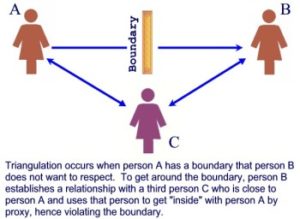
Diagram explaining triangulation, showing how indirect communication through a third party creates division, misalignment, and power imbalance in relationships.

The Quiet Damage of Triangulation

Over the years, my children’s father, my mother, and my sister communicated and met without me. This alliance was formed in the shadows. There was no pre‑existing relationship between my mother or sister and the man I divorced. These gatherings included my children and happened during a period of high conflict with their father. Repeated triangulation and exclusion carried their own message. Exclusion normalized the idea that my voice was optional and my value as a parent was nil. Without instruction or explanation, my children learned—through behavior, not words—that distancing from their mother was acceptable. Disregard was modeled in many ways. Repeatedly. What followed was cumulative. Indoctrination. This is not an assessment of intent. It is an account of what occurred and the impact. I’m fairly certain there’s no coming back from this. I will either die trying or not trying. I see this pattern at home and at work. It’s everywhere: a with‑me‑or‑against‑me logic where the desire for control or reverence outweighs repair, image eclipses truth, and those who question—even in good faith—are made to pay.

Read More
James Baldwin quote about facing truth overlaid on a minimalist image symbolizing emotional clarity, reflection, and the cost of acknowledgment.

The Limits of One-Sided Repair

Letting Go Each day, I live with the ache that I may not see my children again. We may not have another real conversation or moment of closeness. That may be the outcome when children grow in a system that teaches them to diminish me, and when they have no outside support to question that story. I can see how neatly the story lands if I’m “too much,” or if I “opted out.” But I didn’t opt out of love. I opted out of interactions that diminished me, and out of being judged for the pain I carried in response to that. When my older son stopped by this week to pick up some belongings, he said, “OK then, I guess I’ll just keep working on myself.” The tone was pure “seeyuh.” Calm. Clean. Detached. His dad would be impressed. It wasn’t confrontation. It wasn’t repair. It was distance dressed up as resolution. It created a sense of closure without anything actually being closed. His lack of genuine interest made it clear that the decision had already been made somewhere else. When I imagine the worst‑case scenarios — illness, death, finality — I feel no guilt for what I’ve said or done. My choices have always reflected prioritizing them. I feel no shame. I cannot bridge a gap that was created by design, by people frustrated with my lack of reverence and submission. And bridging that gap requires mutual engagement. The cycle begs to repeat. I don’t feel I have amends to make. I continue working on myself because I am here to grow, heal, and love. I know I have been truthful, kind, loyal, and wholesome as a mother. Not perfect, but great in the years before the triangulation that crushed me. My greatest regret is how much exposure they had to my pain, and how my reactions shaped their experience of me. It robbed them of access to parts of me that existed outside suffering. But I didn’t choose the pain. I did the best I could while living inside it. I am neither proud nor ashamed. I accept what was. I accept what is. And I accept that we may not find our way back to each other in this lifetime. As I once said to my family of origin: My first choice is to heal with you. My second is to just heal. I never stopped trying. And- I no longer accept the old belief that I should be grateful for whatever version of connection I’m handed. I’m choosing peace that doesn’t require self‑erasure. No more entanglement with anyone of the mindset that their peace and comfort matter more than others.

Read More
A quote on a dark, stormy abstract background that reads: When it comes to abusive behavior, if they know to hide it, they know it's wrong. If they don't do it in front of other people, they know how to control it.

Beyond Conflict: Identifying the Patterns of Coercive Control in Family Dynamics

Coercive control is a strategic pattern of behavior used to dominate another person and strip away their sense of autonomy. It is not defined by a single violent event, but by a continuous web of intimidation, isolation, and micro-regulation of the victim’s life. When applied to the family unit, this control is often maintained through three primary mechanisms: 1. Scapegoating Scapegoating is the process of blaming one person for the family’s internal problems or the controller’s own failures. The goal: To create a “common enemy.” By making one person—often a child or the other parent—the source of all conflict, the controller deflects accountability and keeps the rest of the family in a state of hyper-vigilance. The result: The victim internalizes the shame, believing they are fundamentally “broken.” 2. Triangulation Triangulation occurs when the controlling person refuses direct communication and instead pulls a third person into the dynamic to create friction or competition. The goal: To divide and conquer. By telling different versions of a story to different people, the controller ensures loyalty while fostering suspicion between others. The result: It prevents victims from forming a united front, leaving the controller as the sole source of “truth.” 3. Parental Alienation In the context of coercive control, parental alienation is the ultimate extension of triangulation. It involves one parent using psychological manipulation to turn a child against the other targeted parent. The goal: To sever the bond between the child and the other parent, effectively erasing that parent’s influence and presence. The result: The child becomes a tool of the controller’s campaign, often resulting in long-term psychological trauma for both the child and the alienated parent. How They Intersect These are not isolated tactics, but interdependent components of a single power dynamic. Coercive control in a family setting operates through a calculated cycle of isolation and psychological pressure. It begins with scapegoating, reinforced through triangulation that manipulates communication and divides family members. These efforts culminate in parental alienation, where the scapegoated parent’s influence is erased, leaving the controller in command of the family’s reality. Coercive control thrives in silence and isolation. Identifying scapegoating, triangulation, and alienation for what they are is essential for protecting your mental health. The confusion you feel is a documented byproduct of the system, not a reflection of your worth as a parent or person.

Read More
Diagram explaining triangulation, showing how indirect communication through a third party creates division, misalignment, and power imbalance in relationships.

The Quiet Damage of Triangulation

Over the years, my children’s father, my mother, and my sister communicated and met without me. This alliance was formed in the shadows. There was no pre‑existing relationship between my mother or sister and the man I divorced. These gatherings included my children and happened during a period of high conflict with their father. Repeated triangulation and exclusion carried their own message. Exclusion normalized the idea that my voice was optional and my value as a parent was nil. Without instruction or explanation, my children learned—through behavior, not words—that distancing from their mother was acceptable. Disregard was modeled in many ways. Repeatedly. What followed was cumulative. Indoctrination. This is not an assessment of intent. It is an account of what occurred and the impact. I’m fairly certain there’s no coming back from this. I will either die trying or not trying. I see this pattern at home and at work. It’s everywhere: a with‑me‑or‑against‑me logic where the desire for control or reverence outweighs repair, image eclipses truth, and those who question—even in good faith—are made to pay.

Read More