Wholesome Badass

A Work in Progress — Healing from All the Things​

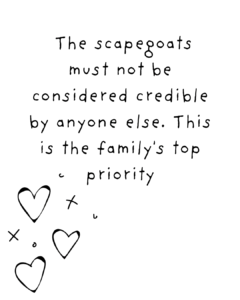
Text image reading: “The scapegoats must not be considered credible by anyone else. This is the family's top priority.” Represents family systems that discredit those who name harm.

When C-PTSD Keeps the Nervous System Braced for Threat

An Ordinary Moment, a Trauma Response My lived experience offered no assurance that I—or anything—would be okay. At a subconscious level, I suspected I might have less trouble if I could just get better at saying no and ouch, because those consistently caused trouble. I was not a discreet or well-adjusted abuse-getter. I was overwhelmed and overstimulated most of the time. The house was loud with fighting, NPR, opera, the stench of lamb and garlic, and the visual chaos of unsightly knickknacks and “art.” Sensory and emotional impact were constant and intense. I am porous, permeable—or as they liked to call it, thin-skinned. And diabolically selfish. I didn’t have a nurturing, protective adult saying any version of: I’ve got this. I’ve got you. It will be okay. Only through 12-Step recovery was I able to parent in those ways—not perfectly, but in ways diametrically opposed to my own experience. And that threatened a system that demanded reverence above all, even above my children’s needs. What was most often punished were my outward reactions to being overwhelmed, diminished, and disregarded. I had every tell of a child experiencing abuse, gaslighting, and scapegoating. I learned maladaptive ways of surviving a home with a protected abuser. To counter my visible anxiety and vigilance, my “family” labeled me paranoid, angry, negative, dramatic, hysterical, oversensitive. Because if I was those things, then I was the problem—not the abuse. What I’m finally coming to understand is that trauma, neurodivergence, and ADHD overlap and live in the nervous system. I’m now accessing the language and support. C-PTSD doesn’t live in my past. It lives in my body. My nervous system. My reactions. It doesn’t take holidays or special occasions off. I don’t choose when I’m triggered. I don’t choose how intense it is. I don’t choose my first reaction. Sometimes the tools help. Sometimes they don’t. A trigger isn’t always big. Sometimes it’s small. A sound. A smell. Light hitting something just right. A few weeks ago at the market—crowded, loud-ish—I was waiting in line. Nothing was happening. Then a well-dressed woman on her hot pink bejeweled speakerphone stood too close. Close enough that I could smell her. My body stiffened without consent. Fight or flee. And this was on a day when I was well-rested, well-fed, not too warm, not rushed, not needing a restroom. Any additional input would have crashed my system. I would have had to leave without checking out. But with some capacity left, I closed my eyes. Counted my breaths. Tapped my fingers. Went through checkout. I made it. And I was spent. Technically, nothing happened. Not if you were watching. And yet the pressure on my CNS might have compared to the stress level a neurotypical person feels during a mortal threat. Intellectually, I knew there was no danger. A dysregulated nervous system is not rational and does not care. I needed the rest of the day to discharge and recover from that energetic overload.

Read More
Text graphic explaining the concept of a family scapegoat as the person a family targets to avoid addressing harmful patterns or abuse.

The Pattern Beneath Estrangement

I’m learning to recognize a pattern. I name something specific: a word that was said, a boundary crossed, a moment that caused distress.The response shifts quickly—to my tone, my sensitivity, my way of being, my capacity to perceive. What starts as a conversation about what happened becomes a conversation about who I am. That shift does the work. It replaces interest and accountability with assessment. What remains is a familiar choice: explain myself, or step away—often described as opting out of connection, though it feels more like leaving a diminishing exchange. I step away from being disregarded. Over time, this response teaches what will and won’t be tolerated. Naming limits or discomfort leads to character judgment. Peace is kept through silence or compliance, not reflection or repair. The system protects itself by working efficiently. Questioning a person’s perception instead of engaging their experience ends the conversation and thins the connection. This took me a long time to understand: patterns like this resist being named. Accountability is replaced by distance, then by a story about why connection became difficult. The focus shifts. The pattern disappears. The person who noticed it remains. I’ve watched this repeat across relationships and roles. Discussion of behavior is rerouted into judgment of character. Repair is replaced by quiet. Distance forms without being acknowledged. And this becomes disorienting. Attempts to understand or address what happened are treated as evidence of being “too much,” while the questioned behavior itself remains unexamined and unamended. Connection is offered provided that nothing difficult is said.

Read More
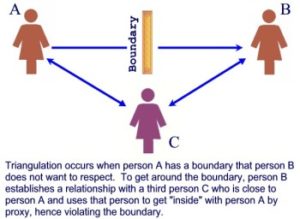
Diagram explaining triangulation, showing how indirect communication through a third party creates division, misalignment, and power imbalance in relationships.

The Quiet Damage of Triangulation

Over the years, my children’s father, my mother, and my sister communicated and met without me. This alliance was formed in the shadows. There was no pre‑existing relationship between my mother or sister and the man I divorced. These gatherings included my children and happened during a period of high conflict with their father. Repeated triangulation and exclusion carried their own message. Exclusion normalized the idea that my voice was optional and my value as a parent was nil. Without instruction or explanation, my children learned—through behavior, not words—that distancing from their mother was acceptable. Disregard was modeled in many ways. Repeatedly. What followed was cumulative. Indoctrination. This is not an assessment of intent. It is an account of what occurred and the impact. I’m fairly certain there’s no coming back from this. I will either die trying or not trying. I see this pattern at home and at work. It’s everywhere: a with‑me‑or‑against‑me logic where the desire for control or reverence outweighs repair, image eclipses truth, and those who question—even in good faith—are made to pay.

Read More
Text graphic reading “You were not chosen — you were targeted,” highlighting trauma bonding, love bombing, and emotional manipulation awareness.

The Season of Losing What I Thought I Needed

Loving the Hologram: A Season of Letting Go This season—honestly, my entire life—has been one of loss and unraveling. And I feel self‑conscious about that, because in a world low on emotional intelligence, it’s easy for people to see a woman breaking under multiple pressures and say, “There she goes again—claiming pain, can’t handle life.” I can hear the judgments before they’re spoken. I wish I could say no one judges me harder than I do, but I’m pretty sure my family—including my sons—absolutely does. And then there’s him—my love bomber, the one I parted with in March. He wasn’t a “shitty person.” He was toxic, yes, but he also brought me more joy, peace, pleasure, and adventure than anyone. It has been hard to reconcile letting go of the only adult person who ever made me feel even remotely glad to be alive. Maybe that’s the theme of this season: letting go of people I thought I couldn’t live without. Here’s where I land: I don’t think he’s a bad man. I think he’s unwell, acting out of a savior complex—compelled to capitalize on the desperation of others. His impulse isn’t love; it’s a deep need to leverage vulnerability as validation. I think he mourns the collateral damage, but not enough to stop creating it. I don’t think he enjoys hurting anyone. The pain he causes is incidental—fallout from whatever is starving inside him. I was fiercely protective of him. When he was broken by fever for days and the church elders, his ex‑wife, and those other two women were all coming for him, I defended him like he was an endangered species of goodness. I sheltered him. I believed in him. I thought he was misunderstood, persecuted, too precious for the world. Then came the devalue/discard phase. The mixed messages. The devotion in words—you’re my best friend, I can’t imagine life without you, you’re my anchor—while his presence went thin, remote, unavailable. His messages to me could’ve gone to anyone, and I’m sure they did. Our dates and conversations shrank to weekdays only, weekends reserved for “Asheville.” It took me a minute to realize he was farming Asheville the same way he farmed me (and the others): attach to the vulnerable, show up strong, perform stability, offer spiritual oxygen, future‑fake, mirror, enthrall, repeat. Good intentions don’t cancel destructive patterns. They just make them harder to see. And still, I can’t fully condemn him. I wish I could. Some part of me still wants him to get well. But I also want his wings trimmed—just enough that he can’t keep circling the vulnerable, sweeping in with intensity that looks like devotion, persistence that feels like passion, attention that mimics care. I want him unable to keep exploiting people who mistake his performance for love of anything but his idea of himself as the good guy, the earnest savior. This week I missed him—annoyingly—so I googled him. And what hit me first was this: he’s not someone I would have chosen. Not on sight. Not based on the facts of who he is. He looks like someone I’d avoid on instinct—performing some rugged, salt‑of‑the‑earth healer aesthetic I don’t even like. Then I googled the other two women he entangled during the same year—both arrested this year—and humiliation rose in my chest. Not because I think I’m “above” anyone, but because I suddenly saw the demographic he reaches for. The vulnerabilities he circles. And the story he fed me—You’re different though; I picked you; they picked me—fell apart instantly. I deeply and genuinely loved the hologram of him. He cultivates his image—the simple man in a van who needs almost nothing, who’s always pleasant, ready for a chat, ready with the perfect tool or solution. So when the hurricane hit and he said he’d be in Asheville “helping,” it read as noble. His charm thrives in collapsed places—towns, women, systems. He—the strong and calm one, armed with his Mercedes Sprinter home, pastoral credentials, emotional fluency, and endless bandwidth. A savior with compassionate eyes. His potency is illuminated in already broken spaces. I once told him he was like penicillin. He replied, “I don’t wanna be penicillin. I wanna be cocaine.” I thought that hysterical at the time. I fell under his spell. A well‑crafted, highly practiced, deeply intoxicating spell. I miss him like a miracle wonder drug of healing and hope—with catastrophic side effects. Ralph Owen #expedtionofhope Expedition of Hope Asheville NC

Read More
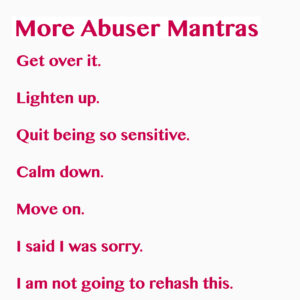
Abusers Mantra- That Did Not Happen

“But What Did She Do?”

Friend: So you’re not in contact with your daughter anymore? Family Member: No, she’s just too much. Always some issue with her. Always making everything harder than it has to be. Friend: Wow. What happened exactly? Did she hurt someone? Lie? Betray you? Family Member: No, not really. It’s more like… she always has needs and limits and feelings that are too much and make no sense. So sensitive. Demanding. Needy. Always demanding conversation. It’s exhausting. Friend: That doesn’t sound like a crime. Did she ask to talk about something hard? Family Member: Yeah, but she turns everything into a problem. Like, she’ll say something felt hurtful, or ask someone to stop doing something—and suddenly, it’s a whole thing. She speaks problems into existence. If she’s upset, that’s the problem. Not what caused it. Friend: So she brings up something painful and you say she’s just trying to cause drama? Family Member: Exactly. We always told her: stop manufacturing chaos. If you’re hurting, you probably imagined it, earned it, or brought it on yourself. Friend: What happens when she does try to talk about it? Family Member: She gets overwhelmed. Emotional. Then she cries and it’s like, see? You can’t even talk to her. She’s unstable. Friend: Did you ever try family therapy? Family Member: Yes, once. She completely fell apart in the session. Couldn’t handle us calmly telling the therapist how hard she is. The therapist saw right through her. Friend: Or maybe she broke down because the room was against her and you used that as proof? Family Member: Whatever. She just needs everything to be her way. We can’t do that. Friend: So what’s the worst thing she actually did? Family Member: She refused to keep showing up—opted out until we had more useless conversations. She always said she’d come to the table if people would be kind. But she made herself the outsider. Ask anyone—she sucks. Friend: But if nobody can name what she actually did—not how she felt, or how you felt about her, but what she really did—then what was she punished for? Family Member: For being impossible. Creating tension to get attention. Friend: Hmmm. 14 Years Later Friend: Wait… so you don’t talk to your mom anymore? Son: Nah. She’s impossible. Always on my case, trying to control everything. Friend: That sucks. But like—what did she do? Was she abusive? Did she lie to you or betray you? Son: No. She just… always had these expectations…demands. And like tried to be my boss. Always correcting me. She wanted me to be perfect. Friend: Okay… but was she unfair? Like punishing you for stuff that wasn’t real? Was she constantly grounding you or taking your phone for no reason? Son: No, not really. I think I got grounded maybe once. She barely ever took my phone. Friend: So you weren’t in trouble all the time? Son: No, not really. She’d just get mad when I didn’t follow through or when I ignored her. Friend: So… she had rules? Son: Yeah, but she wanted consistency. Like, if I did something well for three weeks, and then I would drop the ball and she would correct or redirect me. Like the three weeks did not even count. Friend: That doesn’t sound crazy. That sounds like accountability… parenting? Son: She just wouldn’t let me do whatever I wanted. She’d say no to stuff sometimes. She expected respect. Friend: Did you guys ever try family therapy? Son: Yeah, but I went thinking it’d be my chance to explain my side, and maybe get the therapist to see how hard she is. I don’t think she went in expecting that. Friend: So… you weren’t there to try to heal things? Son: Not really. And she got upset in the session, started crying, and then it was like—“see? She’s so emotional, you can’t even talk to her.” Friend: So her emotional reaction to being overwhelmed was used as proof that she’s the problem? Son: I mean… yeah. Friend: And the worst thing she did was… not agree immediately to let you drive across the country at 16 without a plan? Son: She said I could if I had check-ins and stayed with people we know. But it felt like she didn’t trust me. Friend: So she wanted to keep you safe and be part of the planning, and that made her the enemy? Son: I guess. But still… she sucks. Narrator: This is the anatomy of a smear campaign. A person becomes “too much” only after they become unwilling to be mistreated. They say, “She’s hard to deal with.” But what did she do? Ask again. From every angle. Ask louder. Ask in front of the people who repeat the story. Ask the ones who believe it. What did she do? What did she do? And if no one can name it, then maybe— just maybe— she didn’t do anything at all. Maybe she just stopped agreeing to be the scapegoat. Below are just a few of the books that have been especially informative and healing for me as I navigate my journey of recovery and self-understanding:

Read More
Text image reading: “The scapegoats must not be considered credible by anyone else. This is the family's top priority.” Represents family systems that discredit those who name harm.

When C-PTSD Keeps the Nervous System Braced for Threat

An Ordinary Moment, a Trauma Response My lived experience offered no assurance that I—or anything—would be okay. At a subconscious level, I suspected I might have less trouble if I could just get better at saying no and ouch, because those consistently caused trouble. I was not a discreet or well-adjusted abuse-getter. I was overwhelmed and overstimulated most of the time. The house was loud with fighting, NPR, opera, the stench of lamb and garlic, and the visual chaos of unsightly knickknacks and “art.” Sensory and emotional impact were constant and intense. I am porous, permeable—or as they liked to call it, thin-skinned. And diabolically selfish. I didn’t have a nurturing, protective adult saying any version of: I’ve got this. I’ve got you. It will be okay. Only through 12-Step recovery was I able to parent in those ways—not perfectly, but in ways diametrically opposed to my own experience. And that threatened a system that demanded reverence above all, even above my children’s needs. What was most often punished were my outward reactions to being overwhelmed, diminished, and disregarded. I had every tell of a child experiencing abuse, gaslighting, and scapegoating. I learned maladaptive ways of surviving a home with a protected abuser. To counter my visible anxiety and vigilance, my “family” labeled me paranoid, angry, negative, dramatic, hysterical, oversensitive. Because if I was those things, then I was the problem—not the abuse. What I’m finally coming to understand is that trauma, neurodivergence, and ADHD overlap and live in the nervous system. I’m now accessing the language and support. C-PTSD doesn’t live in my past. It lives in my body. My nervous system. My reactions. It doesn’t take holidays or special occasions off. I don’t choose when I’m triggered. I don’t choose how intense it is. I don’t choose my first reaction. Sometimes the tools help. Sometimes they don’t. A trigger isn’t always big. Sometimes it’s small. A sound. A smell. Light hitting something just right. A few weeks ago at the market—crowded, loud-ish—I was waiting in line. Nothing was happening. Then a well-dressed woman on her hot pink bejeweled speakerphone stood too close. Close enough that I could smell her. My body stiffened without consent. Fight or flee. And this was on a day when I was well-rested, well-fed, not too warm, not rushed, not needing a restroom. Any additional input would have crashed my system. I would have had to leave without checking out. But with some capacity left, I closed my eyes. Counted my breaths. Tapped my fingers. Went through checkout. I made it. And I was spent. Technically, nothing happened. Not if you were watching. And yet the pressure on my CNS might have compared to the stress level a neurotypical person feels during a mortal threat. Intellectually, I knew there was no danger. A dysregulated nervous system is not rational and does not care. I needed the rest of the day to discharge and recover from that energetic overload.

Read More
Text graphic explaining the concept of a family scapegoat as the person a family targets to avoid addressing harmful patterns or abuse.

The Pattern Beneath Estrangement

I’m learning to recognize a pattern. I name something specific: a word that was said, a boundary crossed, a moment that caused distress.The response shifts quickly—to my tone, my sensitivity, my way of being, my capacity to perceive. What starts as a conversation about what happened becomes a conversation about who I am. That shift does the work. It replaces interest and accountability with assessment. What remains is a familiar choice: explain myself, or step away—often described as opting out of connection, though it feels more like leaving a diminishing exchange. I step away from being disregarded. Over time, this response teaches what will and won’t be tolerated. Naming limits or discomfort leads to character judgment. Peace is kept through silence or compliance, not reflection or repair. The system protects itself by working efficiently. Questioning a person’s perception instead of engaging their experience ends the conversation and thins the connection. This took me a long time to understand: patterns like this resist being named. Accountability is replaced by distance, then by a story about why connection became difficult. The focus shifts. The pattern disappears. The person who noticed it remains. I’ve watched this repeat across relationships and roles. Discussion of behavior is rerouted into judgment of character. Repair is replaced by quiet. Distance forms without being acknowledged. And this becomes disorienting. Attempts to understand or address what happened are treated as evidence of being “too much,” while the questioned behavior itself remains unexamined and unamended. Connection is offered provided that nothing difficult is said.

Read More
Diagram explaining triangulation, showing how indirect communication through a third party creates division, misalignment, and power imbalance in relationships.

The Quiet Damage of Triangulation

Over the years, my children’s father, my mother, and my sister communicated and met without me. This alliance was formed in the shadows. There was no pre‑existing relationship between my mother or sister and the man I divorced. These gatherings included my children and happened during a period of high conflict with their father. Repeated triangulation and exclusion carried their own message. Exclusion normalized the idea that my voice was optional and my value as a parent was nil. Without instruction or explanation, my children learned—through behavior, not words—that distancing from their mother was acceptable. Disregard was modeled in many ways. Repeatedly. What followed was cumulative. Indoctrination. This is not an assessment of intent. It is an account of what occurred and the impact. I’m fairly certain there’s no coming back from this. I will either die trying or not trying. I see this pattern at home and at work. It’s everywhere: a with‑me‑or‑against‑me logic where the desire for control or reverence outweighs repair, image eclipses truth, and those who question—even in good faith—are made to pay.

Read More
Text graphic reading “You were not chosen — you were targeted,” highlighting trauma bonding, love bombing, and emotional manipulation awareness.

The Season of Losing What I Thought I Needed

Loving the Hologram: A Season of Letting Go This season—honestly, my entire life—has been one of loss and unraveling. And I feel self‑conscious about that, because in a world low on emotional intelligence, it’s easy for people to see a woman breaking under multiple pressures and say, “There she goes again—claiming pain, can’t handle life.” I can hear the judgments before they’re spoken. I wish I could say no one judges me harder than I do, but I’m pretty sure my family—including my sons—absolutely does. And then there’s him—my love bomber, the one I parted with in March. He wasn’t a “shitty person.” He was toxic, yes, but he also brought me more joy, peace, pleasure, and adventure than anyone. It has been hard to reconcile letting go of the only adult person who ever made me feel even remotely glad to be alive. Maybe that’s the theme of this season: letting go of people I thought I couldn’t live without. Here’s where I land: I don’t think he’s a bad man. I think he’s unwell, acting out of a savior complex—compelled to capitalize on the desperation of others. His impulse isn’t love; it’s a deep need to leverage vulnerability as validation. I think he mourns the collateral damage, but not enough to stop creating it. I don’t think he enjoys hurting anyone. The pain he causes is incidental—fallout from whatever is starving inside him. I was fiercely protective of him. When he was broken by fever for days and the church elders, his ex‑wife, and those other two women were all coming for him, I defended him like he was an endangered species of goodness. I sheltered him. I believed in him. I thought he was misunderstood, persecuted, too precious for the world. Then came the devalue/discard phase. The mixed messages. The devotion in words—you’re my best friend, I can’t imagine life without you, you’re my anchor—while his presence went thin, remote, unavailable. His messages to me could’ve gone to anyone, and I’m sure they did. Our dates and conversations shrank to weekdays only, weekends reserved for “Asheville.” It took me a minute to realize he was farming Asheville the same way he farmed me (and the others): attach to the vulnerable, show up strong, perform stability, offer spiritual oxygen, future‑fake, mirror, enthrall, repeat. Good intentions don’t cancel destructive patterns. They just make them harder to see. And still, I can’t fully condemn him. I wish I could. Some part of me still wants him to get well. But I also want his wings trimmed—just enough that he can’t keep circling the vulnerable, sweeping in with intensity that looks like devotion, persistence that feels like passion, attention that mimics care. I want him unable to keep exploiting people who mistake his performance for love of anything but his idea of himself as the good guy, the earnest savior. This week I missed him—annoyingly—so I googled him. And what hit me first was this: he’s not someone I would have chosen. Not on sight. Not based on the facts of who he is. He looks like someone I’d avoid on instinct—performing some rugged, salt‑of‑the‑earth healer aesthetic I don’t even like. Then I googled the other two women he entangled during the same year—both arrested this year—and humiliation rose in my chest. Not because I think I’m “above” anyone, but because I suddenly saw the demographic he reaches for. The vulnerabilities he circles. And the story he fed me—You’re different though; I picked you; they picked me—fell apart instantly. I deeply and genuinely loved the hologram of him. He cultivates his image—the simple man in a van who needs almost nothing, who’s always pleasant, ready for a chat, ready with the perfect tool or solution. So when the hurricane hit and he said he’d be in Asheville “helping,” it read as noble. His charm thrives in collapsed places—towns, women, systems. He—the strong and calm one, armed with his Mercedes Sprinter home, pastoral credentials, emotional fluency, and endless bandwidth. A savior with compassionate eyes. His potency is illuminated in already broken spaces. I once told him he was like penicillin. He replied, “I don’t wanna be penicillin. I wanna be cocaine.” I thought that hysterical at the time. I fell under his spell. A well‑crafted, highly practiced, deeply intoxicating spell. I miss him like a miracle wonder drug of healing and hope—with catastrophic side effects. Ralph Owen #expedtionofhope Expedition of Hope Asheville NC

Read More
Abusers Mantra- That Did Not Happen

“But What Did She Do?”

Friend: So you’re not in contact with your daughter anymore? Family Member: No, she’s just too much. Always some issue with her. Always making everything harder than it has to be. Friend: Wow. What happened exactly? Did she hurt someone? Lie? Betray you? Family Member: No, not really. It’s more like… she always has needs and limits and feelings that are too much and make no sense. So sensitive. Demanding. Needy. Always demanding conversation. It’s exhausting. Friend: That doesn’t sound like a crime. Did she ask to talk about something hard? Family Member: Yeah, but she turns everything into a problem. Like, she’ll say something felt hurtful, or ask someone to stop doing something—and suddenly, it’s a whole thing. She speaks problems into existence. If she’s upset, that’s the problem. Not what caused it. Friend: So she brings up something painful and you say she’s just trying to cause drama? Family Member: Exactly. We always told her: stop manufacturing chaos. If you’re hurting, you probably imagined it, earned it, or brought it on yourself. Friend: What happens when she does try to talk about it? Family Member: She gets overwhelmed. Emotional. Then she cries and it’s like, see? You can’t even talk to her. She’s unstable. Friend: Did you ever try family therapy? Family Member: Yes, once. She completely fell apart in the session. Couldn’t handle us calmly telling the therapist how hard she is. The therapist saw right through her. Friend: Or maybe she broke down because the room was against her and you used that as proof? Family Member: Whatever. She just needs everything to be her way. We can’t do that. Friend: So what’s the worst thing she actually did? Family Member: She refused to keep showing up—opted out until we had more useless conversations. She always said she’d come to the table if people would be kind. But she made herself the outsider. Ask anyone—she sucks. Friend: But if nobody can name what she actually did—not how she felt, or how you felt about her, but what she really did—then what was she punished for? Family Member: For being impossible. Creating tension to get attention. Friend: Hmmm. 14 Years Later Friend: Wait… so you don’t talk to your mom anymore? Son: Nah. She’s impossible. Always on my case, trying to control everything. Friend: That sucks. But like—what did she do? Was she abusive? Did she lie to you or betray you? Son: No. She just… always had these expectations…demands. And like tried to be my boss. Always correcting me. She wanted me to be perfect. Friend: Okay… but was she unfair? Like punishing you for stuff that wasn’t real? Was she constantly grounding you or taking your phone for no reason? Son: No, not really. I think I got grounded maybe once. She barely ever took my phone. Friend: So you weren’t in trouble all the time? Son: No, not really. She’d just get mad when I didn’t follow through or when I ignored her. Friend: So… she had rules? Son: Yeah, but she wanted consistency. Like, if I did something well for three weeks, and then I would drop the ball and she would correct or redirect me. Like the three weeks did not even count. Friend: That doesn’t sound crazy. That sounds like accountability… parenting? Son: She just wouldn’t let me do whatever I wanted. She’d say no to stuff sometimes. She expected respect. Friend: Did you guys ever try family therapy? Son: Yeah, but I went thinking it’d be my chance to explain my side, and maybe get the therapist to see how hard she is. I don’t think she went in expecting that. Friend: So… you weren’t there to try to heal things? Son: Not really. And she got upset in the session, started crying, and then it was like—“see? She’s so emotional, you can’t even talk to her.” Friend: So her emotional reaction to being overwhelmed was used as proof that she’s the problem? Son: I mean… yeah. Friend: And the worst thing she did was… not agree immediately to let you drive across the country at 16 without a plan? Son: She said I could if I had check-ins and stayed with people we know. But it felt like she didn’t trust me. Friend: So she wanted to keep you safe and be part of the planning, and that made her the enemy? Son: I guess. But still… she sucks. Narrator: This is the anatomy of a smear campaign. A person becomes “too much” only after they become unwilling to be mistreated. They say, “She’s hard to deal with.” But what did she do? Ask again. From every angle. Ask louder. Ask in front of the people who repeat the story. Ask the ones who believe it. What did she do? What did she do? And if no one can name it, then maybe— just maybe— she didn’t do anything at all. Maybe she just stopped agreeing to be the scapegoat. Below are just a few of the books that have been especially informative and healing for me as I navigate my journey of recovery and self-understanding:

Read More