Wholesome Badass

A Work in Progress — Healing from All the Things​

A reflection on conditional belonging, self-worth, anxiety, and growing up with unmet emotional needs.

The Difference Between Lack of Care and Personal Failure

When I was young, I experienced needs, feelings, fears, and sensitivities that did not seem commonly shared, well supported, or even allowed. It seems as though that lack of care and support somehow was framed as reflective only of my unworthiness and unlovability. I am rejecting that. I seemed more affected by things than many of the people around me. My reactions, worries, questions, and needs did not appear to have a place within the common experience. I did not question the environment. I questioned myself. When Feelings Felt Dangerous What I recall vividly is not only the feelings themselves, but what followed. If I was hurt, afraid, overwhelmed, hungry, lonely, or needed something outside what was expected or understood, there seemed to be an unspoken cost. I wasn’t just sad. I was afraid and ashamed of my sadness. I wasn’t just hungry. I was fearful of being hungry. I wasn’t just anxious. I was anxious about being anxious. The feeling and the consequence fused together. The vulnerability and the diminishing or banishing response. What I Made It Mean For years, I thought my depression and anxiety were the problem. What I recognize now is that much of my anxiety and despair may have flowed from anticipating what would happen when I had a need, feeling, preference, limit, or reaction for which there seemed no allowance. What I learned to believe was that there was something wrong with me. That I was less deserving of care, understanding, protection, patience, or support. Not because anyone sat me down and said so. Because that seemed to be the conclusion supported by the evidence available to me. Care, belonging, protection, and support felt conditional. When those things remained absent, the most obvious explanation was that I had somehow failed to qualify for them. It still feels as though the only thing my family and I agreed on was my lack of value. Once I stopped agreeing to that, the system collapsed and I was said to have opted out. That experience shaped how I understood myself, relationships, and what I could expect from other people. Searching for an Exit The problem was that I could not stop being myself. I could not stop feeling what I felt or experiencing the world through the nervous system and sensitivities unique to me. I attempted every means of escape. Food. Sex. Alcohol. Drugs. They solved nothing. They offered interruption. A way to step away from the exhausting experience of being conscious inside a life organized around fear, pain, and loss. Being blacked out, distracted, consumed, or off the grid often felt preferable to being fully present. What If I Wasn’t the Problem? For most of my life, I assumed the missing piece was worthiness. I believed care, understanding, protection, and support existed, and that my task was to make myself deserving enough to receive them. What never occurred to me was that those things might not have been available in the ways I needed them. That their absence was not evidence of my lack of value. I don’t have conclusions. Only questions. What if I spent years trying to solve the wrong problem? What if I mistook the absence of something for evidence of my worth? What if the story was not that I was unworthy? What if the story was that I was unmet? And what if I had been baptized in the waters of being unmet by people who would not meet me, and came to understand that as truth, connection, love, and home? What if those are not the same thing at all?


Read More
Lovestruck girl in March 2024 receiving a bottle labeled Love, Finally, contrasted with April 2025 holding the same bottle labeled Manufactured Closeness after love bombing and emotional withdrawal.

I Thought I Was the Lucky One: Love Bombing, Illusion, and the Spell I Mistook for Love

A year ago I ended a relationship that I had initially believed was the love of my life. I still kind of feel that way, even though being love bombed is technically not love. It is still my only experience of consistently feeling deeply known, completely seen, and ALSO safe and chosen. At long last, a glimpse of a life I wanted to live. I enjoyed more easy laughter, beautiful meals made FOR me — with full-on consideration for my likes and dislikes — more adventure and love and intimacy and actual joy in my year with that man than with anyone across all of my years. The Beginning of the Spell And this was a man I almost didn’t meet. We connected on a dating app and right out of the gate I told him I didn’t think we were a fit. Too short. An overall look I did not care for. Different politics. Born again Baptist preacher. Deeep South Georgia accent. No. No. No. He laughed a deep beautiful laugh at my very direct and repeated NO. Saying, what’s it going to hurt to just meet? If you don’t like me, no big deal. And he showed up in attire I didn’t love and a weird necklace and a gun in the back of his pants — and somehow I DID NOT CARE. Like fuck it. Be a short, necklace-wearing, gun-packing, Southern Baptist Trumper. Who even cares?! I feel like a million dollars in your presence. Free, beautiful, spoiled, protected, chosen. Because he spoke words and carried energy that dissolved me into something completely intoxicating. It was a spell. What It Felt Like to Be Chosen I remember telling him once, you are like a mega-dose of penicillin for me. Like some magical dose of medicine healing wounds that had been hurting for a lifetime. And he laughed and said, I don’t want to be penicillin. I want to be cocaine. Hysterical. Right? Wrong. Fully addicted to and reliant on him for THAT feeling that I literally could not imagine or want life without it. I see now — he wasn’t joking. To marvel was all I could do- at his gift for reading people. His natural attunement. Ease. Agility. Grace. With me, he tracked things no one had ever tracked. He noticed my sensitivities without me explaining them. He sheltered me from things that would overwhelm me or drain me, without needing credit or announcing it. He paid attention to my nervous system in a way nobody ever had. And since being sensitive and reactive is the thing I have paid most dearly for, to exist in a space where not only was that not the standard, I never worried about it. About being A Lot. And that felt like heaven. I never had to ask for consideration OR anything. I certainly did not have to ask twice. And it wasn’t just me. People lit up around him. Doors opened. Light followed him. But looking back now, it wasn’t light exactly. Maybe more like some kind of radioactive glow. Beautiful. Radiant. Compelling. Something people moved toward. Though leaving subtle but fatal erosion in its wake. The Pattern I Didn’t See Yet I knew of two other women who had been affected by his spell casting because he told me about them… in a very strategic way. Well selected clips of messages. Fragments. Probably how reality TV editing creates scenarios that never actually happened. He shared things in a way that made me feel fiercely protective. Assuming: They had mistaken his kindness for more and were problematic. Disruptive. He provided just enough incomplete truths and lack of context for me to draw the conclusion that the problem lay in that these women were deranged and unreasonable. Speaking unfavorably of anyone or anything is a thing he simply did not do. He appeared to be above that. Only an angel…… To say that I was moved by how he spoke of them with compassion while sharing things that made them seem terrifying, would be an understatement. Just enough for me to build “my own” conclusions. I remember thinking, what a good man. Steady. Calm. Curious. Benevolent beyond measure. Not of this world. Because the stretches of time we spent together, how present he was, I couldn’t have imagined he had time or energy to create so much trouble elsewhere. I couldn’t make the math work. One of the women had worked with him years before-whom he had removed. The other had received pastoral care for and support from him for addiction and related issues. There was enough context around them that if they ever spoke out against him(and that they did-relentlessly), he had pre-empted that with calculated actions which rendered them not credible, unreliable narrators, problematic. How he engaged difficult situations was breathtaking with so much ease and grace. No indication of feeling threatened or defensive. I experienced him as INcredible while recognizing them as clearly non-credible. From communication from them which he elected to share with me, I knew their full names and more. I was his lucky confidante. One day when he was behaving questionably on the heels of being taken to court, I optimized the power of Google, which with only a name and a city provided a cell phone number for the one, and boldly reached out. We spoke. The First Break in Reality I led with that I thought maybe we had similar wounds and experiences with (I provided only his initials). That we had each been made to doubt ourselves and our reality. She knew nothing of me while I had been strategically fed information about her unwellness, despair, addiction, suicide attempt, and repeated stints in treatment. Sensitive to her despair, I assured her she was younger and prettier than me, that I meant no harm, and that I would be stepping away for good. I genuinely believed I was being generous and helpful. Like, you are not alone. I’m not sure it had that effect. She shared texts and emails between them. And reported that the night before she had given him a large sum of money. Um ok. After hearing that, I didn’t tell him what I knew or pursue him for explanations. I didn’t allow for the opportunity for him to speak his beautifully crafted words. The End I Couldn’t Process Yet I blocked him and thought I might die from my utterly shattered heart…and withdrawal from the drug of my choice. HIM! Last night, restless and unable to sleep, I googled both women again. The first results were mugshots. And then one— the one I had engaged with—her obituary from December. Forty-five years old. Young children. Gone. And one of my first thoughts—unbelievably—was whether I had somehow contributed by reaching out to her. Typical: I am responsible for anything painful, difficult, or unfortunate. He probably hasn’t lost sleep over it. I would regularly say to him, shit, what if I am really no different from these women? I must in some way be similar. He assured me: You’re not like them. I pursued you. I never wanted this with them. They pursued me. The Meaning I’m Still Wrestling With I really did think I was the lucky one. And I suppose I was. Just not for the reasons I thought. Like I have not been dead or arrested. Yay me.

Read More
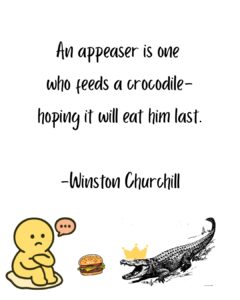
Text image of Winston Churchill quote: “An appeaser is one who feeds a crocodile, hoping it will eat him last,” representing appeasement, coercive control, trauma bonding, and survival in toxic family systems and emotionally abusive relationships.

Healing From Narcissistic Family Systems

I’ve been reflecting on how, in my family—and unironically, in the family of the man I had children with—belonging was not rooted in mutual care, nuance, or individuality. It was rooted in alignment with the people who had decided, and been supported in believing, that they mattered more. Agreement equaled safety. Divergence tracked as threat. There was no space for statements like, “I see it differently,” or “I’m hurt,” or “I need something else,” or even the simple, honest, “This doesn’t work for me.” For everyone but the person who positioned themselves at the center, those weren’t treated as communication but as defection. And once a thing was regarded as defection, the goal was not understanding but eradicating the instability. Restoring an illusion of unity. That meant conforming, suppressing, or being cast as the problem itself. There was no option to simply and safely be—without signaling allegiance. You were either reinforcing the prescribed doctrine or destabilizing it. In systems built on reverence for the ones who’ve assumed the right to define reality and whose comfort functions as law, there is no middle ground. You’re either with me or against me. That system did not simply banish me. It smeared me, discarded me, and snatches at my children, insisting I “forfeited” them by being different crazy — which, in that arrangement, meant nothing more than refusing to agree to matter less. I cannot abide. I won’t.

Read More
James Baldwin quote about facing truth overlaid on a minimalist image symbolizing emotional clarity, reflection, and the cost of acknowledgment.

The Limits of One-Sided Repair

Letting Go Each day, I live with the ache that I may not see my children again. We may not have another real conversation or moment of closeness. That may be the outcome when children grow in a system that teaches them to diminish me, and when they have no outside support to question that story. I can see how neatly the story lands if I’m “too much,” or if I “opted out.” But I didn’t opt out of love. I opted out of interactions that diminished me, and out of being judged for the pain I carried in response to that. When my older son stopped by this week to pick up some belongings, he said, “OK then, I guess I’ll just keep working on myself.” The tone was pure “seeyuh.” Calm. Clean. Detached. His dad would be impressed. It wasn’t confrontation. It wasn’t repair. It was distance dressed up as resolution. It created a sense of closure without anything actually being closed. His lack of genuine interest made it clear that the decision had already been made somewhere else. When I imagine the worst‑case scenarios — illness, death, finality — I feel no guilt for what I’ve said or done. My choices have always reflected prioritizing them. I feel no shame. I cannot bridge a gap that was created by design, by people frustrated with my lack of reverence and submission. And bridging that gap requires mutual engagement. The cycle begs to repeat. I don’t feel I have amends to make. I continue working on myself because I am here to grow, heal, and love. I know I have been truthful, kind, loyal, and wholesome as a mother. Not perfect, but great in the years before the triangulation that crushed me. My greatest regret is how much exposure they had to my pain, and how my reactions shaped their experience of me. It robbed them of access to parts of me that existed outside suffering. But I didn’t choose the pain. I did the best I could while living inside it. I am neither proud nor ashamed. I accept what was. I accept what is. And I accept that we may not find our way back to each other in this lifetime. As I once said to my family of origin: My first choice is to heal with you. My second is to just heal. I never stopped trying. And- I no longer accept the old belief that I should be grateful for whatever version of connection I’m handed. I’m choosing peace that doesn’t require self‑erasure. No more entanglement with anyone of the mindset that their peace and comfort matter more than others.

Read More
Goat standing alone on a cliff symbolizing family scapegoating and avoidance of responsibility

The War They Wanted: A Story of Estrangement

My sons learned, by design, to have zero tolerance for their mother. Ordinary acts of parenting—direction, correction, consequences, even simple questions—were rejected and reframed as manipulation or control. I once read a message from their father telling them, “Disregard your mother.” And they did. Their dismissal was not only permitted but modeled, reinforced, and quietly supported by people who positioned themselves as adversaries. During months of medical crisis—unmanaged pain, heavy medication, complications, emotional collapse—I was met with silence. I lost forty pounds. I couldn’t sit, stand, or lie down without pain. Without sleep, I struggled to function. My children showed little response, a kind of learned distance. My medical devastation wasn’t received as a call for care, but seemed to reinforce the narrative they had been taught to hold. Soon after that year of collapse came two heart attacks—more data, more interpretation, more judgment. I can hold compassion for how my children were shaped without accepting mercilessness as something I choose to live near. My healing has required restraint, even when injustice invites engagement. Over time, my options narrowed to two: escalate or collapse. In that narrowing, the structure became clear. Conflict was the point. They wanted a war—because war produces a winner and a loser, and in war, restraint is a liability. There is no framework of love or care in which it is acceptable to erase a parent. Participating in any activity that knowingly divides children from a parent is emotional violence. I continue to learn about the generational dynamics of scapegoating and parental alienation. I recognize myself in the stories of others whose former partners aligned with extended families in campaigns framed as concern—please pray for her, we’re worried—while undermining, diminishing, and dividing.

Read More
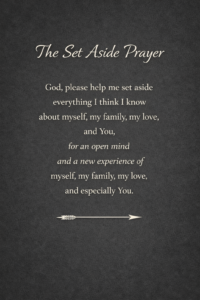
Minimalist graphic displaying the Set Aside Prayer about letting go of assumptions to allow openness, healing, and alignment

The Logic of Familiarity

Looking back, I notice how often I gravitated toward people who couldn’t tolerate my pain but expected the world to organize itself around their pleasure. When they were uncomfortable, everyone rushed to soothe them. What’s especially painful is this: humanity was withdrawn from me when I was small and needed it most. There was a kind of protected harm at work. Each time I struggled, my sister’s standing rose, and my mother’s case against me grew. Anyone could see how that drove beliefs about worth and entitlement—how my suffering had been useful to my sister. She was not only pitied and comforted when I suffered, but rewarded for not being me. It has been like this since my first breath. And I repeated this dynamic in which I consent to mattering less, in almost every relationship I chose. There were exceptions. Sweet Greg. The love bomber, obviously. And the sweetheart I’m seeing now—kind, present, generous, not looking for a reason to deny my comfort or my reality. Still, nothing replaces a family that shelters you—parents, a big sister, your own children. I remember when we moved here and my mother and sister swooned over how sweet my boys were, what a good mother I was. Even that disrupted the familiar roles. Me forming a family of my own threatened a long-standing narrative: one child – the problem, another elevated in contrast, and a mother sustained by sympathy for having such a difficult child. Looking back, it’s devastating to see how carefully that arrangement was preserved. The measures I go to in order to heal, recover, and live, seems diametrically opposed to those to whom I’m genetically linked. I read this the other day: “The way is the goal.” It captures it perfectly. It reminds me of the Set Aside Prayer—and of one of my favorite tattoos: the word –align– inside of an arrow.

Read More
A quote on a dark, stormy abstract background that reads: When it comes to abusive behavior, if they know to hide it, they know it's wrong. If they don't do it in front of other people, they know how to control it.

The Price of Disagreeing

Coercive control is a strategic pattern of behavior used to dominate another person and strip away their sense of autonomy. It is not defined by a single violent event, but by a continuous web of intimidation, isolation, and micro-regulation of the victim’s life. When applied to the family unit, this control is often maintained through three primary mechanisms: 1. Scapegoating Scapegoating is the process of blaming one person for the family’s internal problems or the controller’s own failures. The goal: To create a “common enemy.” By making one person—often a child or the other parent—the source of all conflict, the controller deflects accountability and keeps the rest of the family in a state of hyper-vigilance. The result: The victim internalizes the shame, believing they are fundamentally “broken.” 2. Triangulation Triangulation occurs when the controlling person refuses direct communication and instead pulls a third person into the dynamic to create friction or competition. The goal: To divide and conquer. By telling different versions of a story to different people, the controller ensures loyalty while fostering suspicion between others. The result: It prevents victims from forming a united front, leaving the controller as the sole source of “truth.” 3. Parental Alienation In the context of coercive control, parental alienation is the ultimate extension of triangulation. It involves one parent using psychological manipulation to turn a child against the other targeted parent. The goal: To sever the bond between the child and the other parent, effectively erasing that parent’s influence and presence. The result: The child becomes a tool of the controller’s campaign, often resulting in long-term psychological trauma for both the child and the alienated parent. How They Intersect These are not isolated tactics, but interdependent components of a single power dynamic. Coercive control in a family setting operates through a calculated cycle of isolation and psychological pressure. It begins with scapegoating, reinforced through triangulation that manipulates communication and divides family members. These efforts culminate in parental alienation, where the scapegoated parent’s influence is erased, leaving the controller in command of the family’s reality. Coercive control thrives in silence and isolation. Identifying scapegoating, triangulation, and alienation for what they are is essential for protecting your mental health. The confusion you feel is a documented byproduct of the system, not a reflection of your worth as a parent or person.

Read More
A reflection on conditional belonging, self-worth, anxiety, and growing up with unmet emotional needs.

The Difference Between Lack of Care and Personal Failure

When I was young, I experienced needs, feelings, fears, and sensitivities that did not seem commonly shared, well supported, or even allowed. It seems as though that lack of care and support somehow was framed as reflective only of my unworthiness and unlovability. I am rejecting that. I seemed more affected by things than many of the people around me. My reactions, worries, questions, and needs did not appear to have a place within the common experience. I did not question the environment. I questioned myself. When Feelings Felt Dangerous What I recall vividly is not only the feelings themselves, but what followed. If I was hurt, afraid, overwhelmed, hungry, lonely, or needed something outside what was expected or understood, there seemed to be an unspoken cost. I wasn’t just sad. I was afraid and ashamed of my sadness. I wasn’t just hungry. I was fearful of being hungry. I wasn’t just anxious. I was anxious about being anxious. The feeling and the consequence fused together. The vulnerability and the diminishing or banishing response. What I Made It Mean For years, I thought my depression and anxiety were the problem. What I recognize now is that much of my anxiety and despair may have flowed from anticipating what would happen when I had a need, feeling, preference, limit, or reaction for which there seemed no allowance. What I learned to believe was that there was something wrong with me. That I was less deserving of care, understanding, protection, patience, or support. Not because anyone sat me down and said so. Because that seemed to be the conclusion supported by the evidence available to me. Care, belonging, protection, and support felt conditional. When those things remained absent, the most obvious explanation was that I had somehow failed to qualify for them. It still feels as though the only thing my family and I agreed on was my lack of value. Once I stopped agreeing to that, the system collapsed and I was said to have opted out. That experience shaped how I understood myself, relationships, and what I could expect from other people. Searching for an Exit The problem was that I could not stop being myself. I could not stop feeling what I felt or experiencing the world through the nervous system and sensitivities unique to me. I attempted every means of escape. Food. Sex. Alcohol. Drugs. They solved nothing. They offered interruption. A way to step away from the exhausting experience of being conscious inside a life organized around fear, pain, and loss. Being blacked out, distracted, consumed, or off the grid often felt preferable to being fully present. What If I Wasn’t the Problem? For most of my life, I assumed the missing piece was worthiness. I believed care, understanding, protection, and support existed, and that my task was to make myself deserving enough to receive them. What never occurred to me was that those things might not have been available in the ways I needed them. That their absence was not evidence of my lack of value. I don’t have conclusions. Only questions. What if I spent years trying to solve the wrong problem? What if I mistook the absence of something for evidence of my worth? What if the story was not that I was unworthy? What if the story was that I was unmet? And what if I had been baptized in the waters of being unmet by people who would not meet me, and came to understand that as truth, connection, love, and home? What if those are not the same thing at all?
Read More
Lovestruck girl in March 2024 receiving a bottle labeled Love, Finally, contrasted with April 2025 holding the same bottle labeled Manufactured Closeness after love bombing and emotional withdrawal.

I Thought I Was the Lucky One: Love Bombing, Illusion, and the Spell I Mistook for Love

A year ago I ended a relationship that I had initially believed was the love of my life. I still kind of feel that way, even though being love bombed is technically not love. It is still my only experience of consistently feeling deeply known, completely seen, and ALSO safe and chosen. At long last, a glimpse of a life I wanted to live. I enjoyed more easy laughter, beautiful meals made FOR me — with full-on consideration for my likes and dislikes — more adventure and love and intimacy and actual joy in my year with that man than with anyone across all of my years. The Beginning of the Spell And this was a man I almost didn’t meet. We connected on a dating app and right out of the gate I told him I didn’t think we were a fit. Too short. An overall look I did not care for. Different politics. Born again Baptist preacher. Deeep South Georgia accent. No. No. No. He laughed a deep beautiful laugh at my very direct and repeated NO. Saying, what’s it going to hurt to just meet? If you don’t like me, no big deal. And he showed up in attire I didn’t love and a weird necklace and a gun in the back of his pants — and somehow I DID NOT CARE. Like fuck it. Be a short, necklace-wearing, gun-packing, Southern Baptist Trumper. Who even cares?! I feel like a million dollars in your presence. Free, beautiful, spoiled, protected, chosen. Because he spoke words and carried energy that dissolved me into something completely intoxicating. It was a spell. What It Felt Like to Be Chosen I remember telling him once, you are like a mega-dose of penicillin for me. Like some magical dose of medicine healing wounds that had been hurting for a lifetime. And he laughed and said, I don’t want to be penicillin. I want to be cocaine. Hysterical. Right? Wrong. Fully addicted to and reliant on him for THAT feeling that I literally could not imagine or want life without it. I see now — he wasn’t joking. To marvel was all I could do- at his gift for reading people. His natural attunement. Ease. Agility. Grace. With me, he tracked things no one had ever tracked. He noticed my sensitivities without me explaining them. He sheltered me from things that would overwhelm me or drain me, without needing credit or announcing it. He paid attention to my nervous system in a way nobody ever had. And since being sensitive and reactive is the thing I have paid most dearly for, to exist in a space where not only was that not the standard, I never worried about it. About being A Lot. And that felt like heaven. I never had to ask for consideration OR anything. I certainly did not have to ask twice. And it wasn’t just me. People lit up around him. Doors opened. Light followed him. But looking back now, it wasn’t light exactly. Maybe more like some kind of radioactive glow. Beautiful. Radiant. Compelling. Something people moved toward. Though leaving subtle but fatal erosion in its wake. The Pattern I Didn’t See Yet I knew of two other women who had been affected by his spell casting because he told me about them… in a very strategic way. Well selected clips of messages. Fragments. Probably how reality TV editing creates scenarios that never actually happened. He shared things in a way that made me feel fiercely protective. Assuming: They had mistaken his kindness for more and were problematic. Disruptive. He provided just enough incomplete truths and lack of context for me to draw the conclusion that the problem lay in that these women were deranged and unreasonable. Speaking unfavorably of anyone or anything is a thing he simply did not do. He appeared to be above that. Only an angel…… To say that I was moved by how he spoke of them with compassion while sharing things that made them seem terrifying, would be an understatement. Just enough for me to build “my own” conclusions. I remember thinking, what a good man. Steady. Calm. Curious. Benevolent beyond measure. Not of this world. Because the stretches of time we spent together, how present he was, I couldn’t have imagined he had time or energy to create so much trouble elsewhere. I couldn’t make the math work. One of the women had worked with him years before-whom he had removed. The other had received pastoral care for and support from him for addiction and related issues. There was enough context around them that if they ever spoke out against him(and that they did-relentlessly), he had pre-empted that with calculated actions which rendered them not credible, unreliable narrators, problematic. How he engaged difficult situations was breathtaking with so much ease and grace. No indication of feeling threatened or defensive. I experienced him as INcredible while recognizing them as clearly non-credible. From communication from them which he elected to share with me, I knew their full names and more. I was his lucky confidante. One day when he was behaving questionably on the heels of being taken to court, I optimized the power of Google, which with only a name and a city provided a cell phone number for the one, and boldly reached out. We spoke. The First Break in Reality I led with that I thought maybe we had similar wounds and experiences with (I provided only his initials). That we had each been made to doubt ourselves and our reality. She knew nothing of me while I had been strategically fed information about her unwellness, despair, addiction, suicide attempt, and repeated stints in treatment. Sensitive to her despair, I assured her she was younger and prettier than me, that I meant no harm, and that I would be stepping away for good. I genuinely believed I was being generous and helpful. Like, you are not alone. I’m not sure it had that effect. She shared texts and emails between them. And reported that the night before she had given him a large sum of money. Um ok. After hearing that, I didn’t tell him what I knew or pursue him for explanations. I didn’t allow for the opportunity for him to speak his beautifully crafted words. The End I Couldn’t Process Yet I blocked him and thought I might die from my utterly shattered heart…and withdrawal from the drug of my choice. HIM! Last night, restless and unable to sleep, I googled both women again. The first results were mugshots. And then one— the one I had engaged with—her obituary from December. Forty-five years old. Young children. Gone. And one of my first thoughts—unbelievably—was whether I had somehow contributed by reaching out to her. Typical: I am responsible for anything painful, difficult, or unfortunate. He probably hasn’t lost sleep over it. I would regularly say to him, shit, what if I am really no different from these women? I must in some way be similar. He assured me: You’re not like them. I pursued you. I never wanted this with them. They pursued me. The Meaning I’m Still Wrestling With I really did think I was the lucky one. And I suppose I was. Just not for the reasons I thought. Like I have not been dead or arrested. Yay me.

Read More
Text image of Winston Churchill quote: “An appeaser is one who feeds a crocodile, hoping it will eat him last,” representing appeasement, coercive control, trauma bonding, and survival in toxic family systems and emotionally abusive relationships.

Healing From Narcissistic Family Systems

I’ve been reflecting on how, in my family—and unironically, in the family of the man I had children with—belonging was not rooted in mutual care, nuance, or individuality. It was rooted in alignment with the people who had decided, and been supported in believing, that they mattered more. Agreement equaled safety. Divergence tracked as threat. There was no space for statements like, “I see it differently,” or “I’m hurt,” or “I need something else,” or even the simple, honest, “This doesn’t work for me.” For everyone but the person who positioned themselves at the center, those weren’t treated as communication but as defection. And once a thing was regarded as defection, the goal was not understanding but eradicating the instability. Restoring an illusion of unity. That meant conforming, suppressing, or being cast as the problem itself. There was no option to simply and safely be—without signaling allegiance. You were either reinforcing the prescribed doctrine or destabilizing it. In systems built on reverence for the ones who’ve assumed the right to define reality and whose comfort functions as law, there is no middle ground. You’re either with me or against me. That system did not simply banish me. It smeared me, discarded me, and snatches at my children, insisting I “forfeited” them by being different crazy — which, in that arrangement, meant nothing more than refusing to agree to matter less. I cannot abide. I won’t.

Read More
James Baldwin quote about facing truth overlaid on a minimalist image symbolizing emotional clarity, reflection, and the cost of acknowledgment.

The Limits of One-Sided Repair

Letting Go Each day, I live with the ache that I may not see my children again. We may not have another real conversation or moment of closeness. That may be the outcome when children grow in a system that teaches them to diminish me, and when they have no outside support to question that story. I can see how neatly the story lands if I’m “too much,” or if I “opted out.” But I didn’t opt out of love. I opted out of interactions that diminished me, and out of being judged for the pain I carried in response to that. When my older son stopped by this week to pick up some belongings, he said, “OK then, I guess I’ll just keep working on myself.” The tone was pure “seeyuh.” Calm. Clean. Detached. His dad would be impressed. It wasn’t confrontation. It wasn’t repair. It was distance dressed up as resolution. It created a sense of closure without anything actually being closed. His lack of genuine interest made it clear that the decision had already been made somewhere else. When I imagine the worst‑case scenarios — illness, death, finality — I feel no guilt for what I’ve said or done. My choices have always reflected prioritizing them. I feel no shame. I cannot bridge a gap that was created by design, by people frustrated with my lack of reverence and submission. And bridging that gap requires mutual engagement. The cycle begs to repeat. I don’t feel I have amends to make. I continue working on myself because I am here to grow, heal, and love. I know I have been truthful, kind, loyal, and wholesome as a mother. Not perfect, but great in the years before the triangulation that crushed me. My greatest regret is how much exposure they had to my pain, and how my reactions shaped their experience of me. It robbed them of access to parts of me that existed outside suffering. But I didn’t choose the pain. I did the best I could while living inside it. I am neither proud nor ashamed. I accept what was. I accept what is. And I accept that we may not find our way back to each other in this lifetime. As I once said to my family of origin: My first choice is to heal with you. My second is to just heal. I never stopped trying. And- I no longer accept the old belief that I should be grateful for whatever version of connection I’m handed. I’m choosing peace that doesn’t require self‑erasure. No more entanglement with anyone of the mindset that their peace and comfort matter more than others.

Read More
Goat standing alone on a cliff symbolizing family scapegoating and avoidance of responsibility

The War They Wanted: A Story of Estrangement

My sons learned, by design, to have zero tolerance for their mother. Ordinary acts of parenting—direction, correction, consequences, even simple questions—were rejected and reframed as manipulation or control. I once read a message from their father telling them, “Disregard your mother.” And they did. Their dismissal was not only permitted but modeled, reinforced, and quietly supported by people who positioned themselves as adversaries. During months of medical crisis—unmanaged pain, heavy medication, complications, emotional collapse—I was met with silence. I lost forty pounds. I couldn’t sit, stand, or lie down without pain. Without sleep, I struggled to function. My children showed little response, a kind of learned distance. My medical devastation wasn’t received as a call for care, but seemed to reinforce the narrative they had been taught to hold. Soon after that year of collapse came two heart attacks—more data, more interpretation, more judgment. I can hold compassion for how my children were shaped without accepting mercilessness as something I choose to live near. My healing has required restraint, even when injustice invites engagement. Over time, my options narrowed to two: escalate or collapse. In that narrowing, the structure became clear. Conflict was the point. They wanted a war—because war produces a winner and a loser, and in war, restraint is a liability. There is no framework of love or care in which it is acceptable to erase a parent. Participating in any activity that knowingly divides children from a parent is emotional violence. I continue to learn about the generational dynamics of scapegoating and parental alienation. I recognize myself in the stories of others whose former partners aligned with extended families in campaigns framed as concern—please pray for her, we’re worried—while undermining, diminishing, and dividing.

Read More
Minimalist graphic displaying the Set Aside Prayer about letting go of assumptions to allow openness, healing, and alignment

The Logic of Familiarity

Looking back, I notice how often I gravitated toward people who couldn’t tolerate my pain but expected the world to organize itself around their pleasure. When they were uncomfortable, everyone rushed to soothe them. What’s especially painful is this: humanity was withdrawn from me when I was small and needed it most. There was a kind of protected harm at work. Each time I struggled, my sister’s standing rose, and my mother’s case against me grew. Anyone could see how that drove beliefs about worth and entitlement—how my suffering had been useful to my sister. She was not only pitied and comforted when I suffered, but rewarded for not being me. It has been like this since my first breath. And I repeated this dynamic in which I consent to mattering less, in almost every relationship I chose. There were exceptions. Sweet Greg. The love bomber, obviously. And the sweetheart I’m seeing now—kind, present, generous, not looking for a reason to deny my comfort or my reality. Still, nothing replaces a family that shelters you—parents, a big sister, your own children. I remember when we moved here and my mother and sister swooned over how sweet my boys were, what a good mother I was. Even that disrupted the familiar roles. Me forming a family of my own threatened a long-standing narrative: one child – the problem, another elevated in contrast, and a mother sustained by sympathy for having such a difficult child. Looking back, it’s devastating to see how carefully that arrangement was preserved. The measures I go to in order to heal, recover, and live, seems diametrically opposed to those to whom I’m genetically linked. I read this the other day: “The way is the goal.” It captures it perfectly. It reminds me of the Set Aside Prayer—and of one of my favorite tattoos: the word –align– inside of an arrow.

Read More
A quote on a dark, stormy abstract background that reads: When it comes to abusive behavior, if they know to hide it, they know it's wrong. If they don't do it in front of other people, they know how to control it.

The Price of Disagreeing

Coercive control is a strategic pattern of behavior used to dominate another person and strip away their sense of autonomy. It is not defined by a single violent event, but by a continuous web of intimidation, isolation, and micro-regulation of the victim’s life. When applied to the family unit, this control is often maintained through three primary mechanisms: 1. Scapegoating Scapegoating is the process of blaming one person for the family’s internal problems or the controller’s own failures. The goal: To create a “common enemy.” By making one person—often a child or the other parent—the source of all conflict, the controller deflects accountability and keeps the rest of the family in a state of hyper-vigilance. The result: The victim internalizes the shame, believing they are fundamentally “broken.” 2. Triangulation Triangulation occurs when the controlling person refuses direct communication and instead pulls a third person into the dynamic to create friction or competition. The goal: To divide and conquer. By telling different versions of a story to different people, the controller ensures loyalty while fostering suspicion between others. The result: It prevents victims from forming a united front, leaving the controller as the sole source of “truth.” 3. Parental Alienation In the context of coercive control, parental alienation is the ultimate extension of triangulation. It involves one parent using psychological manipulation to turn a child against the other targeted parent. The goal: To sever the bond between the child and the other parent, effectively erasing that parent’s influence and presence. The result: The child becomes a tool of the controller’s campaign, often resulting in long-term psychological trauma for both the child and the alienated parent. How They Intersect These are not isolated tactics, but interdependent components of a single power dynamic. Coercive control in a family setting operates through a calculated cycle of isolation and psychological pressure. It begins with scapegoating, reinforced through triangulation that manipulates communication and divides family members. These efforts culminate in parental alienation, where the scapegoated parent’s influence is erased, leaving the controller in command of the family’s reality. Coercive control thrives in silence and isolation. Identifying scapegoating, triangulation, and alienation for what they are is essential for protecting your mental health. The confusion you feel is a documented byproduct of the system, not a reflection of your worth as a parent or person.

Read More