Wholesome Badass

A Work in Progress — Healing from All the Things​

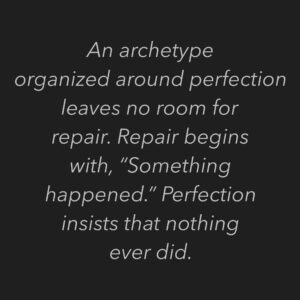
Black-and-white typography graphic with a quote about how relationships require acknowledgment of ruptures in order to repair, and how perfectionism can prevent emotional repair and trust.

Growing or Outgrowing?

I’ve spent a lot of time thinking about the c-word….”conflict ” and also–avoidance and repair. The archetype, to whom I have gravitated to like a moth to a flame, seems to have little room for either. Being non-pleased feels unacceptable. Causing displeasure feels unacceptable. Being imperfect feels unacceptable. So concerns don’t get raised directly. They leak out sideways through passive aggression, distance, stonewalling, or the preTENSE that everything is fine. The script for that: All good. Everything is fine. No worries. Of course. Perfect. No problem. Good vibes only. smile emoji lol And if someone does directly bring up a concern, the conversation can quickly shift to intentions, perceptions, or disproving any negative impact in the first place. I’ve lived inside enough of those relationships to recognize a clear pattern. One conversation with Sweet Greg from years ago–went differently. I brought up something that would have been disruptive to just about anyone. And he began his reply by explaining his intentions and my perceptions. I finally said, “If the only version of this conversation is the one where everything supports that you had no negative impact, our season has ended. Not because that issue was dramatic or catastrophic but because that manner of communication after conflict is one I’m too familiar with.” That changed the conversation. We stopped trying to establish innocence. We started talking about the impact, which is unmitagted by intention. Neither of us had to be the bad guy. Neither of us had to abandon our dignity. After that, we spent the next six years intentionally getting better at repair. Not because we had constant conflict. Because neither of us had to wonder. If something landed wrong, we said it. If one of us missed the mark, we talked about it. If an apology was needed, it wasn’t treated like a character indictment. Those moments were not dramatic. Most of them were like paper cuts, as far as gravity. But a thousand paper cuts can finally erupt by with irreperable injury. Left alone, “paper cuts” have a way of becoming stories that the cutty tells themselves about how little they matter. Addressed early, they become moments of understanding. Maybe that’s what repair has felt like to me. Not the absence of conflict. The absence of guessing and ruminating. The freedom to ask, “Did something happen?” without fearing the question itself. The freedom to hear, “That landed differently than you intended,” without feeling like either person has to lose. It became natural to laugh at ourselves, own our blind spots, and keep moving toward each other instead of away from each other. That kind of repair didn’t make either of us perfect. It made us close. I’ve only experienced that kind of relationship a handful of times. I think I understand something now that I didn’t then. For me, relationships no longer end because of conflict or a fight. For me, the season has concluded when evolving and expanding have stopped. When there’s not room to speak truth, make an adjustment, extend grace, laugh at ourselves, or discover a better way of loving each other. Or maybe the season just ends, but not because of a fight. And nobody is left to wonder, what did I do or what is going on? Whatever else may be true, this is my experience.
Read More
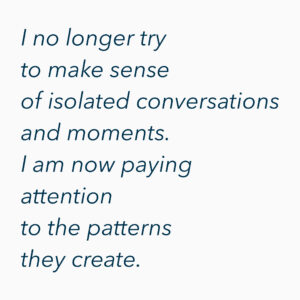
A minimalist quote graphic that reads, "I no longer try to make sense of isolated conversations or moments. I pay attention to the patterns they create." The image reflects themes of self-trust, relationship patterns, emotional healing, and personal growth.

If There Had Been a Fly on the Wall

Memory Memory can be unreliable. Interpretation certainly is. Two people can experience the same interaction and leave with very different narratives about what happened. What feels more meaningful to me now is paying attention to patterns that could have been observed by someone with no emotional investment. A quiet witness. A fly on the wall. Not someone deciding who was right. Just someone noticing what happened. Here are some of the things I believe that fly on the wall would have witnessed. -concerns met with defensive explanations more often than curiosity -hurt followed by rebuttal instead of repair -long conversations devoted to why my experience was inaccurate, exaggerated, unfair, or incomplete, while the original concern quietly disappeared -accountability flow much more comfortably in one direction than the other -apologies followed by explanations that softened or erased accountability -requests for change become deep dives into my shortcomings -a basic conflict become a courtroom instead of a collaboration They would have seen me trying harder. Communicating more carefully. Choosing my words more precisely. Waiting for better timing. Trying different approaches. Apologizing for trying so hard. Hoping that one more adjustment on my part would finally create the relationship I longed for and believed possible. They would have seen moments of warmth. Humor. Affection. Thoughtfulness. Hope. Those moments were real. They were also unpredictable. And they were enough to keep me believing things could be different. But they would have also seen those moments disappear without much explanation, leaving me searching for what had changed and what I needed to do differently to bring them back. They would have seen important conversations postponed until they quietly disappeared. Promises made in emotional moments but rarely translated into lasting change. They would have seen responsibilities become negotiable when they belonged to him and urgent when they belonged to me. They would have seen me begin monitoring his mood before bringing up difficult subjects. Editing my feelings before sharing them. Trying to predict which version of him I would be speaking to that day. Eventually, the fly on the wall would have noticed something else. The conversations were not reflective of two people trying to solve a problem together. But conversations about whether I had the right to have the problem in the first place. Over time, that changed me. I began wondering whether my expectations were too high. Whether my memory was inaccurate. Whether my nervous system was defective. Whether my needs were simply too much. Looking back, I no longer think any single interaction tells the story. The story is the repetition. Not because repetition proves someone’s intentions. It doesn’t. But repetition reveals the emotional climate a relationship creates. I don’t know why another person behaved the way they did. I no longer spend much time trying to answer that question. The question that matters to me now is much simpler. Who was I becoming and what was I agreeing to while I was trying so hard to make sense of it? Whatever else may be true, this is my experience.

Read More
Illustration of two one woman sharing details of someone else's private struggle. And being praised for kind thoughtfulness. The woman they are discussing sits nearby, unaware.

The Irony of Weaponized Concern

The Reality of Gossip Discussing the details of someone else’s life—their hardships, their choices, or how they live—is a fundamentally unwholesome practice. Gossip happens, and we can be honest about that and not pretend that engaging in it is useful, considerate, or kind.  The “Concerned” Persona So it is fascinating to witness someone who is known for not being particularly fond of a person take an openly concerned stance in sharing the depth of their worry for that person’s wellness, stability, and functionality. The energy attempt:  “I’m only saying this because I care…” Engineered Destabilization It is a stunning social loophole. Cloaking gossip with empathy, is an attempt to engineer a kind of social undermining while seeking praise for thoughtfulness. If I knew how to do emojis from my Mac- Barfing emoji for sure right fkn here. The Blind Spot What is confusing, is how easily bystanders buy the act. How does a person or group look at someone with an obvious grudge or bias, listen to them trade in the unfavorable assessment of another person’s private life, and see a caring soul instead of an invasive, scheming act? Skull and Crossbones emoji here. The Performance vs. Real Consideration Genuine care and consideration tend to be quiet and direct and require no recognition. They check in and ask what they can do to help. They honor respect and privacy with discernement and intention. When the “concern” is instead passed around from person to person, it isn’t support—it’s unwholesome gossip disguised as  goodness. It makes you ask “how does a sound person buy into the performance?” Insert Comedy Tragedy mask emoji here. Whatever else may be true, this also happened.

Read More
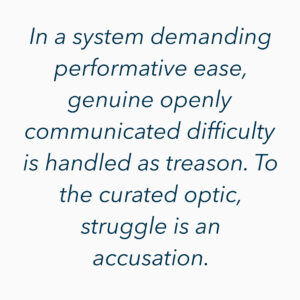
Text graphic quote: In a system demanding performative ease, genuine openly communicated difficulty is handled as treason. To the curated optic, struggle is an accusation.

Holding Court, Keeping the Crown Straight

The Binary The archetypes seem to move through life inside a rigid binary: winners and losers, heroes and villains, right and wrong. In their accounting for outcomes, there seems a lacking awareness for the possibility of their own poor decisions, regrettable reactions, or personal shortcomings.  Ironically, those are my favorite parts of any story. They are where humility lives and where connection is deepened.  To present as innocent, infallible, or heroic, someone else must always carry the shadow. When the archetype FAILs to achieve something, the explanation is rarely capability, circumstance, or choice. Instead, someone else must have been unfair, jealous, dishonest, or unjust. But the standard changes when hardship belongs to someone outside their circle of favor. Then the loss is framed as deserved.  Proof of poor character.  Evidence of defectiveness. Similar outcomes get narrated through two entirely different lenses, depending on who it happened to. The Meritocracy There seems a profound reliance on meritocracy as a reason for nearly every outcome. Success as proof of virtue.  Failure as proof that the game was rigged—at least when it happens to the archetype. And stories are shared with performative ease. Becuase struggle and dis-ease are marks of unworthiness and defect. Cue smiling emoji. A casual “lol.” “No worries.” “Perfect” The performance broadcast says, I’m completely unbothered. The pulsing tension whispers otherwise. Beneath the carefully arranged face seems a deep fear of losing status, admiration, or control. This must never happen. And there is an unspoken truth that if the archetype is worried, everyone else should be worried too. When your worth depends on always appearing victorious, peace becomes impossible. Protecting the delusion illusion is more important than connection or truth. In a system demanding performative ease, genuine and openly communicated difficulty is handled as treason. To the curated optic, struggle is an accusation. Whatever else may be true, this also happens.

Read More
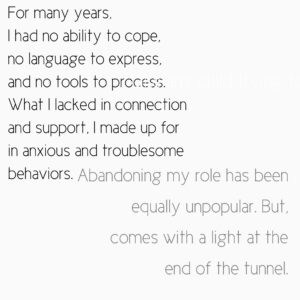
A minimalist graphic with white text on a solid, neutral background. The text reads: "I had no ability to cope, no language to express, and no tools to process. What I lacked in connection, I made up for in anxious behaviors. It was a costly way to exist—paying with myself just for proximity. Abandoning my role has been equally unpopular. But, it comes with a light at the end of the tunnel."⁠

When Victory Demands Wreckage

The Architecture of Binary Victory I have intentionally been studying a particular archetype whose sense of rightness often seems to depend on projecting wrongness onto someone else. The Perceived Victimization The archetype appears to operate under a specific system of binary beliefs: the conviction that winning and “being right” at all costs remains the ultimate proof of goodness, and that causing another to struggle is a valid tool to establish who is in the wrong. Under this framework, if someone in anyway interferes with what the archetype feels entitled to, it is experienced as a personal victimization. To restore the power imbalance, the system demands the plight of the person who deviated from the script. The Circular Trap of Blame Within this structure, a peaceful disagreement, ending or exit is out of the question; the archetype often requires visible social, financial, or professional struggle. Resulting pain is regarded not as a wound in need of care, but as proof of a deserving loser. The narrative becomes circular: the imposed hardship(which they rationalize as natural consequences–but natural consequences by definition are not imposed) is held up as evidence of “bad choices” and a “bad personality,” while the behaviors that contributed to the struggle are casually dismissed. Claiming the Third Way The fixed mindset of the archetype fights hard against a third way—a reality where someone can step away, choose peace, and quietly build a life outside of those win-loss columns.

Read More
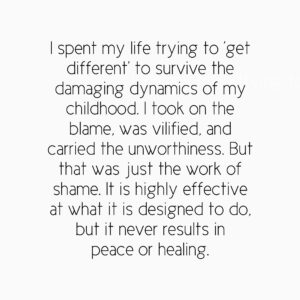
Unpacking the exhausting cycle of trying to "get different" to survive childhood dynamics, and why shame never produces the goodness we are looking for.⁠

The Cost of Challenging Toxic Systems

The Sovereignty Tax (My Refusal to Bleed) I am 57 years old, and I am only just now learning the practices of sovereignty and radical neutrality. Until recently, no one who has known me would have thought me even remotely sovereign or neutral- as I was NOT at all. And in a dedicated quest to actually live my life, to inhabit my own actual space, I have poked a few hornets’ nests. Different nests, but always an insidious sting. Me thinks me see a pattern. The Posture of Royalty Throughout my life—my family of origin, my marriage, historical friendships, and recently a neighbor—I have navigated people who try to assume a posture of royalty. For now, I will apply the term archetype to this personality. The archetype’s need for elevated status seems heavily reliant on a network of enablers propping them up—people who are either dependent, impressed, or intimidated by them in some way. I think there may be confsuion around those, as proxies for respect. With fragility of said crown, there is no such thing as safe, neutral ground(autonomy). If you aren’t actively prioritizing- propping them up (keeping them rightfully pleased), they perceive a traitor- actively trying to reduce or defy them. “You are either blindly for me or you are against me.” In each instance in which I have attempted to inhabit my space with an upright posture, I find myself squarely in the crosshairs of the archetype—and therefore, the crosshairs of the enablers. In psychology, there is a term “flying monkeys”. The Weaponized Concern Once inside the crosshairs, the campaign begins—wrapped in the soft language of concern. They don’t attack openly or directly check in. Instead, they whisper to friends, neighbors, managers, family, and peers: “Oh my gosh, I’m just worried about her. She seems so overwhelmed. She seems frantic. Confused.” It is a brilliant, insidious strategy to strip away validity and leave you vulnerable. By painting you as “frantic” or “struggling,” they accomplish three things at once: 1. They position themselves as THE “compassionate, stable” ones. 2. They pre-emptively compromise your credibility and validity. When you question the impact of their behavior, the script flips back to said problematic personality, perception, sensitivity, or struggles. The initiatives contributing negative impact are not acknowledged. In calling them out, you are accused of speaking problems into existence that don’t exist and creating drama. Abuse did not cause drama. Not quietly absorbing it did. 3. They set the trap. If you react, defend yourself, express discomfort, they get to sigh, throw up their hands, and say, “See? I told you she was unstable.” They get to confirm the very narrative they artfully spun and spread about you. When you dare to sit or stand upright to claim your own space and they can’t knock you down directly (because that would be questionable behavior), they set promptly to working to dissolve the ground beneath you. The Science of the Shark It is basic science that if you are bleeding in the water, you will attract sharks. That is just biology. I see the role I was cast in and have played with dedication. When you are born to sharks, you neeeeed the sharks! To be clear, I don’t make people behave sharkishly. I dont force or imagine them to behave as predators, and I didn’t knowingly choose to bleed out for a lifetime. It’s a dynamic, a well documented and studied pattern. Those who choose the comforting lie that “anything is possible if you just make the right choices” would love to hang this on me—to suggest that my bleeding was my own doing,earning, or imangining since clearly, I was “such a bloody mess.” But the truth is, a shark was always going to do the sharky things. For a long time, it seems my only clear option was to keep offering up the blood—to keep them close, because their attention—even when violent—felt safer than being entirely abandoned. Often, I attempted to mimic shark behavior that never fit my soul. Now, adopting the practices of radical neutrality has changed the water. The Unwelcome Healing When bleeding supply is curtailed, the sharks are disoriented. Because if I am not chumming the waters for them, how will they establish their mighty sharkiness? As if I must have forgotten how powerful and dangerous they are. “Don’t you know who you are dealing with?“ So, the system responds to my autonomy(my intentional choice to nurture and protect my most basic needs and limits) as an attack. The system functions smoothly as long as I agree to stay broken and matter less. The archetype—and enablers—respond with a highly specific theater of terror aimed at diminishing me, clawing at my peace- to prove they possess the power to make me flinch. I think there may be more favorable powers than this. I recall, with chilling clarity, my sister boasting about doing this thing to a woman at work. She literally glowed as she reported, “I know exactly how to make her cook her own goose,” simply because the woman carried herself in a way that made my sister feel non elevated and non- revered. The Third Way I am no authority on anyone else’s family or relationships. I am simply learning to recognize the cost of quietly claiming my right to peaceful ground. I have chosen to pay the heavy price of refusing to kiss the ring. Stepping away from my assigned script and choosing a third way—neither escalation nor collapse—has unsettled the system around me. There is a cost to no longer playing the role others expect you to play. It is a steep tax. But for the first time in my life, I am paying that price for my dignity instead of surrendering it to maintain unsafe contact and no connection. I am not proud of many things. But I feel deeply proud of my courage.

Read More
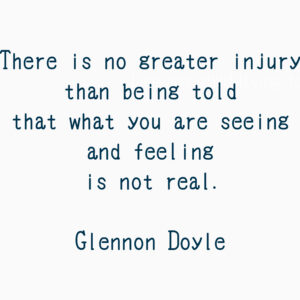
A clean, minimalist square graphic with clear text on a solid, neutral background. The text reads: "There is no greater injury than being told that what you are seeing and feeling is not real. — Glennon Doyle"

A Systemic Disregard

Someone once told me that the cruelest thing you can do to another human being is to label their suspicions as false when you know them to be true. It would be impossible to count the instances where my questioning led to the same responses: You’re crazy. You made that up. Stop trying to manufacture chaos.  It’s in your head. I don’t know what you’re talking about. Something inside of me shattered each time these sentiments were hurled at me. My self-esteem, confidence, and sense of self were deeply compromised- crushing to my spirit. The continued touching of me left me confused, unwanted contact in place of connection- resulting in lifelong emotional deprivation, self-doubt, fear, disordered sleeping, disordered eating, and trust issues that defy articulation. When I threatened to tell on her, she laughed- boasting how nobody would believe me. She made sure of it. Since I’m Not Gay, I Couldn’t Have Done That She spent a fair amount of talking to me about friends of hers who were or seemed gay or butchy, and how repulsive it felt to her, while simultaneously feeling generous that she was friends with them. Like always trying to convince me she wasn’t gay—because in that logic, if she wasn’t gay, she couldn’t possibly have done what she did repeatedly. But being gay does not make someone a predator. She dedicated her life to making me feel crazy and afraid, while simultaneously offering intermittent reinforcement as my heroine—the only person who could understand or protect me. She made it clear that she would be in charge of my relief and my punishment. Like any child looking to assign reasons to that which they cannot control, I blamed myself and spent my life trying to get worthy or at least pretend to. Identity Theft My personhood was snatched–erased. I could not count on myself to know what I felt or wanted, what I needed, and what was true. Whether it was my favorite color, or if I was hungry, tired, or cold, these things were either criticized or treated as debatable. I lost touch with my ability and confidence to know what was true, important, and real. The Fast Track to Addiction It makes sense to me now why I started so early using alcohol, food, drugs, shoplifting, sex—literally anything to alter my brain chemistry for even a brief respite. To feel better. To feel different. To feel nothing. There was never enough. Addiction, impulsive, and compulsive behaviors. A lifetime of instability, insecurity, and unsafety at a cellular level. A systemic disregard for my well-being. I had so many self-help books, so much therapy, 12-step programs, journaling, and any kind of exercise to try to unlock the secrets of how to just fucken be—or maybe even just how to pretend to be better than I actually am. How Are You? For more than forty years, the question “How are you?” has felt like a trick. I always answer “Super duper.” I would say that if I won the lottery or if I crashed my car, because legit nobody actually cared, but also—how am I? How should I know?  Hold on let me check with those who have a monopoly on my truth. As I look back, realizing that I can only remember what I remember how I remember it, I was in no way groomed for success, self-mastery, or even self-sufficiency. In fact, the opposite- I was dismantled. And then I was judged for the exact outcome that was engineered for me. Constant messaging: “You are fundamentally different, and nobody has any interest in building a bridge to where you are.”

Read More
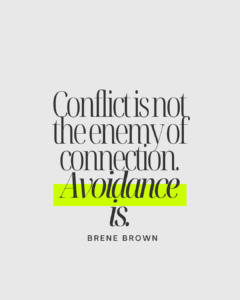
Text graphic that reads: "Conflict is not the enemy of connection, avoidance is.

The Fragile Structure of Happiness

I’ve been sitting with a word that has always troubled me, a state of “being” that feels out of reach: happiness. There seems to be so little capacity out there to make space for those of us whose life experiences haven’t exactly been a gifted accumulation of things that make you say, yeah, this is good, I want to keep doing it. Perhaps the hardest truth to accept is that my upbringing never provided the raw materials or the architecture required to build or even envision a lasting happiness. The Problem with Toxic Positivity Interesting how frustrated or put out people can get when they run into what they view as unhappy “negative energy” that they cannot relate to, correct or ignore. The toxic positivity crowd seems fragile, openly displeased when things are not exactly their way. Looking closely, it feels like happiness isn’t an organic state of being. A construct built on top of an essential foundation of peace and security. It demands safety and structure to exist at all. Or perhaps the blessed state resilience of a careferee disposition. Expecting happiness to materialize out of nowhere after a foundation has been fractured by neglect and abuse is like demanding a roof when there are no walls. Unhappiness, by that same token, is just the weight of things that tear at that security. Why I Am Wired for Joy And yet, somehow, I am wired for joy. I delight easily. But joy and delight don’t care about a curated stack of ease or good fortunes. They live entirely in the immediate moment of being present and vulnerable. Happiness feels like it requires a whole history and a guaranteed future, but joy requires only the now, a sudden, fertile space which presents itself in the middle of whatever reality actually is. Happiness relies on a world that goes right, while joy only requires the willingness to stay open enough to notice a single, fleeting second of presence, belonging entirely to the moment, independent of a foundation beneath it which may be whole or broken. The Requirement of Happiness I recently learned that in the Mennonite tradition, there is a core insistence that suffering must never be done alone. It stopped me in my tracks. It made me wonder: what is the word for the exact opposite of that? Because the relationships that shaped me and then chosen out of habit—the ones that faithfully mirror my family of origin—operate on a completely different framework. In that world, the unwritten rule is that suffering doesn’t exist for the right kind of people. If it does, it must be masked, suppressed, blamed, and cast away– if you can’t manage it as prescribed. It’s an energy that says suffering is for losers, an energy that promises, “I’ll give you something to cry about.” The Autocracy of the Untroubled Growing up, happiness seemed a strict requirement. Yet, there was zero consideration for the lower levels of security—no foundational, protective caretaking that could flow into actual happiness. Instead, my sensitivities/struggles were used as evidence against me in a sort of autocratic system. Those who are not troubled or taxed with more than they can handle believe their peace is a birthright they earned and shall not be troubled by anyone lesser. By that same insulting logic, they identify most anyone hit by things consistently they cannot get back up from as deserving of the fall. Looking back, I wonder how my “care givers” believed it possible for me to be happy when I was chronically overwhelmed, without a steady support or floor beneath me. Sitting in Darkness: Ten Minutes a Day I listened to a podcast recently with Kate Bowler, a survivor of stage four cancer at a surprisingly young age. She talked about how many people really just do not want to know the truth of a difficult reality. In the season in which she thought she was months away from death, parting her from aloving family, husband and young son, a co-worker asked how she was doing, and she gave a brilliantly genuine answer: “I’m doing mostly okay, except for about ten minutes every day.” He didn’t say, “Well, at least it’s only ten minutes”. He didn’t offer a dismissive holow reassurance or pivot away from discomfort. Instead, he looked her in the eyes and said, “Will you tell me about those ten minutes?” It was a glaring, beautiful contrast to the standard script. No toxic positivity, no rushing to fix or minimize it, no turning away. Genuine inquiry – a quiet, compassionate presence willing to sit in the dark with someone else’s ten minutes. Kate wrote a piece in one of her books that captures that rare posture perfectly: Blessing for the Ones Who Stay Blessed are you who stay. Who sit beside pain that cannot be fixed. Who choose presence over platitudes, and silence over shallow comfort. Blessed are you who ask hard questions without rushing toward answers. Who bear witness to the kind of grief that rearranges the world. You who try. Try to imagine. Try to listen. Try to love in the absence of tidy outcomes. May your staying be its own kind of balm. Because it says: your pain matters. You matter. And may you feel, even now, that this, too, is holy. To stay. To try. To say yes to life in all of its complexity. And to love each other all the way through. The Courage to Stay It takes courage—and intentional humility—to stay present with someone whose reality is grim. Why is that so rare? Entitled people often behave as though the suffering are the fragile ones. But couldn’t fragility be more accurately defined as the inability to acknowledge, engage with, or endure difficulty? I am many things, but I am not fucking fragile. Those who judge me most harshly would crumble after a mile in my shoes. And then, with absolute conviction, they’d insist that if I were a better person, I’d have better shoes. What’s interesting is how comfortable—if not confident—these folks seem with speaking and doing harm while banking on their target being too ashamed to acknowledge the harm done. It’s a kind of meritocracy bullshit: if you’re suffering, you must have earned it; if you’re struggling, it must be a character flaw. That belief conveniently absolves them of any responsibility for the damage they cause.

Read More
Black-and-white typography graphic with a quote about how relationships require acknowledgment of ruptures in order to repair, and how perfectionism can prevent emotional repair and trust.

Growing or Outgrowing?

I’ve spent a lot of time thinking about the c-word….”conflict ” and also–avoidance and repair. The archetype, to whom I have gravitated to like a moth to a flame, seems to have little room for either. Being non-pleased feels unacceptable. Causing displeasure feels unacceptable. Being imperfect feels unacceptable. So concerns don’t get raised directly. They leak out sideways through passive aggression, distance, stonewalling, or the preTENSE that everything is fine. The script for that: All good. Everything is fine. No worries. Of course. Perfect. No problem. Good vibes only. smile emoji lol And if someone does directly bring up a concern, the conversation can quickly shift to intentions, perceptions, or disproving any negative impact in the first place. I’ve lived inside enough of those relationships to recognize a clear pattern. One conversation with Sweet Greg from years ago–went differently. I brought up something that would have been disruptive to just about anyone. And he began his reply by explaining his intentions and my perceptions. I finally said, “If the only version of this conversation is the one where everything supports that you had no negative impact, our season has ended. Not because that issue was dramatic or catastrophic but because that manner of communication after conflict is one I’m too familiar with.” That changed the conversation. We stopped trying to establish innocence. We started talking about the impact, which is unmitagted by intention. Neither of us had to be the bad guy. Neither of us had to abandon our dignity. After that, we spent the next six years intentionally getting better at repair. Not because we had constant conflict. Because neither of us had to wonder. If something landed wrong, we said it. If one of us missed the mark, we talked about it. If an apology was needed, it wasn’t treated like a character indictment. Those moments were not dramatic. Most of them were like paper cuts, as far as gravity. But a thousand paper cuts can finally erupt by with irreperable injury. Left alone, “paper cuts” have a way of becoming stories that the cutty tells themselves about how little they matter. Addressed early, they become moments of understanding. Maybe that’s what repair has felt like to me. Not the absence of conflict. The absence of guessing and ruminating. The freedom to ask, “Did something happen?” without fearing the question itself. The freedom to hear, “That landed differently than you intended,” without feeling like either person has to lose. It became natural to laugh at ourselves, own our blind spots, and keep moving toward each other instead of away from each other. That kind of repair didn’t make either of us perfect. It made us close. I’ve only experienced that kind of relationship a handful of times. I think I understand something now that I didn’t then. For me, relationships no longer end because of conflict or a fight. For me, the season has concluded when evolving and expanding have stopped. When there’s not room to speak truth, make an adjustment, extend grace, laugh at ourselves, or discover a better way of loving each other. Or maybe the season just ends, but not because of a fight. And nobody is left to wonder, what did I do or what is going on? Whatever else may be true, this is my experience.
Read More
A minimalist quote graphic that reads, "I no longer try to make sense of isolated conversations or moments. I pay attention to the patterns they create." The image reflects themes of self-trust, relationship patterns, emotional healing, and personal growth.

If There Had Been a Fly on the Wall

Memory Memory can be unreliable. Interpretation certainly is. Two people can experience the same interaction and leave with very different narratives about what happened. What feels more meaningful to me now is paying attention to patterns that could have been observed by someone with no emotional investment. A quiet witness. A fly on the wall. Not someone deciding who was right. Just someone noticing what happened. Here are some of the things I believe that fly on the wall would have witnessed. -concerns met with defensive explanations more often than curiosity -hurt followed by rebuttal instead of repair -long conversations devoted to why my experience was inaccurate, exaggerated, unfair, or incomplete, while the original concern quietly disappeared -accountability flow much more comfortably in one direction than the other -apologies followed by explanations that softened or erased accountability -requests for change become deep dives into my shortcomings -a basic conflict become a courtroom instead of a collaboration They would have seen me trying harder. Communicating more carefully. Choosing my words more precisely. Waiting for better timing. Trying different approaches. Apologizing for trying so hard. Hoping that one more adjustment on my part would finally create the relationship I longed for and believed possible. They would have seen moments of warmth. Humor. Affection. Thoughtfulness. Hope. Those moments were real. They were also unpredictable. And they were enough to keep me believing things could be different. But they would have also seen those moments disappear without much explanation, leaving me searching for what had changed and what I needed to do differently to bring them back. They would have seen important conversations postponed until they quietly disappeared. Promises made in emotional moments but rarely translated into lasting change. They would have seen responsibilities become negotiable when they belonged to him and urgent when they belonged to me. They would have seen me begin monitoring his mood before bringing up difficult subjects. Editing my feelings before sharing them. Trying to predict which version of him I would be speaking to that day. Eventually, the fly on the wall would have noticed something else. The conversations were not reflective of two people trying to solve a problem together. But conversations about whether I had the right to have the problem in the first place. Over time, that changed me. I began wondering whether my expectations were too high. Whether my memory was inaccurate. Whether my nervous system was defective. Whether my needs were simply too much. Looking back, I no longer think any single interaction tells the story. The story is the repetition. Not because repetition proves someone’s intentions. It doesn’t. But repetition reveals the emotional climate a relationship creates. I don’t know why another person behaved the way they did. I no longer spend much time trying to answer that question. The question that matters to me now is much simpler. Who was I becoming and what was I agreeing to while I was trying so hard to make sense of it? Whatever else may be true, this is my experience.
Read More
Illustration of two one woman sharing details of someone else's private struggle. And being praised for kind thoughtfulness. The woman they are discussing sits nearby, unaware.

The Irony of Weaponized Concern

The Reality of Gossip Discussing the details of someone else’s life—their hardships, their choices, or how they live—is a fundamentally unwholesome practice. Gossip happens, and we can be honest about that and not pretend that engaging in it is useful, considerate, or kind.  The “Concerned” Persona So it is fascinating to witness someone who is known for not being particularly fond of a person take an openly concerned stance in sharing the depth of their worry for that person’s wellness, stability, and functionality. The energy attempt:  “I’m only saying this because I care…” Engineered Destabilization It is a stunning social loophole. Cloaking gossip with empathy, is an attempt to engineer a kind of social undermining while seeking praise for thoughtfulness. If I knew how to do emojis from my Mac- Barfing emoji for sure right fkn here. The Blind Spot What is confusing, is how easily bystanders buy the act. How does a person or group look at someone with an obvious grudge or bias, listen to them trade in the unfavorable assessment of another person’s private life, and see a caring soul instead of an invasive, scheming act? Skull and Crossbones emoji here. The Performance vs. Real Consideration Genuine care and consideration tend to be quiet and direct and require no recognition. They check in and ask what they can do to help. They honor respect and privacy with discernement and intention. When the “concern” is instead passed around from person to person, it isn’t support—it’s unwholesome gossip disguised as  goodness. It makes you ask “how does a sound person buy into the performance?” Insert Comedy Tragedy mask emoji here. Whatever else may be true, this also happened.

Read More
Text graphic quote: In a system demanding performative ease, genuine openly communicated difficulty is handled as treason. To the curated optic, struggle is an accusation.

Holding Court, Keeping the Crown Straight

The Binary The archetypes seem to move through life inside a rigid binary: winners and losers, heroes and villains, right and wrong. In their accounting for outcomes, there seems a lacking awareness for the possibility of their own poor decisions, regrettable reactions, or personal shortcomings.  Ironically, those are my favorite parts of any story. They are where humility lives and where connection is deepened.  To present as innocent, infallible, or heroic, someone else must always carry the shadow. When the archetype FAILs to achieve something, the explanation is rarely capability, circumstance, or choice. Instead, someone else must have been unfair, jealous, dishonest, or unjust. But the standard changes when hardship belongs to someone outside their circle of favor. Then the loss is framed as deserved.  Proof of poor character.  Evidence of defectiveness. Similar outcomes get narrated through two entirely different lenses, depending on who it happened to. The Meritocracy There seems a profound reliance on meritocracy as a reason for nearly every outcome. Success as proof of virtue.  Failure as proof that the game was rigged—at least when it happens to the archetype. And stories are shared with performative ease. Becuase struggle and dis-ease are marks of unworthiness and defect. Cue smiling emoji. A casual “lol.” “No worries.” “Perfect” The performance broadcast says, I’m completely unbothered. The pulsing tension whispers otherwise. Beneath the carefully arranged face seems a deep fear of losing status, admiration, or control. This must never happen. And there is an unspoken truth that if the archetype is worried, everyone else should be worried too. When your worth depends on always appearing victorious, peace becomes impossible. Protecting the delusion illusion is more important than connection or truth. In a system demanding performative ease, genuine and openly communicated difficulty is handled as treason. To the curated optic, struggle is an accusation. Whatever else may be true, this also happens.

Read More
A minimalist graphic with white text on a solid, neutral background. The text reads: "I had no ability to cope, no language to express, and no tools to process. What I lacked in connection, I made up for in anxious behaviors. It was a costly way to exist—paying with myself just for proximity. Abandoning my role has been equally unpopular. But, it comes with a light at the end of the tunnel."⁠

When Victory Demands Wreckage

The Architecture of Binary Victory I have intentionally been studying a particular archetype whose sense of rightness often seems to depend on projecting wrongness onto someone else. The Perceived Victimization The archetype appears to operate under a specific system of binary beliefs: the conviction that winning and “being right” at all costs remains the ultimate proof of goodness, and that causing another to struggle is a valid tool to establish who is in the wrong. Under this framework, if someone in anyway interferes with what the archetype feels entitled to, it is experienced as a personal victimization. To restore the power imbalance, the system demands the plight of the person who deviated from the script. The Circular Trap of Blame Within this structure, a peaceful disagreement, ending or exit is out of the question; the archetype often requires visible social, financial, or professional struggle. Resulting pain is regarded not as a wound in need of care, but as proof of a deserving loser. The narrative becomes circular: the imposed hardship(which they rationalize as natural consequences–but natural consequences by definition are not imposed) is held up as evidence of “bad choices” and a “bad personality,” while the behaviors that contributed to the struggle are casually dismissed. Claiming the Third Way The fixed mindset of the archetype fights hard against a third way—a reality where someone can step away, choose peace, and quietly build a life outside of those win-loss columns.

Read More
Unpacking the exhausting cycle of trying to "get different" to survive childhood dynamics, and why shame never produces the goodness we are looking for.⁠

The Cost of Challenging Toxic Systems

The Sovereignty Tax (My Refusal to Bleed) I am 57 years old, and I am only just now learning the practices of sovereignty and radical neutrality. Until recently, no one who has known me would have thought me even remotely sovereign or neutral- as I was NOT at all. And in a dedicated quest to actually live my life, to inhabit my own actual space, I have poked a few hornets’ nests. Different nests, but always an insidious sting. Me thinks me see a pattern. The Posture of Royalty Throughout my life—my family of origin, my marriage, historical friendships, and recently a neighbor—I have navigated people who try to assume a posture of royalty. For now, I will apply the term archetype to this personality. The archetype’s need for elevated status seems heavily reliant on a network of enablers propping them up—people who are either dependent, impressed, or intimidated by them in some way. I think there may be confsuion around those, as proxies for respect. With fragility of said crown, there is no such thing as safe, neutral ground(autonomy). If you aren’t actively prioritizing- propping them up (keeping them rightfully pleased), they perceive a traitor- actively trying to reduce or defy them. “You are either blindly for me or you are against me.” In each instance in which I have attempted to inhabit my space with an upright posture, I find myself squarely in the crosshairs of the archetype—and therefore, the crosshairs of the enablers. In psychology, there is a term “flying monkeys”. The Weaponized Concern Once inside the crosshairs, the campaign begins—wrapped in the soft language of concern. They don’t attack openly or directly check in. Instead, they whisper to friends, neighbors, managers, family, and peers: “Oh my gosh, I’m just worried about her. She seems so overwhelmed. She seems frantic. Confused.” It is a brilliant, insidious strategy to strip away validity and leave you vulnerable. By painting you as “frantic” or “struggling,” they accomplish three things at once: 1. They position themselves as THE “compassionate, stable” ones. 2. They pre-emptively compromise your credibility and validity. When you question the impact of their behavior, the script flips back to said problematic personality, perception, sensitivity, or struggles. The initiatives contributing negative impact are not acknowledged. In calling them out, you are accused of speaking problems into existence that don’t exist and creating drama. Abuse did not cause drama. Not quietly absorbing it did. 3. They set the trap. If you react, defend yourself, express discomfort, they get to sigh, throw up their hands, and say, “See? I told you she was unstable.” They get to confirm the very narrative they artfully spun and spread about you. When you dare to sit or stand upright to claim your own space and they can’t knock you down directly (because that would be questionable behavior), they set promptly to working to dissolve the ground beneath you. The Science of the Shark It is basic science that if you are bleeding in the water, you will attract sharks. That is just biology. I see the role I was cast in and have played with dedication. When you are born to sharks, you neeeeed the sharks! To be clear, I don’t make people behave sharkishly. I dont force or imagine them to behave as predators, and I didn’t knowingly choose to bleed out for a lifetime. It’s a dynamic, a well documented and studied pattern. Those who choose the comforting lie that “anything is possible if you just make the right choices” would love to hang this on me—to suggest that my bleeding was my own doing,earning, or imangining since clearly, I was “such a bloody mess.” But the truth is, a shark was always going to do the sharky things. For a long time, it seems my only clear option was to keep offering up the blood—to keep them close, because their attention—even when violent—felt safer than being entirely abandoned. Often, I attempted to mimic shark behavior that never fit my soul. Now, adopting the practices of radical neutrality has changed the water. The Unwelcome Healing When bleeding supply is curtailed, the sharks are disoriented. Because if I am not chumming the waters for them, how will they establish their mighty sharkiness? As if I must have forgotten how powerful and dangerous they are. “Don’t you know who you are dealing with?“ So, the system responds to my autonomy(my intentional choice to nurture and protect my most basic needs and limits) as an attack. The system functions smoothly as long as I agree to stay broken and matter less. The archetype—and enablers—respond with a highly specific theater of terror aimed at diminishing me, clawing at my peace- to prove they possess the power to make me flinch. I think there may be more favorable powers than this. I recall, with chilling clarity, my sister boasting about doing this thing to a woman at work. She literally glowed as she reported, “I know exactly how to make her cook her own goose,” simply because the woman carried herself in a way that made my sister feel non elevated and non- revered. The Third Way I am no authority on anyone else’s family or relationships. I am simply learning to recognize the cost of quietly claiming my right to peaceful ground. I have chosen to pay the heavy price of refusing to kiss the ring. Stepping away from my assigned script and choosing a third way—neither escalation nor collapse—has unsettled the system around me. There is a cost to no longer playing the role others expect you to play. It is a steep tax. But for the first time in my life, I am paying that price for my dignity instead of surrendering it to maintain unsafe contact and no connection. I am not proud of many things. But I feel deeply proud of my courage.

Read More
A clean, minimalist square graphic with clear text on a solid, neutral background. The text reads: "There is no greater injury than being told that what you are seeing and feeling is not real. — Glennon Doyle"

A Systemic Disregard

Someone once told me that the cruelest thing you can do to another human being is to label their suspicions as false when you know them to be true. It would be impossible to count the instances where my questioning led to the same responses: You’re crazy. You made that up. Stop trying to manufacture chaos.  It’s in your head. I don’t know what you’re talking about. Something inside of me shattered each time these sentiments were hurled at me. My self-esteem, confidence, and sense of self were deeply compromised- crushing to my spirit. The continued touching of me left me confused, unwanted contact in place of connection- resulting in lifelong emotional deprivation, self-doubt, fear, disordered sleeping, disordered eating, and trust issues that defy articulation. When I threatened to tell on her, she laughed- boasting how nobody would believe me. She made sure of it. Since I’m Not Gay, I Couldn’t Have Done That She spent a fair amount of talking to me about friends of hers who were or seemed gay or butchy, and how repulsive it felt to her, while simultaneously feeling generous that she was friends with them. Like always trying to convince me she wasn’t gay—because in that logic, if she wasn’t gay, she couldn’t possibly have done what she did repeatedly. But being gay does not make someone a predator. She dedicated her life to making me feel crazy and afraid, while simultaneously offering intermittent reinforcement as my heroine—the only person who could understand or protect me. She made it clear that she would be in charge of my relief and my punishment. Like any child looking to assign reasons to that which they cannot control, I blamed myself and spent my life trying to get worthy or at least pretend to. Identity Theft My personhood was snatched–erased. I could not count on myself to know what I felt or wanted, what I needed, and what was true. Whether it was my favorite color, or if I was hungry, tired, or cold, these things were either criticized or treated as debatable. I lost touch with my ability and confidence to know what was true, important, and real. The Fast Track to Addiction It makes sense to me now why I started so early using alcohol, food, drugs, shoplifting, sex—literally anything to alter my brain chemistry for even a brief respite. To feel better. To feel different. To feel nothing. There was never enough. Addiction, impulsive, and compulsive behaviors. A lifetime of instability, insecurity, and unsafety at a cellular level. A systemic disregard for my well-being. I had so many self-help books, so much therapy, 12-step programs, journaling, and any kind of exercise to try to unlock the secrets of how to just fucken be—or maybe even just how to pretend to be better than I actually am. How Are You? For more than forty years, the question “How are you?” has felt like a trick. I always answer “Super duper.” I would say that if I won the lottery or if I crashed my car, because legit nobody actually cared, but also—how am I? How should I know?  Hold on let me check with those who have a monopoly on my truth. As I look back, realizing that I can only remember what I remember how I remember it, I was in no way groomed for success, self-mastery, or even self-sufficiency. In fact, the opposite- I was dismantled. And then I was judged for the exact outcome that was engineered for me. Constant messaging: “You are fundamentally different, and nobody has any interest in building a bridge to where you are.”

Read More
Text graphic that reads: "Conflict is not the enemy of connection, avoidance is.

The Fragile Structure of Happiness

I’ve been sitting with a word that has always troubled me, a state of “being” that feels out of reach: happiness. There seems to be so little capacity out there to make space for those of us whose life experiences haven’t exactly been a gifted accumulation of things that make you say, yeah, this is good, I want to keep doing it. Perhaps the hardest truth to accept is that my upbringing never provided the raw materials or the architecture required to build or even envision a lasting happiness. The Problem with Toxic Positivity Interesting how frustrated or put out people can get when they run into what they view as unhappy “negative energy” that they cannot relate to, correct or ignore. The toxic positivity crowd seems fragile, openly displeased when things are not exactly their way. Looking closely, it feels like happiness isn’t an organic state of being. A construct built on top of an essential foundation of peace and security. It demands safety and structure to exist at all. Or perhaps the blessed state resilience of a careferee disposition. Expecting happiness to materialize out of nowhere after a foundation has been fractured by neglect and abuse is like demanding a roof when there are no walls. Unhappiness, by that same token, is just the weight of things that tear at that security. Why I Am Wired for Joy And yet, somehow, I am wired for joy. I delight easily. But joy and delight don’t care about a curated stack of ease or good fortunes. They live entirely in the immediate moment of being present and vulnerable. Happiness feels like it requires a whole history and a guaranteed future, but joy requires only the now, a sudden, fertile space which presents itself in the middle of whatever reality actually is. Happiness relies on a world that goes right, while joy only requires the willingness to stay open enough to notice a single, fleeting second of presence, belonging entirely to the moment, independent of a foundation beneath it which may be whole or broken. The Requirement of Happiness I recently learned that in the Mennonite tradition, there is a core insistence that suffering must never be done alone. It stopped me in my tracks. It made me wonder: what is the word for the exact opposite of that? Because the relationships that shaped me and then chosen out of habit—the ones that faithfully mirror my family of origin—operate on a completely different framework. In that world, the unwritten rule is that suffering doesn’t exist for the right kind of people. If it does, it must be masked, suppressed, blamed, and cast away– if you can’t manage it as prescribed. It’s an energy that says suffering is for losers, an energy that promises, “I’ll give you something to cry about.” The Autocracy of the Untroubled Growing up, happiness seemed a strict requirement. Yet, there was zero consideration for the lower levels of security—no foundational, protective caretaking that could flow into actual happiness. Instead, my sensitivities/struggles were used as evidence against me in a sort of autocratic system. Those who are not troubled or taxed with more than they can handle believe their peace is a birthright they earned and shall not be troubled by anyone lesser. By that same insulting logic, they identify most anyone hit by things consistently they cannot get back up from as deserving of the fall. Looking back, I wonder how my “care givers” believed it possible for me to be happy when I was chronically overwhelmed, without a steady support or floor beneath me. Sitting in Darkness: Ten Minutes a Day I listened to a podcast recently with Kate Bowler, a survivor of stage four cancer at a surprisingly young age. She talked about how many people really just do not want to know the truth of a difficult reality. In the season in which she thought she was months away from death, parting her from aloving family, husband and young son, a co-worker asked how she was doing, and she gave a brilliantly genuine answer: “I’m doing mostly okay, except for about ten minutes every day.” He didn’t say, “Well, at least it’s only ten minutes”. He didn’t offer a dismissive holow reassurance or pivot away from discomfort. Instead, he looked her in the eyes and said, “Will you tell me about those ten minutes?” It was a glaring, beautiful contrast to the standard script. No toxic positivity, no rushing to fix or minimize it, no turning away. Genuine inquiry – a quiet, compassionate presence willing to sit in the dark with someone else’s ten minutes. Kate wrote a piece in one of her books that captures that rare posture perfectly: Blessing for the Ones Who Stay Blessed are you who stay. Who sit beside pain that cannot be fixed. Who choose presence over platitudes, and silence over shallow comfort. Blessed are you who ask hard questions without rushing toward answers. Who bear witness to the kind of grief that rearranges the world. You who try. Try to imagine. Try to listen. Try to love in the absence of tidy outcomes. May your staying be its own kind of balm. Because it says: your pain matters. You matter. And may you feel, even now, that this, too, is holy. To stay. To try. To say yes to life in all of its complexity. And to love each other all the way through. The Courage to Stay It takes courage—and intentional humility—to stay present with someone whose reality is grim. Why is that so rare? Entitled people often behave as though the suffering are the fragile ones. But couldn’t fragility be more accurately defined as the inability to acknowledge, engage with, or endure difficulty? I am many things, but I am not fucking fragile. Those who judge me most harshly would crumble after a mile in my shoes. And then, with absolute conviction, they’d insist that if I were a better person, I’d have better shoes. What’s interesting is how comfortable—if not confident—these folks seem with speaking and doing harm while banking on their target being too ashamed to acknowledge the harm done. It’s a kind of meritocracy bullshit: if you’re suffering, you must have earned it; if you’re struggling, it must be a character flaw. That belief conveniently absolves them of any responsibility for the damage they cause.

Read More