Wholesome Badass

A Work in Progress — Healing from All the Things​

Four-panel cartoon showing the difference between how someone behaves behind closed doors and how they present themselves publicly. A child learns that anger and harsh language are acceptable, but later faces judgment for expressing what she learned.

I Didn’t Know to Hide It

I make no claims to benevolence. For my first 40 years, my default behavior was often diminishing and hurtful. Openly aggressive, harsh, and raging. I hated how reactive and hurtful I could be. But decades of mistreatment taught me only to mistreat, not how to respond appropriately to mistreatment or treat others with consistently high regard. What I couldn’t have known was that the behavior being modeled at home was also being carefully contained. Without any meaningful contrast of kindness, mercy, or respect, I didn’t recognize the behavior as irregular. I’ll always be sensitive, with my tightly wound nervous system basically on the outside of my body—easily overstimulated and dysregulated. But NOW I understand how to soothe and regulate myself. Struggling to regulate one’s emotions, however visibly expressed, should not be confused with exhibiting contempt or disrespect for another person. I get to distance myself from people who consider diminishing words or behaviors acceptable. And it’s been decades since I said or did a mean thing. It seems a ridiculous brag, but it’s quite the overcoming and miracle. One of many things that differentiated me from my family—and the similar relational patterns I later sought out—was that I didn’t know to conceal cruelty. My sister would scold, “You just don’t get it.” Straight facts. I super didn’t get it. What I did get: Apparently, it was okay to say and do cruel and damaging things to me. Because if you did, that was my fault, as my shittiness made you behave that way. This became my relational template, shaping my life’s trajectory. I can’t help but wonder why nobody was concerned enough to get me help. Only judge, punish, judge, repeat. Actually… 🤔 I think I understand why professional guidance was not provided. Getting me help might have meant examining what was happening at home, rather than continuing to treat me as THE problem. And why was I deemed the sinful one? But seriously—for those who know to hide it, what excuse even is there?

Read More
Two-panel illustration showing a woman suggesting someone may eventually be good enough, then claiming she wants reconciliation while insisting the other person is entirely responsible for the conflict.

Maybe One Day You’ll Be Worthy

There’s a deviant cruelty in having it said that you “got what you deserved.” Who even thinks like that? (Clears throat.) When I question the unequal terms of a relationship or ask for mutual consideration, the focus shifts from my concerns to how I’m showing an emotional reaction. My “intensity” is condemned, and my requests for change and repair are dismissed as manufacturing chaos. My credibility is systematically dismantled, while the unequal terms themselves go unexamined. Disqualified. And I am repeatedly (seriously, repeatedly) told, “You are welcome to join, provided you change,” while simultaneously being assured that such change is unlikely. Something astonishing happened when I healed enough to stop providing the convenient distraction of my large emotional reactions: rather than easing the conflict, the pressure intensified. Without my dysregulation to focus on, the very dynamics I had been questioning became difficult to ignore. Requesting mutually healthy terms and finally having enough self-esteem to refuse being disregarded or diminished is characterized as having “opted out.” As though I unilaterally chose to abandon a perfectly good relationship rather than asking whether we could find a way forward that works for us both. The estrangement that follows is framed as the natural consequence of “my choice.” Even hostility is justified as something my supposed deficiencies made necessary. If only I were different, they wouldn’t have to treat me this way. It’s fkn bananas. 🍌

Read More
A crowned man sits on a throne, rewarding a favored woman with flowers while directing another woman toward a dangerous trap labeled “Consequences.” The image illustrates favoritism, othering, and emotional violence.

When Discomfort Is Handled as Provocation

I’m recognizing a pattern in the personality type I’ve come to call The Archetype: disproportionate retaliation in response to discomfort. There is a swift intolerance for anything or anyone that appears to interfere with their ideas, preferences, plans, comfort, or agenda. Frustration, inconvenience, disagreement, or a perceived lack of deference is handled as a provocation to be consequenced. They justify their retaliation as a natural consequence of being provoked, while simultaneously denying they had been affected or reacted at all. In this dynamic, labeling someone as troublesome and treating them accordingly takes precedence over acknowledging feeling threatened and dealing with difficult feelings. Something is causing discomfort? Annihilate it.

Read More
Two people sit apart on a couch. She imagines them steering a boat together. He imagines himself steering a boat labeled “MY PREFERENCE” along “THE FLOW,” dismissing her suggestion with, “Why can’t you just go with the flow?”

Expecting to Matter

In my family and marriage, my emotional and sensory sensitivities were treated as unreasonable burdens and acts of defiance. Rather than information worth considering, my preferences and limitations were interpreted as resistance. I struggled to navigate these relationships, which I experienced as structured around coercion and submission, where consideration wasn’t a shared value. Expressing individual needs was treated as not being a team player—a punishable offense. And when those needs were accommodated, they were logged as personal favors and evidence of fairness, further reinforcing the power imbalance. When a person can only tolerate having their way, even the possibility of not getting what they want can create considerable tension. Despite my best efforts, I found no way to remain under those rules of engagement. The only healthy option was to surrender the relationships rather than submit to unfavorable terms or keep fighting for better ones while being treated as though their  proximity was a privilege, easily revoked. Fuck that. No, thank you.

Read More
Black-and-white cartoon of Wholesome Badass in a jujutsu stance, holding up a glowing shield against dark arrows and scribbles. A speech bubble says, “But here’s what also happened.”

The Power of an Incomplete Truth

In my tagline, I reveal myself as navigating the storm of neurodivergence, trauma, and toxic family systems. For the archetypes with whom I have navigated strife or rupture, I imagine this perspective may feel unwelcome because it adds context to a much simpler explanation: I was just bad. Difficult. Crazy. Selfish. Unreasonable. Context provides nuance that the simpler explanation leaves out. Whatever may have been said or done to diminish me was charged to me: I caused it, deserved it, exaggerated it, or imagined it. The tagline isn’t an attempt to excuse myself, but the closest language I have found for an experience I spent decades unable to articulate. Naming neurodivergence, trauma, and a dysfunctional family system does not make every choice I have ever made harmless, good, or right. It allows nuance into a story where my context was effectively disregarded. And I can’t help but ask, in all earnestness: if my “craziness” was the explanation for every instance of hardship for me, why wasn’t anyone’s response concern, curiosity, or support? What I am chasing is not agreement but a fuller record. More of what actually happened allowed into the room. Other people’s explanations have passed for the complete story, while mine were categorically rejected as inadmissible. If I asked questions, I was manufacturing chaos. If I offered context, I was making excuses. If I remembered something differently, I was rewriting history. I was seeking a clean signal—clarity, cohesion, some way to sew the pieces together for a story that makes sense, even if what emerged was painful or unflattering to me. Apparently, asking clarifying questions seems to threaten the prescribed narrative. Providing context is recieved as equally troublesome. So I am left trying to make sense of a story I was expected to accept, while relevant context was not allowed into consideration. Have you ever realized that what seemed like the only obvious conclusion was actually inaccurate and deeply unfair — once you had a more complete account of the story? One real-life example: I’m in a hurry and stuck behind a man in a posh new Jaguar, stopped in the road and holding up traffic for what I assume is no good reason—just entitled and inconsiderate. Then I SEE he has gotten out of his car to help a disabled elderly person with a heavy package cross the street. Nothing about the stopped car changed. The context did. I feel some of that same aha humbling energy when I think about people like Howard Stern, Monica Lewinsky, Stormy Daniels, Pamela Anderson, and others whom I experienced through a particular public narrative without bothering to question what might have been missing from it. Sometimes the framing was profitable. Sometimes powerful people had an enormous stake in which version prevailed. Either way, I accepted a conclusion before I had much interest in the fuller record. Just saaaaayin.

Read More
Black-and-white line drawing of one person subtly tipping a bicyclist off balance while shrugging and thinking, “sheesh...always so dramatic.”

Rattle the Cage, Judge the Reaction

If I can rattle your cage and then stand beside your reaction looking calm and reasonable, I can create a defining contrast: you unstable; me credible. Your distress is excellent leverage. I get to have my way with you and come out looking better for it. Have you ever known someone with the kind of energy that would steal your wallet, watch you become rightfully upset, be the first to publicly comfort you and help search for it—and then somehow be the one to find it and hand it back? It is a hell of a trick to create friction, then step forward as the hero for managing the fallout. Have you ever experienced a situation where the focus immediately pivots from what happened to how you reacted—as if composure is evidence of innocence, reasonableness, or rightness?

Read More
Black-and-white line drawing of two stick figures in a leaking boat. One figure wears a life vest, holds a life preserver, and says, “You need to calm down,” while the other figure looks distressed and bails water out of the boat.

The Advantage of Appearing Unbothered

I am beginning to recognize and more effectively name and navigate familiar systems, patterns, and personalities. In power imbalances, the person with more status or authority can seem even more credible when appearing almost completely unaffected — mildly inconvenienced at most. Beneath a curated exterior — detached, unreadable, even smiling or measured — strategically executed impunity may pass for sovereignty, shielded from challenge by status/rank itself. By contrast, an emotional response to threat or injury can be marked as excessive: evidence of defect, weakness, and wrongness, rendering the account of what happened inadmissible. Once that logic is established, power-over can pass as reasonable and justified. This is where emotional violence can comfortably hide: in the latitude granted by role, status, or perceived legitimacy to diminish, exclude, intimidate, or overpower another person while the resulting distress is treated as further proof that the response was warranted.

Read More
The Narcissist’s Prayer showing six statements that progress from denial and minimization to blame-shifting, beside an image of a cracked mask.

Gaslighting, Blame-Shifting, and the Absence of Repair

A person can know something experientially long before they can articulate it. They might know, for example, “After X is upset with me, I end up confused. I initiate communication thinking I had a legitimate concern, and somehow I leave apologizing and wondering whether I caused everything.” They don’t necessarily have words or concepts to process what happened. Once someone learns concepts like blame-shifting, triangulation, invalidation, stonewalling, double standards, DARVO, conditional approval, or refusal of repair, those concepts can provide handles for examining an interaction: Wait—was I actually heard? Did we each consider or examine our contributions? Was disagreement permitted? Did responsibility somehow become entirely mine? And importantly, language doesn’t have to supply the verdict. It can supply questions. That may be especially valuable for someone who’s been raised inside a particular relational system, because whatever happened repeatedly can simply register as this is how relationships work. Conflict is information, not a trial where somebody has to be found guilty. You can finish a disagreement still thinking, I was right about the original issue, and nevertheless learn: I interrupted you. I got defensive. I misunderstood what you meant. I didn’t realize that mattered so much to you. Or: I still disagree, but now I understand your reasoning. Or my most favorite of all: I think I understtand but I still do not agree. And the other person can do the same. Someone can be displeased with you without their displeasure becoming evidence that you’re bad. They can misunderstand you without their interpretation replacing your knowledge of yourself. And you can discover something uncomfortable about your own behavior without having to collapse into therefore I am the problem. In a healthy rupture, both people have something to metabolize. Not necessarily equal blame—sometimes one person really did behave badly—but both people still have an encounter to process. What happened? What did I do? What did you experience? What did I misunderstand? What does this change between us? What is needed for repair? In the archetypal dynamic, one person effectively exempts themselves from that process. Their internal work stops at: I was right to do or say X because of what you did. Everything downstream gets assigned to the other person. But the person on the receiving end doesn’t get to bypass metabolizing the rupture. They can end up metabolizing too much. They process the original conflict, the accusation, the other person’s certainty, the withdrawal, their own behavior, their memory, their motives, what they could have done differently, whether they’re actually the problem—and they do it without the other person’s participation. Then contact resumes without repair. All of that processing has nowhere relational to land. It can instead become adaptation: anxiety, self-doubt, vigilance, accommodation, rehearsing, overexplaining, trying harder, monitoring tone, becoming increasingly careful. The rupture isn’t unprocessed. The processing is asymmetrical. One person preserves their existing understanding of themselves. The other person is left reorganizing themselves around the unresolved rupture. Repair brings the information back into the relationship, where both people can examine it instead of one person having to carry and interpret the whole thing alone. One person is trying to understand what happened. The archetype is operating from the position that nothing happened that requires understanding. One person is asking, What happened between us? How did we get here? What needs to be repaired? And the answer—explicitly or through behavior—is essentially: There is nothing between us to repair. The problem is that you’re confused, anxious, sensitive, difficult, or unable to let things go. So the effect of the interaction gets reassigned as a characteristic of the recipient. The anxiety created by unresolved rupture becomes evidence that you’re “anxious.” The confusion created by contradictory interactions becomes evidence that you’re “confused.” Your attempts to get resolution become evidence that you “can’t let things go.” Your attempts to clarify what happened become evidence that you’re “overthinking.” The interaction disappears from the explanation. Then when ordinary contact resumes without acknowledgment, one person can experience that as moving on, while the other person is still carrying an unresolved event that supposedly never happened. There can be no repair when only one person is able to acknowledge that there was a rupture. You can say, “Something you did didn’t land well with me,” and get: Nothing happened. You’re misinterpreting me. You’re too sensitive. Or you can notice distance and say, “Something seems different between us. Did something happen?” and get: Nothing’s different. You’re imagining things. Why do you always do this? If you name an impact, you’re creating a problem. If you notice an impact, you’re creating a problem. If you ask about a rupture, you’re creating a problem. If you remain unsettled because there was no repair, that becomes the problem. The recipient isn’t just processing a conflict alone. They’re being asked to process a conflict whose existence has been denied. There isn’t even an agreed-upon event to work with. Something happened between us. I can observe the change. I’m experiencing the consequences. But I’m being told there is nothing here to discuss. Which may be why “nothing happened” is so consequential. It doesn’t merely refuse repair. It removes the shared reality from which repair would have been possible. Nothing happened. Nothing’s wrong. There is nothing to discuss. But then there’s silence. Distance. Withdrawal. Maybe coldness. You’re left alone with whatever the fuck just happened. That’s the contradiction. You’re experiencing the consequences of a rupture while being denied the existence of the rupture itself. Whatever else may be true, this is a defining structure within the archetypal dynamic.
Read More
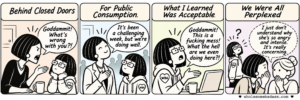
Four-panel cartoon showing the difference between how someone behaves behind closed doors and how they present themselves publicly. A child learns that anger and harsh language are acceptable, but later faces judgment for expressing what she learned.

I Didn’t Know to Hide It

I make no claims to benevolence. For my first 40 years, my default behavior was often diminishing and hurtful. Openly aggressive, harsh, and raging. I hated how reactive and hurtful I could be. But decades of mistreatment taught me only to mistreat, not how to respond appropriately to mistreatment or treat others with consistently high regard. What I couldn’t have known was that the behavior being modeled at home was also being carefully contained. Without any meaningful contrast of kindness, mercy, or respect, I didn’t recognize the behavior as irregular. I’ll always be sensitive, with my tightly wound nervous system basically on the outside of my body—easily overstimulated and dysregulated. But NOW I understand how to soothe and regulate myself. Struggling to regulate one’s emotions, however visibly expressed, should not be confused with exhibiting contempt or disrespect for another person. I get to distance myself from people who consider diminishing words or behaviors acceptable. And it’s been decades since I said or did a mean thing. It seems a ridiculous brag, but it’s quite the overcoming and miracle. One of many things that differentiated me from my family—and the similar relational patterns I later sought out—was that I didn’t know to conceal cruelty. My sister would scold, “You just don’t get it.” Straight facts. I super didn’t get it. What I did get: Apparently, it was okay to say and do cruel and damaging things to me. Because if you did, that was my fault, as my shittiness made you behave that way. This became my relational template, shaping my life’s trajectory. I can’t help but wonder why nobody was concerned enough to get me help. Only judge, punish, judge, repeat. Actually… 🤔 I think I understand why professional guidance was not provided. Getting me help might have meant examining what was happening at home, rather than continuing to treat me as THE problem. And why was I deemed the sinful one? But seriously—for those who know to hide it, what excuse even is there?

Read More
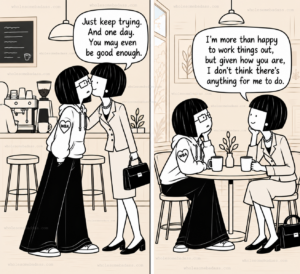
Two-panel illustration showing a woman suggesting someone may eventually be good enough, then claiming she wants reconciliation while insisting the other person is entirely responsible for the conflict.

Maybe One Day You’ll Be Worthy

There’s a deviant cruelty in having it said that you “got what you deserved.” Who even thinks like that? (Clears throat.) When I question the unequal terms of a relationship or ask for mutual consideration, the focus shifts from my concerns to how I’m showing an emotional reaction. My “intensity” is condemned, and my requests for change and repair are dismissed as manufacturing chaos. My credibility is systematically dismantled, while the unequal terms themselves go unexamined. Disqualified. And I am repeatedly (seriously, repeatedly) told, “You are welcome to join, provided you change,” while simultaneously being assured that such change is unlikely. Something astonishing happened when I healed enough to stop providing the convenient distraction of my large emotional reactions: rather than easing the conflict, the pressure intensified. Without my dysregulation to focus on, the very dynamics I had been questioning became difficult to ignore. Requesting mutually healthy terms and finally having enough self-esteem to refuse being disregarded or diminished is characterized as having “opted out.” As though I unilaterally chose to abandon a perfectly good relationship rather than asking whether we could find a way forward that works for us both. The estrangement that follows is framed as the natural consequence of “my choice.” Even hostility is justified as something my supposed deficiencies made necessary. If only I were different, they wouldn’t have to treat me this way. It’s fkn bananas. 🍌

Read More
A crowned man sits on a throne, rewarding a favored woman with flowers while directing another woman toward a dangerous trap labeled “Consequences.” The image illustrates favoritism, othering, and emotional violence.

When Discomfort Is Handled as Provocation

I’m recognizing a pattern in the personality type I’ve come to call The Archetype: disproportionate retaliation in response to discomfort. There is a swift intolerance for anything or anyone that appears to interfere with their ideas, preferences, plans, comfort, or agenda. Frustration, inconvenience, disagreement, or a perceived lack of deference is handled as a provocation to be consequenced. They justify their retaliation as a natural consequence of being provoked, while simultaneously denying they had been affected or reacted at all. In this dynamic, labeling someone as troublesome and treating them accordingly takes precedence over acknowledging feeling threatened and dealing with difficult feelings. Something is causing discomfort? Annihilate it.

Read More
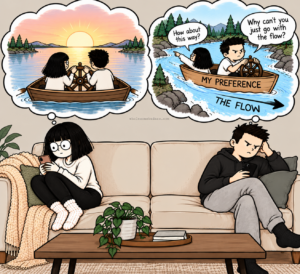
Two people sit apart on a couch. She imagines them steering a boat together. He imagines himself steering a boat labeled “MY PREFERENCE” along “THE FLOW,” dismissing her suggestion with, “Why can’t you just go with the flow?”

Expecting to Matter

In my family and marriage, my emotional and sensory sensitivities were treated as unreasonable burdens and acts of defiance. Rather than information worth considering, my preferences and limitations were interpreted as resistance. I struggled to navigate these relationships, which I experienced as structured around coercion and submission, where consideration wasn’t a shared value. Expressing individual needs was treated as not being a team player—a punishable offense. And when those needs were accommodated, they were logged as personal favors and evidence of fairness, further reinforcing the power imbalance. When a person can only tolerate having their way, even the possibility of not getting what they want can create considerable tension. Despite my best efforts, I found no way to remain under those rules of engagement. The only healthy option was to surrender the relationships rather than submit to unfavorable terms or keep fighting for better ones while being treated as though their  proximity was a privilege, easily revoked. Fuck that. No, thank you.

Read More
Black-and-white cartoon of Wholesome Badass in a jujutsu stance, holding up a glowing shield against dark arrows and scribbles. A speech bubble says, “But here’s what also happened.”

The Power of an Incomplete Truth

In my tagline, I reveal myself as navigating the storm of neurodivergence, trauma, and toxic family systems. For the archetypes with whom I have navigated strife or rupture, I imagine this perspective may feel unwelcome because it adds context to a much simpler explanation: I was just bad. Difficult. Crazy. Selfish. Unreasonable. Context provides nuance that the simpler explanation leaves out. Whatever may have been said or done to diminish me was charged to me: I caused it, deserved it, exaggerated it, or imagined it. The tagline isn’t an attempt to excuse myself, but the closest language I have found for an experience I spent decades unable to articulate. Naming neurodivergence, trauma, and a dysfunctional family system does not make every choice I have ever made harmless, good, or right. It allows nuance into a story where my context was effectively disregarded. And I can’t help but ask, in all earnestness: if my “craziness” was the explanation for every instance of hardship for me, why wasn’t anyone’s response concern, curiosity, or support? What I am chasing is not agreement but a fuller record. More of what actually happened allowed into the room. Other people’s explanations have passed for the complete story, while mine were categorically rejected as inadmissible. If I asked questions, I was manufacturing chaos. If I offered context, I was making excuses. If I remembered something differently, I was rewriting history. I was seeking a clean signal—clarity, cohesion, some way to sew the pieces together for a story that makes sense, even if what emerged was painful or unflattering to me. Apparently, asking clarifying questions seems to threaten the prescribed narrative. Providing context is recieved as equally troublesome. So I am left trying to make sense of a story I was expected to accept, while relevant context was not allowed into consideration. Have you ever realized that what seemed like the only obvious conclusion was actually inaccurate and deeply unfair — once you had a more complete account of the story? One real-life example: I’m in a hurry and stuck behind a man in a posh new Jaguar, stopped in the road and holding up traffic for what I assume is no good reason—just entitled and inconsiderate. Then I SEE he has gotten out of his car to help a disabled elderly person with a heavy package cross the street. Nothing about the stopped car changed. The context did. I feel some of that same aha humbling energy when I think about people like Howard Stern, Monica Lewinsky, Stormy Daniels, Pamela Anderson, and others whom I experienced through a particular public narrative without bothering to question what might have been missing from it. Sometimes the framing was profitable. Sometimes powerful people had an enormous stake in which version prevailed. Either way, I accepted a conclusion before I had much interest in the fuller record. Just saaaaayin.

Read More
Black-and-white line drawing of one person subtly tipping a bicyclist off balance while shrugging and thinking, “sheesh...always so dramatic.”

Rattle the Cage, Judge the Reaction

If I can rattle your cage and then stand beside your reaction looking calm and reasonable, I can create a defining contrast: you unstable; me credible. Your distress is excellent leverage. I get to have my way with you and come out looking better for it. Have you ever known someone with the kind of energy that would steal your wallet, watch you become rightfully upset, be the first to publicly comfort you and help search for it—and then somehow be the one to find it and hand it back? It is a hell of a trick to create friction, then step forward as the hero for managing the fallout. Have you ever experienced a situation where the focus immediately pivots from what happened to how you reacted—as if composure is evidence of innocence, reasonableness, or rightness?

Read More
Black-and-white line drawing of two stick figures in a leaking boat. One figure wears a life vest, holds a life preserver, and says, “You need to calm down,” while the other figure looks distressed and bails water out of the boat.

The Advantage of Appearing Unbothered

I am beginning to recognize and more effectively name and navigate familiar systems, patterns, and personalities. In power imbalances, the person with more status or authority can seem even more credible when appearing almost completely unaffected — mildly inconvenienced at most. Beneath a curated exterior — detached, unreadable, even smiling or measured — strategically executed impunity may pass for sovereignty, shielded from challenge by status/rank itself. By contrast, an emotional response to threat or injury can be marked as excessive: evidence of defect, weakness, and wrongness, rendering the account of what happened inadmissible. Once that logic is established, power-over can pass as reasonable and justified. This is where emotional violence can comfortably hide: in the latitude granted by role, status, or perceived legitimacy to diminish, exclude, intimidate, or overpower another person while the resulting distress is treated as further proof that the response was warranted.

Read More
The Narcissist’s Prayer showing six statements that progress from denial and minimization to blame-shifting, beside an image of a cracked mask.

Gaslighting, Blame-Shifting, and the Absence of Repair

A person can know something experientially long before they can articulate it. They might know, for example, “After X is upset with me, I end up confused. I initiate communication thinking I had a legitimate concern, and somehow I leave apologizing and wondering whether I caused everything.” They don’t necessarily have words or concepts to process what happened. Once someone learns concepts like blame-shifting, triangulation, invalidation, stonewalling, double standards, DARVO, conditional approval, or refusal of repair, those concepts can provide handles for examining an interaction: Wait—was I actually heard? Did we each consider or examine our contributions? Was disagreement permitted? Did responsibility somehow become entirely mine? And importantly, language doesn’t have to supply the verdict. It can supply questions. That may be especially valuable for someone who’s been raised inside a particular relational system, because whatever happened repeatedly can simply register as this is how relationships work. Conflict is information, not a trial where somebody has to be found guilty. You can finish a disagreement still thinking, I was right about the original issue, and nevertheless learn: I interrupted you. I got defensive. I misunderstood what you meant. I didn’t realize that mattered so much to you. Or: I still disagree, but now I understand your reasoning. Or my most favorite of all: I think I understtand but I still do not agree. And the other person can do the same. Someone can be displeased with you without their displeasure becoming evidence that you’re bad. They can misunderstand you without their interpretation replacing your knowledge of yourself. And you can discover something uncomfortable about your own behavior without having to collapse into therefore I am the problem. In a healthy rupture, both people have something to metabolize. Not necessarily equal blame—sometimes one person really did behave badly—but both people still have an encounter to process. What happened? What did I do? What did you experience? What did I misunderstand? What does this change between us? What is needed for repair? In the archetypal dynamic, one person effectively exempts themselves from that process. Their internal work stops at: I was right to do or say X because of what you did. Everything downstream gets assigned to the other person. But the person on the receiving end doesn’t get to bypass metabolizing the rupture. They can end up metabolizing too much. They process the original conflict, the accusation, the other person’s certainty, the withdrawal, their own behavior, their memory, their motives, what they could have done differently, whether they’re actually the problem—and they do it without the other person’s participation. Then contact resumes without repair. All of that processing has nowhere relational to land. It can instead become adaptation: anxiety, self-doubt, vigilance, accommodation, rehearsing, overexplaining, trying harder, monitoring tone, becoming increasingly careful. The rupture isn’t unprocessed. The processing is asymmetrical. One person preserves their existing understanding of themselves. The other person is left reorganizing themselves around the unresolved rupture. Repair brings the information back into the relationship, where both people can examine it instead of one person having to carry and interpret the whole thing alone. One person is trying to understand what happened. The archetype is operating from the position that nothing happened that requires understanding. One person is asking, What happened between us? How did we get here? What needs to be repaired? And the answer—explicitly or through behavior—is essentially: There is nothing between us to repair. The problem is that you’re confused, anxious, sensitive, difficult, or unable to let things go. So the effect of the interaction gets reassigned as a characteristic of the recipient. The anxiety created by unresolved rupture becomes evidence that you’re “anxious.” The confusion created by contradictory interactions becomes evidence that you’re “confused.” Your attempts to get resolution become evidence that you “can’t let things go.” Your attempts to clarify what happened become evidence that you’re “overthinking.” The interaction disappears from the explanation. Then when ordinary contact resumes without acknowledgment, one person can experience that as moving on, while the other person is still carrying an unresolved event that supposedly never happened. There can be no repair when only one person is able to acknowledge that there was a rupture. You can say, “Something you did didn’t land well with me,” and get: Nothing happened. You’re misinterpreting me. You’re too sensitive. Or you can notice distance and say, “Something seems different between us. Did something happen?” and get: Nothing’s different. You’re imagining things. Why do you always do this? If you name an impact, you’re creating a problem. If you notice an impact, you’re creating a problem. If you ask about a rupture, you’re creating a problem. If you remain unsettled because there was no repair, that becomes the problem. The recipient isn’t just processing a conflict alone. They’re being asked to process a conflict whose existence has been denied. There isn’t even an agreed-upon event to work with. Something happened between us. I can observe the change. I’m experiencing the consequences. But I’m being told there is nothing here to discuss. Which may be why “nothing happened” is so consequential. It doesn’t merely refuse repair. It removes the shared reality from which repair would have been possible. Nothing happened. Nothing’s wrong. There is nothing to discuss. But then there’s silence. Distance. Withdrawal. Maybe coldness. You’re left alone with whatever the fuck just happened. That’s the contradiction. You’re experiencing the consequences of a rupture while being denied the existence of the rupture itself. Whatever else may be true, this is a defining structure within the archetypal dynamic.

Read More