Wholesome Badass

A Work in Progress — Healing from All the Things​

Illustration of two one woman sharing details of someone else's private struggle. And being praised for kind thoughtfulness. The woman they are discussing sits nearby, unaware.

The Irony of Weaponized Concern

The Reality of Gossip Discussing the details of someone else’s life—their hardships, their choices, or how they live—is a fundamentally unwholesome practice. Gossip happens, and we can be honest about that and not pretend that engaging in it is useful, considerate, or kind.  The “Concerned” Persona So it is fascinating to witness someone who is known for not being particularly fond of a person take an openly concerned stance in sharing the depth of their worry for that person’s wellness, stability, and functionality. The energy attempt:  “I’m only saying this because I care…” Engineered Destabilization It is a stunning social loophole. Cloaking gossip with empathy, is an attempt to engineer a kind of social undermining while seeking praise for thoughtfulness. If I knew how to do emojis from my Mac- Barfing emoji for sure right fkn here. The Blind Spot What is confusing, is how easily bystanders buy the act. How does a person or group look at someone with an obvious grudge or bias, listen to them trade in the unfavorable assessment of another person’s private life, and see a caring soul instead of an invasive, scheming act? Skull and Crossbones emoji here. The Performance vs. Real Consideration Genuine care and consideration tend to be quiet and direct and require no recognition. They check in and ask what they can do to help. They honor respect and privacy with discernement and intention. When the “concern” is instead passed around from person to person, it isn’t support—it’s unwholesome gossip disguised as  goodness. It makes you ask “how does a sound person buy into the performance?” Insert Comedy Tragedy mask emoji here. Whatever else may be true, this also happened.

Read More
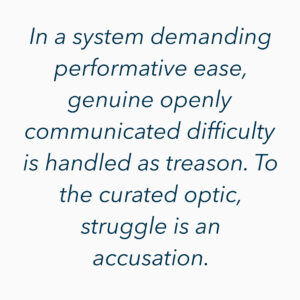
Text graphic quote: In a system demanding performative ease, genuine openly communicated difficulty is handled as treason. To the curated optic, struggle is an accusation.

Holding Court, Keeping the Crown Straight

The Binary The archetypes seem to move through life inside a rigid binary: winners and losers, heroes and villains, right and wrong. In their accounting for outcomes, there seems a lacking awareness for the possibility of their own poor decisions, regrettable reactions, or personal shortcomings.  Ironically, those are my favorite parts of any story. They are where humility lives and where connection is deepened.  To present as innocent, infallible, or heroic, someone else must always carry the shadow. When the archetype FAILs to achieve something, the explanation is rarely capability, circumstance, or choice. Instead, someone else must have been unfair, jealous, dishonest, or unjust. But the standard changes when hardship belongs to someone outside their circle of favor. Then the loss is framed as deserved.  Proof of poor character.  Evidence of defectiveness. Similar outcomes get narrated through two entirely different lenses, depending on who it happened to. The Meritocracy There seems a profound reliance on meritocracy as a reason for nearly every outcome. Success as proof of virtue.  Failure as proof that the game was rigged—at least when it happens to the archetype. And stories are shared with performative ease. Becuase struggle and dis-ease are marks of unworthiness and defect. Cue smiling emoji. A casual “lol.” “No worries.” “Perfect” The performance broadcast says, I’m completely unbothered. The pulsing tension whispers otherwise. Beneath the carefully arranged face seems a deep fear of losing status, admiration, or control. This must never happen. And there is an unspoken truth that if the archetype is worried, everyone else should be worried too. When your worth depends on always appearing victorious, peace becomes impossible. Protecting the delusion illusion is more important than connection or truth. In a system demanding performative ease, genuine and openly communicated difficulty is handled as treason. To the curated optic, struggle is an accusation. Whatever else may be true, this also happens.

Read More
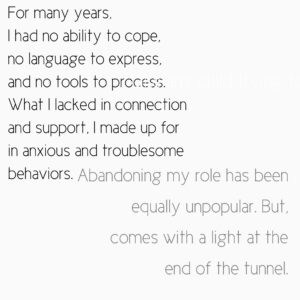
A minimalist graphic with white text on a solid, neutral background. The text reads: "I had no ability to cope, no language to express, and no tools to process. What I lacked in connection, I made up for in anxious behaviors. It was a costly way to exist—paying with myself just for proximity. Abandoning my role has been equally unpopular. But, it comes with a light at the end of the tunnel."⁠

When Victory Demands Wreckage

The Architecture of Binary Victory I have intentionally been studying a particular archetype whose sense of rightness often seems to depend on projecting wrongness onto someone else. The Perceived Victimization The archetype appears to operate under a specific system of binary beliefs: the conviction that winning and “being right” at all costs remains the ultimate proof of goodness, and that causing another to struggle is a valid tool to establish who is in the wrong. Under this framework, if someone in anyway interferes with what the archetype feels entitled to, it is experienced as a personal victimization. To restore the power imbalance, the system demands the plight of the person who deviated from the script. The Circular Trap of Blame Within this structure, a peaceful disagreement, ending or exit is out of the question; the archetype often requires visible social, financial, or professional struggle. Resulting pain is regarded not as a wound in need of care, but as proof of a deserving loser. The narrative becomes circular: the imposed hardship(which they rationalize as natural consequences–but natural consequences by definition are not imposed) is held up as evidence of “bad choices” and a “bad personality,” while the behaviors that contributed to the struggle are casually dismissed. Claiming the Third Way The fixed mindset of the archetype fights hard against a third way—a reality where someone can step away, choose peace, and quietly build a life outside of those win-loss columns.

Read More
A quote on a dark, stormy abstract background that reads: When it comes to abusive behavior, if they know to hide it, they know it's wrong. If they don't do it in front of other people, they know how to control it.

The Price of Disagreeing

Coercive control is a strategic pattern of behavior used to dominate another person and strip away their sense of autonomy. It is not defined by a single violent event, but by a continuous web of intimidation, isolation, and micro-regulation of the victim’s life. When applied to the family unit, this control is often maintained through three primary mechanisms: 1. Scapegoating Scapegoating is the process of blaming one person for the family’s internal problems or the controller’s own failures. The goal: To create a “common enemy.” By making one person—often a child or the other parent—the source of all conflict, the controller deflects accountability and keeps the rest of the family in a state of hyper-vigilance. The result: The victim internalizes the shame, believing they are fundamentally “broken.” 2. Triangulation Triangulation occurs when the controlling person refuses direct communication and instead pulls a third person into the dynamic to create friction or competition. The goal: To divide and conquer. By telling different versions of a story to different people, the controller ensures loyalty while fostering suspicion between others. The result: It prevents victims from forming a united front, leaving the controller as the sole source of “truth.” 3. Parental Alienation In the context of coercive control, parental alienation is the ultimate extension of triangulation. It involves one parent using psychological manipulation to turn a child against the other targeted parent. The goal: To sever the bond between the child and the other parent, effectively erasing that parent’s influence and presence. The result: The child becomes a tool of the controller’s campaign, often resulting in long-term psychological trauma for both the child and the alienated parent. How They Intersect These are not isolated tactics, but interdependent components of a single power dynamic. Coercive control in a family setting operates through a calculated cycle of isolation and psychological pressure. It begins with scapegoating, reinforced through triangulation that manipulates communication and divides family members. These efforts culminate in parental alienation, where the scapegoated parent’s influence is erased, leaving the controller in command of the family’s reality. Coercive control thrives in silence and isolation. Identifying scapegoating, triangulation, and alienation for what they are is essential for protecting your mental health. The confusion you feel is a documented byproduct of the system, not a reflection of your worth as a parent or person.

Read More
Woman with half her face visibly distressed and tearful, the other half covered by a composed mask of her own face, symbolizing emotional masking and how composure is rewarded while distress is invalidated.

When “What Are You So Angry/Upset About?” Isn’t Actually Concern

I’m finally recognizing how validity gets measured not necessarily by the truth of what’s said, but by the composure of the person saying it. My sister recognized this dynamic early on. As someone deeply sensitive and reactive, I was easy to push. She could use subtle, almost invisible cues—like dog whistles—to trigger me. When I reacted, my distress was visible. She soared, by contrast, appearing calm, composed. The comparison was stark: her unaffectedness made her look right, while my emotional presentation made me look wrong. If you’re overwhelmed, overstimulated, or visibly distressed, your words can be dismissed simply because the delivery isn’t “correct.” You’re invalidated—not for what you say, but for failing to mask emotion. Meanwhile, those who appear composed—whether less sensitive, more resilient, or simply checked out—are granted credibility. In conflict, content matters less than presentation. This dynamic is often weaponized. A question like, “What are you so angry about?” masquerades as concern but functions as control, subtly discrediting the other person. In closed systems—family, workplace, or community—the sensitive one easily becomes the scapegoat. Sensitivity is reframed as weakness, instability, or unreliability. Any emotional communication that challenges the status quo is disqualified before it’s even heard, dismissed not for its substance but for the unmasked feelings attached. Composure paraded as proof of virtue; sensitivity condemned as proof of sin.

Read More
Closed interior door with a narrow line of light beneath it, representing the experience of being shut out while continuing to endure, witness, and remain present.

Scapegoating and the Cost of Speaking Up

The Truth That Cannot Be Erased For over a decade, this space has been my witness. For a multitude of reasons, outside of what has been designated as my willfullness and lack of gratitude, I have never been a pleasing or “quiet” victim sufferer. By around age eleven, I understood that my highest goal in life was to become someone else—or to become more palatable while absorbing abuse. I failed equally at both. I sought and gave myself to many similarly toxic situationships, I suppose, in the name of practice and growth in the art of better abuse-getting. The Reality of the Scapegoat As a neurodivergent survivor of childhood trauma and sibling molestation, my so-called “hysteria” was the only language available to me in an environment that protected my abuser and pathologized my pain. My sister was endorsed as the golden child. I was left to navigate the wreckage of her actions alone. She was praised for not being like me and pitied for having to deal with my “drama.” The Refusal to Be Gaslit This blog documents my experience as the family scapegoat—the person who could not believe or pretend that the “flow” was good. I was encouraged to calm down, be positive, grateful, you know- JUST go with the flow, even when that flow was designed to drown me. A Legacy of Resistance My “tantrums” were protests. My “outbursts” were the sound of a person being erased in real time. I write about the dirty and unsurprising alliance between an abusive sister and a similarly narcissistic ex-husband for what it is: a coordinated effort which denied me peace and my children. The Record for My Sons I am not begging for a seat at a table where I am not respected. I keep this record so my children may one day understand that their mother was not “unhinged” simply as a defect. She was unsupported, overstimulated, and being crushed by a system she could not fathom. A Note on My Methods of Survival In earlier chapters, I used my sister’s full name and shared specific accounts of professional and personal abuse, including details she offered as warning shots about how she handles uncooperative others. I did this frantically, without a playbook on navigating coercive abuse or even any idea that coercive abuse was a thing. I did so without a support system. I am not proud of the desperation that shaped those posts. But I am not ashamed of how I reacted to being molested, scapegoated, and erased. I was a person without a net, doing the only that I could—telling my truth- raging against those who harmed and silenced and erased me. In the only space I can.

Read More
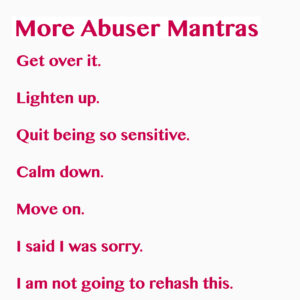
Abusers Mantra- That Did Not Happen

“But What Did She Do?”

Friend: So you’re not in contact with your daughter anymore? Family Member: No, she’s just too much. Always some issue with her. Always making everything harder than it has to be. Friend: Wow. What happened exactly? Did she hurt someone? Lie? Betray you? Family Member: No, not really. It’s more like… she always has needs and limits and feelings that are too much and make no sense. So sensitive. Demanding. Needy. Always demanding conversation. It’s exhausting. Friend: That doesn’t sound like a crime. Did she ask to talk about something hard? Family Member: Yeah, but she turns everything into a problem. Like, she’ll say something felt hurtful, or ask someone to stop doing something—and suddenly, it’s a whole thing. She speaks problems into existence. If she’s upset, that’s the problem. Not what caused it. Friend: So she brings up something painful and you say she’s just trying to cause drama? Family Member: Exactly. We always told her: stop manufacturing chaos. If you’re hurting, you probably imagined it, earned it, or brought it on yourself. Friend: What happens when she does try to talk about it? Family Member: She gets overwhelmed. Emotional. Then she cries and it’s like, see? You can’t even talk to her. She’s unstable. Friend: Did you ever try family therapy? Family Member: Yes, once. She completely fell apart in the session. Couldn’t handle us calmly telling the therapist how hard she is. The therapist saw right through her. Friend: Or maybe she broke down because the room was against her and you used that as proof? Family Member: Whatever. She just needs everything to be her way. We can’t do that. Friend: So what’s the worst thing she actually did? Family Member: She refused to keep showing up—opted out until we had more useless conversations. She always said she’d come to the table if people would be kind. But she made herself the outsider. Ask anyone—she sucks. Friend: But if nobody can name what she actually did—not how she felt, or how you felt about her, but what she really did—then what was she punished for? Family Member: For being impossible. Creating tension to get attention. Friend: Hmmm. 14 Years Later Friend: Wait… so you don’t talk to your mom anymore? Son: Nah. She’s impossible. Always on my case, trying to control everything. Friend: That sucks. But like—what did she do? Was she abusive? Did she lie to you or betray you? Son: No. She just… always had these expectations…demands. And like tried to be my boss. Always correcting me. She wanted me to be perfect. Friend: Okay… but was she unfair? Like punishing you for stuff that wasn’t real? Was she constantly grounding you or taking your phone for no reason? Son: No, not really. I think I got grounded maybe once. She barely ever took my phone. Friend: So you weren’t in trouble all the time? Son: No, not really. She’d just get mad when I didn’t follow through or when I ignored her. Friend: So… she had rules? Son: Yeah, but she wanted consistency. Like, if I did something well for three weeks, and then I would drop the ball and she would correct or redirect me. Like the three weeks did not even count. Friend: That doesn’t sound crazy. That sounds like accountability… parenting? Son: She just wouldn’t let me do whatever I wanted. She’d say no to stuff sometimes. She expected respect. Friend: Did you guys ever try family therapy? Son: Yeah, but I went thinking it’d be my chance to explain my side, and maybe get the therapist to see how hard she is. I don’t think she went in expecting that. Friend: So… you weren’t there to try to heal things? Son: Not really. And she got upset in the session, started crying, and then it was like—“see? She’s so emotional, you can’t even talk to her.” Friend: So her emotional reaction to being overwhelmed was used as proof that she’s the problem? Son: I mean… yeah. Friend: And the worst thing she did was… not agree immediately to let you drive across the country at 16 without a plan? Son: She said I could if I had check-ins and stayed with people we know. But it felt like she didn’t trust me. Friend: So she wanted to keep you safe and be part of the planning, and that made her the enemy? Son: I guess. But still… she sucks. Narrator: This is the anatomy of a smear campaign. A person becomes “too much” only after they become unwilling to be mistreated. They say, “She’s hard to deal with.” But what did she do? Ask again. From every angle. Ask louder. Ask in front of the people who repeat the story. Ask the ones who believe it. What did she do? What did she do? And if no one can name it, then maybe— just maybe— she didn’t do anything at all. Maybe she just stopped agreeing to be the scapegoat. Below are just a few of the books that have been especially informative and healing for me as I navigate my journey of recovery and self-understanding:

Read More
Black-and-white illustration of a woman isolated behind a wall as family members reinforce the divide, symbolizing triangulation and parental alienation.

Your Enemy’s Enemy Is Your Friend

Being publicly told “you’re welcome to join” by people who openly disregard and disrespect me is hardly evidence of genuine inclusion. The invitation is presented as evidence of goodwill, while my condition of repair before returning is presented as proof that I’m choosing to separate myself from the family. No contact was a tragic last resort. There’s something particularly cruel about weaponizing my decision to protect myself from further harm. Years after a loveless, volatile marriage and unnecessarily contentious divorce, my estranged sister and ex-husband established an alliance of their own. I had married a man whose emotional patterns mirrored my sister’s, recreating the same relational dynamic. Given their shared, longstanding patterns of divisive behavior, their alliance was hardly surprising. They began gathering with my children while excluding me, despite my repeated requests that my sister stop. The resulting division extended beyond my relationships with either of them, affecting my children, our co-parenting relationship, and my already strained relationship with my mother. As my mother liked to say, “Your enemy’s enemy is your friend.” Whatever their intentions or explanations, their words and actions hurt our family. That harm was not mitigated by context or justification.

Read More
Illustration of two one woman sharing details of someone else's private struggle. And being praised for kind thoughtfulness. The woman they are discussing sits nearby, unaware.

The Irony of Weaponized Concern

The Reality of Gossip Discussing the details of someone else’s life—their hardships, their choices, or how they live—is a fundamentally unwholesome practice. Gossip happens, and we can be honest about that and not pretend that engaging in it is useful, considerate, or kind.  The “Concerned” Persona So it is fascinating to witness someone who is known for not being particularly fond of a person take an openly concerned stance in sharing the depth of their worry for that person’s wellness, stability, and functionality. The energy attempt:  “I’m only saying this because I care…” Engineered Destabilization It is a stunning social loophole. Cloaking gossip with empathy, is an attempt to engineer a kind of social undermining while seeking praise for thoughtfulness. If I knew how to do emojis from my Mac- Barfing emoji for sure right fkn here. The Blind Spot What is confusing, is how easily bystanders buy the act. How does a person or group look at someone with an obvious grudge or bias, listen to them trade in the unfavorable assessment of another person’s private life, and see a caring soul instead of an invasive, scheming act? Skull and Crossbones emoji here. The Performance vs. Real Consideration Genuine care and consideration tend to be quiet and direct and require no recognition. They check in and ask what they can do to help. They honor respect and privacy with discernement and intention. When the “concern” is instead passed around from person to person, it isn’t support—it’s unwholesome gossip disguised as  goodness. It makes you ask “how does a sound person buy into the performance?” Insert Comedy Tragedy mask emoji here. Whatever else may be true, this also happened.

Read More
Text graphic quote: In a system demanding performative ease, genuine openly communicated difficulty is handled as treason. To the curated optic, struggle is an accusation.

Holding Court, Keeping the Crown Straight

The Binary The archetypes seem to move through life inside a rigid binary: winners and losers, heroes and villains, right and wrong. In their accounting for outcomes, there seems a lacking awareness for the possibility of their own poor decisions, regrettable reactions, or personal shortcomings.  Ironically, those are my favorite parts of any story. They are where humility lives and where connection is deepened.  To present as innocent, infallible, or heroic, someone else must always carry the shadow. When the archetype FAILs to achieve something, the explanation is rarely capability, circumstance, or choice. Instead, someone else must have been unfair, jealous, dishonest, or unjust. But the standard changes when hardship belongs to someone outside their circle of favor. Then the loss is framed as deserved.  Proof of poor character.  Evidence of defectiveness. Similar outcomes get narrated through two entirely different lenses, depending on who it happened to. The Meritocracy There seems a profound reliance on meritocracy as a reason for nearly every outcome. Success as proof of virtue.  Failure as proof that the game was rigged—at least when it happens to the archetype. And stories are shared with performative ease. Becuase struggle and dis-ease are marks of unworthiness and defect. Cue smiling emoji. A casual “lol.” “No worries.” “Perfect” The performance broadcast says, I’m completely unbothered. The pulsing tension whispers otherwise. Beneath the carefully arranged face seems a deep fear of losing status, admiration, or control. This must never happen. And there is an unspoken truth that if the archetype is worried, everyone else should be worried too. When your worth depends on always appearing victorious, peace becomes impossible. Protecting the delusion illusion is more important than connection or truth. In a system demanding performative ease, genuine and openly communicated difficulty is handled as treason. To the curated optic, struggle is an accusation. Whatever else may be true, this also happens.

Read More
A minimalist graphic with white text on a solid, neutral background. The text reads: "I had no ability to cope, no language to express, and no tools to process. What I lacked in connection, I made up for in anxious behaviors. It was a costly way to exist—paying with myself just for proximity. Abandoning my role has been equally unpopular. But, it comes with a light at the end of the tunnel."⁠

When Victory Demands Wreckage

The Architecture of Binary Victory I have intentionally been studying a particular archetype whose sense of rightness often seems to depend on projecting wrongness onto someone else. The Perceived Victimization The archetype appears to operate under a specific system of binary beliefs: the conviction that winning and “being right” at all costs remains the ultimate proof of goodness, and that causing another to struggle is a valid tool to establish who is in the wrong. Under this framework, if someone in anyway interferes with what the archetype feels entitled to, it is experienced as a personal victimization. To restore the power imbalance, the system demands the plight of the person who deviated from the script. The Circular Trap of Blame Within this structure, a peaceful disagreement, ending or exit is out of the question; the archetype often requires visible social, financial, or professional struggle. Resulting pain is regarded not as a wound in need of care, but as proof of a deserving loser. The narrative becomes circular: the imposed hardship(which they rationalize as natural consequences–but natural consequences by definition are not imposed) is held up as evidence of “bad choices” and a “bad personality,” while the behaviors that contributed to the struggle are casually dismissed. Claiming the Third Way The fixed mindset of the archetype fights hard against a third way—a reality where someone can step away, choose peace, and quietly build a life outside of those win-loss columns.

Read More
A quote on a dark, stormy abstract background that reads: When it comes to abusive behavior, if they know to hide it, they know it's wrong. If they don't do it in front of other people, they know how to control it.

The Price of Disagreeing

Coercive control is a strategic pattern of behavior used to dominate another person and strip away their sense of autonomy. It is not defined by a single violent event, but by a continuous web of intimidation, isolation, and micro-regulation of the victim’s life. When applied to the family unit, this control is often maintained through three primary mechanisms: 1. Scapegoating Scapegoating is the process of blaming one person for the family’s internal problems or the controller’s own failures. The goal: To create a “common enemy.” By making one person—often a child or the other parent—the source of all conflict, the controller deflects accountability and keeps the rest of the family in a state of hyper-vigilance. The result: The victim internalizes the shame, believing they are fundamentally “broken.” 2. Triangulation Triangulation occurs when the controlling person refuses direct communication and instead pulls a third person into the dynamic to create friction or competition. The goal: To divide and conquer. By telling different versions of a story to different people, the controller ensures loyalty while fostering suspicion between others. The result: It prevents victims from forming a united front, leaving the controller as the sole source of “truth.” 3. Parental Alienation In the context of coercive control, parental alienation is the ultimate extension of triangulation. It involves one parent using psychological manipulation to turn a child against the other targeted parent. The goal: To sever the bond between the child and the other parent, effectively erasing that parent’s influence and presence. The result: The child becomes a tool of the controller’s campaign, often resulting in long-term psychological trauma for both the child and the alienated parent. How They Intersect These are not isolated tactics, but interdependent components of a single power dynamic. Coercive control in a family setting operates through a calculated cycle of isolation and psychological pressure. It begins with scapegoating, reinforced through triangulation that manipulates communication and divides family members. These efforts culminate in parental alienation, where the scapegoated parent’s influence is erased, leaving the controller in command of the family’s reality. Coercive control thrives in silence and isolation. Identifying scapegoating, triangulation, and alienation for what they are is essential for protecting your mental health. The confusion you feel is a documented byproduct of the system, not a reflection of your worth as a parent or person.

Read More
Woman with half her face visibly distressed and tearful, the other half covered by a composed mask of her own face, symbolizing emotional masking and how composure is rewarded while distress is invalidated.

When “What Are You So Angry/Upset About?” Isn’t Actually Concern

I’m finally recognizing how validity gets measured not necessarily by the truth of what’s said, but by the composure of the person saying it. My sister recognized this dynamic early on. As someone deeply sensitive and reactive, I was easy to push. She could use subtle, almost invisible cues—like dog whistles—to trigger me. When I reacted, my distress was visible. She soared, by contrast, appearing calm, composed. The comparison was stark: her unaffectedness made her look right, while my emotional presentation made me look wrong. If you’re overwhelmed, overstimulated, or visibly distressed, your words can be dismissed simply because the delivery isn’t “correct.” You’re invalidated—not for what you say, but for failing to mask emotion. Meanwhile, those who appear composed—whether less sensitive, more resilient, or simply checked out—are granted credibility. In conflict, content matters less than presentation. This dynamic is often weaponized. A question like, “What are you so angry about?” masquerades as concern but functions as control, subtly discrediting the other person. In closed systems—family, workplace, or community—the sensitive one easily becomes the scapegoat. Sensitivity is reframed as weakness, instability, or unreliability. Any emotional communication that challenges the status quo is disqualified before it’s even heard, dismissed not for its substance but for the unmasked feelings attached. Composure paraded as proof of virtue; sensitivity condemned as proof of sin.

Read More
Closed interior door with a narrow line of light beneath it, representing the experience of being shut out while continuing to endure, witness, and remain present.

Scapegoating and the Cost of Speaking Up

The Truth That Cannot Be Erased For over a decade, this space has been my witness. For a multitude of reasons, outside of what has been designated as my willfullness and lack of gratitude, I have never been a pleasing or “quiet” victim sufferer. By around age eleven, I understood that my highest goal in life was to become someone else—or to become more palatable while absorbing abuse. I failed equally at both. I sought and gave myself to many similarly toxic situationships, I suppose, in the name of practice and growth in the art of better abuse-getting. The Reality of the Scapegoat As a neurodivergent survivor of childhood trauma and sibling molestation, my so-called “hysteria” was the only language available to me in an environment that protected my abuser and pathologized my pain. My sister was endorsed as the golden child. I was left to navigate the wreckage of her actions alone. She was praised for not being like me and pitied for having to deal with my “drama.” The Refusal to Be Gaslit This blog documents my experience as the family scapegoat—the person who could not believe or pretend that the “flow” was good. I was encouraged to calm down, be positive, grateful, you know- JUST go with the flow, even when that flow was designed to drown me. A Legacy of Resistance My “tantrums” were protests. My “outbursts” were the sound of a person being erased in real time. I write about the dirty and unsurprising alliance between an abusive sister and a similarly narcissistic ex-husband for what it is: a coordinated effort which denied me peace and my children. The Record for My Sons I am not begging for a seat at a table where I am not respected. I keep this record so my children may one day understand that their mother was not “unhinged” simply as a defect. She was unsupported, overstimulated, and being crushed by a system she could not fathom. A Note on My Methods of Survival In earlier chapters, I used my sister’s full name and shared specific accounts of professional and personal abuse, including details she offered as warning shots about how she handles uncooperative others. I did this frantically, without a playbook on navigating coercive abuse or even any idea that coercive abuse was a thing. I did so without a support system. I am not proud of the desperation that shaped those posts. But I am not ashamed of how I reacted to being molested, scapegoated, and erased. I was a person without a net, doing the only that I could—telling my truth- raging against those who harmed and silenced and erased me. In the only space I can.

Read More
Abusers Mantra- That Did Not Happen

“But What Did She Do?”

Friend: So you’re not in contact with your daughter anymore? Family Member: No, she’s just too much. Always some issue with her. Always making everything harder than it has to be. Friend: Wow. What happened exactly? Did she hurt someone? Lie? Betray you? Family Member: No, not really. It’s more like… she always has needs and limits and feelings that are too much and make no sense. So sensitive. Demanding. Needy. Always demanding conversation. It’s exhausting. Friend: That doesn’t sound like a crime. Did she ask to talk about something hard? Family Member: Yeah, but she turns everything into a problem. Like, she’ll say something felt hurtful, or ask someone to stop doing something—and suddenly, it’s a whole thing. She speaks problems into existence. If she’s upset, that’s the problem. Not what caused it. Friend: So she brings up something painful and you say she’s just trying to cause drama? Family Member: Exactly. We always told her: stop manufacturing chaos. If you’re hurting, you probably imagined it, earned it, or brought it on yourself. Friend: What happens when she does try to talk about it? Family Member: She gets overwhelmed. Emotional. Then she cries and it’s like, see? You can’t even talk to her. She’s unstable. Friend: Did you ever try family therapy? Family Member: Yes, once. She completely fell apart in the session. Couldn’t handle us calmly telling the therapist how hard she is. The therapist saw right through her. Friend: Or maybe she broke down because the room was against her and you used that as proof? Family Member: Whatever. She just needs everything to be her way. We can’t do that. Friend: So what’s the worst thing she actually did? Family Member: She refused to keep showing up—opted out until we had more useless conversations. She always said she’d come to the table if people would be kind. But she made herself the outsider. Ask anyone—she sucks. Friend: But if nobody can name what she actually did—not how she felt, or how you felt about her, but what she really did—then what was she punished for? Family Member: For being impossible. Creating tension to get attention. Friend: Hmmm. 14 Years Later Friend: Wait… so you don’t talk to your mom anymore? Son: Nah. She’s impossible. Always on my case, trying to control everything. Friend: That sucks. But like—what did she do? Was she abusive? Did she lie to you or betray you? Son: No. She just… always had these expectations…demands. And like tried to be my boss. Always correcting me. She wanted me to be perfect. Friend: Okay… but was she unfair? Like punishing you for stuff that wasn’t real? Was she constantly grounding you or taking your phone for no reason? Son: No, not really. I think I got grounded maybe once. She barely ever took my phone. Friend: So you weren’t in trouble all the time? Son: No, not really. She’d just get mad when I didn’t follow through or when I ignored her. Friend: So… she had rules? Son: Yeah, but she wanted consistency. Like, if I did something well for three weeks, and then I would drop the ball and she would correct or redirect me. Like the three weeks did not even count. Friend: That doesn’t sound crazy. That sounds like accountability… parenting? Son: She just wouldn’t let me do whatever I wanted. She’d say no to stuff sometimes. She expected respect. Friend: Did you guys ever try family therapy? Son: Yeah, but I went thinking it’d be my chance to explain my side, and maybe get the therapist to see how hard she is. I don’t think she went in expecting that. Friend: So… you weren’t there to try to heal things? Son: Not really. And she got upset in the session, started crying, and then it was like—“see? She’s so emotional, you can’t even talk to her.” Friend: So her emotional reaction to being overwhelmed was used as proof that she’s the problem? Son: I mean… yeah. Friend: And the worst thing she did was… not agree immediately to let you drive across the country at 16 without a plan? Son: She said I could if I had check-ins and stayed with people we know. But it felt like she didn’t trust me. Friend: So she wanted to keep you safe and be part of the planning, and that made her the enemy? Son: I guess. But still… she sucks. Narrator: This is the anatomy of a smear campaign. A person becomes “too much” only after they become unwilling to be mistreated. They say, “She’s hard to deal with.” But what did she do? Ask again. From every angle. Ask louder. Ask in front of the people who repeat the story. Ask the ones who believe it. What did she do? What did she do? And if no one can name it, then maybe— just maybe— she didn’t do anything at all. Maybe she just stopped agreeing to be the scapegoat. Below are just a few of the books that have been especially informative and healing for me as I navigate my journey of recovery and self-understanding:
Read More
Black-and-white illustration of a woman isolated behind a wall as family members reinforce the divide, symbolizing triangulation and parental alienation.

Your Enemy’s Enemy Is Your Friend

Being publicly told “you’re welcome to join” by people who openly disregard and disrespect me is hardly evidence of genuine inclusion. The invitation is presented as evidence of goodwill, while my condition of repair before returning is presented as proof that I’m choosing to separate myself from the family. No contact was a tragic last resort. There’s something particularly cruel about weaponizing my decision to protect myself from further harm. Years after a loveless, volatile marriage and unnecessarily contentious divorce, my estranged sister and ex-husband established an alliance of their own. I had married a man whose emotional patterns mirrored my sister’s, recreating the same relational dynamic. Given their shared, longstanding patterns of divisive behavior, their alliance was hardly surprising. They began gathering with my children while excluding me, despite my repeated requests that my sister stop. The resulting division extended beyond my relationships with either of them, affecting my children, our co-parenting relationship, and my already strained relationship with my mother. As my mother liked to say, “Your enemy’s enemy is your friend.” Whatever their intentions or explanations, their words and actions hurt our family. That harm was not mitigated by context or justification.

Read More