Wholesome Badass

A Work in Progress — Healing from All the Things​

In Charge of Rejection

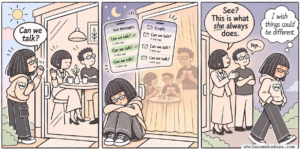
The love I knew was conditional, unpredictable, and readily withheld. I had no template for love that was safe, steady, and kind. I continued to reenact that relational trauma in nearly every relationship. While I am the common variable, so are my template for connection and the personality type it consistently draws me to. For much of my life, I engaged in relationships that diminished me. I tried, with limited understanding and skill, to redeem them. Which seemed impossible, particularly once I stopped agreeing to matter less. I’d try emphatically to understand what was happening between us so we could really connect, navigate our differences, and engage on mutual terms and in good faith. Instead, I was met with defensiveness, denial, and accusations of manufacturing chaos. Eventually, stonewalling. I was seeking connection with people whose behavior, I now see, as prioritizing deference. I didn’t recognize that we weren’t seeking the same thing, or that my attempts to communicate and establish mutuality might be received as defiance. Apparently, I was challenging the terms of a power dynamic I hadn’t even recognized. And when I finally stopped trying, that was unacceptable, too. With profound grief, I have had to acknowledge that the bond is too harmful to continue. The choice to stop chasing connection and approval has been ill-received. And cited only as further evidence of my troublesome, ungrateful, poor character and as the sole cause of our issues. “See? This is what you always do.” “Well, I guess that’s how much it meant to you.” “I thought you said you wanted to work things out.” “And you wonder why things are the way they are.” But isn’t it kind of like a doctor calling the time of death or delivering a diagnosis? The doctor doesn’t speak the death or disease into existence. He simply records it and moves forward accordingly. I’m not claiming to be a doctor. Obviously. I’m just saying, I’m finally able to trust my own experience and recognize the larger pattern without allowing someone else’s explanations, justifications, or occasional good moments to override it. And I can make my decisions based on that pattern rather than its exceptions.
Read More
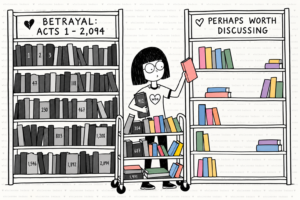
Hand-drawn girl sorting books between two shelves. One is packed with numbered gray books beneath “Betrayal: Acts 1–2,094” and a broken heart. The other holds fewer colorful books beneath “Perhaps Worth Discussing” and an outlined heart.

From Unprocessed Trauma to Integration

Over the last six months, I’ve experienced significant shifts in my recovery. I’m feeling it in my writing and illustrations, where I’m now able to convey things that previously defied articulation or required 42 million words. Looking back, my older writing reads almost like an attempt to assemble evidence for litigation. Or a screenplay. Trying with all earnestness to force light onto things that had been kept in the shadows for too long. And while looking at those things was essential to my healing, part of me desperately needed someone to recognize what I was trying to survive and make sense of. I was frantic for one fucking witness. Someone. Anyone. To say, “I see it. I saw it. That happened. It was rough and wrong and shitty and painful.” And if I were really lucky, maybe someone might even have said, “I get it.” Or, “You’re right.” Or, “Help me understand.” And I would have absolutely settled for, “That shit fucking happened.” “What do you need?” And it is astonishing to me that today, I don’t think I need that anymore. I no longer feel terrorized by the need for outside acknowledgment of my experience in order for it to be true or traumatic. I know what happened to me. I know how it affected me. And somehow, that seems to be enough. Is this what it’s like to have a sense of self? Or self-worth? Like maybe I can honor myself and what I know to be true without needing somebody else to affirm it. So I’ve taken down older writing for examination, saving only what feels useful. That writing gave me a chance to voice things I hadn’t been welcome to say. Things that had left me feeling silenced and erased and impotent. I’m not sorry for writing those things. The writing did what I needed. Its work is done. It’s not for the trash, but it no longer interests me. It’s lost its hold. And I love that. Have you ever exhausted yourself trying to access the most perfectly accurate words, the ones that couldn’t be disputed or denied, so you could finally get someone to see what happened? ♡

Read More
Wholesome Badass girl imagines herself drawing a winding path toward a yellow sunrise beneath a calming blue sky.

Who am I when my life is no longer organized around survival?

1. Identity — Who am I without the struggle? 2. Agency — The difference between reacting and initiating 3. The nervous system — When peace is unfamiliar 4. Desire — Discovering what I actually want 5. Dignity — Beyond defending my worth 6. Relationships — Connection without a role to perform 7. The future — A life that isn’t a response to the past Who might I get to be when my choices are guided by curiosity, desire, and intention rather than adaptation and self-protection?

Read More
A woman in Japan reacting with surprise and joy as a Japanese woman bows respectfully to her.

What I Thought Was Normal

I can’t help but laugh in disbelief as I recall my initial encounter of Japan. I seriously took the bowing personally. Not joking. I was 22, and not an all an adult. My understanding of respect, deference, and what people were entitled to take from one another was impossibly distorted. What I experienced as exceptional “kindness” was, in many ways, ordinary cultural respect. How could I have known? I do not recall behavioral models for respect and kindness. I was witness to only varied posturing, which was baffling and not at all intuitive for me. And no system with which to engage and demonstrate high regard for others. Just like weird reverence and what I would now call coercive abuse. A New Way to Relate For much of my life, the only familiar relational dynamic was binary: power over or be powered over. I saw rare others (like unicorns) living with more ease, mutuality, and peace, but that seemed remote. I knew only the system I had been brought up with. And if I had to choose from the menu of options I understood, I definitely believed it preferable to be on the giving end of the abuse because I equated that with authority and rightness. In recognizing and unlearning harmful patterns, I am also staring head-on at the ways I engaged and contributed. I had internalized the belief that how others treated me was information about who I was and what I deserved, and so learned to try and excuse my own harmful behavior by charging it to someone else…like my reaction to them was reflective of ONLY them. I could make no sense of why relationships hurt so much and why connection seemed synonymous with struggle. Looking back, of course it was miserable. If the only options were intimidation or submission, there was no room for flow, cohesion, or safety. And I am actually an avid fan of submission and surrender, but only with those who can be trusted on the other side of that dynamic—more harmony and collaboration than coercion. I have been utterly shocked to learn that some things can be familiar, common, and still symptomatic of unwellness. What feels pivotal is seeing both directions clearly: the harm done to me, and the harm I learned to repeat and then to end. I am deeply pained and regret the harm I learned to absorb, carry, and then offload onto other people. I understand more now, and I live differently, but understanding does not undo impact. Still—so much fkn unlearning. Reparenting yourself at 60 is a lot. What did you once think was normal and acceptable that you now view differently?

Read More
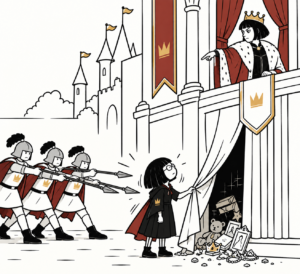
Illustration of a queen in an ornate palace while a woman pulls back a curtain revealing rats hidden behind it.

Love, As I Understand It

In my unlearning — and in forming an understanding of the kinds of love and energy that make sense and feel safe to me — I am having to unlearn a lot of the scary love that shaped me into someone who both accepted and offered scary love. In the love (the verb) that I am now learning, the thing I refer to as “badass love” – sacrifices for others. It does not sacrifice others for any reason. While wholesome love is safe, steady, and nourishing, badass love is that same love under pressure — willing to take a stand, risk vulnerability, and accept the responsibility that comes with having power, influence, or status. Because having the ability to choose differently matters. Badass love has grit. I understand it as healthy love capable of tolerating difficulty without sacrificing dignity, honesty, or another person’s humanity. It is merciful — refusing to leverage status or rightness as a weapon. Badass Love Has Grit I have witnessed badass love in remarkably unremarkable things. Doing a kind thing when nobody will know you did it. Helping when helping is inconvenient and opting out would be preferable. Accepting some discomfort, delay, or less for yourself so someone else can have what they need. Continuing to show up in service when there is no praise coming, no acknowledgment, perhaps not even gratitude. Doing something useful for someone without keeping the receipt for a future argument. Taking a relational risk because healing matters. Being more willing to absorb the cost of doing what feels loving -than to collect credit for having done it. And maybe that is where love reveals the most about itself: when something prized is threatened by what is true. When the status quo could be easily sustained if one person were simply eliminated from it. Evidence of Love For me, love cannot live only in the explanation someone gives for their behavior. Love has to show up in what they are willing to do to another human being in order to remain right or have their way. I keep coming back to something much less romantic: Love is a verb, not a fucking feeling or an intention. Calling something loving does not make it so. Love and character seem well reflected in how much collateral damage a person is willing to cause or accept in defense of their position.  I am all for wholesome badass love. Apparently, it is not for everyone. Have you ever known someone who felt completely certain of their own rightness and entitlement while also understanding themselves as deeply loving? I am certainly no expert, but I have a hard time seeing deep entitlement as a loving posture. Naahmsaaayyyin?

Read More
doesn’t.

What Wholesome Love Looks Like

I’ve been reading about relationships—attachment, avoidance, conflict, repair, deflection, ego, intimacy. And I am noting things that feel true to me. Not rules. Not credentials I suddenly possess. Just observations about the habits and behaviors that seem to accompany loving relationships—and that sometimes stand in stark contrast to what I have known. Things like: Habits and Behaviors of Wholesome Love Loving people don’t want to hurt you. And when they do, they are interested in what happened, how it affected you, and what is needed of them. Loving people can appreciate your joy when they aren’t the source of it. They can be interested in what matters to you even when the thing itself doesn’t particularly interest them. They don’t experience your success as threatening, inconsequential, or unworthy of acknowledgment. They can sit beside frustration, disappointment, or despair they cannot fix without needing those feelings to go away so they can be comfortable again. They can hear, “That hurt me,” without automatically translating it into, “You are a terrible person.” They can be deeply interested in their impact even when they are certain of their intent. They can hold two things at once: I didn’t mean to hurt you and you were hurt by what I did. They don’t ask you to name a time, then punish you for bringing up the past when you do. They don’t move the conversation from what happened to what is wrong with you for being affected by what happened. They don’t use your reaction to deflect from the thing you were reacting to. They can be wrong without needing someone else to be wronger. They don’t require agreement before your experience is worthy of consideration. They don’t punish honesty and then seem confused when you stop talking. They don’t repeatedly teach you that bringing them one problem will leave you with two. They don’t call the absence of conflict peace when one person has simply learned that speaking costs too much. They don’t require you to abandon your own perception in order to remain close to them. They don’t need their understanding of themselves to outrank your experience of them. They participate in repair. They remain curious about you. And maybe that is the thing I am noticing most. It is easy to feel loving when nothing about the other person is difficult for you. I am becoming much more interested in what happens when it is. These are some of the things I am beginning to recognize as wholesome love. What Wholesome Love Doesn’t Do And there are some things I believe, as a standard, loving people don’t do. They don’t lie to you or deliberately deceive you. They don’t hide things you have a right to know or withhold information that affects you. They don’t entertain other people in ways that betray you or your relationship. They don’t ridicule, mock, or call you names. They don’t join other people in disrespecting you or stand comfortably by while it happens. They don’t intimidate you. They don’t deliberately make you feel small, afraid, alone, or outside. They don’t take pleasure in your pain. They don’t manipulate situations to protect themselves at your expense. They don’t rewrite what they said or did once it has upset you. They don’t make you pay for knowing or saying something they would rather you didn’t know or say. They don’t use what you love, fear, need, or have trusted them with against you. They don’t make cruelty acceptable because they were angry. They don’t make betrayal acceptable because they were unhappy. They dont punish you. And call it a natural consequence. They don’t require your confusion for their story to work. And they don’t repeatedly leave you wondering whether you matter to them at all. I guess, if I were to be succinct: loving people lift others up. Not just people they wish to impress or need something from. Just people. They don’t break others down. What would you add about what wholesome love does—and doesn’t do?

Read More
Two speech bubbles on a light background. A green bubble says, “Are we okay?” and a red bubble says, “I. Am. Fine.”

I’m sorry I hurt you 

In a system where acknowledging injury threatens the archetypal version of reality everyone is supposed to be organized around: The governing mythology seems to be that strong, healthy, rational people are unaffected. They do not feel disturbed, injured, angry, or overwhelmed. Those experiences belong exclusively to the other category of person—the difficult, unstable, dramatic, overly sensitive conflict-maker. So when I ask, “Are we okay?” or notice tension and inquire about it, my question can carry two almost outrageous assertions: You appear emotionally affected. And: I believe I might matter enough to have affected you. The response cannot be, “Yeah, that bothered me.” It is some version of: Nothing is wrong. I am fine.(door-slamming energy) The attempt at repair is treated as intrusion, neediness, conflict creation, or self-importance. The only issue is ME, my core-wrongness. There was another scenario in which the inquiry was weaponized. My sister could do something upsetting, mock or gossip about me, then circle back shortly after in what appeared to be a tender way and ask if something was wrong. I understood that as an invitation to connect. Looking back, it may have been closer to: Are you aware of what I have done? If I said, Yeah, X bothered me, that was the on-ramp to a debate over the wrongness of my perception, character, and personality. If emotional negative impact itself is associated with weakness, repair is unnecessary by definition. There shall be no repair for a thing the other person insists never happened. No amends for an injury dismissed as the injured person’s sensitivity. No space for either giving a meaningful apology or receiving one. I’m sorry I hurt you will not be said or well received. I find this as stunning as it is common. I have realized in this season of life that it is not safe for me to engage in non-optional relationships with people who cannot, in good faith, enter into challenging conversations aimed at resolution and repair. This is the dynamic and personality type I have spent much of my life trying to navigate. Whatever else may be true, this has been my experience, and it is a pattern I am intent on breaking.

Read More

An Invitation to Heal-Repair or Release

I am slowly mining gems of peace from the work of reconciling and healing, I must do on my own.  According to Reverend Desmond Tutu; healing and reconciliation do not erase the reality of injuries that occur AND forgiveness is not pretending that what has indeed happened did not happen. “Healing does not draw a veil over the hurt.”   For a lifetime I have longed for honest reckoning– which consistently has been denied/attacked by those whom I relate to by virtue of birth….And no matter the diminishing words and behaviors, I remain willing to reconcile–with them.” An invitation to forgive is an invitation to find healing and peace, not to forget or pretend.”  My invitation stands- and is as offensive to them today as it was 25 years ago and 2 years ago and 1 year ago.  I will pray for the willingness to remain open to the possibilities of healing in my mother’s lifetime with people who show no promise of being able to sustain a presence beyond celebrations and emergencies.  Shutting down would be much easier.

Read More

In Charge of Rejection

The love I knew was conditional, unpredictable, and readily withheld. I had no template for love that was safe, steady, and kind. I continued to reenact that relational trauma in nearly every relationship. While I am the common variable, so are my template for connection and the personality type it consistently draws me to. For much of my life, I engaged in relationships that diminished me. I tried, with limited understanding and skill, to redeem them. Which seemed impossible, particularly once I stopped agreeing to matter less. I’d try emphatically to understand what was happening between us so we could really connect, navigate our differences, and engage on mutual terms and in good faith. Instead, I was met with defensiveness, denial, and accusations of manufacturing chaos. Eventually, stonewalling. I was seeking connection with people whose behavior, I now see, as prioritizing deference. I didn’t recognize that we weren’t seeking the same thing, or that my attempts to communicate and establish mutuality might be received as defiance. Apparently, I was challenging the terms of a power dynamic I hadn’t even recognized. And when I finally stopped trying, that was unacceptable, too. With profound grief, I have had to acknowledge that the bond is too harmful to continue. The choice to stop chasing connection and approval has been ill-received. And cited only as further evidence of my troublesome, ungrateful, poor character and as the sole cause of our issues. “See? This is what you always do.” “Well, I guess that’s how much it meant to you.” “I thought you said you wanted to work things out.” “And you wonder why things are the way they are.” But isn’t it kind of like a doctor calling the time of death or delivering a diagnosis? The doctor doesn’t speak the death or disease into existence. He simply records it and moves forward accordingly. I’m not claiming to be a doctor. Obviously. I’m just saying, I’m finally able to trust my own experience and recognize the larger pattern without allowing someone else’s explanations, justifications, or occasional good moments to override it. And I can make my decisions based on that pattern rather than its exceptions.

Read More
Hand-drawn girl sorting books between two shelves. One is packed with numbered gray books beneath “Betrayal: Acts 1–2,094” and a broken heart. The other holds fewer colorful books beneath “Perhaps Worth Discussing” and an outlined heart.

From Unprocessed Trauma to Integration

Over the last six months, I’ve experienced significant shifts in my recovery. I’m feeling it in my writing and illustrations, where I’m now able to convey things that previously defied articulation or required 42 million words. Looking back, my older writing reads almost like an attempt to assemble evidence for litigation. Or a screenplay. Trying with all earnestness to force light onto things that had been kept in the shadows for too long. And while looking at those things was essential to my healing, part of me desperately needed someone to recognize what I was trying to survive and make sense of. I was frantic for one fucking witness. Someone. Anyone. To say, “I see it. I saw it. That happened. It was rough and wrong and shitty and painful.” And if I were really lucky, maybe someone might even have said, “I get it.” Or, “You’re right.” Or, “Help me understand.” And I would have absolutely settled for, “That shit fucking happened.” “What do you need?” And it is astonishing to me that today, I don’t think I need that anymore. I no longer feel terrorized by the need for outside acknowledgment of my experience in order for it to be true or traumatic. I know what happened to me. I know how it affected me. And somehow, that seems to be enough. Is this what it’s like to have a sense of self? Or self-worth? Like maybe I can honor myself and what I know to be true without needing somebody else to affirm it. So I’ve taken down older writing for examination, saving only what feels useful. That writing gave me a chance to voice things I hadn’t been welcome to say. Things that had left me feeling silenced and erased and impotent. I’m not sorry for writing those things. The writing did what I needed. Its work is done. It’s not for the trash, but it no longer interests me. It’s lost its hold. And I love that. Have you ever exhausted yourself trying to access the most perfectly accurate words, the ones that couldn’t be disputed or denied, so you could finally get someone to see what happened? ♡

Read More
Wholesome Badass girl imagines herself drawing a winding path toward a yellow sunrise beneath a calming blue sky.

Who am I when my life is no longer organized around survival?

1. Identity — Who am I without the struggle? 2. Agency — The difference between reacting and initiating 3. The nervous system — When peace is unfamiliar 4. Desire — Discovering what I actually want 5. Dignity — Beyond defending my worth 6. Relationships — Connection without a role to perform 7. The future — A life that isn’t a response to the past Who might I get to be when my choices are guided by curiosity, desire, and intention rather than adaptation and self-protection?

Read More
A woman in Japan reacting with surprise and joy as a Japanese woman bows respectfully to her.

What I Thought Was Normal

I can’t help but laugh in disbelief as I recall my initial encounter of Japan. I seriously took the bowing personally. Not joking. I was 22, and not an all an adult. My understanding of respect, deference, and what people were entitled to take from one another was impossibly distorted. What I experienced as exceptional “kindness” was, in many ways, ordinary cultural respect. How could I have known? I do not recall behavioral models for respect and kindness. I was witness to only varied posturing, which was baffling and not at all intuitive for me. And no system with which to engage and demonstrate high regard for others. Just like weird reverence and what I would now call coercive abuse. A New Way to Relate For much of my life, the only familiar relational dynamic was binary: power over or be powered over. I saw rare others (like unicorns) living with more ease, mutuality, and peace, but that seemed remote. I knew only the system I had been brought up with. And if I had to choose from the menu of options I understood, I definitely believed it preferable to be on the giving end of the abuse because I equated that with authority and rightness. In recognizing and unlearning harmful patterns, I am also staring head-on at the ways I engaged and contributed. I had internalized the belief that how others treated me was information about who I was and what I deserved, and so learned to try and excuse my own harmful behavior by charging it to someone else…like my reaction to them was reflective of ONLY them. I could make no sense of why relationships hurt so much and why connection seemed synonymous with struggle. Looking back, of course it was miserable. If the only options were intimidation or submission, there was no room for flow, cohesion, or safety. And I am actually an avid fan of submission and surrender, but only with those who can be trusted on the other side of that dynamic—more harmony and collaboration than coercion. I have been utterly shocked to learn that some things can be familiar, common, and still symptomatic of unwellness. What feels pivotal is seeing both directions clearly: the harm done to me, and the harm I learned to repeat and then to end. I am deeply pained and regret the harm I learned to absorb, carry, and then offload onto other people. I understand more now, and I live differently, but understanding does not undo impact. Still—so much fkn unlearning. Reparenting yourself at 60 is a lot. What did you once think was normal and acceptable that you now view differently?

Read More
Illustration of a queen in an ornate palace while a woman pulls back a curtain revealing rats hidden behind it.

Love, As I Understand It

In my unlearning — and in forming an understanding of the kinds of love and energy that make sense and feel safe to me — I am having to unlearn a lot of the scary love that shaped me into someone who both accepted and offered scary love. In the love (the verb) that I am now learning, the thing I refer to as “badass love” – sacrifices for others. It does not sacrifice others for any reason. While wholesome love is safe, steady, and nourishing, badass love is that same love under pressure — willing to take a stand, risk vulnerability, and accept the responsibility that comes with having power, influence, or status. Because having the ability to choose differently matters. Badass love has grit. I understand it as healthy love capable of tolerating difficulty without sacrificing dignity, honesty, or another person’s humanity. It is merciful — refusing to leverage status or rightness as a weapon. Badass Love Has Grit I have witnessed badass love in remarkably unremarkable things. Doing a kind thing when nobody will know you did it. Helping when helping is inconvenient and opting out would be preferable. Accepting some discomfort, delay, or less for yourself so someone else can have what they need. Continuing to show up in service when there is no praise coming, no acknowledgment, perhaps not even gratitude. Doing something useful for someone without keeping the receipt for a future argument. Taking a relational risk because healing matters. Being more willing to absorb the cost of doing what feels loving -than to collect credit for having done it. And maybe that is where love reveals the most about itself: when something prized is threatened by what is true. When the status quo could be easily sustained if one person were simply eliminated from it. Evidence of Love For me, love cannot live only in the explanation someone gives for their behavior. Love has to show up in what they are willing to do to another human being in order to remain right or have their way. I keep coming back to something much less romantic: Love is a verb, not a fucking feeling or an intention. Calling something loving does not make it so. Love and character seem well reflected in how much collateral damage a person is willing to cause or accept in defense of their position.  I am all for wholesome badass love. Apparently, it is not for everyone. Have you ever known someone who felt completely certain of their own rightness and entitlement while also understanding themselves as deeply loving? I am certainly no expert, but I have a hard time seeing deep entitlement as a loving posture. Naahmsaaayyyin?

Read More
doesn’t.

What Wholesome Love Looks Like

I’ve been reading about relationships—attachment, avoidance, conflict, repair, deflection, ego, intimacy. And I am noting things that feel true to me. Not rules. Not credentials I suddenly possess. Just observations about the habits and behaviors that seem to accompany loving relationships—and that sometimes stand in stark contrast to what I have known. Things like: Habits and Behaviors of Wholesome Love Loving people don’t want to hurt you. And when they do, they are interested in what happened, how it affected you, and what is needed of them. Loving people can appreciate your joy when they aren’t the source of it. They can be interested in what matters to you even when the thing itself doesn’t particularly interest them. They don’t experience your success as threatening, inconsequential, or unworthy of acknowledgment. They can sit beside frustration, disappointment, or despair they cannot fix without needing those feelings to go away so they can be comfortable again. They can hear, “That hurt me,” without automatically translating it into, “You are a terrible person.” They can be deeply interested in their impact even when they are certain of their intent. They can hold two things at once: I didn’t mean to hurt you and you were hurt by what I did. They don’t ask you to name a time, then punish you for bringing up the past when you do. They don’t move the conversation from what happened to what is wrong with you for being affected by what happened. They don’t use your reaction to deflect from the thing you were reacting to. They can be wrong without needing someone else to be wronger. They don’t require agreement before your experience is worthy of consideration. They don’t punish honesty and then seem confused when you stop talking. They don’t repeatedly teach you that bringing them one problem will leave you with two. They don’t call the absence of conflict peace when one person has simply learned that speaking costs too much. They don’t require you to abandon your own perception in order to remain close to them. They don’t need their understanding of themselves to outrank your experience of them. They participate in repair. They remain curious about you. And maybe that is the thing I am noticing most. It is easy to feel loving when nothing about the other person is difficult for you. I am becoming much more interested in what happens when it is. These are some of the things I am beginning to recognize as wholesome love. What Wholesome Love Doesn’t Do And there are some things I believe, as a standard, loving people don’t do. They don’t lie to you or deliberately deceive you. They don’t hide things you have a right to know or withhold information that affects you. They don’t entertain other people in ways that betray you or your relationship. They don’t ridicule, mock, or call you names. They don’t join other people in disrespecting you or stand comfortably by while it happens. They don’t intimidate you. They don’t deliberately make you feel small, afraid, alone, or outside. They don’t take pleasure in your pain. They don’t manipulate situations to protect themselves at your expense. They don’t rewrite what they said or did once it has upset you. They don’t make you pay for knowing or saying something they would rather you didn’t know or say. They don’t use what you love, fear, need, or have trusted them with against you. They don’t make cruelty acceptable because they were angry. They don’t make betrayal acceptable because they were unhappy. They dont punish you. And call it a natural consequence. They don’t require your confusion for their story to work. And they don’t repeatedly leave you wondering whether you matter to them at all. I guess, if I were to be succinct: loving people lift others up. Not just people they wish to impress or need something from. Just people. They don’t break others down. What would you add about what wholesome love does—and doesn’t do?

Read More
Two speech bubbles on a light background. A green bubble says, “Are we okay?” and a red bubble says, “I. Am. Fine.”

I’m sorry I hurt you 

In a system where acknowledging injury threatens the archetypal version of reality everyone is supposed to be organized around: The governing mythology seems to be that strong, healthy, rational people are unaffected. They do not feel disturbed, injured, angry, or overwhelmed. Those experiences belong exclusively to the other category of person—the difficult, unstable, dramatic, overly sensitive conflict-maker. So when I ask, “Are we okay?” or notice tension and inquire about it, my question can carry two almost outrageous assertions: You appear emotionally affected. And: I believe I might matter enough to have affected you. The response cannot be, “Yeah, that bothered me.” It is some version of: Nothing is wrong. I am fine.(door-slamming energy) The attempt at repair is treated as intrusion, neediness, conflict creation, or self-importance. The only issue is ME, my core-wrongness. There was another scenario in which the inquiry was weaponized. My sister could do something upsetting, mock or gossip about me, then circle back shortly after in what appeared to be a tender way and ask if something was wrong. I understood that as an invitation to connect. Looking back, it may have been closer to: Are you aware of what I have done? If I said, Yeah, X bothered me, that was the on-ramp to a debate over the wrongness of my perception, character, and personality. If emotional negative impact itself is associated with weakness, repair is unnecessary by definition. There shall be no repair for a thing the other person insists never happened. No amends for an injury dismissed as the injured person’s sensitivity. No space for either giving a meaningful apology or receiving one. I’m sorry I hurt you will not be said or well received. I find this as stunning as it is common. I have realized in this season of life that it is not safe for me to engage in non-optional relationships with people who cannot, in good faith, enter into challenging conversations aimed at resolution and repair. This is the dynamic and personality type I have spent much of my life trying to navigate. Whatever else may be true, this has been my experience, and it is a pattern I am intent on breaking.

Read More

An Invitation to Heal-Repair or Release

I am slowly mining gems of peace from the work of reconciling and healing, I must do on my own.  According to Reverend Desmond Tutu; healing and reconciliation do not erase the reality of injuries that occur AND forgiveness is not pretending that what has indeed happened did not happen. “Healing does not draw a veil over the hurt.”   For a lifetime I have longed for honest reckoning– which consistently has been denied/attacked by those whom I relate to by virtue of birth….And no matter the diminishing words and behaviors, I remain willing to reconcile–with them.” An invitation to forgive is an invitation to find healing and peace, not to forget or pretend.”  My invitation stands- and is as offensive to them today as it was 25 years ago and 2 years ago and 1 year ago.  I will pray for the willingness to remain open to the possibilities of healing in my mother’s lifetime with people who show no promise of being able to sustain a presence beyond celebrations and emergencies.  Shutting down would be much easier.

Read More