Wholesome Badass

A Work in Progress — Healing from All the Things​

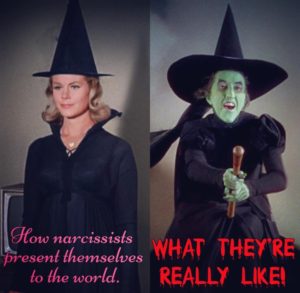
Split image showing a smiling “good witch” labeled as how narcissistic personalities present publicly, contrasted with an angry “wicked witch” labeled as how they behave privately in close relationships.

The Binary: Invisible or a Spectacle

Post-therapy processing. I keep noticing a painful pattern. When I speak directly—calmly, clearly, logically—it’s often received as aggression. Meanwhile, dishonesty softened with politeness, or harm delivered with a smile, is protected, even rewarded. In the past, I would escalate or collapse, distracting from the issue with my reaction. I don’t…
Read More
Illustration of Gottman’s Four Horsemen representing criticism, contempt, defensiveness, and stonewalling in relationships

When Rightness Trumps Repair: Patterns in Diifficult Relationships

I’m getting closer to being able to name and understand this pattern after friction or  rupture in relationships with people heavily invested in their rightness and entitlement, and equally invested in my wrongness and unworthiness. When the conversation—tilts into litigation mode, they get to focus on proving the impeccability of…
Read More
James Baldwin quote about facing truth overlaid on a minimalist image symbolizing emotional clarity, reflection, and the cost of acknowledgment.

How to Alienate Others and Die Alone

How to Alienate Others and Die Completely Alone A Working Draft Introduction I used to believe relationships failed because of misunderstanding. This is my attempt to document how I learned they fail faster when you insist on a shared understanding. Proven Alienation Accellerants Step One: Take Everything Seriously Assume words…
Read More
Text message-style graphic showing an abuse disclosure met with demands for extensive evidence, while the denial "I didn't do it" is immediately met with "WE beleive YOU"

The Emotional Person Is Always the Problem

I am a survivor studying the wreckage, noticing a pattern.When a person is being harmed, a mountain of tidy evidence is demanded—transcripts, videotapes, witnesses, perfectly composed testimony—and even then, it is rarely sufficient. Meanwhile, the person with the well-fitting mask and an image to manage says, “I didn’t do it. The…
Read More
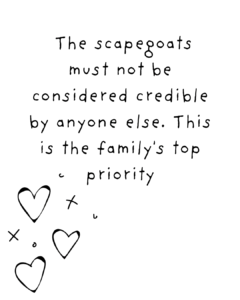
Text image reading: “The scapegoats must not be considered credible by anyone else. This is the family's top priority.” Represents family systems that discredit those who name harm.

When C-PTSD Keeps the Nervous System Braced for Threat

An Ordinary Moment, a Trauma Response My lived experience offered no assurance that I—or anything—would be okay. At a subconscious level, I suspected I might have less trouble if I could just get better at saying no and ouch, because those consistently caused trouble. I was not a discreet or…
Read More
Text graphic explaining the concept of a family scapegoat as the person a family targets to avoid addressing harmful patterns or abuse.

The Pattern Beneath Estrangement

I’m learning to recognize a pattern. I name something specific: a word that was said, a boundary crossed, a moment that caused distress.The response shifts quickly—to my tone, my sensitivity, my way of being, my capacity to perceive. What starts as a conversation about what happened becomes a conversation about…
Read More
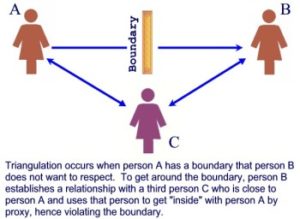
Diagram explaining triangulation, showing how indirect communication through a third party creates division, misalignment, and power imbalance in relationships.

The Quiet Damage of Triangulation

Over the years, my children’s father, my mother, and my sister communicated and met without me. This alliance was formed in the shadows. There was no pre‑existing relationship between my mother or sister and the man I divorced. These gatherings included my children and happened during a period of high…
Read More
Text graphic reading “You were not chosen — you were targeted,” highlighting trauma bonding, love bombing, and emotional manipulation awareness.

The Season of Losing What I Thought I Needed

Loving the Hologram: A Season of Letting Go This season—honestly, my entire life—has been one of loss and unraveling. And I feel self‑conscious about that, because in a world low on emotional intelligence, it’s easy for people to see a woman breaking under multiple pressures and say, “There she goes…
Read More