Wholesome Badass

A Work in Progress — Healing from All the Things​

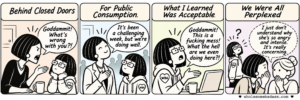
Four-panel cartoon showing the difference between how someone behaves behind closed doors and how they present themselves publicly. A child learns that anger and harsh language are acceptable, but later faces judgment for expressing what she learned.

I Didn’t Know to Hide It

I make no claims to benevolence. For my first 40 years, my default behavior was often diminishing and hurtful. Openly aggressive, harsh, and raging. I hated how reactive and hurtful I could be. But decades of mistreatment taught me only to mistreat, not how to respond appropriately to mistreatment or treat others with consistently high regard. What I couldn’t have known was that the behavior being modeled at home was also being carefully contained. Without any meaningful contrast of kindness, mercy, or respect, I didn’t recognize the behavior as irregular. I’ll always be sensitive, with my tightly wound nervous system basically on the outside of my body—easily overstimulated and dysregulated. But NOW I understand how to soothe and regulate myself. Struggling to regulate one’s emotions, however visibly expressed, should not be confused with exhibiting contempt or disrespect for another person. I get to distance myself from people who consider diminishing words or behaviors acceptable. And it’s been decades since I said or did a mean thing. It seems a ridiculous brag, but it’s quite the overcoming and miracle. One of many things that differentiated me from my family—and the similar relational patterns I later sought out—was that I didn’t know to conceal cruelty. My sister would scold, “You just don’t get it.” Straight facts. I super didn’t get it. What I did get: Apparently, it was okay to say and do cruel and damaging things to me. Because if you did, that was my fault, as my shittiness made you behave that way. This became my relational template, shaping my life’s trajectory. I can’t help but wonder why nobody was concerned enough to get me help. Only judge, punish, judge, repeat. Actually… 🤔 I think I understand why professional guidance was not provided. Getting me help might have meant examining what was happening at home, rather than continuing to treat me as THE problem. And why was I deemed the sinful one? But seriously—for those who know to hide it, what excuse even is there?

Read More
Cartoon-style black-and-white drawing on a soft green background of a girl feeding papers labeled trauma, confusion, misinformation, doubt, and shame into a machine labeled “Processing Through Writing.” Papers coming out say agency, discernment, and intention. Her bag has a small WBA heart logo, and the image is watermarked with wholesomebadass.com.

The Shit Before the Shift

No Dimmer Switch I feel everything the most amount—the good and the unpleasant—constantly. Everything in high definition. I am a deep feeler, or as the archetype likes to say: thin-skinned, overly sensitive. Not a crime. Not a defect. But not an easy way to be in the world. From my tiniest days, I recall feeling inconsolably rattled, navigating my tightly wound nervous system and sensitive disposition with no guidance, knowledge, language, or skill set for any of it. I cannot recall another version of myself underneath it all – who ever felt secure, grounded, safe, and not overwhelmed. That has been my baseline. It is not a great point of departure. Billed to Me I was raised to believe that other people’s harsh behavior spoke directly to the quality of my person, my character, and my worth. Which was terribly confusing, because I was also often scolded for asking if a person was upset with me, “Not everything is about you.” And yet other people’s unfavorable moods and behaviors were consistently billed to me or altogether denied. So… difficult moods and feelings—mine and theirs—were my responsibility. And no clue how to manage that. Painfully aware: I was constantly and undeniably failing. While nobody taught or encouraged me to know, soothe, value, or care for myself, I was expected to read, anticipate, prevent, and manage other people’s difficult feelings. So many times, blood relatives would demand in a menacing tone, “What are you so angry about?” But it was not a genuine inquiry. It was a callout: look at you, with that massive chink in your armor. Feel ashamed and pipe down or else. There is real sadness in looking back and realizing how much unmanaged, daily compounded stress was attributed exclusively to my “poor character.” I spent more than forty years trying to do the impossible thing of getting different and becoming someone else. My only ambition. What a tragic fucken waste. Stripped of any potential to self-actualize. The Familiar And having been been handled like a piece of literal shit—a poopy diaper—I did not instinctively seek nourishing and affirming relationships. I had learned that love looked like people who genuinely were not FOR me—unless and only when I was useful to them. This explains so much. At many levels, I believe the only thing I shared in common with my family of origin was that we all held me in the lowest regard. That is hard to reconcile. And tragically, my only direction was toward the familiar. Ooof. Decades of trying to feel better, by any means possible, without really knowing what I was trying to feel better from. From being a shiftless piece of shit?? There is literally no relief from that. I mistook random positive intermittent reinforcement for kindness and brought that out into the world with me as the love I sought. And sometimes the love I gave. I hate that. Better Information I am proud to have interrupted that cycle, that I did not hand that poison directly to my sons. No matter what is said about me, it cannot be denied that I rode faithfully for my children. Without exception. Maybe not perfectly or without pain to them, but with fierce loyalty and constant sacrifice. In learning about trauma and nervous systems. Neglect. Generational abuse. Coercive abuse. Scapegoating. Triangulation. Attachment, fear, compulsion. I recognize how I confused what was recognizable with what was safe and acceptable. For and from myself. Agency With better information now, I get to experience something that for so long eluded me: agency—where I carefully consider who, what, how, and when to engage, and whether engagement is even required or prudent. Writing helps me recognize and organize all of the me’s inside of me—with no intent to prosecute my past or acquit any of my me’s. I work tirelessly to untangle my myths and misconceptions about myself, love, connection, and kindness. It is a true miracle to have grown into the loving, honest, dependable, funny, compassionate, and loyal woman I am. And this is also true: I have not always known how to move in these ways—or how to move with people who equally value them. First the unlearning. The shit before the shift, I guess. What were you led to believe about yourself because of the way someone else treated you? And do you still belive it?
Read More
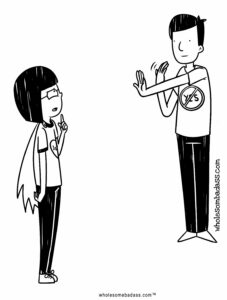
Black-and-white illustration of a girl facing a man whose right hand beckons her closer while his left hand signals stop.

The System with No Name

For most of my life, I could see the individual friction points but not the structure they shared. I experienced them as isolated interactions. A misunderstanding. A rupture. A person who was displeased with me (and seemingly intent on making me pay). A relationship I had somehow failed to navigate correctly. I explained. Apologized. Twisted myself. Worked harder. Questioned myself. Tried another approach (but still, tragically, as myself). There was the conviction that if I could just understand what I was missing, I could make myself fit. My life energy was wastefully consumed trying to navigate first my family of origin, then people and patterns that mimicked the dynamic where I was expected to want, feel, and need what I did not– and also agree to matter less. I realize nobody got handed the rules. For mainstream, untraumatized, neurotypical people, it seems to make sense and work. Expressing any version of no or ouch or confusion consistently resulted in friction. This was baffling to me, honestly. I seriously expected support or comfort, or maybe even some genuine interest. Now, after nearly six decades of swinging and missing by miles, I have begun to recognize patterns. Systems. Dynamics. Power imbalance. Coercion. All of it. I see now how easily familiarity masqueraded as normalcy. If a relational structure has been encoded deeply enough, it does not necessarily feel like a structure. It can simply feel like the way things, people, and relationships are—like water to a fish, not something experienced as a condition or even a variable, but simply the world as it is. And when the majority can function comfortably inside it, a person who cannot is what—a traitor, deviant, pariah? The person who does not go with THE FLOW is THE problem. Gosh—-That boxing-with-ghosts fucking energy- it was pure mind fuckery. I kept approaching each interaction as though there must be a successful response available to me. As though enough insight, enough humility, enough explanation, enough effort would eventually make the thing workable. It didn’t. What I am now able to do is name my experience of it—to take something that has remained amorphous and make it legible. Healing has helped me recognize systems that are damaging to me rather than inclusive or supportive, like FOR and not opposed to me. I can choose more carefully where I participate, what I adapt to, and what I no longer agree to organize myself around. Putting it into language demystifies it. Ideally, that helps someone else recognize the structure too—something that may have previously defied articulation andfelt like theirs alone. Like a shared truth. Are you also learning to recognize the systems and people who are for you—and those who are not?

Read More
Black-and-white cartoon of a worried girl handing over a paper labeled “OUCH” while a giant hand stamps it “DEFECTIVE.” Pink text at the top reads “When hurt gets submitted as evidence,” and a small watermark at the bottom says “wholesomebadass.com.”

When Your Sensitivity Is Framed as the Problem

In my family of origin, and then quite unsurprisingly in the marriage I chose, I re-enacted the familiar pattern. I accepted the charge for all discomfort—mine and everybody’s. If only I would’ve just gotten different, as was directed so very many times, we could’ve all been soooo close and comfortable. Your discomfort was my fault; so was my own. My distress was treated as a burden to the people I depended on to care for and guide me, and as proof that I was unreasonable, selfish, ungrateful, dramatic—defective. I lived in a state of perplexity that expressing any version of no or ouch consistently created friction, the very opposite of what a child might anticipate. My best efforts to communicate what I could and could not tolerate were dismissed as negative, dramatic, hysterical, oversensitive. My behavior, existence, personality, and pain were used as evidence against my character and worthiness each time they caused discomfort for one of the archetypes. My discomfort indicted me. Yours also did. I can see now how neurodivergence, scapegoating, and narcissistic family dynamics all fed the same machinery: difference was treated as defect, one person carried the emotional burden for everyone, and any separate reality that disrupted the preferred one became an offense. The opposite of sensitivity is not strength. It is insensitivity. The fact that I am affected does not make me weak, dangerous, or wrong. The way that I exist may be uncomfortable, but it’s not fucking violent or lacking in good character. What was violent, and what I have come to question as a matter of character, was the coercive control deployed in service to THE narrative, system, version of love, care, and peace. Have you ever noticed how people deeply invested in appearing strong can be the least able to, in good faith, directly engage friction?

Read More
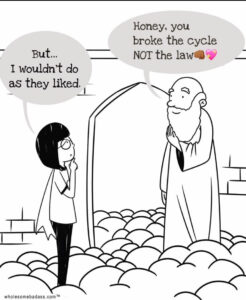
Alt text: Wholesome Badass girl speaking with Saint Peter. She says, “But I would not do as they liked,” and he replies, “You broke the cycle, not the law.”

Your Behavior Defines You – Not Me

Somewhere along the way, a practice took hold: metabolizing what other people believed, said, or did as information about me rather than data about them. Today, that data gets classified more appropriately. It may hurt deeply and alter what a relationship means. But it will no longer serve to indict me. In its crudest form: their hurtful behavior was somehow treated as a reasonable response to the fact of my existence. That premise no longer holds. Recognizing this has brought with it the gifts of self-esteem and dignity. There is something clarifying in reflecting on how consistently I attempted to engage difficult moments in good faith, even when the same was not afforded to me. Repeatedly presenting opportunities for course correction and repair—for people to respond responsibly, nobly, and peacefully—was also part of that good-faith engagement. Whether they did or did not is information about them. Were you ever asked to interpret someone else’s damaging behavior as information about you?  Like the people who do not hesitate to drag you through the mud and then ask you why you are so muddy, or better yet, ask others why you are like that? fkrz

Read More
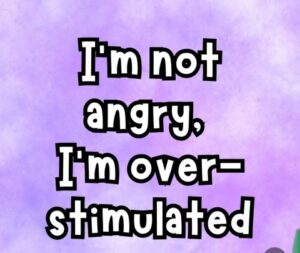
Text image with the words: “I am not angry. I am overstimulated.” Indicates that emotional reactions may reflect overwhelm, not anger.

When Dysregulation Is Treated as Being Intentionally Difficult

I do not seem naturally wired to preserve “harmony” by pretending not to see what I see and not feel what I feel. It is not as if everyone is having roughly the same experience and others make the more agreeable decision to go with the flow while I make the objectionable decision to diverge, which gets me branded not as divergent but deviant. Difficult to govern gets conflated with untrustworthy and unworthy. Not a team player. I simply cannot go with a flow that feels wildly dysregulating. My nervous system picks up and responds to things that either do not hit other people’s radar at all or do not register with anything close to the same intensity. It is not unlike some version of a dog whistle. We can be in the same room, inside the same system, and not be receiving the same input or impact from it. If something barely bothers a person, accommodating it will require little of them—nothing to resist or mask. They can easily carry on, genuinely unaffected. If the same thing is creating unmanageable discomfort in me, going along can leave me completely taxed. My depletion gets read as attitude. And yet the person who can comfortably accommodate is regarded as flexible and cooperative—which may not be untrue. But the converse about me is not necessarily true. Yes, I am less easy. But I don’t think less easy is the same as difficult or deviant. So how much of what I have understood as something wrong with me was actually the branding of a person who could not seamlessly abide without a trace a visible strain?

Read More
Black-and-white illustration of a woman isolated behind a wall as family members reinforce the divide, symbolizing triangulation and parental alienation.

Your Enemy’s Enemy Is Your Friend

Being publicly told “you’re welcome to join” by people who openly disregard and disrespect me is hardly evidence of genuine inclusion. The invitation is presented as evidence of goodwill, while my condition of repair before returning is presented as proof that I’m choosing to separate myself from the family. No contact was a tragic last resort. There’s something particularly cruel about weaponizing my decision to protect myself from further harm. Years after a loveless, volatile marriage and unnecessarily contentious divorce, my estranged sister and ex-husband established an alliance of their own. I had married a man whose emotional patterns mirrored my sister’s, recreating the same relational dynamic. Given their shared, longstanding patterns of divisive behavior, their alliance was hardly surprising. They began gathering with my children while excluding me, despite my repeated requests that my sister stop. The resulting division extended beyond my relationships with either of them, affecting my children, our co-parenting relationship, and my already strained relationship with my mother. As my mother liked to say, “Your enemy’s enemy is your friend.” Whatever their intentions or explanations, their words and actions hurt our family. That harm was not mitigated by context or justification.

Read More
Four-panel cartoon showing the difference between how someone behaves behind closed doors and how they present themselves publicly. A child learns that anger and harsh language are acceptable, but later faces judgment for expressing what she learned.

I Didn’t Know to Hide It

I make no claims to benevolence. For my first 40 years, my default behavior was often diminishing and hurtful. Openly aggressive, harsh, and raging. I hated how reactive and hurtful I could be. But decades of mistreatment taught me only to mistreat, not how to respond appropriately to mistreatment or treat others with consistently high regard. What I couldn’t have known was that the behavior being modeled at home was also being carefully contained. Without any meaningful contrast of kindness, mercy, or respect, I didn’t recognize the behavior as irregular. I’ll always be sensitive, with my tightly wound nervous system basically on the outside of my body—easily overstimulated and dysregulated. But NOW I understand how to soothe and regulate myself. Struggling to regulate one’s emotions, however visibly expressed, should not be confused with exhibiting contempt or disrespect for another person. I get to distance myself from people who consider diminishing words or behaviors acceptable. And it’s been decades since I said or did a mean thing. It seems a ridiculous brag, but it’s quite the overcoming and miracle. One of many things that differentiated me from my family—and the similar relational patterns I later sought out—was that I didn’t know to conceal cruelty. My sister would scold, “You just don’t get it.” Straight facts. I super didn’t get it. What I did get: Apparently, it was okay to say and do cruel and damaging things to me. Because if you did, that was my fault, as my shittiness made you behave that way. This became my relational template, shaping my life’s trajectory. I can’t help but wonder why nobody was concerned enough to get me help. Only judge, punish, judge, repeat. Actually… 🤔 I think I understand why professional guidance was not provided. Getting me help might have meant examining what was happening at home, rather than continuing to treat me as THE problem. And why was I deemed the sinful one? But seriously—for those who know to hide it, what excuse even is there?

Read More
Cartoon-style black-and-white drawing on a soft green background of a girl feeding papers labeled trauma, confusion, misinformation, doubt, and shame into a machine labeled “Processing Through Writing.” Papers coming out say agency, discernment, and intention. Her bag has a small WBA heart logo, and the image is watermarked with wholesomebadass.com.

The Shit Before the Shift

No Dimmer Switch I feel everything the most amount—the good and the unpleasant—constantly. Everything in high definition. I am a deep feeler, or as the archetype likes to say: thin-skinned, overly sensitive. Not a crime. Not a defect. But not an easy way to be in the world. From my tiniest days, I recall feeling inconsolably rattled, navigating my tightly wound nervous system and sensitive disposition with no guidance, knowledge, language, or skill set for any of it. I cannot recall another version of myself underneath it all – who ever felt secure, grounded, safe, and not overwhelmed. That has been my baseline. It is not a great point of departure. Billed to Me I was raised to believe that other people’s harsh behavior spoke directly to the quality of my person, my character, and my worth. Which was terribly confusing, because I was also often scolded for asking if a person was upset with me, “Not everything is about you.” And yet other people’s unfavorable moods and behaviors were consistently billed to me or altogether denied. So… difficult moods and feelings—mine and theirs—were my responsibility. And no clue how to manage that. Painfully aware: I was constantly and undeniably failing. While nobody taught or encouraged me to know, soothe, value, or care for myself, I was expected to read, anticipate, prevent, and manage other people’s difficult feelings. So many times, blood relatives would demand in a menacing tone, “What are you so angry about?” But it was not a genuine inquiry. It was a callout: look at you, with that massive chink in your armor. Feel ashamed and pipe down or else. There is real sadness in looking back and realizing how much unmanaged, daily compounded stress was attributed exclusively to my “poor character.” I spent more than forty years trying to do the impossible thing of getting different and becoming someone else. My only ambition. What a tragic fucken waste. Stripped of any potential to self-actualize. The Familiar And having been been handled like a piece of literal shit—a poopy diaper—I did not instinctively seek nourishing and affirming relationships. I had learned that love looked like people who genuinely were not FOR me—unless and only when I was useful to them. This explains so much. At many levels, I believe the only thing I shared in common with my family of origin was that we all held me in the lowest regard. That is hard to reconcile. And tragically, my only direction was toward the familiar. Ooof. Decades of trying to feel better, by any means possible, without really knowing what I was trying to feel better from. From being a shiftless piece of shit?? There is literally no relief from that. I mistook random positive intermittent reinforcement for kindness and brought that out into the world with me as the love I sought. And sometimes the love I gave. I hate that. Better Information I am proud to have interrupted that cycle, that I did not hand that poison directly to my sons. No matter what is said about me, it cannot be denied that I rode faithfully for my children. Without exception. Maybe not perfectly or without pain to them, but with fierce loyalty and constant sacrifice. In learning about trauma and nervous systems. Neglect. Generational abuse. Coercive abuse. Scapegoating. Triangulation. Attachment, fear, compulsion. I recognize how I confused what was recognizable with what was safe and acceptable. For and from myself. Agency With better information now, I get to experience something that for so long eluded me: agency—where I carefully consider who, what, how, and when to engage, and whether engagement is even required or prudent. Writing helps me recognize and organize all of the me’s inside of me—with no intent to prosecute my past or acquit any of my me’s. I work tirelessly to untangle my myths and misconceptions about myself, love, connection, and kindness. It is a true miracle to have grown into the loving, honest, dependable, funny, compassionate, and loyal woman I am. And this is also true: I have not always known how to move in these ways—or how to move with people who equally value them. First the unlearning. The shit before the shift, I guess. What were you led to believe about yourself because of the way someone else treated you? And do you still belive it?
Read More
Black-and-white illustration of a girl facing a man whose right hand beckons her closer while his left hand signals stop.

The System with No Name

For most of my life, I could see the individual friction points but not the structure they shared. I experienced them as isolated interactions. A misunderstanding. A rupture. A person who was displeased with me (and seemingly intent on making me pay). A relationship I had somehow failed to navigate correctly. I explained. Apologized. Twisted myself. Worked harder. Questioned myself. Tried another approach (but still, tragically, as myself). There was the conviction that if I could just understand what I was missing, I could make myself fit. My life energy was wastefully consumed trying to navigate first my family of origin, then people and patterns that mimicked the dynamic where I was expected to want, feel, and need what I did not– and also agree to matter less. I realize nobody got handed the rules. For mainstream, untraumatized, neurotypical people, it seems to make sense and work. Expressing any version of no or ouch or confusion consistently resulted in friction. This was baffling to me, honestly. I seriously expected support or comfort, or maybe even some genuine interest. Now, after nearly six decades of swinging and missing by miles, I have begun to recognize patterns. Systems. Dynamics. Power imbalance. Coercion. All of it. I see now how easily familiarity masqueraded as normalcy. If a relational structure has been encoded deeply enough, it does not necessarily feel like a structure. It can simply feel like the way things, people, and relationships are—like water to a fish, not something experienced as a condition or even a variable, but simply the world as it is. And when the majority can function comfortably inside it, a person who cannot is what—a traitor, deviant, pariah? The person who does not go with THE FLOW is THE problem. Gosh—-That boxing-with-ghosts fucking energy- it was pure mind fuckery. I kept approaching each interaction as though there must be a successful response available to me. As though enough insight, enough humility, enough explanation, enough effort would eventually make the thing workable. It didn’t. What I am now able to do is name my experience of it—to take something that has remained amorphous and make it legible. Healing has helped me recognize systems that are damaging to me rather than inclusive or supportive, like FOR and not opposed to me. I can choose more carefully where I participate, what I adapt to, and what I no longer agree to organize myself around. Putting it into language demystifies it. Ideally, that helps someone else recognize the structure too—something that may have previously defied articulation andfelt like theirs alone. Like a shared truth. Are you also learning to recognize the systems and people who are for you—and those who are not?

Read More
Black-and-white cartoon of a worried girl handing over a paper labeled “OUCH” while a giant hand stamps it “DEFECTIVE.” Pink text at the top reads “When hurt gets submitted as evidence,” and a small watermark at the bottom says “wholesomebadass.com.”

When Your Sensitivity Is Framed as the Problem

In my family of origin, and then quite unsurprisingly in the marriage I chose, I re-enacted the familiar pattern. I accepted the charge for all discomfort—mine and everybody’s. If only I would’ve just gotten different, as was directed so very many times, we could’ve all been soooo close and comfortable. Your discomfort was my fault; so was my own. My distress was treated as a burden to the people I depended on to care for and guide me, and as proof that I was unreasonable, selfish, ungrateful, dramatic—defective. I lived in a state of perplexity that expressing any version of no or ouch consistently created friction, the very opposite of what a child might anticipate. My best efforts to communicate what I could and could not tolerate were dismissed as negative, dramatic, hysterical, oversensitive. My behavior, existence, personality, and pain were used as evidence against my character and worthiness each time they caused discomfort for one of the archetypes. My discomfort indicted me. Yours also did. I can see now how neurodivergence, scapegoating, and narcissistic family dynamics all fed the same machinery: difference was treated as defect, one person carried the emotional burden for everyone, and any separate reality that disrupted the preferred one became an offense. The opposite of sensitivity is not strength. It is insensitivity. The fact that I am affected does not make me weak, dangerous, or wrong. The way that I exist may be uncomfortable, but it’s not fucking violent or lacking in good character. What was violent, and what I have come to question as a matter of character, was the coercive control deployed in service to THE narrative, system, version of love, care, and peace. Have you ever noticed how people deeply invested in appearing strong can be the least able to, in good faith, directly engage friction?

Read More
Alt text: Wholesome Badass girl speaking with Saint Peter. She says, “But I would not do as they liked,” and he replies, “You broke the cycle, not the law.”

Your Behavior Defines You – Not Me

Somewhere along the way, a practice took hold: metabolizing what other people believed, said, or did as information about me rather than data about them. Today, that data gets classified more appropriately. It may hurt deeply and alter what a relationship means. But it will no longer serve to indict me. In its crudest form: their hurtful behavior was somehow treated as a reasonable response to the fact of my existence. That premise no longer holds. Recognizing this has brought with it the gifts of self-esteem and dignity. There is something clarifying in reflecting on how consistently I attempted to engage difficult moments in good faith, even when the same was not afforded to me. Repeatedly presenting opportunities for course correction and repair—for people to respond responsibly, nobly, and peacefully—was also part of that good-faith engagement. Whether they did or did not is information about them. Were you ever asked to interpret someone else’s damaging behavior as information about you?  Like the people who do not hesitate to drag you through the mud and then ask you why you are so muddy, or better yet, ask others why you are like that? fkrz

Read More
Text image with the words: “I am not angry. I am overstimulated.” Indicates that emotional reactions may reflect overwhelm, not anger.

When Dysregulation Is Treated as Being Intentionally Difficult

I do not seem naturally wired to preserve “harmony” by pretending not to see what I see and not feel what I feel. It is not as if everyone is having roughly the same experience and others make the more agreeable decision to go with the flow while I make the objectionable decision to diverge, which gets me branded not as divergent but deviant. Difficult to govern gets conflated with untrustworthy and unworthy. Not a team player. I simply cannot go with a flow that feels wildly dysregulating. My nervous system picks up and responds to things that either do not hit other people’s radar at all or do not register with anything close to the same intensity. It is not unlike some version of a dog whistle. We can be in the same room, inside the same system, and not be receiving the same input or impact from it. If something barely bothers a person, accommodating it will require little of them—nothing to resist or mask. They can easily carry on, genuinely unaffected. If the same thing is creating unmanageable discomfort in me, going along can leave me completely taxed. My depletion gets read as attitude. And yet the person who can comfortably accommodate is regarded as flexible and cooperative—which may not be untrue. But the converse about me is not necessarily true. Yes, I am less easy. But I don’t think less easy is the same as difficult or deviant. So how much of what I have understood as something wrong with me was actually the branding of a person who could not seamlessly abide without a trace a visible strain?

Read More
Black-and-white illustration of a woman isolated behind a wall as family members reinforce the divide, symbolizing triangulation and parental alienation.

Your Enemy’s Enemy Is Your Friend

Being publicly told “you’re welcome to join” by people who openly disregard and disrespect me is hardly evidence of genuine inclusion. The invitation is presented as evidence of goodwill, while my condition of repair before returning is presented as proof that I’m choosing to separate myself from the family. No contact was a tragic last resort. There’s something particularly cruel about weaponizing my decision to protect myself from further harm. Years after a loveless, volatile marriage and unnecessarily contentious divorce, my estranged sister and ex-husband established an alliance of their own. I had married a man whose emotional patterns mirrored my sister’s, recreating the same relational dynamic. Given their shared, longstanding patterns of divisive behavior, their alliance was hardly surprising. They began gathering with my children while excluding me, despite my repeated requests that my sister stop. The resulting division extended beyond my relationships with either of them, affecting my children, our co-parenting relationship, and my already strained relationship with my mother. As my mother liked to say, “Your enemy’s enemy is your friend.” Whatever their intentions or explanations, their words and actions hurt our family. That harm was not mitigated by context or justification.

Read More