Wholesome Badass

A Work in Progress — Healing from All the Things​

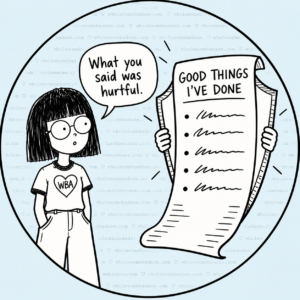
Black-and-white illustration of a girl saying, “What you said was hurtful,” facing a large shield covered by a receipt titled “Good Things I've Done.”

After All I’ve Done for You.

May I Remind You? Different people. Different circumstances. Continued familiar patterns. A few months ago, I said to my neighbor, “Hey, when you said X, it hurt my feelings.” Her response? “May I remind you…” followed by a list of ways she’d been helpful to me. I still don’t know why her response stunned me. It was entirely consistent with a familiar archetype: the person who expects things to automatically go their way and has no tolerance for frustration, disappointment, or anything that challenges their preferred version of themselves. And 100% of the time, with this archetype, my direct expression of hurt is received not as information about my experience or how our connection has been affected, but as an accusation to defend against or a claim to debate. I never responded. Interesting, though. We’d each been generous and helpful to one another. But I’d never considered my generosity protection against accountability. I’ve read about rejection sensitivity and narcissistic traits, particularly the need to be right, entitlement to having things their way, and the insistence on a narrative in which they can only be the hero or the victim. I’m increasingly interested in recognizing and understanding the patterns rather than proving anything about specific people. Since when does being helpful mean you can’t also have been hurtful? Both can be true. And similarly—Have you ever known someone who would only say “No” to a request along side listing all of the things they’d done for others or everything they “had” to do? Or who offered a reluctant yes or vague maybe when they already knew the answer was no?But with no thoguthful pause to genuinely ask, “Can we figure out a time that works for both of us?”Also, I do not discount that going to the gym and getting your hair done are legitimate needs. I find the long narrative that presents them as both the heroically generous and the overburdened victim to be unwholesome.
Read More
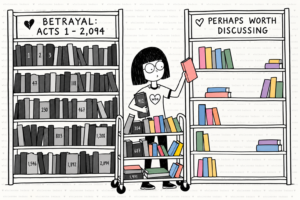
Hand-drawn girl sorting books between two shelves. One is packed with numbered gray books beneath “Betrayal: Acts 1–2,094” and a broken heart. The other holds fewer colorful books beneath “Perhaps Worth Discussing” and an outlined heart.

From Unprocessed Trauma to Integration

Over the last six months, I’ve experienced significant shifts in my recovery. I’m feeling it in my writing and illustrations, where I’m now able to convey things that previously defied articulation or required 42 million words. Looking back, my older writing reads almost like an attempt to assemble evidence for litigation. Or a screenplay. Trying with all earnestness to force light onto things that had been kept in the shadows for too long. And while looking at those things was essential to my healing, part of me desperately needed someone to recognize what I was trying to survive and make sense of. I was frantic for one fucking witness. Someone. Anyone. To say, “I see it. I saw it. That happened. It was rough and wrong and shitty and painful.” And if I were really lucky, maybe someone might even have said, “I get it.” Or, “You’re right.” Or, “Help me understand.” And I would have absolutely settled for, “That shit fucking happened.” “What do you need?” And it is astonishing to me that today, I don’t think I need that anymore. I no longer feel terrorized by the need for outside acknowledgment of my experience in order for it to be true or traumatic. I know what happened to me. I know how it affected me. And somehow, that seems to be enough. Is this what it’s like to have a sense of self? Or self-worth? Like maybe I can honor myself and what I know to be true without needing somebody else to affirm it. So I’ve taken down older writing for examination, saving only what feels useful. That writing gave me a chance to voice things I hadn’t been welcome to say. Things that had left me feeling silenced and erased and impotent. I’m not sorry for writing those things. The writing did what I needed. Its work is done. It’s not for the trash, but it no longer interests me. It’s lost its hold. And I love that. Have you ever exhausted yourself trying to access the most perfectly accurate words, the ones that couldn’t be disputed or denied, so you could finally get someone to see what happened? ♡

Read More
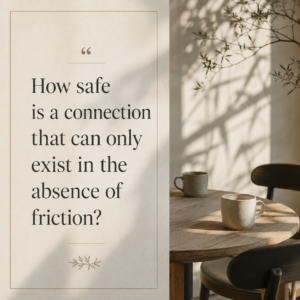
Quote graphic reading, “How safe is a connection that can only exist in the absence of friction?” beside two coffee cups at a table.

Why Can’t We Ever Resolve Anything?

I’ve been thinking about my ability to participate safely in relationships which are non-essential and technically intended as sources of safe, healthy connection. Some discord is guaranteed. But sustained and avoided discord is too much for my nervous system. I am thinking most recently of a neighbor. From our first exchange, there was something in her energy and the way she communicated that seemed to always be broadcasting some version of a world in which she was right, she knew what was right, and she was beyond comfortable imposing her knowing across the board. But we were neighbors, and we began connecting around plants and pets, and I found some enjoyment in that. I laughed in promptly reporting to my therapist that I could enjoy the connection for what it was, and I was confident it would not survive even a little bit of friction or disagreement. And it didn’t. Not because I manifested or forecasted it, but because patterns. And yet I was friendly, present and engaged with her as I would with someone I was interested in getting to know. She made more than one comment about the medical protocol for my dog which felt judgmental and hurtful. When I initiated her in good faith to say that hurt my feelings and to please not say it again, she pulled out the ledger—immediately cataloguing things I had done or not done before, what I was conflating, why my response wasn’t reasonable and why I was out of line. I did not respond. This is another part of the archetype dynamic/pattern I am noticing. The relationship can apparently remain in strained silence indefinitely rather than move toward acknowledgment, closure or repair. And when I don’t beg, argue, persuade or eventually concede in order to get us out of that silence, I can then be identified as the person who ghosted or opted out. I am increasingly unsure what my other (healthy) option is. If I tell a personal relationship person that their words or actions impacted me negatively, in order for me to stay, it seems that I need for them to legitimately care. Not agree or comply or even necessarily relate, just care. I suppose a relationship can seem safe so long as the agreement is that everybody shuts the fuck up, absorbs whatever doesn’t feel good and doesn’t create “burden” or “drama” by bringing up difficult feelings. I don’t think I can be okay inside of that. I’m intentionally examining what is available when there is friction or rupture. Is there any shared capacity to see it, acknowledge it and engage honestly and kindly with an inntent to repair and restore connection? Some of my go-to readings on challenging feelings, people and dynamics have been: On Repentance and Repair by Danya Ruttenberg, The Book of Forgiving by Desmond Tutu, Why Won’t You Apologize?by Harriet Lerner, Rising Strong by Brené Brown and The Relationship Cure by John Gottman. Have you been in a relationship where you preferred clean, direct communication, short accounts and a mutual interest in addressing whatever comes up, with someone who seems more invested in there being nothing wrong, nothing to discuss—and when you suggest otherwise, THE problem is identified as you, your perception and/or personhood?

Read More
A warmly lit room with an open closet, hanging clothes, photographs, books, keepsakes, boxes, and a ceramic mug surrounding a scattered pile of personal belongings. The image includes the quote, "Nothing ever goes away until it has taught us what we need to know," by Pema Chödrön.

Making Sense of Life Through Patterns

With all of the therapy, writing, reading, reflection, and somatic work, a lot is coming up for me. Memories. Patterns. Correlations that I had not previously made. I am finding that this process is much less like the discovery of something new and much more like noticing something that has been there all along. I would describe it as so much stuff from the past lying in a tangled heap on a closet floor, too overwhelming to tackle or ignore. Slowly, I am making order of it, identifying items and events, and putting them in their places. The tangled mess shrinks, and the grip of it all is loosening. I am also discovering that memory is a strange thing. I don’t trust every detail, every conversation, or every interpretation. But I do trust patterns, especially those that repeat themselves in what seems like perpetuity. I am trying very hard to engage this with humility, admitting my blind spots. I recognize that other people have had different experiences and interpretations. I can’t know intent or motivation, but only I can name the impact they have had on me.

Read More
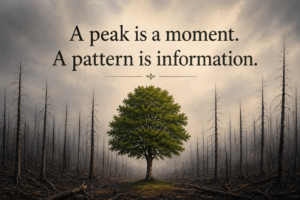
One healthy green tree standing in the middle of a forest of dead trees beneath the quote, “A peak is a moment. A pattern is information.”

The Truth Is in the Pattern

Sheesh. How many more times will I have to navigate this particular circuit before I have learned everything I can from it? The turth is in the pattern, not the explanation. It almost feels as though I have been given a false map. There are things people say that, if I allow them to guide me, will take me completely off course because they don’t align with reality, their actions, or my lived experience. I am starting to recognize that the real story lives inside the patterns. Words do matter. Conversations matter. Moments matter. But patterns persist regardless of what is said. Sometimes there is an incongruency or lack of alignment between words, the suggested intent of those words, and actions. Sometimes things are not communicated directly at all, and yet they are communicated clearly through repeated behaviors. I am intentionally allowing patterns to inform me more than peak moments, conversations, or exchanges. If there is a pleasurable moment in a relationship, I can no longer hold onto that moment as though it represents restoration or the relationship as a whole. I will not waste energy trying to figure out how to get back to that place, as though I have somehow lost the thread. Perhaps it was the exception. Possibly, it was simply a moment. The information is in the pattern. That doesn’t necessarily tell me what is true in some absolute sense, but it does tell me what is real. And when I allow patterns to inform what I say or do next, I am able to remain aligned with my quest for sovereignty and radical neutrality. A thing has happened. I don’t get to change it, reinterpret it, or spin it into something else. I don’t have to lose myself reacting or trying to understand it from every possible angle. I don’t have to overexplain my experience or convince anyone else of it. I can simply acknowledge what is and decide what my actual options are, keeping in alignment with my North Star. Whatever else may be true, this also happened.

Read More
Black-and-white illustration of a girl saying, “What you said was hurtful,” facing a large shield covered by a receipt titled “Good Things I've Done.”

After All I’ve Done for You.

May I Remind You? Different people. Different circumstances. Continued familiar patterns. A few months ago, I said to my neighbor, “Hey, when you said X, it hurt my feelings.” Her response? “May I remind you…” followed by a list of ways she’d been helpful to me. I still don’t know why her response stunned me. It was entirely consistent with a familiar archetype: the person who expects things to automatically go their way and has no tolerance for frustration, disappointment, or anything that challenges their preferred version of themselves. And 100% of the time, with this archetype, my direct expression of hurt is received not as information about my experience or how our connection has been affected, but as an accusation to defend against or a claim to debate. I never responded. Interesting, though. We’d each been generous and helpful to one another. But I’d never considered my generosity protection against accountability. I’ve read about rejection sensitivity and narcissistic traits, particularly the need to be right, entitlement to having things their way, and the insistence on a narrative in which they can only be the hero or the victim. I’m increasingly interested in recognizing and understanding the patterns rather than proving anything about specific people. Since when does being helpful mean you can’t also have been hurtful? Both can be true. And similarly—Have you ever known someone who would only say “No” to a request along side listing all of the things they’d done for others or everything they “had” to do? Or who offered a reluctant yes or vague maybe when they already knew the answer was no?But with no thoguthful pause to genuinely ask, “Can we figure out a time that works for both of us?”Also, I do not discount that going to the gym and getting your hair done are legitimate needs. I find the long narrative that presents them as both the heroically generous and the overburdened victim to be unwholesome.

Read More
Hand-drawn girl sorting books between two shelves. One is packed with numbered gray books beneath “Betrayal: Acts 1–2,094” and a broken heart. The other holds fewer colorful books beneath “Perhaps Worth Discussing” and an outlined heart.

From Unprocessed Trauma to Integration

Over the last six months, I’ve experienced significant shifts in my recovery. I’m feeling it in my writing and illustrations, where I’m now able to convey things that previously defied articulation or required 42 million words. Looking back, my older writing reads almost like an attempt to assemble evidence for litigation. Or a screenplay. Trying with all earnestness to force light onto things that had been kept in the shadows for too long. And while looking at those things was essential to my healing, part of me desperately needed someone to recognize what I was trying to survive and make sense of. I was frantic for one fucking witness. Someone. Anyone. To say, “I see it. I saw it. That happened. It was rough and wrong and shitty and painful.” And if I were really lucky, maybe someone might even have said, “I get it.” Or, “You’re right.” Or, “Help me understand.” And I would have absolutely settled for, “That shit fucking happened.” “What do you need?” And it is astonishing to me that today, I don’t think I need that anymore. I no longer feel terrorized by the need for outside acknowledgment of my experience in order for it to be true or traumatic. I know what happened to me. I know how it affected me. And somehow, that seems to be enough. Is this what it’s like to have a sense of self? Or self-worth? Like maybe I can honor myself and what I know to be true without needing somebody else to affirm it. So I’ve taken down older writing for examination, saving only what feels useful. That writing gave me a chance to voice things I hadn’t been welcome to say. Things that had left me feeling silenced and erased and impotent. I’m not sorry for writing those things. The writing did what I needed. Its work is done. It’s not for the trash, but it no longer interests me. It’s lost its hold. And I love that. Have you ever exhausted yourself trying to access the most perfectly accurate words, the ones that couldn’t be disputed or denied, so you could finally get someone to see what happened? ♡

Read More
Quote graphic reading, “How safe is a connection that can only exist in the absence of friction?” beside two coffee cups at a table.

Why Can’t We Ever Resolve Anything?

I’ve been thinking about my ability to participate safely in relationships which are non-essential and technically intended as sources of safe, healthy connection. Some discord is guaranteed. But sustained and avoided discord is too much for my nervous system. I am thinking most recently of a neighbor. From our first exchange, there was something in her energy and the way she communicated that seemed to always be broadcasting some version of a world in which she was right, she knew what was right, and she was beyond comfortable imposing her knowing across the board. But we were neighbors, and we began connecting around plants and pets, and I found some enjoyment in that. I laughed in promptly reporting to my therapist that I could enjoy the connection for what it was, and I was confident it would not survive even a little bit of friction or disagreement. And it didn’t. Not because I manifested or forecasted it, but because patterns. And yet I was friendly, present and engaged with her as I would with someone I was interested in getting to know. She made more than one comment about the medical protocol for my dog which felt judgmental and hurtful. When I initiated her in good faith to say that hurt my feelings and to please not say it again, she pulled out the ledger—immediately cataloguing things I had done or not done before, what I was conflating, why my response wasn’t reasonable and why I was out of line. I did not respond. This is another part of the archetype dynamic/pattern I am noticing. The relationship can apparently remain in strained silence indefinitely rather than move toward acknowledgment, closure or repair. And when I don’t beg, argue, persuade or eventually concede in order to get us out of that silence, I can then be identified as the person who ghosted or opted out. I am increasingly unsure what my other (healthy) option is. If I tell a personal relationship person that their words or actions impacted me negatively, in order for me to stay, it seems that I need for them to legitimately care. Not agree or comply or even necessarily relate, just care. I suppose a relationship can seem safe so long as the agreement is that everybody shuts the fuck up, absorbs whatever doesn’t feel good and doesn’t create “burden” or “drama” by bringing up difficult feelings. I don’t think I can be okay inside of that. I’m intentionally examining what is available when there is friction or rupture. Is there any shared capacity to see it, acknowledge it and engage honestly and kindly with an inntent to repair and restore connection? Some of my go-to readings on challenging feelings, people and dynamics have been: On Repentance and Repair by Danya Ruttenberg, The Book of Forgiving by Desmond Tutu, Why Won’t You Apologize?by Harriet Lerner, Rising Strong by Brené Brown and The Relationship Cure by John Gottman. Have you been in a relationship where you preferred clean, direct communication, short accounts and a mutual interest in addressing whatever comes up, with someone who seems more invested in there being nothing wrong, nothing to discuss—and when you suggest otherwise, THE problem is identified as you, your perception and/or personhood?

Read More
A warmly lit room with an open closet, hanging clothes, photographs, books, keepsakes, boxes, and a ceramic mug surrounding a scattered pile of personal belongings. The image includes the quote, "Nothing ever goes away until it has taught us what we need to know," by Pema Chödrön.

Making Sense of Life Through Patterns

With all of the therapy, writing, reading, reflection, and somatic work, a lot is coming up for me. Memories. Patterns. Correlations that I had not previously made. I am finding that this process is much less like the discovery of something new and much more like noticing something that has been there all along. I would describe it as so much stuff from the past lying in a tangled heap on a closet floor, too overwhelming to tackle or ignore. Slowly, I am making order of it, identifying items and events, and putting them in their places. The tangled mess shrinks, and the grip of it all is loosening. I am also discovering that memory is a strange thing. I don’t trust every detail, every conversation, or every interpretation. But I do trust patterns, especially those that repeat themselves in what seems like perpetuity. I am trying very hard to engage this with humility, admitting my blind spots. I recognize that other people have had different experiences and interpretations. I can’t know intent or motivation, but only I can name the impact they have had on me.

Read More
One healthy green tree standing in the middle of a forest of dead trees beneath the quote, “A peak is a moment. A pattern is information.”

The Truth Is in the Pattern

Sheesh. How many more times will I have to navigate this particular circuit before I have learned everything I can from it? The turth is in the pattern, not the explanation. It almost feels as though I have been given a false map. There are things people say that, if I allow them to guide me, will take me completely off course because they don’t align with reality, their actions, or my lived experience. I am starting to recognize that the real story lives inside the patterns. Words do matter. Conversations matter. Moments matter. But patterns persist regardless of what is said. Sometimes there is an incongruency or lack of alignment between words, the suggested intent of those words, and actions. Sometimes things are not communicated directly at all, and yet they are communicated clearly through repeated behaviors. I am intentionally allowing patterns to inform me more than peak moments, conversations, or exchanges. If there is a pleasurable moment in a relationship, I can no longer hold onto that moment as though it represents restoration or the relationship as a whole. I will not waste energy trying to figure out how to get back to that place, as though I have somehow lost the thread. Perhaps it was the exception. Possibly, it was simply a moment. The information is in the pattern. That doesn’t necessarily tell me what is true in some absolute sense, but it does tell me what is real. And when I allow patterns to inform what I say or do next, I am able to remain aligned with my quest for sovereignty and radical neutrality. A thing has happened. I don’t get to change it, reinterpret it, or spin it into something else. I don’t have to lose myself reacting or trying to understand it from every possible angle. I don’t have to overexplain my experience or convince anyone else of it. I can simply acknowledge what is and decide what my actual options are, keeping in alignment with my North Star. Whatever else may be true, this also happened.

Read More