Wholesome Badass

A Work in Progress — Healing from All the Things​

Black-and-white cartoon of a girl with glasses sitting on a couch between a fluffy white dog and a small black dog. A thought bubble above her says, “Zero contempt. Excellent and steady ROI.” The image includes the watermark wholesomebadass.com.

Attachment Without Connection

I have been circling the relationship between attachment, connection, and repair. I understand now how it is possible for me to feel deeply—and painfully—attached to someone and still have no genuine access: the unbearable absence of mutual kindness, curiosity, emotional access, or even respect. I have wasted an enormous energy suffering inside relationships I was desperate to redeem. Situationships that, in retrospect, may have been enmeshment, transactional, or convenient in some way. Not balanced or founded on shared high regard for one another. Too fragile for depth and difficulty. Years of unaddressed friction become suffocating, ending in an unnamed rupture never to be met with repair. Irredeemable. Relational repair simply cannot be achieved by me alone. When a person has adopted an air of contempt, good-faith resolution is unlikely. When they feel so fucking right and righteous that they cannot even look upon me with kindness, my experience and effort carry no weight because the larger conclusion has already been reached about who I am. The archetypal system demands one right and one wrong, snuffing out the possibility of peaceful resolution with mutual intent. More effort by me only creates more suffering. There is literally zero ROI. And this is where I get to examining surrender and resignation. Resignation is apathy or indifference, like: Fuck it. I am done and don’t care. Surrender is a spiritual practice and a choice with agency, dignity, and even peace. Like… This matters to me. I wish it were different. I love you. And I am no longer going to throw myself at a thing that requires presence and intention from each of us. I have stopped confusing my attachment to someone for evidence that a workable relationship is available. There will always be things I wish I had handled differently and things I might do differently now. I acknowledge my failed efforts: They didn’t go incredibly, but I’m proud of how I tried. I find solace and self-worth in owning that I was imperfect without turning that into justification to continue tryyyyying. I am not abandoning the relationship. Or myself. I am withdrawing fruitless, degrading labor from an outcome that requires another participant. Have you ever caught yourself working tirelessly to salvage or preserve an attachment you had confused for deep, lasting connection—even as the effort brought only suffering and indignity?

Read More
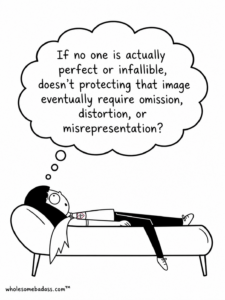
Black-and-white Wholesome Badass drawing of a girl lying on a couch with a thought bubble that says, “If no one is actually perfect or infallible, doesn’t protecting that image eventually require omission, distortion, or misrepresentation?”

Can the Need to Appear Infallible Make Someone Less Honest?

I am increasingly interested in the archetypal persona—the kind of person for whom being, or even appearing, incorrect, uncertain, or imperfect seems almost unthinkable. Like what happens when being seen as good, right, or infallible is key to the archetypal identity? One who can readily accept and explore a mistake or misstep has less reason to distort the truth. If admitting fault threatens the whole structure, there is reason to alter, omit, or misrepresent whatever threatens it. The story may need managing.Incomplete truths may need to stand in for the whole truth.Harm may need minimizing.Someone else may need to be positioned as wrong. At some point, the way we protect our image is also information about our character. Maybe goodness is not being beyond error. Maybe it is the ability to remain honest when we have erred or fallen short. As I continue to seek a wholesome path through life—one rooted in spiritual grace—I am also finding out exactly how badassery shows up in my daily life as a byproduct. I think the two may be inextricably linked.

Read More
Two speech bubbles on a light background. A green bubble says, “Are we okay?” and a red bubble says, “I. Am. Fine.”

I’m sorry I hurt you 

In a system where acknowledging injury threatens the archetypal version of reality everyone is supposed to be organized around: The governing mythology seems to be that strong, healthy, rational people are unaffected. They do not feel disturbed, injured, angry, or overwhelmed. Those experiences belong exclusively to the other category of person—the difficult, unstable, dramatic, overly sensitive conflict-maker. So when I ask, “Are we okay?” or notice tension and inquire about it, my question can carry two almost outrageous assertions: You appear emotionally affected. And: I believe I might matter enough to have affected you. The response cannot be, “Yeah, that bothered me.” It is some version of: Nothing is wrong. I am fine.(door-slamming energy) The attempt at repair is treated as intrusion, neediness, conflict creation, or self-importance. The only issue is ME, my core-wrongness. There was another scenario in which the inquiry was weaponized. My sister could do something upsetting, mock or gossip about me, then circle back shortly after in what appeared to be a tender way and ask if something was wrong. I understood that as an invitation to connect. Looking back, it may have been closer to: Are you aware of what I have done? If I said, Yeah, X bothered me, that was the on-ramp to a debate over the wrongness of my perception, character, and personality. If emotional negative impact itself is associated with weakness, repair is unnecessary by definition. There shall be no repair for a thing the other person insists never happened. No amends for an injury dismissed as the injured person’s sensitivity. No space for either giving a meaningful apology or receiving one. I’m sorry I hurt you will not be said or well received. I find this as stunning as it is common. I have realized in this season of life that it is not safe for me to engage in non-optional relationships with people who cannot, in good faith, enter into challenging conversations aimed at resolution and repair. This is the dynamic and personality type I have spent much of my life trying to navigate. Whatever else may be true, this has been my experience, and it is a pattern I am intent on breaking.

Read More
Rattlesnake wearing a party hat on a pink unicorn bed, symbolizing hidden danger in plain sight.

When Influence Obscures The Facts

How a Narrative Protects Predatory Behavior The Branding Becomes the Lens I am recognizing something in real time: the story about someone can matter more than what they actually say and do. When someone is characterized unfavorably by a person of greater status or influence, the language is often directed toward creating a shared lens through which others understand them. That version can serve as the starting assumption. Hierarchy gives it weight. This is the branding. The packaging. And it matters who establishes it. From there, a trajectory takes shape. The branding creates two outcomes at once: one person is invalidated while the other is insulated and immune to scrutiny. The branding calls the person to defense, then uses that defense as evidence that the characterization was right. Distress is recast as instability, attempts at clarity as difficulty, withdrawal as withholding, and any strong response as confirmation. Evidence to the contrary is inadmissible. It does not weaken the characterization. This is what makes the role difficult to escape. The arrangement is zero-sum: for one person to remain credible and protected, the other has to remain discredited. This is not a self-fulfilling prophecy in the usual sense because the premise does not originate with the branded one. It is imposed from “above,” then used to interpret everything that follows. Reality gets outranked by narrative. A response can be disproportionate, messy, or wrong without making the underlying experience unreal. Someone can be difficult or unpopular and still have been treated poorly. But the formula reigns: When the conduct of the protected archetype is questioned: Well, I only acted this way because of who and how YOU/THEY are. Have you been in a relationship in which another person’s missteps, poor choices, words, or conduct were repeatedly assigned to something supposedly wrong with you? WTAF? As in: If I behave like an asshole, it is only because you suck.

Read More
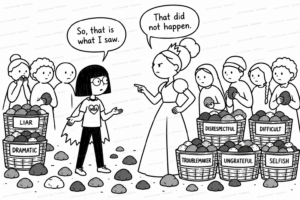
Black-and-white cartoon of a girl describing what she witnessed while a stern woman denies it. Villagers hold baskets of stones labeled liar, dramatic, selfish, ungrateful, and disrespectful, illustrating gaslighting and scapegoating.

When Harm Wears a Virtuous Mask

Whatever is said or believed about me does not change what was said and done. I keep coming back to the possibility that the golden child can occupy the position of a protected abuser. So much of my childhood was lost in the shadow of what happened with my female sibling, older than me by 7 years. Decades later, she came for my children. I am only beginning to recognize the correlation between the two. Not identical acts. A familiar code. She acts. I object. My objection is treated as the offense. My experience is displaced. Her version is granted authority. Others are drawn in. Her position remains protected. Mine grows increasingly difficult to hold without defending myself. She was afforded the identity and cover of “good,” while I was named a menace for directly objecting and emotionally reacting to behavior that was, in fact, objectionable by almost any standard. She was able to compromise me in plain sight from behind the protective shield of who everyone believed her to be. It was never-ending. From the outside, it must have looked as if I were crazy—boxing with ghosts. People could see my distress. They could not see the quiet dog whistles, unwanted touching, exclusions, implications, and positioning I was responding to. And I can say now that I was fucking crazed by what was happening—not only because it was harmful, but because the harm was denied and protected. The asymmetry was brutal: one person retained the cover of goodness while my visible distress was treated as if it had appeared out of nowhere- a thing I elected to do. My reaction was indeed spectacular. What preceded it remained invisible. Maybe that is part of what I am processing now. For decades, people must have thought, Yikes. What is wrong with her? I have spent years interrogating that question too. Only recently have I become more interested in a different question: What happened to her, to lil Magda? Why is it easier to ask what is wrong with someone than to ask what happened to them? The first question leaves the existing narrative intact. The second invites examination. It is a fascinating pattern: harm can be easily masked by a role, a reputation, even an act that looks virtuous from across the room. A person can be doing harm while being protected by the belief that they are good. Years later, I would be profoundly affected by a pastor whose attention felt like the most extraordinary care. I can see now how I had been groomed to mistrust my own perception, particularly when harm came through someone occupying a role presumed to be protective—a shepherd, someone understood to be good, trustworthy, and morally authoritative. I keep thinking of the line, “Not all villains wear black.” There is an almost absurd irony in that for me: I tend to dress mostly in black, while my female sibling favors white. hmmmm…. I don’t think clothing color informs us of character, of course. Have you ever watched harmful behavior happen in plain sight while others showed and spoke no objection – maybe because of the status, influence, or authority of the person doing it, or the lesser status of the person being harmed—so that neutrality itself functioned as permission? What is that even called? It reminds me of that scene in Boardwalk Empire where a priest appears to be baptizing a man in front of the entire church. What everyone else sees is a sacred ritual performed by someone occupying one of the most trusted positions in the room. What is actually happening is murder.

Read More
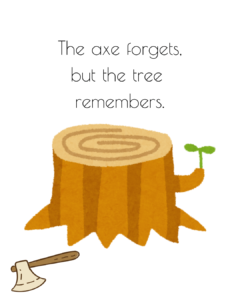
Chopped down tree symbolizing the lasting impact of family betrayal and parental alienation.

When Family Betrayal Pulls Young Children Into the Middle

At a very tense Mother’s Day gathering in 2016, I learned that my niece’s graduation was less than four weeks away and on the same night as a concert I had already committed to. The tickets had been a Valentine’s Day gift and the plans had been in place for months. It wasn’t that I chose a concert over her graduation. I simply already had plans by the time I was given the date. With no other way to get my boys to the graduation, and valuing the opportunity for family that being there would give them, I sent them with their dad. Even then, I sensed it could be a fatal choice. Later, my mother told me that while they were at the graduation, plans began for a birthday gathering for my son that would intentionally exclude me. Whatever was happening between the adults, I had directly and repeatedly asked that it stay there, and that we do the work of repair. Something in the fabric of my universe was torn beyond repair. Whatever else may be true, this also happened. I’ve been accused of being negative- always imagining the worst. Maybe I was never imagining the worst. Maybe I’m recognizing and recalling what I have lived. Have you ever been called negative for noticing a pattern that later proved real?

Read More
A crowd beside a woman standing alone, illustrating what it feels like when someone more influential controls the narrative and everyone believes their version.

The Power of Controlling the Narrative

Something does not become untrue because somebody more influential tells the story differently. I have spent a lot of my life attempting to reconcile the version of events that prevailed with my lived experience. Influence seems to determine which version is adopted and repeated. A person with more influence can shape or manipulate how events are understood. Their version becomes the more widely accepted narrative. And those under that person’s influence tend to organize around it, as THE truth. It shapes who is protected. Who is believed. Who gets the benefit of the doubt. Who belongs. And sometimes, for one person to remain elevated within that narrative, somebody else has to occupy the lesser position. Less credible. Less valid. Easier to dismiss. Then anything that person shares of what happened gets heard through what has already been established about them—and becomes, at some level, inadmissible. That’s the part—that part right there. You are not only trying to process and overcome what happened. You’re trying to tell it from a position where your credibility has already been diminished. Whatever else may be true, this also happens. A narrative can do more than determine what gets believed. It can determine who remains protected and included—and who becomes increasingly easy to disregard, diminish, and exclude. How much of what we believe about someone comes from what we have actually experienced with them, and how much was already decided for us by the story we were handed?

Read More
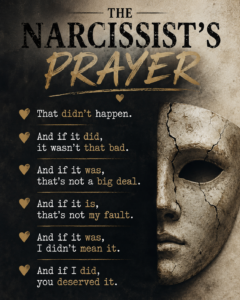
The Narcissist’s Prayer showing six statements that progress from denial and minimization to blame-shifting, beside an image of a cracked mask.

Gaslighting, Blame-Shifting, and the Absence of Repair

A person can know something experientially long before they can articulate it. They might know, for example, “After X is upset with me, I end up confused. I initiate communication thinking I had a legitimate concern, and somehow I leave apologizing and wondering whether I caused everything.” They don’t necessarily have words or concepts to process what happened. Once someone learns concepts like blame-shifting, triangulation, invalidation, stonewalling, double standards, DARVO, conditional approval, or refusal of repair, those concepts can provide handles for examining an interaction: Wait—was I actually heard? Did we each consider or examine our contributions? Was disagreement permitted? Did responsibility somehow become entirely mine? And importantly, language doesn’t have to supply the verdict. It can supply questions. That may be especially valuable for someone who’s been raised inside a particular relational system, because whatever happened repeatedly can simply register as this is how relationships work. Conflict is information, not a trial where somebody has to be found guilty. You can finish a disagreement still thinking, I was right about the original issue, and nevertheless learn: I interrupted you. I got defensive. I misunderstood what you meant. I didn’t realize that mattered so much to you. Or: I still disagree, but now I understand your reasoning. Or my most favorite of all: I think I understtand but I still do not agree. And the other person can do the same. Someone can be displeased with you without their displeasure becoming evidence that you’re bad. They can misunderstand you without their interpretation replacing your knowledge of yourself. And you can discover something uncomfortable about your own behavior without having to collapse into therefore I am the problem. In a healthy rupture, both people have something to metabolize. Not necessarily equal blame—sometimes one person really did behave badly—but both people still have an encounter to process. What happened? What did I do? What did you experience? What did I misunderstand? What does this change between us? What is needed for repair? In the archetypal dynamic, one person effectively exempts themselves from that process. Their internal work stops at: I was right to do or say X because of what you did. Everything downstream gets assigned to the other person. But the person on the receiving end doesn’t get to bypass metabolizing the rupture. They can end up metabolizing too much. They process the original conflict, the accusation, the other person’s certainty, the withdrawal, their own behavior, their memory, their motives, what they could have done differently, whether they’re actually the problem—and they do it without the other person’s participation. Then contact resumes without repair. All of that processing has nowhere relational to land. It can instead become adaptation: anxiety, self-doubt, vigilance, accommodation, rehearsing, overexplaining, trying harder, monitoring tone, becoming increasingly careful. The rupture isn’t unprocessed. The processing is asymmetrical. One person preserves their existing understanding of themselves. The other person is left reorganizing themselves around the unresolved rupture. Repair brings the information back into the relationship, where both people can examine it instead of one person having to carry and interpret the whole thing alone. One person is trying to understand what happened. The archetype is operating from the position that nothing happened that requires understanding. One person is asking, What happened between us? How did we get here? What needs to be repaired? And the answer—explicitly or through behavior—is essentially: There is nothing between us to repair. The problem is that you’re confused, anxious, sensitive, difficult, or unable to let things go. So the effect of the interaction gets reassigned as a characteristic of the recipient. The anxiety created by unresolved rupture becomes evidence that you’re “anxious.” The confusion created by contradictory interactions becomes evidence that you’re “confused.” Your attempts to get resolution become evidence that you “can’t let things go.” Your attempts to clarify what happened become evidence that you’re “overthinking.” The interaction disappears from the explanation. Then when ordinary contact resumes without acknowledgment, one person can experience that as moving on, while the other person is still carrying an unresolved event that supposedly never happened. There can be no repair when only one person is able to acknowledge that there was a rupture. You can say, “Something you did didn’t land well with me,” and get: Nothing happened. You’re misinterpreting me. You’re too sensitive. Or you can notice distance and say, “Something seems different between us. Did something happen?” and get: Nothing’s different. You’re imagining things. Why do you always do this? If you name an impact, you’re creating a problem. If you notice an impact, you’re creating a problem. If you ask about a rupture, you’re creating a problem. If you remain unsettled because there was no repair, that becomes the problem. The recipient isn’t just processing a conflict alone. They’re being asked to process a conflict whose existence has been denied. There isn’t even an agreed-upon event to work with. Something happened between us. I can observe the change. I’m experiencing the consequences. But I’m being told there is nothing here to discuss. Which may be why “nothing happened” is so consequential. It doesn’t merely refuse repair. It removes the shared reality from which repair would have been possible. Nothing happened. Nothing’s wrong. There is nothing to discuss. But then there’s silence. Distance. Withdrawal. Maybe coldness. You’re left alone with whatever the fuck just happened. That’s the contradiction. You’re experiencing the consequences of a rupture while being denied the existence of the rupture itself. Whatever else may be true, this is a defining structure within the archetypal dynamic.

Read More
Black-and-white cartoon of a girl with glasses sitting on a couch between a fluffy white dog and a small black dog. A thought bubble above her says, “Zero contempt. Excellent and steady ROI.” The image includes the watermark wholesomebadass.com.

Attachment Without Connection

I have been circling the relationship between attachment, connection, and repair. I understand now how it is possible for me to feel deeply—and painfully—attached to someone and still have no genuine access: the unbearable absence of mutual kindness, curiosity, emotional access, or even respect. I have wasted an enormous energy suffering inside relationships I was desperate to redeem. Situationships that, in retrospect, may have been enmeshment, transactional, or convenient in some way. Not balanced or founded on shared high regard for one another. Too fragile for depth and difficulty. Years of unaddressed friction become suffocating, ending in an unnamed rupture never to be met with repair. Irredeemable. Relational repair simply cannot be achieved by me alone. When a person has adopted an air of contempt, good-faith resolution is unlikely. When they feel so fucking right and righteous that they cannot even look upon me with kindness, my experience and effort carry no weight because the larger conclusion has already been reached about who I am. The archetypal system demands one right and one wrong, snuffing out the possibility of peaceful resolution with mutual intent. More effort by me only creates more suffering. There is literally zero ROI. And this is where I get to examining surrender and resignation. Resignation is apathy or indifference, like: Fuck it. I am done and don’t care. Surrender is a spiritual practice and a choice with agency, dignity, and even peace. Like… This matters to me. I wish it were different. I love you. And I am no longer going to throw myself at a thing that requires presence and intention from each of us. I have stopped confusing my attachment to someone for evidence that a workable relationship is available. There will always be things I wish I had handled differently and things I might do differently now. I acknowledge my failed efforts: They didn’t go incredibly, but I’m proud of how I tried. I find solace and self-worth in owning that I was imperfect without turning that into justification to continue tryyyyying. I am not abandoning the relationship. Or myself. I am withdrawing fruitless, degrading labor from an outcome that requires another participant. Have you ever caught yourself working tirelessly to salvage or preserve an attachment you had confused for deep, lasting connection—even as the effort brought only suffering and indignity?

Read More
Black-and-white Wholesome Badass drawing of a girl lying on a couch with a thought bubble that says, “If no one is actually perfect or infallible, doesn’t protecting that image eventually require omission, distortion, or misrepresentation?”

Can the Need to Appear Infallible Make Someone Less Honest?

I am increasingly interested in the archetypal persona—the kind of person for whom being, or even appearing, incorrect, uncertain, or imperfect seems almost unthinkable. Like what happens when being seen as good, right, or infallible is key to the archetypal identity? One who can readily accept and explore a mistake or misstep has less reason to distort the truth. If admitting fault threatens the whole structure, there is reason to alter, omit, or misrepresent whatever threatens it. The story may need managing.Incomplete truths may need to stand in for the whole truth.Harm may need minimizing.Someone else may need to be positioned as wrong. At some point, the way we protect our image is also information about our character. Maybe goodness is not being beyond error. Maybe it is the ability to remain honest when we have erred or fallen short. As I continue to seek a wholesome path through life—one rooted in spiritual grace—I am also finding out exactly how badassery shows up in my daily life as a byproduct. I think the two may be inextricably linked.

Read More
Two speech bubbles on a light background. A green bubble says, “Are we okay?” and a red bubble says, “I. Am. Fine.”

I’m sorry I hurt you 

In a system where acknowledging injury threatens the archetypal version of reality everyone is supposed to be organized around: The governing mythology seems to be that strong, healthy, rational people are unaffected. They do not feel disturbed, injured, angry, or overwhelmed. Those experiences belong exclusively to the other category of person—the difficult, unstable, dramatic, overly sensitive conflict-maker. So when I ask, “Are we okay?” or notice tension and inquire about it, my question can carry two almost outrageous assertions: You appear emotionally affected. And: I believe I might matter enough to have affected you. The response cannot be, “Yeah, that bothered me.” It is some version of: Nothing is wrong. I am fine.(door-slamming energy) The attempt at repair is treated as intrusion, neediness, conflict creation, or self-importance. The only issue is ME, my core-wrongness. There was another scenario in which the inquiry was weaponized. My sister could do something upsetting, mock or gossip about me, then circle back shortly after in what appeared to be a tender way and ask if something was wrong. I understood that as an invitation to connect. Looking back, it may have been closer to: Are you aware of what I have done? If I said, Yeah, X bothered me, that was the on-ramp to a debate over the wrongness of my perception, character, and personality. If emotional negative impact itself is associated with weakness, repair is unnecessary by definition. There shall be no repair for a thing the other person insists never happened. No amends for an injury dismissed as the injured person’s sensitivity. No space for either giving a meaningful apology or receiving one. I’m sorry I hurt you will not be said or well received. I find this as stunning as it is common. I have realized in this season of life that it is not safe for me to engage in non-optional relationships with people who cannot, in good faith, enter into challenging conversations aimed at resolution and repair. This is the dynamic and personality type I have spent much of my life trying to navigate. Whatever else may be true, this has been my experience, and it is a pattern I am intent on breaking.

Read More
Rattlesnake wearing a party hat on a pink unicorn bed, symbolizing hidden danger in plain sight.

When Influence Obscures The Facts

How a Narrative Protects Predatory Behavior The Branding Becomes the Lens I am recognizing something in real time: the story about someone can matter more than what they actually say and do. When someone is characterized unfavorably by a person of greater status or influence, the language is often directed toward creating a shared lens through which others understand them. That version can serve as the starting assumption. Hierarchy gives it weight. This is the branding. The packaging. And it matters who establishes it. From there, a trajectory takes shape. The branding creates two outcomes at once: one person is invalidated while the other is insulated and immune to scrutiny. The branding calls the person to defense, then uses that defense as evidence that the characterization was right. Distress is recast as instability, attempts at clarity as difficulty, withdrawal as withholding, and any strong response as confirmation. Evidence to the contrary is inadmissible. It does not weaken the characterization. This is what makes the role difficult to escape. The arrangement is zero-sum: for one person to remain credible and protected, the other has to remain discredited. This is not a self-fulfilling prophecy in the usual sense because the premise does not originate with the branded one. It is imposed from “above,” then used to interpret everything that follows. Reality gets outranked by narrative. A response can be disproportionate, messy, or wrong without making the underlying experience unreal. Someone can be difficult or unpopular and still have been treated poorly. But the formula reigns: When the conduct of the protected archetype is questioned: Well, I only acted this way because of who and how YOU/THEY are. Have you been in a relationship in which another person’s missteps, poor choices, words, or conduct were repeatedly assigned to something supposedly wrong with you? WTAF? As in: If I behave like an asshole, it is only because you suck.

Read More
Black-and-white cartoon of a girl describing what she witnessed while a stern woman denies it. Villagers hold baskets of stones labeled liar, dramatic, selfish, ungrateful, and disrespectful, illustrating gaslighting and scapegoating.

When Harm Wears a Virtuous Mask

Whatever is said or believed about me does not change what was said and done. I keep coming back to the possibility that the golden child can occupy the position of a protected abuser. So much of my childhood was lost in the shadow of what happened with my female sibling, older than me by 7 years. Decades later, she came for my children. I am only beginning to recognize the correlation between the two. Not identical acts. A familiar code. She acts. I object. My objection is treated as the offense. My experience is displaced. Her version is granted authority. Others are drawn in. Her position remains protected. Mine grows increasingly difficult to hold without defending myself. She was afforded the identity and cover of “good,” while I was named a menace for directly objecting and emotionally reacting to behavior that was, in fact, objectionable by almost any standard. She was able to compromise me in plain sight from behind the protective shield of who everyone believed her to be. It was never-ending. From the outside, it must have looked as if I were crazy—boxing with ghosts. People could see my distress. They could not see the quiet dog whistles, unwanted touching, exclusions, implications, and positioning I was responding to. And I can say now that I was fucking crazed by what was happening—not only because it was harmful, but because the harm was denied and protected. The asymmetry was brutal: one person retained the cover of goodness while my visible distress was treated as if it had appeared out of nowhere- a thing I elected to do. My reaction was indeed spectacular. What preceded it remained invisible. Maybe that is part of what I am processing now. For decades, people must have thought, Yikes. What is wrong with her? I have spent years interrogating that question too. Only recently have I become more interested in a different question: What happened to her, to lil Magda? Why is it easier to ask what is wrong with someone than to ask what happened to them? The first question leaves the existing narrative intact. The second invites examination. It is a fascinating pattern: harm can be easily masked by a role, a reputation, even an act that looks virtuous from across the room. A person can be doing harm while being protected by the belief that they are good. Years later, I would be profoundly affected by a pastor whose attention felt like the most extraordinary care. I can see now how I had been groomed to mistrust my own perception, particularly when harm came through someone occupying a role presumed to be protective—a shepherd, someone understood to be good, trustworthy, and morally authoritative. I keep thinking of the line, “Not all villains wear black.” There is an almost absurd irony in that for me: I tend to dress mostly in black, while my female sibling favors white. hmmmm…. I don’t think clothing color informs us of character, of course. Have you ever watched harmful behavior happen in plain sight while others showed and spoke no objection – maybe because of the status, influence, or authority of the person doing it, or the lesser status of the person being harmed—so that neutrality itself functioned as permission? What is that even called? It reminds me of that scene in Boardwalk Empire where a priest appears to be baptizing a man in front of the entire church. What everyone else sees is a sacred ritual performed by someone occupying one of the most trusted positions in the room. What is actually happening is murder.

Read More
Chopped down tree symbolizing the lasting impact of family betrayal and parental alienation.

When Family Betrayal Pulls Young Children Into the Middle

At a very tense Mother’s Day gathering in 2016, I learned that my niece’s graduation was less than four weeks away and on the same night as a concert I had already committed to. The tickets had been a Valentine’s Day gift and the plans had been in place for months. It wasn’t that I chose a concert over her graduation. I simply already had plans by the time I was given the date. With no other way to get my boys to the graduation, and valuing the opportunity for family that being there would give them, I sent them with their dad. Even then, I sensed it could be a fatal choice. Later, my mother told me that while they were at the graduation, plans began for a birthday gathering for my son that would intentionally exclude me. Whatever was happening between the adults, I had directly and repeatedly asked that it stay there, and that we do the work of repair. Something in the fabric of my universe was torn beyond repair. Whatever else may be true, this also happened. I’ve been accused of being negative- always imagining the worst. Maybe I was never imagining the worst. Maybe I’m recognizing and recalling what I have lived. Have you ever been called negative for noticing a pattern that later proved real?

Read More
A crowd beside a woman standing alone, illustrating what it feels like when someone more influential controls the narrative and everyone believes their version.

The Power of Controlling the Narrative

Something does not become untrue because somebody more influential tells the story differently. I have spent a lot of my life attempting to reconcile the version of events that prevailed with my lived experience. Influence seems to determine which version is adopted and repeated. A person with more influence can shape or manipulate how events are understood. Their version becomes the more widely accepted narrative. And those under that person’s influence tend to organize around it, as THE truth. It shapes who is protected. Who is believed. Who gets the benefit of the doubt. Who belongs. And sometimes, for one person to remain elevated within that narrative, somebody else has to occupy the lesser position. Less credible. Less valid. Easier to dismiss. Then anything that person shares of what happened gets heard through what has already been established about them—and becomes, at some level, inadmissible. That’s the part—that part right there. You are not only trying to process and overcome what happened. You’re trying to tell it from a position where your credibility has already been diminished. Whatever else may be true, this also happens. A narrative can do more than determine what gets believed. It can determine who remains protected and included—and who becomes increasingly easy to disregard, diminish, and exclude. How much of what we believe about someone comes from what we have actually experienced with them, and how much was already decided for us by the story we were handed?

Read More
The Narcissist’s Prayer showing six statements that progress from denial and minimization to blame-shifting, beside an image of a cracked mask.

Gaslighting, Blame-Shifting, and the Absence of Repair

A person can know something experientially long before they can articulate it. They might know, for example, “After X is upset with me, I end up confused. I initiate communication thinking I had a legitimate concern, and somehow I leave apologizing and wondering whether I caused everything.” They don’t necessarily have words or concepts to process what happened. Once someone learns concepts like blame-shifting, triangulation, invalidation, stonewalling, double standards, DARVO, conditional approval, or refusal of repair, those concepts can provide handles for examining an interaction: Wait—was I actually heard? Did we each consider or examine our contributions? Was disagreement permitted? Did responsibility somehow become entirely mine? And importantly, language doesn’t have to supply the verdict. It can supply questions. That may be especially valuable for someone who’s been raised inside a particular relational system, because whatever happened repeatedly can simply register as this is how relationships work. Conflict is information, not a trial where somebody has to be found guilty. You can finish a disagreement still thinking, I was right about the original issue, and nevertheless learn: I interrupted you. I got defensive. I misunderstood what you meant. I didn’t realize that mattered so much to you. Or: I still disagree, but now I understand your reasoning. Or my most favorite of all: I think I understtand but I still do not agree. And the other person can do the same. Someone can be displeased with you without their displeasure becoming evidence that you’re bad. They can misunderstand you without their interpretation replacing your knowledge of yourself. And you can discover something uncomfortable about your own behavior without having to collapse into therefore I am the problem. In a healthy rupture, both people have something to metabolize. Not necessarily equal blame—sometimes one person really did behave badly—but both people still have an encounter to process. What happened? What did I do? What did you experience? What did I misunderstand? What does this change between us? What is needed for repair? In the archetypal dynamic, one person effectively exempts themselves from that process. Their internal work stops at: I was right to do or say X because of what you did. Everything downstream gets assigned to the other person. But the person on the receiving end doesn’t get to bypass metabolizing the rupture. They can end up metabolizing too much. They process the original conflict, the accusation, the other person’s certainty, the withdrawal, their own behavior, their memory, their motives, what they could have done differently, whether they’re actually the problem—and they do it without the other person’s participation. Then contact resumes without repair. All of that processing has nowhere relational to land. It can instead become adaptation: anxiety, self-doubt, vigilance, accommodation, rehearsing, overexplaining, trying harder, monitoring tone, becoming increasingly careful. The rupture isn’t unprocessed. The processing is asymmetrical. One person preserves their existing understanding of themselves. The other person is left reorganizing themselves around the unresolved rupture. Repair brings the information back into the relationship, where both people can examine it instead of one person having to carry and interpret the whole thing alone. One person is trying to understand what happened. The archetype is operating from the position that nothing happened that requires understanding. One person is asking, What happened between us? How did we get here? What needs to be repaired? And the answer—explicitly or through behavior—is essentially: There is nothing between us to repair. The problem is that you’re confused, anxious, sensitive, difficult, or unable to let things go. So the effect of the interaction gets reassigned as a characteristic of the recipient. The anxiety created by unresolved rupture becomes evidence that you’re “anxious.” The confusion created by contradictory interactions becomes evidence that you’re “confused.” Your attempts to get resolution become evidence that you “can’t let things go.” Your attempts to clarify what happened become evidence that you’re “overthinking.” The interaction disappears from the explanation. Then when ordinary contact resumes without acknowledgment, one person can experience that as moving on, while the other person is still carrying an unresolved event that supposedly never happened. There can be no repair when only one person is able to acknowledge that there was a rupture. You can say, “Something you did didn’t land well with me,” and get: Nothing happened. You’re misinterpreting me. You’re too sensitive. Or you can notice distance and say, “Something seems different between us. Did something happen?” and get: Nothing’s different. You’re imagining things. Why do you always do this? If you name an impact, you’re creating a problem. If you notice an impact, you’re creating a problem. If you ask about a rupture, you’re creating a problem. If you remain unsettled because there was no repair, that becomes the problem. The recipient isn’t just processing a conflict alone. They’re being asked to process a conflict whose existence has been denied. There isn’t even an agreed-upon event to work with. Something happened between us. I can observe the change. I’m experiencing the consequences. But I’m being told there is nothing here to discuss. Which may be why “nothing happened” is so consequential. It doesn’t merely refuse repair. It removes the shared reality from which repair would have been possible. Nothing happened. Nothing’s wrong. There is nothing to discuss. But then there’s silence. Distance. Withdrawal. Maybe coldness. You’re left alone with whatever the fuck just happened. That’s the contradiction. You’re experiencing the consequences of a rupture while being denied the existence of the rupture itself. Whatever else may be true, this is a defining structure within the archetypal dynamic.

Read More