Wholesome Badass

A Work in Progress — Healing from All the Things​

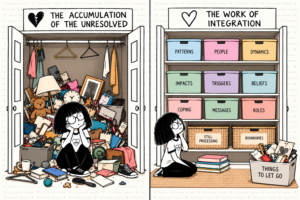
Split illustration of trauma integration. On the left, a distressed girl sits among a heap of clutter beneath “The Accumulation of the Unresolved.” On the right, she sits peacefully before organized bins labeled Patterns, People, Dynamics, Impacts, Triggers, Beliefs, Coping, Messages, Roles, Boundaries, and Still Processing. A separate bin reads “Things to Let Go.” Copy alt text

Who Are We Beyond Survival Mode?

For me, survival mode has felt like living under the weight of an ever-growing, tangled mess. Every unsettling interaction compounded it. I couldn’t untangle it, and I couldn’t leave it alone. After decades of debilitating confusion, I’m finally recognizing patterns and finding ways to organize my experiences. The mess hasn’t disappeared, but it’s loosening its grip on me. I missed so much of my life trying to figure out what had just happened and worrying about what might happen next. I’m beginning to see how life could be more.

Read More
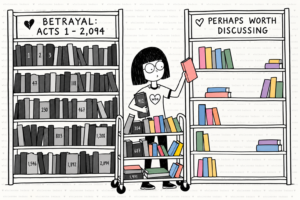
Hand-drawn girl sorting books between two shelves. One is packed with numbered gray books beneath “Betrayal: Acts 1–2,094” and a broken heart. The other holds fewer colorful books beneath “Perhaps Worth Discussing” and an outlined heart.

From Unprocessed Trauma to Integration

Over the last six months, I’ve experienced significant shifts in my recovery. I’m feeling it in my writing and illustrations, where I’m now able to convey things that previously defied articulation or required 42 million words. Looking back, my older writing reads almost like an attempt to assemble evidence for litigation. Or a screenplay. Trying with all earnestness to force light onto things that had been kept in the shadows for too long. And while looking at those things was essential to my healing, part of me desperately needed someone to recognize what I was trying to survive and make sense of. I was frantic for one fucking witness. Someone. Anyone. To say, “I see it. I saw it. That happened. It was rough and wrong and shitty and painful.” And if I were really lucky, maybe someone might even have said, “I get it.” Or, “You’re right.” Or, “Help me understand.” And I would have absolutely settled for, “That shit fucking happened.” “What do you need?” And it is astonishing to me that today, I don’t think I need that anymore. I no longer feel terrorized by the need for outside acknowledgment of my experience in order for it to be true or traumatic. I know what happened to me. I know how it affected me. And somehow, that seems to be enough. Is this what it’s like to have a sense of self? Or self-worth? Like maybe I can honor myself and what I know to be true without needing somebody else to affirm it. So I’ve taken down older writing for examination, saving only what feels useful. That writing gave me a chance to voice things I hadn’t been welcome to say. Things that had left me feeling silenced and erased and impotent. I’m not sorry for writing those things. The writing did what I needed. Its work is done. It’s not for the trash, but it no longer interests me. It’s lost its hold. And I love that. Have you ever exhausted yourself trying to access the most perfectly accurate words, the ones that couldn’t be disputed or denied, so you could finally get someone to see what happened? ♡

Read More
Wholesome Badass girl imagines herself drawing a winding path toward a yellow sunrise beneath a calming blue sky.

Who am I when my life is no longer organized around survival?

1. Identity — Who am I without the struggle? 2. Agency — The difference between reacting and initiating 3. The nervous system — When peace is unfamiliar 4. Desire — Discovering what I actually want 5. Dignity — Beyond defending my worth 6. Relationships — Connection without a role to perform 7. The future — A life that isn’t a response to the past Who might I get to be when my choices are guided by curiosity, desire, and intention rather than adaptation and self-protection?

Read More
Cartoon-style black-and-white drawing on a soft green background of a girl feeding papers labeled trauma, confusion, misinformation, doubt, and shame into a machine labeled “Processing Through Writing.” Papers coming out say agency, discernment, and intention. Her bag has a small WBA heart logo, and the image is watermarked with wholesomebadass.com.

The Shit Before the Shift

No Dimmer Switch I feel everything the most amount—the good and the unpleasant—constantly. Everything in high definition. I am a deep feeler, or as the archetype likes to say: thin-skinned, overly sensitive. Not a crime. Not a defect. But not an easy way to be in the world. From my tiniest days, I recall feeling inconsolably rattled, navigating my tightly wound nervous system and sensitive disposition with no guidance, knowledge, language, or skill set for any of it. I cannot recall another version of myself underneath it all – who ever felt secure, grounded, safe, and not overwhelmed. That has been my baseline. It is not a great point of departure. Billed to Me I was raised to believe that other people’s harsh behavior spoke directly to the quality of my person, my character, and my worth. Which was terribly confusing, because I was also often scolded for asking if a person was upset with me, “Not everything is about you.” And yet other people’s unfavorable moods and behaviors were consistently billed to me or altogether denied. So… difficult moods and feelings—mine and theirs—were my responsibility. And no clue how to manage that. Painfully aware: I was constantly and undeniably failing. While nobody taught or encouraged me to know, soothe, value, or care for myself, I was expected to read, anticipate, prevent, and manage other people’s difficult feelings. So many times, blood relatives would demand in a menacing tone, “What are you so angry about?” But it was not a genuine inquiry. It was a callout: look at you, with that massive chink in your armor. Feel ashamed and pipe down or else. There is real sadness in looking back and realizing how much unmanaged, daily compounded stress was attributed exclusively to my “poor character.” I spent more than forty years trying to do the impossible thing of getting different and becoming someone else. My only ambition. What a tragic fucken waste. Stripped of any potential to self-actualize. The Familiar And having been been handled like a piece of literal shit—a poopy diaper—I did not instinctively seek nourishing and affirming relationships. I had learned that love looked like people who genuinely were not FOR me—unless and only when I was useful to them. This explains so much. At many levels, I believe the only thing I shared in common with my family of origin was that we all held me in the lowest regard. That is hard to reconcile. And tragically, my only direction was toward the familiar. Ooof. Decades of trying to feel better, by any means possible, without really knowing what I was trying to feel better from. From being a shiftless piece of shit?? There is literally no relief from that. I mistook random positive intermittent reinforcement for kindness and brought that out into the world with me as the love I sought. And sometimes the love I gave. I hate that. Better Information I am proud to have interrupted that cycle, that I did not hand that poison directly to my sons. No matter what is said about me, it cannot be denied that I rode faithfully for my children. Without exception. Maybe not perfectly or without pain to them, but with fierce loyalty and constant sacrifice. In learning about trauma and nervous systems. Neglect. Generational abuse. Coercive abuse. Scapegoating. Triangulation. Attachment, fear, compulsion. I recognize how I confused what was recognizable with what was safe and acceptable. For and from myself. Agency With better information now, I get to experience something that for so long eluded me: agency—where I carefully consider who, what, how, and when to engage, and whether engagement is even required or prudent. Writing helps me recognize and organize all of the me’s inside of me—with no intent to prosecute my past or acquit any of my me’s. I work tirelessly to untangle my myths and misconceptions about myself, love, connection, and kindness. It is a true miracle to have grown into the loving, honest, dependable, funny, compassionate, and loyal woman I am. And this is also true: I have not always known how to move in these ways—or how to move with people who equally value them. First the unlearning. The shit before the shift, I guess. What were you led to believe about yourself because of the way someone else treated you? And do you still belive it?
Read More
Woman surrounded by flames with the words, “Don’t set yourself on fire to keep others warm.”

When Accountability Flows in Only One Direction

For more than 40 years, I didn’t really know how to exist inside a relationship unless I was the broken one, bowing in reliance to anyone gracious enough to let me hang around, no matter the quality of treatment. Could you stay with me? Could you help me? What have I done to be so lucky to have someone strong and knowing and right like you? Barf. Fangirl, fawning, degrading shit. I knew how to engage only that way. What I’m learning now is something different. I don’t want to have to be broken to belong. I am going off script. This is wildly unpopular with the patterned archetypes I have gone barreling toward at every opportunity. I no longer agree to that—to matter less so that a relationship may continue. I cannot abandon what I know and adopt someone else’s perspective in place of my lived experience. That is me gaslighting myself. I cannot accept someone else’s explanation of my motives when it isn’t mine. I can be wrong. I can fuck up. I can apologize. I can change. But I have to remain a whole person while I do it. And the relationships that have cost me the most have not been the ones where people hurt me or got things wrong. They have been the ones where somehow there was always something for me to examine, own, apologize for or change, and nothing on the other side of the relationship was ever available for the same examination. I welcome the responsibility to own my part. I cannot own yours too. My hunger for connection has kept me engaged in things long after I knew they weren’t feeding me. Hunger will do that. But if my body is asking for fiber and what’s being offered is refined sugar, eating it because I’m hungry doesn’t nourish me. It’s not nothing. But it’s not neutral either. I won’t keep feeding myself the opposite of what I’m hungry for and then wonder why I feel poisoned. And feel shame for my resulting condition. So yes. Some relationships may cost too much to keep. Not because they don’t matter to me. Because I finally matter too. Have you ever been tangled up with someone like this? Someone where every attempt to address a conflict somehow ends with you being the only person under examination? They didn’t misunderstand. They didn’t contribute. They didn’t hurt you. They didn’t get anything wrong. You did. Every fucking time….Whatever else may be true, this also happened.

Read More
A warmly lit room with an open closet, hanging clothes, photographs, books, keepsakes, boxes, and a ceramic mug surrounding a scattered pile of personal belongings. The image includes the quote, "Nothing ever goes away until it has taught us what we need to know," by Pema Chödrön.

Making Sense of Life Through Patterns

With all of the therapy, writing, reading, reflection, and somatic work, a lot is coming up for me. Memories. Patterns. Correlations that I had not previously made. I am finding that this process is much less like the discovery of something new and much more like noticing something that has been there all along. I would describe it as so much stuff from the past lying in a tangled heap on a closet floor, too overwhelming to tackle or ignore. Slowly, I am making order of it, identifying items and events, and putting them in their places. The tangled mess shrinks, and the grip of it all is loosening. I am also discovering that memory is a strange thing. I don’t trust every detail, every conversation, or every interpretation. But I do trust patterns, especially those that repeat themselves in what seems like perpetuity. I am trying very hard to engage this with humility, admitting my blind spots. I recognize that other people have had different experiences and interpretations. I can’t know intent or motivation, but only I can name the impact they have had on me.

Read More
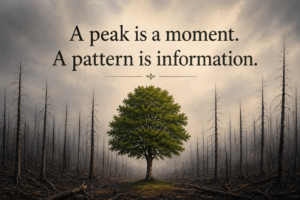
One healthy green tree standing in the middle of a forest of dead trees beneath the quote, “A peak is a moment. A pattern is information.”

The Truth Is in the Pattern

Sheesh. How many more times will I have to navigate this particular circuit before I have learned everything I can from it? The turth is in the pattern, not the explanation. It almost feels as though I have been given a false map. There are things people say that, if I allow them to guide me, will take me completely off course because they don’t align with reality, their actions, or my lived experience. I am starting to recognize that the real story lives inside the patterns. Words do matter. Conversations matter. Moments matter. But patterns persist regardless of what is said. Sometimes there is an incongruency or lack of alignment between words, the suggested intent of those words, and actions. Sometimes things are not communicated directly at all, and yet they are communicated clearly through repeated behaviors. I am intentionally allowing patterns to inform me more than peak moments, conversations, or exchanges. If there is a pleasurable moment in a relationship, I can no longer hold onto that moment as though it represents restoration or the relationship as a whole. I will not waste energy trying to figure out how to get back to that place, as though I have somehow lost the thread. Perhaps it was the exception. Possibly, it was simply a moment. The information is in the pattern. That doesn’t necessarily tell me what is true in some absolute sense, but it does tell me what is real. And when I allow patterns to inform what I say or do next, I am able to remain aligned with my quest for sovereignty and radical neutrality. A thing has happened. I don’t get to change it, reinterpret it, or spin it into something else. I don’t have to lose myself reacting or trying to understand it from every possible angle. I don’t have to overexplain my experience or convince anyone else of it. I can simply acknowledge what is and decide what my actual options are, keeping in alignment with my North Star. Whatever else may be true, this also happened.

Read More
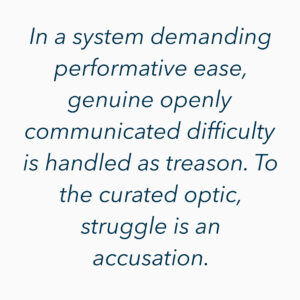
Text graphic quote: In a system demanding performative ease, genuine openly communicated difficulty is handled as treason. To the curated optic, struggle is an accusation.

Beneath the Paper Crown and the Carefully Arranged Face

The Binary The archetypes seem to move through life inside a rigid binary: winners and losers, heroes and villains, right and wrong. In their accounting for outcomes, there seems a lacking awareness for the possibility of their own poor decisions, regrettable reactions, or personal shortcomings.  Ironically, those are my favorite parts of any story. They are where humility lives and where connection is deepened.  To present as innocent, infallible, or heroic, someone else must always carry the shadow. When the archetype FAILs to achieve something, the explanation is rarely capability, circumstance, or choice. Instead, someone else must have been unfair, jealous, dishonest, or unjust. But the standard changes when hardship belongs to someone outside their circle of favor. Then the loss is framed as deserved.  Proof of poor character.  Evidence of defectiveness. Similar outcomes get narrated through two entirely different lenses, depending on who it happened to. The Meritocracy There seems a profound reliance on meritocracy as a reason for nearly every outcome. Success as proof of virtue.  Failure as proof that the game was rigged—at least when it happens to the archetype. And stories are shared with performative ease. Becuase struggle and dis-ease are marks of unworthiness and defect. Cue smiling emoji. A casual “lol.” “No worries.” “Perfect” The performance broadcast says, I’m completely unbothered. The pulsing tension whispers otherwise. Beneath the carefully arranged face seems a deep fear of losing status, admiration, or control. This must never happen. And there is an unspoken truth that if the archetype is worried, everyone else should be worried too. When your worth depends on always appearing victorious, peace becomes impossible. Protecting the delusion illusion is more important than connection or truth. In a system demanding performative ease, genuine and openly communicated difficulty is handled as treason. To the curated optic, struggle is an accusation. Whatever else may be true, this also happens.

Read More
Split illustration of trauma integration. On the left, a distressed girl sits among a heap of clutter beneath “The Accumulation of the Unresolved.” On the right, she sits peacefully before organized bins labeled Patterns, People, Dynamics, Impacts, Triggers, Beliefs, Coping, Messages, Roles, Boundaries, and Still Processing. A separate bin reads “Things to Let Go.” Copy alt text

Who Are We Beyond Survival Mode?

For me, survival mode has felt like living under the weight of an ever-growing, tangled mess. Every unsettling interaction compounded it. I couldn’t untangle it, and I couldn’t leave it alone. After decades of debilitating confusion, I’m finally recognizing patterns and finding ways to organize my experiences. The mess hasn’t disappeared, but it’s loosening its grip on me. I missed so much of my life trying to figure out what had just happened and worrying about what might happen next. I’m beginning to see how life could be more.

Read More
Hand-drawn girl sorting books between two shelves. One is packed with numbered gray books beneath “Betrayal: Acts 1–2,094” and a broken heart. The other holds fewer colorful books beneath “Perhaps Worth Discussing” and an outlined heart.

From Unprocessed Trauma to Integration

Over the last six months, I’ve experienced significant shifts in my recovery. I’m feeling it in my writing and illustrations, where I’m now able to convey things that previously defied articulation or required 42 million words. Looking back, my older writing reads almost like an attempt to assemble evidence for litigation. Or a screenplay. Trying with all earnestness to force light onto things that had been kept in the shadows for too long. And while looking at those things was essential to my healing, part of me desperately needed someone to recognize what I was trying to survive and make sense of. I was frantic for one fucking witness. Someone. Anyone. To say, “I see it. I saw it. That happened. It was rough and wrong and shitty and painful.” And if I were really lucky, maybe someone might even have said, “I get it.” Or, “You’re right.” Or, “Help me understand.” And I would have absolutely settled for, “That shit fucking happened.” “What do you need?” And it is astonishing to me that today, I don’t think I need that anymore. I no longer feel terrorized by the need for outside acknowledgment of my experience in order for it to be true or traumatic. I know what happened to me. I know how it affected me. And somehow, that seems to be enough. Is this what it’s like to have a sense of self? Or self-worth? Like maybe I can honor myself and what I know to be true without needing somebody else to affirm it. So I’ve taken down older writing for examination, saving only what feels useful. That writing gave me a chance to voice things I hadn’t been welcome to say. Things that had left me feeling silenced and erased and impotent. I’m not sorry for writing those things. The writing did what I needed. Its work is done. It’s not for the trash, but it no longer interests me. It’s lost its hold. And I love that. Have you ever exhausted yourself trying to access the most perfectly accurate words, the ones that couldn’t be disputed or denied, so you could finally get someone to see what happened? ♡

Read More
Wholesome Badass girl imagines herself drawing a winding path toward a yellow sunrise beneath a calming blue sky.

Who am I when my life is no longer organized around survival?

1. Identity — Who am I without the struggle? 2. Agency — The difference between reacting and initiating 3. The nervous system — When peace is unfamiliar 4. Desire — Discovering what I actually want 5. Dignity — Beyond defending my worth 6. Relationships — Connection without a role to perform 7. The future — A life that isn’t a response to the past Who might I get to be when my choices are guided by curiosity, desire, and intention rather than adaptation and self-protection?

Read More
Cartoon-style black-and-white drawing on a soft green background of a girl feeding papers labeled trauma, confusion, misinformation, doubt, and shame into a machine labeled “Processing Through Writing.” Papers coming out say agency, discernment, and intention. Her bag has a small WBA heart logo, and the image is watermarked with wholesomebadass.com.

The Shit Before the Shift

No Dimmer Switch I feel everything the most amount—the good and the unpleasant—constantly. Everything in high definition. I am a deep feeler, or as the archetype likes to say: thin-skinned, overly sensitive. Not a crime. Not a defect. But not an easy way to be in the world. From my tiniest days, I recall feeling inconsolably rattled, navigating my tightly wound nervous system and sensitive disposition with no guidance, knowledge, language, or skill set for any of it. I cannot recall another version of myself underneath it all – who ever felt secure, grounded, safe, and not overwhelmed. That has been my baseline. It is not a great point of departure. Billed to Me I was raised to believe that other people’s harsh behavior spoke directly to the quality of my person, my character, and my worth. Which was terribly confusing, because I was also often scolded for asking if a person was upset with me, “Not everything is about you.” And yet other people’s unfavorable moods and behaviors were consistently billed to me or altogether denied. So… difficult moods and feelings—mine and theirs—were my responsibility. And no clue how to manage that. Painfully aware: I was constantly and undeniably failing. While nobody taught or encouraged me to know, soothe, value, or care for myself, I was expected to read, anticipate, prevent, and manage other people’s difficult feelings. So many times, blood relatives would demand in a menacing tone, “What are you so angry about?” But it was not a genuine inquiry. It was a callout: look at you, with that massive chink in your armor. Feel ashamed and pipe down or else. There is real sadness in looking back and realizing how much unmanaged, daily compounded stress was attributed exclusively to my “poor character.” I spent more than forty years trying to do the impossible thing of getting different and becoming someone else. My only ambition. What a tragic fucken waste. Stripped of any potential to self-actualize. The Familiar And having been been handled like a piece of literal shit—a poopy diaper—I did not instinctively seek nourishing and affirming relationships. I had learned that love looked like people who genuinely were not FOR me—unless and only when I was useful to them. This explains so much. At many levels, I believe the only thing I shared in common with my family of origin was that we all held me in the lowest regard. That is hard to reconcile. And tragically, my only direction was toward the familiar. Ooof. Decades of trying to feel better, by any means possible, without really knowing what I was trying to feel better from. From being a shiftless piece of shit?? There is literally no relief from that. I mistook random positive intermittent reinforcement for kindness and brought that out into the world with me as the love I sought. And sometimes the love I gave. I hate that. Better Information I am proud to have interrupted that cycle, that I did not hand that poison directly to my sons. No matter what is said about me, it cannot be denied that I rode faithfully for my children. Without exception. Maybe not perfectly or without pain to them, but with fierce loyalty and constant sacrifice. In learning about trauma and nervous systems. Neglect. Generational abuse. Coercive abuse. Scapegoating. Triangulation. Attachment, fear, compulsion. I recognize how I confused what was recognizable with what was safe and acceptable. For and from myself. Agency With better information now, I get to experience something that for so long eluded me: agency—where I carefully consider who, what, how, and when to engage, and whether engagement is even required or prudent. Writing helps me recognize and organize all of the me’s inside of me—with no intent to prosecute my past or acquit any of my me’s. I work tirelessly to untangle my myths and misconceptions about myself, love, connection, and kindness. It is a true miracle to have grown into the loving, honest, dependable, funny, compassionate, and loyal woman I am. And this is also true: I have not always known how to move in these ways—or how to move with people who equally value them. First the unlearning. The shit before the shift, I guess. What were you led to believe about yourself because of the way someone else treated you? And do you still belive it?

Read More
Woman surrounded by flames with the words, “Don’t set yourself on fire to keep others warm.”

When Accountability Flows in Only One Direction

For more than 40 years, I didn’t really know how to exist inside a relationship unless I was the broken one, bowing in reliance to anyone gracious enough to let me hang around, no matter the quality of treatment. Could you stay with me? Could you help me? What have I done to be so lucky to have someone strong and knowing and right like you? Barf. Fangirl, fawning, degrading shit. I knew how to engage only that way. What I’m learning now is something different. I don’t want to have to be broken to belong. I am going off script. This is wildly unpopular with the patterned archetypes I have gone barreling toward at every opportunity. I no longer agree to that—to matter less so that a relationship may continue. I cannot abandon what I know and adopt someone else’s perspective in place of my lived experience. That is me gaslighting myself. I cannot accept someone else’s explanation of my motives when it isn’t mine. I can be wrong. I can fuck up. I can apologize. I can change. But I have to remain a whole person while I do it. And the relationships that have cost me the most have not been the ones where people hurt me or got things wrong. They have been the ones where somehow there was always something for me to examine, own, apologize for or change, and nothing on the other side of the relationship was ever available for the same examination. I welcome the responsibility to own my part. I cannot own yours too. My hunger for connection has kept me engaged in things long after I knew they weren’t feeding me. Hunger will do that. But if my body is asking for fiber and what’s being offered is refined sugar, eating it because I’m hungry doesn’t nourish me. It’s not nothing. But it’s not neutral either. I won’t keep feeding myself the opposite of what I’m hungry for and then wonder why I feel poisoned. And feel shame for my resulting condition. So yes. Some relationships may cost too much to keep. Not because they don’t matter to me. Because I finally matter too. Have you ever been tangled up with someone like this? Someone where every attempt to address a conflict somehow ends with you being the only person under examination? They didn’t misunderstand. They didn’t contribute. They didn’t hurt you. They didn’t get anything wrong. You did. Every fucking time….Whatever else may be true, this also happened.

Read More
A warmly lit room with an open closet, hanging clothes, photographs, books, keepsakes, boxes, and a ceramic mug surrounding a scattered pile of personal belongings. The image includes the quote, "Nothing ever goes away until it has taught us what we need to know," by Pema Chödrön.

Making Sense of Life Through Patterns

With all of the therapy, writing, reading, reflection, and somatic work, a lot is coming up for me. Memories. Patterns. Correlations that I had not previously made. I am finding that this process is much less like the discovery of something new and much more like noticing something that has been there all along. I would describe it as so much stuff from the past lying in a tangled heap on a closet floor, too overwhelming to tackle or ignore. Slowly, I am making order of it, identifying items and events, and putting them in their places. The tangled mess shrinks, and the grip of it all is loosening. I am also discovering that memory is a strange thing. I don’t trust every detail, every conversation, or every interpretation. But I do trust patterns, especially those that repeat themselves in what seems like perpetuity. I am trying very hard to engage this with humility, admitting my blind spots. I recognize that other people have had different experiences and interpretations. I can’t know intent or motivation, but only I can name the impact they have had on me.

Read More
One healthy green tree standing in the middle of a forest of dead trees beneath the quote, “A peak is a moment. A pattern is information.”

The Truth Is in the Pattern

Sheesh. How many more times will I have to navigate this particular circuit before I have learned everything I can from it? The turth is in the pattern, not the explanation. It almost feels as though I have been given a false map. There are things people say that, if I allow them to guide me, will take me completely off course because they don’t align with reality, their actions, or my lived experience. I am starting to recognize that the real story lives inside the patterns. Words do matter. Conversations matter. Moments matter. But patterns persist regardless of what is said. Sometimes there is an incongruency or lack of alignment between words, the suggested intent of those words, and actions. Sometimes things are not communicated directly at all, and yet they are communicated clearly through repeated behaviors. I am intentionally allowing patterns to inform me more than peak moments, conversations, or exchanges. If there is a pleasurable moment in a relationship, I can no longer hold onto that moment as though it represents restoration or the relationship as a whole. I will not waste energy trying to figure out how to get back to that place, as though I have somehow lost the thread. Perhaps it was the exception. Possibly, it was simply a moment. The information is in the pattern. That doesn’t necessarily tell me what is true in some absolute sense, but it does tell me what is real. And when I allow patterns to inform what I say or do next, I am able to remain aligned with my quest for sovereignty and radical neutrality. A thing has happened. I don’t get to change it, reinterpret it, or spin it into something else. I don’t have to lose myself reacting or trying to understand it from every possible angle. I don’t have to overexplain my experience or convince anyone else of it. I can simply acknowledge what is and decide what my actual options are, keeping in alignment with my North Star. Whatever else may be true, this also happened.

Read More
Text graphic quote: In a system demanding performative ease, genuine openly communicated difficulty is handled as treason. To the curated optic, struggle is an accusation.

Beneath the Paper Crown and the Carefully Arranged Face

The Binary The archetypes seem to move through life inside a rigid binary: winners and losers, heroes and villains, right and wrong. In their accounting for outcomes, there seems a lacking awareness for the possibility of their own poor decisions, regrettable reactions, or personal shortcomings.  Ironically, those are my favorite parts of any story. They are where humility lives and where connection is deepened.  To present as innocent, infallible, or heroic, someone else must always carry the shadow. When the archetype FAILs to achieve something, the explanation is rarely capability, circumstance, or choice. Instead, someone else must have been unfair, jealous, dishonest, or unjust. But the standard changes when hardship belongs to someone outside their circle of favor. Then the loss is framed as deserved.  Proof of poor character.  Evidence of defectiveness. Similar outcomes get narrated through two entirely different lenses, depending on who it happened to. The Meritocracy There seems a profound reliance on meritocracy as a reason for nearly every outcome. Success as proof of virtue.  Failure as proof that the game was rigged—at least when it happens to the archetype. And stories are shared with performative ease. Becuase struggle and dis-ease are marks of unworthiness and defect. Cue smiling emoji. A casual “lol.” “No worries.” “Perfect” The performance broadcast says, I’m completely unbothered. The pulsing tension whispers otherwise. Beneath the carefully arranged face seems a deep fear of losing status, admiration, or control. This must never happen. And there is an unspoken truth that if the archetype is worried, everyone else should be worried too. When your worth depends on always appearing victorious, peace becomes impossible. Protecting the delusion illusion is more important than connection or truth. In a system demanding performative ease, genuine and openly communicated difficulty is handled as treason. To the curated optic, struggle is an accusation. Whatever else may be true, this also happens.

Read More