Wholesome Badass

A Work in Progress — Healing from All the Things​

In Charge of Rejection

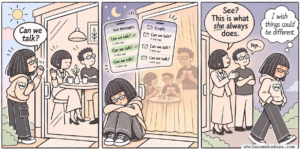
The love I knew was conditional, unpredictable, and readily withheld. I had no template for love that was safe, steady, and kind. I continued to reenact that relational trauma in nearly every relationship. While I am the common variable, so are my template for connection and the personality type it consistently draws me to. For much of my life, I engaged in relationships that diminished me. I tried, with limited understanding and skill, to redeem them. Which seemed impossible, particularly once I stopped agreeing to matter less. I’d try emphatically to understand what was happening between us so we could really connect, navigate our differences, and engage on mutual terms and in good faith. Instead, I was met with defensiveness, denial, and accusations of manufacturing chaos. Eventually, stonewalling. I was seeking connection with people whose behavior, I now see, as prioritizing deference. I didn’t recognize that we weren’t seeking the same thing, or that my attempts to communicate and establish mutuality might be received as defiance. Apparently, I was challenging the terms of a power dynamic I hadn’t even recognized. And when I finally stopped trying, that was unacceptable, too. With profound grief, I have had to acknowledge that the bond is too harmful to continue. The choice to stop chasing connection and approval has been ill-received. And cited only as further evidence of my troublesome, ungrateful, poor character and as the sole cause of our issues. “See? This is what you always do.” “Well, I guess that’s how much it meant to you.” “I thought you said you wanted to work things out.” “And you wonder why things are the way they are.” But isn’t it kind of like a doctor calling the time of death or delivering a diagnosis? The doctor doesn’t speak the death or disease into existence. He simply records it and moves forward accordingly. I’m not claiming to be a doctor. Obviously. I’m just saying, I’m finally able to trust my own experience and recognize the larger pattern without allowing someone else’s explanations, justifications, or occasional good moments to override it. And I can make my decisions based on that pattern rather than its exceptions.

Read More

Toxic and Nurturing Relationship Data

For most of my life, I didn’t even recognize healthy and unhealthy connection as distinct possibilities. Like a fish unaware of the water it’s swimming in, I understood relationships through the only environment I’d ever known. I had learned distorted definitions of love, safety, trust, and connection. What if the most important measure of love isn’t how much someone loves a person, but what happens in the experience of being loved by them? Family ties, intensity, chemistry, and intermittently good experiences aren’t evidence of a healthy relationship. I’m recognizing how toxicity can exist in the way a relationship functions—the architecture of the bond—not simply in either person. Someone may have an entirely different experience with a person than I did, particularly when admiration, usefulness, or reliance shapes how that person relates to them. When someone says, “I’ve never experienced them that way,” I recognize that may be true. What’s hurtful and inappropriate, is when their experience is intended to invalidate mine. Their experience doesn’t disprove mine, any more than mine disproves theirs. I’m describing the relationship I experienced, not issuing a verdict on every relationship that person has. I’m going to place my trust in the prevailing patterns over the peak moments and occasional exceptions. ♡ Feelings I Associate with Nourishing Love ♡ ☠ Feelings I Associate with Harmful Relationship Dynamics ☠ Healing ♡ Alienation-Division Soothing ♡ Diminished-Disregarded Safety ♡ Confused Growth ♡ Silenced Exploration ♡ Frightened Self-expression ♡ Power-imbalance Expansion ♡ Contracted Yes, I am the common denominator in all my relationships—as are we all. So is the relational template I carried into them. It influenced not only the relationships I entered, but what I helped create and sustain within them. That template shaped: I recognize my contribution to my relational patterns without taking ANY esponsibility for another person’s behavior.

Read More
A woman in Japan reacting with surprise and joy as a Japanese woman bows respectfully to her.

What I Thought Was Normal

I can’t help but laugh in disbelief as I recall my initial encounter of Japan. I seriously took the bowing personally. Not joking. I was 22, and not an all an adult. My understanding of respect, deference, and what people were entitled to take from one another was impossibly distorted. What I experienced as exceptional “kindness” was, in many ways, ordinary cultural respect. How could I have known? I do not recall behavioral models for respect and kindness. I was witness to only varied posturing, which was baffling and not at all intuitive for me. And no system with which to engage and demonstrate high regard for others. Just like weird reverence and what I would now call coercive abuse. A New Way to Relate For much of my life, the only familiar relational dynamic was binary: power over or be powered over. I saw rare others (like unicorns) living with more ease, mutuality, and peace, but that seemed remote. I knew only the system I had been brought up with. And if I had to choose from the menu of options I understood, I definitely believed it preferable to be on the giving end of the abuse because I equated that with authority and rightness. In recognizing and unlearning harmful patterns, I am also staring head-on at the ways I engaged and contributed. I had internalized the belief that how others treated me was information about who I was and what I deserved, and so learned to try and excuse my own harmful behavior by charging it to someone else…like my reaction to them was reflective of ONLY them. I could make no sense of why relationships hurt so much and why connection seemed synonymous with struggle. Looking back, of course it was miserable. If the only options were intimidation or submission, there was no room for flow, cohesion, or safety. And I am actually an avid fan of submission and surrender, but only with those who can be trusted on the other side of that dynamic—more harmony and collaboration than coercion. I have been utterly shocked to learn that some things can be familiar, common, and still symptomatic of unwellness. What feels pivotal is seeing both directions clearly: the harm done to me, and the harm I learned to repeat and then to end. I am deeply pained and regret the harm I learned to absorb, carry, and then offload onto other people. I understand more now, and I live differently, but understanding does not undo impact. Still—so much fkn unlearning. Reparenting yourself at 60 is a lot. What did you once think was normal and acceptable that you now view differently?

Read More
doesn’t.

What Wholesome Love Looks Like

I’ve been reading about relationships—attachment, avoidance, conflict, repair, deflection, ego, intimacy. And I am noting things that feel true to me. Not rules. Not credentials I suddenly possess. Just observations about the habits and behaviors that seem to accompany loving relationships—and that sometimes stand in stark contrast to what I have known. Things like: Habits and Behaviors of Wholesome Love Loving people don’t want to hurt you. And when they do, they are interested in what happened, how it affected you, and what is needed of them. Loving people can appreciate your joy when they aren’t the source of it. They can be interested in what matters to you even when the thing itself doesn’t particularly interest them. They don’t experience your success as threatening, inconsequential, or unworthy of acknowledgment. They can sit beside frustration, disappointment, or despair they cannot fix without needing those feelings to go away so they can be comfortable again. They can hear, “That hurt me,” without automatically translating it into, “You are a terrible person.” They can be deeply interested in their impact even when they are certain of their intent. They can hold two things at once: I didn’t mean to hurt you and you were hurt by what I did. They don’t ask you to name a time, then punish you for bringing up the past when you do. They don’t move the conversation from what happened to what is wrong with you for being affected by what happened. They don’t use your reaction to deflect from the thing you were reacting to. They can be wrong without needing someone else to be wronger. They don’t require agreement before your experience is worthy of consideration. They don’t punish honesty and then seem confused when you stop talking. They don’t repeatedly teach you that bringing them one problem will leave you with two. They don’t call the absence of conflict peace when one person has simply learned that speaking costs too much. They don’t require you to abandon your own perception in order to remain close to them. They don’t need their understanding of themselves to outrank your experience of them. They participate in repair. They remain curious about you. And maybe that is the thing I am noticing most. It is easy to feel loving when nothing about the other person is difficult for you. I am becoming much more interested in what happens when it is. These are some of the things I am beginning to recognize as wholesome love. What Wholesome Love Doesn’t Do And there are some things I believe, as a standard, loving people don’t do. They don’t lie to you or deliberately deceive you. They don’t hide things you have a right to know or withhold information that affects you. They don’t entertain other people in ways that betray you or your relationship. They don’t ridicule, mock, or call you names. They don’t join other people in disrespecting you or stand comfortably by while it happens. They don’t intimidate you. They don’t deliberately make you feel small, afraid, alone, or outside. They don’t take pleasure in your pain. They don’t manipulate situations to protect themselves at your expense. They don’t rewrite what they said or did once it has upset you. They don’t make you pay for knowing or saying something they would rather you didn’t know or say. They don’t use what you love, fear, need, or have trusted them with against you. They don’t make cruelty acceptable because they were angry. They don’t make betrayal acceptable because they were unhappy. They dont punish you. And call it a natural consequence. They don’t require your confusion for their story to work. And they don’t repeatedly leave you wondering whether you matter to them at all. I guess, if I were to be succinct: loving people lift others up. Not just people they wish to impress or need something from. Just people. They don’t break others down. What would you add about what wholesome love does—and doesn’t do?

Read More
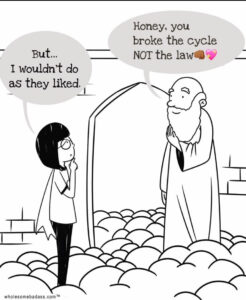
Alt text: Wholesome Badass girl speaking with Saint Peter. She says, “But I would not do as they liked,” and he replies, “You broke the cycle, not the law.”

Your Behavior Defines You – Not Me

Somewhere along the way, a practice took hold: metabolizing what other people believed, said, or did as information about me rather than data about them. Today, that data gets classified more appropriately. It may hurt deeply and alter what a relationship means. But it will no longer serve to indict me. In its crudest form: their hurtful behavior was somehow treated as a reasonable response to the fact of my existence. That premise no longer holds. Recognizing this has brought with it the gifts of self-esteem and dignity. There is something clarifying in reflecting on how consistently I attempted to engage difficult moments in good faith, even when the same was not afforded to me. Repeatedly presenting opportunities for course correction and repair—for people to respond responsibly, nobly, and peacefully—was also part of that good-faith engagement. Whether they did or did not is information about them. Were you ever asked to interpret someone else’s damaging behavior as information about you?  Like the people who do not hesitate to drag you through the mud and then ask you why you are so muddy, or better yet, ask others why you are like that? fkrz

Read More
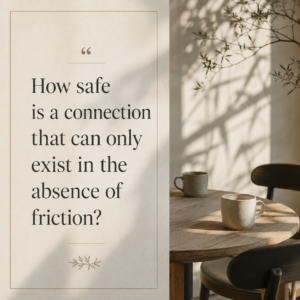
Quote graphic reading, “How safe is a connection that can only exist in the absence of friction?” beside two coffee cups at a table.

Why Can’t We Ever Resolve Anything?

I’ve been thinking about my ability to participate safely in relationships which are non-essential and technically intended as sources of safe, healthy connection. Some discord is guaranteed. But sustained and avoided discord is too much for my nervous system. I am thinking most recently of a neighbor. From our first exchange, there was something in her energy and the way she communicated that seemed to always be broadcasting some version of a world in which she was right, she knew what was right, and she was beyond comfortable imposing her knowing across the board. But we were neighbors, and we began connecting around plants and pets, and I found some enjoyment in that. I laughed in promptly reporting to my therapist that I could enjoy the connection for what it was, and I was confident it would not survive even a little bit of friction or disagreement. And it didn’t. Not because I manifested or forecasted it, but because patterns. And yet I was friendly, present and engaged with her as I would with someone I was interested in getting to know. She made more than one comment about the medical protocol for my dog which felt judgmental and hurtful. When I initiated her in good faith to say that hurt my feelings and to please not say it again, she pulled out the ledger—immediately cataloguing things I had done or not done before, what I was conflating, why my response wasn’t reasonable and why I was out of line. I did not respond. This is another part of the archetype dynamic/pattern I am noticing. The relationship can apparently remain in strained silence indefinitely rather than move toward acknowledgment, closure or repair. And when I don’t beg, argue, persuade or eventually concede in order to get us out of that silence, I can then be identified as the person who ghosted or opted out. I am increasingly unsure what my other (healthy) option is. If I tell a personal relationship person that their words or actions impacted me negatively, in order for me to stay, it seems that I need for them to legitimately care. Not agree or comply or even necessarily relate, just care. I suppose a relationship can seem safe so long as the agreement is that everybody shuts the fuck up, absorbs whatever doesn’t feel good and doesn’t create “burden” or “drama” by bringing up difficult feelings. I don’t think I can be okay inside of that. I’m intentionally examining what is available when there is friction or rupture. Is there any shared capacity to see it, acknowledge it and engage honestly and kindly with an inntent to repair and restore connection? Some of my go-to readings on challenging feelings, people and dynamics have been: On Repentance and Repair by Danya Ruttenberg, The Book of Forgiving by Desmond Tutu, Why Won’t You Apologize?by Harriet Lerner, Rising Strong by Brené Brown and The Relationship Cure by John Gottman. Have you been in a relationship where you preferred clean, direct communication, short accounts and a mutual interest in addressing whatever comes up, with someone who seems more invested in there being nothing wrong, nothing to discuss—and when you suggest otherwise, THE problem is identified as you, your perception and/or personhood?

Read More
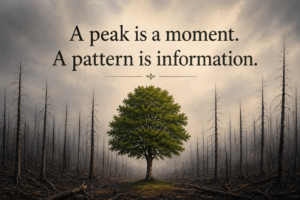
One healthy green tree standing in the middle of a forest of dead trees beneath the quote, “A peak is a moment. A pattern is information.”

The Truth Is in the Pattern

Sheesh. How many more times will I have to navigate this particular circuit before I have learned everything I can from it? The turth is in the pattern, not the explanation. It almost feels as though I have been given a false map. There are things people say that, if I allow them to guide me, will take me completely off course because they don’t align with reality, their actions, or my lived experience. I am starting to recognize that the real story lives inside the patterns. Words do matter. Conversations matter. Moments matter. But patterns persist regardless of what is said. Sometimes there is an incongruency or lack of alignment between words, the suggested intent of those words, and actions. Sometimes things are not communicated directly at all, and yet they are communicated clearly through repeated behaviors. I am intentionally allowing patterns to inform me more than peak moments, conversations, or exchanges. If there is a pleasurable moment in a relationship, I can no longer hold onto that moment as though it represents restoration or the relationship as a whole. I will not waste energy trying to figure out how to get back to that place, as though I have somehow lost the thread. Perhaps it was the exception. Possibly, it was simply a moment. The information is in the pattern. That doesn’t necessarily tell me what is true in some absolute sense, but it does tell me what is real. And when I allow patterns to inform what I say or do next, I am able to remain aligned with my quest for sovereignty and radical neutrality. A thing has happened. I don’t get to change it, reinterpret it, or spin it into something else. I don’t have to lose myself reacting or trying to understand it from every possible angle. I don’t have to overexplain my experience or convince anyone else of it. I can simply acknowledge what is and decide what my actual options are, keeping in alignment with my North Star. Whatever else may be true, this also happened.

Read More
Lovestruck girl in March 2024 receiving a bottle labeled Love, Finally, contrasted with April 2025 holding the same bottle labeled Manufactured Closeness after love bombing and emotional withdrawal.

I Thought I Was the Lucky One: Love Bombing, Illusion, and the Spell I Mistook for Love

A year ago I ended a relationship that I had initially believed was the love of my life. I still kind of feel that way, even though being love bombed is technically not love. It is still my only experience of consistently feeling deeply known, completely seen, and ALSO safe and chosen. At long last, a glimpse of a life I wanted to live. I enjoyed more easy laughter, beautiful meals made FOR me — with full-on consideration for my likes and dislikes — more adventure and love and intimacy and actual joy in my year with that man than with anyone across all of my years. The Beginning of the Spell And this was a man I almost didn’t meet. We connected on a dating app and right out of the gate I told him I didn’t think we were a fit. Too short. An overall look I did not care for. Different politics. Born again Baptist preacher. Deeep South Georgia accent. No. No. No. He laughed a deep beautiful laugh at my very direct and repeated NO. Saying, what’s it going to hurt to just meet? If you don’t like me, no big deal. And he showed up in attire I didn’t love and a weird necklace and a gun in the back of his pants — and somehow I DID NOT CARE. Like fuck it. Be a short, necklace-wearing, gun-packing, Southern Baptist Trumper. Who even cares?! I feel like a million dollars in your presence. Free, beautiful, spoiled, protected, chosen. Because he spoke words and carried energy that dissolved me into something completely intoxicating. It was a spell. What It Felt Like to Be Chosen I remember telling him once, you are like a mega-dose of penicillin for me. Like some magical dose of medicine healing wounds that had been hurting for a lifetime. And he laughed and said, I don’t want to be penicillin. I want to be cocaine. Hysterical. Right? Wrong. Fully addicted to and reliant on him for THAT feeling that I literally could not imagine or want life without it. I see now — he wasn’t joking. To marvel was all I could do- at his gift for reading people. His natural attunement. Ease. Agility. Grace. With me, he tracked things no one had ever tracked. He noticed my sensitivities without me explaining them. He sheltered me from things that would overwhelm me or drain me, without needing credit or announcing it. He paid attention to my nervous system in a way nobody ever had. And since being sensitive and reactive is the thing I have paid most dearly for, to exist in a space where not only was that not the standard, I never worried about it. About being A Lot. And that felt like heaven. I never had to ask for consideration OR anything. I certainly did not have to ask twice. And it wasn’t just me. People lit up around him. Doors opened. Light followed him. But looking back now, it wasn’t light exactly. Maybe more like some kind of radioactive glow. Beautiful. Radiant. Compelling. Something people moved toward. Though leaving subtle but fatal erosion in its wake. The Pattern I Didn’t See Yet I knew of two other women who had been affected by his spell casting because he told me about them… in a very strategic way. Well selected clips of messages. Fragments. Probably how reality TV editing creates scenarios that never actually happened. He shared things in a way that made me feel fiercely protective. Assuming: They had mistaken his kindness for more and were problematic. Disruptive. He provided just enough incomplete truths and lack of context for me to draw the conclusion that the problem lay in that these women were deranged and unreasonable. Speaking unfavorably of anyone or anything is a thing he simply did not do. He appeared to be above that. Only an angel…… To say that I was moved by how he spoke of them with compassion while sharing things that made them seem terrifying, would be an understatement. Just enough for me to build “my own” conclusions. I remember thinking, what a good man. Steady. Calm. Curious. Benevolent beyond measure. Not of this world. Because the stretches of time we spent together, how present he was, I couldn’t have imagined he had time or energy to create so much trouble elsewhere. I couldn’t make the math work. One of the women had worked with him years before-whom he had removed. The other had received pastoral care for and support from him for addiction and related issues. There was enough context around them that if they ever spoke out against him(and that they did-relentlessly), he had pre-empted that with calculated actions which rendered them not credible, unreliable narrators, problematic. How he engaged difficult situations was breathtaking with so much ease and grace. No indication of feeling threatened or defensive. I experienced him as INcredible while recognizing them as clearly non-credible. From communication from them which he elected to share with me, I knew their full names and more. I was his lucky confidante. One day when he was behaving questionably on the heels of being taken to court, I optimized the power of Google, which with only a name and a city provided a cell phone number for the one, and boldly reached out. We spoke. The First Break in Reality I led with that I thought maybe we had similar wounds and experiences with (I provided only his initials). That we had each been made to doubt ourselves and our reality. She knew nothing of me while I had been strategically fed information about her unwellness, despair, addiction, suicide attempt, and repeated stints in treatment. Sensitive to her despair, I assured her she was younger and prettier than me, that I meant no harm, and that I would be stepping away for good. I genuinely believed I was being generous and helpful. Like, you are not alone. I’m not sure it had that effect. She shared texts and emails between them. And reported that the night before she had given him a large sum of money. Um ok. After hearing that, I didn’t tell him what I knew or pursue him for explanations. I didn’t allow for the opportunity for him to speak his beautifully crafted words. The End I Couldn’t Process Yet I blocked him and thought I might die from my utterly shattered heart…and withdrawal from the drug of my choice. HIM! Last night, restless and unable to sleep, I googled both women again. The first results were mugshots. And then one— the one I had engaged with—her obituary from December. Forty-five years old. Young children. Gone. And one of my first thoughts—unbelievably—was whether I had somehow contributed by reaching out to her. Typical: I am responsible for anything painful, difficult, or unfortunate. He probably hasn’t lost sleep over it. I would regularly say to him, shit, what if I am really no different from these women? I must in some way be similar. He assured me: You’re not like them. I pursued you. I never wanted this with them. They pursued me. The Meaning I’m Still Wrestling With I really did think I was the lucky one. And I suppose I was. Just not for the reasons I thought. Like I have not been dead or arrested. Yay me.
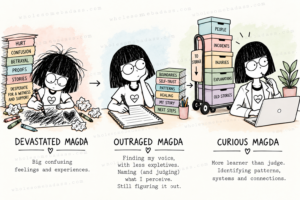
Read More

In Charge of Rejection

The love I knew was conditional, unpredictable, and readily withheld. I had no template for love that was safe, steady, and kind. I continued to reenact that relational trauma in nearly every relationship. While I am the common variable, so are my template for connection and the personality type it consistently draws me to. For much of my life, I engaged in relationships that diminished me. I tried, with limited understanding and skill, to redeem them. Which seemed impossible, particularly once I stopped agreeing to matter less. I’d try emphatically to understand what was happening between us so we could really connect, navigate our differences, and engage on mutual terms and in good faith. Instead, I was met with defensiveness, denial, and accusations of manufacturing chaos. Eventually, stonewalling. I was seeking connection with people whose behavior, I now see, as prioritizing deference. I didn’t recognize that we weren’t seeking the same thing, or that my attempts to communicate and establish mutuality might be received as defiance. Apparently, I was challenging the terms of a power dynamic I hadn’t even recognized. And when I finally stopped trying, that was unacceptable, too. With profound grief, I have had to acknowledge that the bond is too harmful to continue. The choice to stop chasing connection and approval has been ill-received. And cited only as further evidence of my troublesome, ungrateful, poor character and as the sole cause of our issues. “See? This is what you always do.” “Well, I guess that’s how much it meant to you.” “I thought you said you wanted to work things out.” “And you wonder why things are the way they are.” But isn’t it kind of like a doctor calling the time of death or delivering a diagnosis? The doctor doesn’t speak the death or disease into existence. He simply records it and moves forward accordingly. I’m not claiming to be a doctor. Obviously. I’m just saying, I’m finally able to trust my own experience and recognize the larger pattern without allowing someone else’s explanations, justifications, or occasional good moments to override it. And I can make my decisions based on that pattern rather than its exceptions.

Read More

Toxic and Nurturing Relationship Data

For most of my life, I didn’t even recognize healthy and unhealthy connection as distinct possibilities. Like a fish unaware of the water it’s swimming in, I understood relationships through the only environment I’d ever known. I had learned distorted definitions of love, safety, trust, and connection. What if the most important measure of love isn’t how much someone loves a person, but what happens in the experience of being loved by them? Family ties, intensity, chemistry, and intermittently good experiences aren’t evidence of a healthy relationship. I’m recognizing how toxicity can exist in the way a relationship functions—the architecture of the bond—not simply in either person. Someone may have an entirely different experience with a person than I did, particularly when admiration, usefulness, or reliance shapes how that person relates to them. When someone says, “I’ve never experienced them that way,” I recognize that may be true. What’s hurtful and inappropriate, is when their experience is intended to invalidate mine. Their experience doesn’t disprove mine, any more than mine disproves theirs. I’m describing the relationship I experienced, not issuing a verdict on every relationship that person has. I’m going to place my trust in the prevailing patterns over the peak moments and occasional exceptions. ♡ Feelings I Associate with Nourishing Love ♡ ☠ Feelings I Associate with Harmful Relationship Dynamics ☠ Healing ♡ Alienation-Division Soothing ♡ Diminished-Disregarded Safety ♡ Confused Growth ♡ Silenced Exploration ♡ Frightened Self-expression ♡ Power-imbalance Expansion ♡ Contracted Yes, I am the common denominator in all my relationships—as are we all. So is the relational template I carried into them. It influenced not only the relationships I entered, but what I helped create and sustain within them. That template shaped: I recognize my contribution to my relational patterns without taking ANY esponsibility for another person’s behavior.

Read More
A woman in Japan reacting with surprise and joy as a Japanese woman bows respectfully to her.

What I Thought Was Normal

I can’t help but laugh in disbelief as I recall my initial encounter of Japan. I seriously took the bowing personally. Not joking. I was 22, and not an all an adult. My understanding of respect, deference, and what people were entitled to take from one another was impossibly distorted. What I experienced as exceptional “kindness” was, in many ways, ordinary cultural respect. How could I have known? I do not recall behavioral models for respect and kindness. I was witness to only varied posturing, which was baffling and not at all intuitive for me. And no system with which to engage and demonstrate high regard for others. Just like weird reverence and what I would now call coercive abuse. A New Way to Relate For much of my life, the only familiar relational dynamic was binary: power over or be powered over. I saw rare others (like unicorns) living with more ease, mutuality, and peace, but that seemed remote. I knew only the system I had been brought up with. And if I had to choose from the menu of options I understood, I definitely believed it preferable to be on the giving end of the abuse because I equated that with authority and rightness. In recognizing and unlearning harmful patterns, I am also staring head-on at the ways I engaged and contributed. I had internalized the belief that how others treated me was information about who I was and what I deserved, and so learned to try and excuse my own harmful behavior by charging it to someone else…like my reaction to them was reflective of ONLY them. I could make no sense of why relationships hurt so much and why connection seemed synonymous with struggle. Looking back, of course it was miserable. If the only options were intimidation or submission, there was no room for flow, cohesion, or safety. And I am actually an avid fan of submission and surrender, but only with those who can be trusted on the other side of that dynamic—more harmony and collaboration than coercion. I have been utterly shocked to learn that some things can be familiar, common, and still symptomatic of unwellness. What feels pivotal is seeing both directions clearly: the harm done to me, and the harm I learned to repeat and then to end. I am deeply pained and regret the harm I learned to absorb, carry, and then offload onto other people. I understand more now, and I live differently, but understanding does not undo impact. Still—so much fkn unlearning. Reparenting yourself at 60 is a lot. What did you once think was normal and acceptable that you now view differently?

Read More
doesn’t.

What Wholesome Love Looks Like

I’ve been reading about relationships—attachment, avoidance, conflict, repair, deflection, ego, intimacy. And I am noting things that feel true to me. Not rules. Not credentials I suddenly possess. Just observations about the habits and behaviors that seem to accompany loving relationships—and that sometimes stand in stark contrast to what I have known. Things like: Habits and Behaviors of Wholesome Love Loving people don’t want to hurt you. And when they do, they are interested in what happened, how it affected you, and what is needed of them. Loving people can appreciate your joy when they aren’t the source of it. They can be interested in what matters to you even when the thing itself doesn’t particularly interest them. They don’t experience your success as threatening, inconsequential, or unworthy of acknowledgment. They can sit beside frustration, disappointment, or despair they cannot fix without needing those feelings to go away so they can be comfortable again. They can hear, “That hurt me,” without automatically translating it into, “You are a terrible person.” They can be deeply interested in their impact even when they are certain of their intent. They can hold two things at once: I didn’t mean to hurt you and you were hurt by what I did. They don’t ask you to name a time, then punish you for bringing up the past when you do. They don’t move the conversation from what happened to what is wrong with you for being affected by what happened. They don’t use your reaction to deflect from the thing you were reacting to. They can be wrong without needing someone else to be wronger. They don’t require agreement before your experience is worthy of consideration. They don’t punish honesty and then seem confused when you stop talking. They don’t repeatedly teach you that bringing them one problem will leave you with two. They don’t call the absence of conflict peace when one person has simply learned that speaking costs too much. They don’t require you to abandon your own perception in order to remain close to them. They don’t need their understanding of themselves to outrank your experience of them. They participate in repair. They remain curious about you. And maybe that is the thing I am noticing most. It is easy to feel loving when nothing about the other person is difficult for you. I am becoming much more interested in what happens when it is. These are some of the things I am beginning to recognize as wholesome love. What Wholesome Love Doesn’t Do And there are some things I believe, as a standard, loving people don’t do. They don’t lie to you or deliberately deceive you. They don’t hide things you have a right to know or withhold information that affects you. They don’t entertain other people in ways that betray you or your relationship. They don’t ridicule, mock, or call you names. They don’t join other people in disrespecting you or stand comfortably by while it happens. They don’t intimidate you. They don’t deliberately make you feel small, afraid, alone, or outside. They don’t take pleasure in your pain. They don’t manipulate situations to protect themselves at your expense. They don’t rewrite what they said or did once it has upset you. They don’t make you pay for knowing or saying something they would rather you didn’t know or say. They don’t use what you love, fear, need, or have trusted them with against you. They don’t make cruelty acceptable because they were angry. They don’t make betrayal acceptable because they were unhappy. They dont punish you. And call it a natural consequence. They don’t require your confusion for their story to work. And they don’t repeatedly leave you wondering whether you matter to them at all. I guess, if I were to be succinct: loving people lift others up. Not just people they wish to impress or need something from. Just people. They don’t break others down. What would you add about what wholesome love does—and doesn’t do?

Read More
Alt text: Wholesome Badass girl speaking with Saint Peter. She says, “But I would not do as they liked,” and he replies, “You broke the cycle, not the law.”

Your Behavior Defines You – Not Me

Somewhere along the way, a practice took hold: metabolizing what other people believed, said, or did as information about me rather than data about them. Today, that data gets classified more appropriately. It may hurt deeply and alter what a relationship means. But it will no longer serve to indict me. In its crudest form: their hurtful behavior was somehow treated as a reasonable response to the fact of my existence. That premise no longer holds. Recognizing this has brought with it the gifts of self-esteem and dignity. There is something clarifying in reflecting on how consistently I attempted to engage difficult moments in good faith, even when the same was not afforded to me. Repeatedly presenting opportunities for course correction and repair—for people to respond responsibly, nobly, and peacefully—was also part of that good-faith engagement. Whether they did or did not is information about them. Were you ever asked to interpret someone else’s damaging behavior as information about you?  Like the people who do not hesitate to drag you through the mud and then ask you why you are so muddy, or better yet, ask others why you are like that? fkrz

Read More
Quote graphic reading, “How safe is a connection that can only exist in the absence of friction?” beside two coffee cups at a table.

Why Can’t We Ever Resolve Anything?

I’ve been thinking about my ability to participate safely in relationships which are non-essential and technically intended as sources of safe, healthy connection. Some discord is guaranteed. But sustained and avoided discord is too much for my nervous system. I am thinking most recently of a neighbor. From our first exchange, there was something in her energy and the way she communicated that seemed to always be broadcasting some version of a world in which she was right, she knew what was right, and she was beyond comfortable imposing her knowing across the board. But we were neighbors, and we began connecting around plants and pets, and I found some enjoyment in that. I laughed in promptly reporting to my therapist that I could enjoy the connection for what it was, and I was confident it would not survive even a little bit of friction or disagreement. And it didn’t. Not because I manifested or forecasted it, but because patterns. And yet I was friendly, present and engaged with her as I would with someone I was interested in getting to know. She made more than one comment about the medical protocol for my dog which felt judgmental and hurtful. When I initiated her in good faith to say that hurt my feelings and to please not say it again, she pulled out the ledger—immediately cataloguing things I had done or not done before, what I was conflating, why my response wasn’t reasonable and why I was out of line. I did not respond. This is another part of the archetype dynamic/pattern I am noticing. The relationship can apparently remain in strained silence indefinitely rather than move toward acknowledgment, closure or repair. And when I don’t beg, argue, persuade or eventually concede in order to get us out of that silence, I can then be identified as the person who ghosted or opted out. I am increasingly unsure what my other (healthy) option is. If I tell a personal relationship person that their words or actions impacted me negatively, in order for me to stay, it seems that I need for them to legitimately care. Not agree or comply or even necessarily relate, just care. I suppose a relationship can seem safe so long as the agreement is that everybody shuts the fuck up, absorbs whatever doesn’t feel good and doesn’t create “burden” or “drama” by bringing up difficult feelings. I don’t think I can be okay inside of that. I’m intentionally examining what is available when there is friction or rupture. Is there any shared capacity to see it, acknowledge it and engage honestly and kindly with an inntent to repair and restore connection? Some of my go-to readings on challenging feelings, people and dynamics have been: On Repentance and Repair by Danya Ruttenberg, The Book of Forgiving by Desmond Tutu, Why Won’t You Apologize?by Harriet Lerner, Rising Strong by Brené Brown and The Relationship Cure by John Gottman. Have you been in a relationship where you preferred clean, direct communication, short accounts and a mutual interest in addressing whatever comes up, with someone who seems more invested in there being nothing wrong, nothing to discuss—and when you suggest otherwise, THE problem is identified as you, your perception and/or personhood?

Read More
One healthy green tree standing in the middle of a forest of dead trees beneath the quote, “A peak is a moment. A pattern is information.”

The Truth Is in the Pattern

Sheesh. How many more times will I have to navigate this particular circuit before I have learned everything I can from it? The turth is in the pattern, not the explanation. It almost feels as though I have been given a false map. There are things people say that, if I allow them to guide me, will take me completely off course because they don’t align with reality, their actions, or my lived experience. I am starting to recognize that the real story lives inside the patterns. Words do matter. Conversations matter. Moments matter. But patterns persist regardless of what is said. Sometimes there is an incongruency or lack of alignment between words, the suggested intent of those words, and actions. Sometimes things are not communicated directly at all, and yet they are communicated clearly through repeated behaviors. I am intentionally allowing patterns to inform me more than peak moments, conversations, or exchanges. If there is a pleasurable moment in a relationship, I can no longer hold onto that moment as though it represents restoration or the relationship as a whole. I will not waste energy trying to figure out how to get back to that place, as though I have somehow lost the thread. Perhaps it was the exception. Possibly, it was simply a moment. The information is in the pattern. That doesn’t necessarily tell me what is true in some absolute sense, but it does tell me what is real. And when I allow patterns to inform what I say or do next, I am able to remain aligned with my quest for sovereignty and radical neutrality. A thing has happened. I don’t get to change it, reinterpret it, or spin it into something else. I don’t have to lose myself reacting or trying to understand it from every possible angle. I don’t have to overexplain my experience or convince anyone else of it. I can simply acknowledge what is and decide what my actual options are, keeping in alignment with my North Star. Whatever else may be true, this also happened.

Read More
Lovestruck girl in March 2024 receiving a bottle labeled Love, Finally, contrasted with April 2025 holding the same bottle labeled Manufactured Closeness after love bombing and emotional withdrawal.

I Thought I Was the Lucky One: Love Bombing, Illusion, and the Spell I Mistook for Love

A year ago I ended a relationship that I had initially believed was the love of my life. I still kind of feel that way, even though being love bombed is technically not love. It is still my only experience of consistently feeling deeply known, completely seen, and ALSO safe and chosen. At long last, a glimpse of a life I wanted to live. I enjoyed more easy laughter, beautiful meals made FOR me — with full-on consideration for my likes and dislikes — more adventure and love and intimacy and actual joy in my year with that man than with anyone across all of my years. The Beginning of the Spell And this was a man I almost didn’t meet. We connected on a dating app and right out of the gate I told him I didn’t think we were a fit. Too short. An overall look I did not care for. Different politics. Born again Baptist preacher. Deeep South Georgia accent. No. No. No. He laughed a deep beautiful laugh at my very direct and repeated NO. Saying, what’s it going to hurt to just meet? If you don’t like me, no big deal. And he showed up in attire I didn’t love and a weird necklace and a gun in the back of his pants — and somehow I DID NOT CARE. Like fuck it. Be a short, necklace-wearing, gun-packing, Southern Baptist Trumper. Who even cares?! I feel like a million dollars in your presence. Free, beautiful, spoiled, protected, chosen. Because he spoke words and carried energy that dissolved me into something completely intoxicating. It was a spell. What It Felt Like to Be Chosen I remember telling him once, you are like a mega-dose of penicillin for me. Like some magical dose of medicine healing wounds that had been hurting for a lifetime. And he laughed and said, I don’t want to be penicillin. I want to be cocaine. Hysterical. Right? Wrong. Fully addicted to and reliant on him for THAT feeling that I literally could not imagine or want life without it. I see now — he wasn’t joking. To marvel was all I could do- at his gift for reading people. His natural attunement. Ease. Agility. Grace. With me, he tracked things no one had ever tracked. He noticed my sensitivities without me explaining them. He sheltered me from things that would overwhelm me or drain me, without needing credit or announcing it. He paid attention to my nervous system in a way nobody ever had. And since being sensitive and reactive is the thing I have paid most dearly for, to exist in a space where not only was that not the standard, I never worried about it. About being A Lot. And that felt like heaven. I never had to ask for consideration OR anything. I certainly did not have to ask twice. And it wasn’t just me. People lit up around him. Doors opened. Light followed him. But looking back now, it wasn’t light exactly. Maybe more like some kind of radioactive glow. Beautiful. Radiant. Compelling. Something people moved toward. Though leaving subtle but fatal erosion in its wake. The Pattern I Didn’t See Yet I knew of two other women who had been affected by his spell casting because he told me about them… in a very strategic way. Well selected clips of messages. Fragments. Probably how reality TV editing creates scenarios that never actually happened. He shared things in a way that made me feel fiercely protective. Assuming: They had mistaken his kindness for more and were problematic. Disruptive. He provided just enough incomplete truths and lack of context for me to draw the conclusion that the problem lay in that these women were deranged and unreasonable. Speaking unfavorably of anyone or anything is a thing he simply did not do. He appeared to be above that. Only an angel…… To say that I was moved by how he spoke of them with compassion while sharing things that made them seem terrifying, would be an understatement. Just enough for me to build “my own” conclusions. I remember thinking, what a good man. Steady. Calm. Curious. Benevolent beyond measure. Not of this world. Because the stretches of time we spent together, how present he was, I couldn’t have imagined he had time or energy to create so much trouble elsewhere. I couldn’t make the math work. One of the women had worked with him years before-whom he had removed. The other had received pastoral care for and support from him for addiction and related issues. There was enough context around them that if they ever spoke out against him(and that they did-relentlessly), he had pre-empted that with calculated actions which rendered them not credible, unreliable narrators, problematic. How he engaged difficult situations was breathtaking with so much ease and grace. No indication of feeling threatened or defensive. I experienced him as INcredible while recognizing them as clearly non-credible. From communication from them which he elected to share with me, I knew their full names and more. I was his lucky confidante. One day when he was behaving questionably on the heels of being taken to court, I optimized the power of Google, which with only a name and a city provided a cell phone number for the one, and boldly reached out. We spoke. The First Break in Reality I led with that I thought maybe we had similar wounds and experiences with (I provided only his initials). That we had each been made to doubt ourselves and our reality. She knew nothing of me while I had been strategically fed information about her unwellness, despair, addiction, suicide attempt, and repeated stints in treatment. Sensitive to her despair, I assured her she was younger and prettier than me, that I meant no harm, and that I would be stepping away for good. I genuinely believed I was being generous and helpful. Like, you are not alone. I’m not sure it had that effect. She shared texts and emails between them. And reported that the night before she had given him a large sum of money. Um ok. After hearing that, I didn’t tell him what I knew or pursue him for explanations. I didn’t allow for the opportunity for him to speak his beautifully crafted words. The End I Couldn’t Process Yet I blocked him and thought I might die from my utterly shattered heart…and withdrawal from the drug of my choice. HIM! Last night, restless and unable to sleep, I googled both women again. The first results were mugshots. And then one— the one I had engaged with—her obituary from December. Forty-five years old. Young children. Gone. And one of my first thoughts—unbelievably—was whether I had somehow contributed by reaching out to her. Typical: I am responsible for anything painful, difficult, or unfortunate. He probably hasn’t lost sleep over it. I would regularly say to him, shit, what if I am really no different from these women? I must in some way be similar. He assured me: You’re not like them. I pursued you. I never wanted this with them. They pursued me. The Meaning I’m Still Wrestling With I really did think I was the lucky one. And I suppose I was. Just not for the reasons I thought. Like I have not been dead or arrested. Yay me.

Read More