Wholesome Badass

A Work in Progress — Healing from All the Things​

In Charge of Rejection

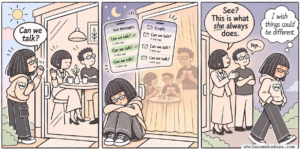
The love I knew was conditional, unpredictable, and readily withheld. I had no template for love that was safe, steady, and kind. I continued to reenact that relational trauma in nearly every relationship. While I am the common variable, so are my template for connection and the personality type it consistently draws me to. For much of my life, I engaged in relationships that diminished me. I tried, with limited understanding and skill, to redeem them. Which seemed impossible, particularly once I stopped agreeing to matter less. I’d try emphatically to understand what was happening between us so we could really connect, navigate our differences, and engage on mutual terms and in good faith. Instead, I was met with defensiveness, denial, and accusations of manufacturing chaos. Eventually, stonewalling. I was seeking connection with people whose behavior, I now see, as prioritizing deference. I didn’t recognize that we weren’t seeking the same thing, or that my attempts to communicate and establish mutuality might be received as defiance. Apparently, I was challenging the terms of a power dynamic I hadn’t even recognized. And when I finally stopped trying, that was unacceptable, too. With profound grief, I have had to acknowledge that the bond is too harmful to continue. The choice to stop chasing connection and approval has been ill-received. And cited only as further evidence of my troublesome, ungrateful, poor character and as the sole cause of our issues. “See? This is what you always do.” “Well, I guess that’s how much it meant to you.” “I thought you said you wanted to work things out.” “And you wonder why things are the way they are.” But isn’t it kind of like a doctor calling the time of death or delivering a diagnosis? The doctor doesn’t speak the death or disease into existence. He simply records it and moves forward accordingly. I’m not claiming to be a doctor. Obviously. I’m just saying, I’m finally able to trust my own experience and recognize the larger pattern without allowing someone else’s explanations, justifications, or occasional good moments to override it. And I can make my decisions based on that pattern rather than its exceptions.
Read More
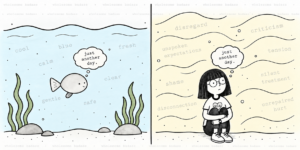
Split-screen illustration of a fish swimming in calm blue water and a girl surrounded by criticism, shame, and silent treatment. Both think, “just another day.”

What If It Was the Water?

I spent much of my life believing something was terribly wrong with me. In fact, I’m fairly certain that was suggested more than a handful of times. My struggle to exist harmoniously didn’t make me question my environment. It seemed only to confirm that I was the problem. It reminds me of the quote: “When a flower doesn’t bloom, you fix the environment in which it grows, not the flower.” My failure to thrive was unmistakable. Overwhelmed by the intensity and confusion of the dynamic, I developed constant, involuntary, maladaptive behaviors. Rather than recognizing them as reactions to what I was experiencing, they were treated as evidence of my defectiveness. And that’s how I learned to see myself. And then, to add insult to injury, I was labeled as negative for my low self-esteem and the anger that came from living in constant turmoil without reprieve or guidance. It really was an inescapable loop.  As a young adult, I began recognizing the consequences of directly expressing my needs or limits. I lacked both the understanding and the agency to respond in any useful way.  I was essentially boxing with ghosts. I was taking hits, swinging blindly, and looking completely unhinged (which I was) to anyone watching. And so I relocated, first across the country and then out of the country, attempting to match the physical distance to the devastating emotional distance. Learning to identify the water hasn’t undone what living in it taught me—or made me an excellent swimmer. But I’m discovering who I am when I’m not constantly overwhelmed and reacting to what’s happening around me. And for the first time, I’m enjoying who I am.  Engaging with life from a place of intention and agency is a far cry from living in reaction to something I couldn’t see or name.

Read More
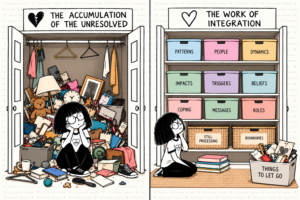
Split illustration of trauma integration. On the left, a distressed girl sits among a heap of clutter beneath “The Accumulation of the Unresolved.” On the right, she sits peacefully before organized bins labeled Patterns, People, Dynamics, Impacts, Triggers, Beliefs, Coping, Messages, Roles, Boundaries, and Still Processing. A separate bin reads “Things to Let Go.” Copy alt text

Who Are We Beyond Survival Mode?

For me, survival mode has felt like living under the weight of an ever-growing, tangled mess. Every unsettling interaction compounded it. I couldn’t untangle it, and I couldn’t leave it alone. After decades of debilitating confusion, I’m finally recognizing patterns and finding ways to organize my experiences. The mess hasn’t disappeared, but it’s loosening its grip on me. I missed so much of my life trying to figure out what had just happened and worrying about what might happen next. I’m beginning to see how life could be more.

Read More
A woman in Japan reacting with surprise and joy as a Japanese woman bows respectfully to her.

What I Thought Was Normal

I can’t help but laugh in disbelief as I recall my initial encounter of Japan. I seriously took the bowing personally. Not joking. I was 22, and not an all an adult. My understanding of respect, deference, and what people were entitled to take from one another was impossibly distorted. What I experienced as exceptional “kindness” was, in many ways, ordinary cultural respect. How could I have known? I do not recall behavioral models for respect and kindness. I was witness to only varied posturing, which was baffling and not at all intuitive for me. And no system with which to engage and demonstrate high regard for others. Just like weird reverence and what I would now call coercive abuse. A New Way to Relate For much of my life, the only familiar relational dynamic was binary: power over or be powered over. I saw rare others (like unicorns) living with more ease, mutuality, and peace, but that seemed remote. I knew only the system I had been brought up with. And if I had to choose from the menu of options I understood, I definitely believed it preferable to be on the giving end of the abuse because I equated that with authority and rightness. In recognizing and unlearning harmful patterns, I am also staring head-on at the ways I engaged and contributed. I had internalized the belief that how others treated me was information about who I was and what I deserved, and so learned to try and excuse my own harmful behavior by charging it to someone else…like my reaction to them was reflective of ONLY them. I could make no sense of why relationships hurt so much and why connection seemed synonymous with struggle. Looking back, of course it was miserable. If the only options were intimidation or submission, there was no room for flow, cohesion, or safety. And I am actually an avid fan of submission and surrender, but only with those who can be trusted on the other side of that dynamic—more harmony and collaboration than coercion. I have been utterly shocked to learn that some things can be familiar, common, and still symptomatic of unwellness. What feels pivotal is seeing both directions clearly: the harm done to me, and the harm I learned to repeat and then to end. I am deeply pained and regret the harm I learned to absorb, carry, and then offload onto other people. I understand more now, and I live differently, but understanding does not undo impact. Still—so much fkn unlearning. Reparenting yourself at 60 is a lot. What did you once think was normal and acceptable that you now view differently?

Read More
Black-and-white cartoon of a worried girl handing over a paper labeled “OUCH” while a giant hand stamps it “DEFECTIVE.” Pink text at the top reads “When hurt gets submitted as evidence,” and a small watermark at the bottom says “wholesomebadass.com.”

When Your Sensitivity Is Framed as the Problem

In my family of origin, and then quite unsurprisingly in the marriage I chose, I re-enacted the familiar pattern. I accepted the charge for all discomfort—mine and everybody’s. If only I would’ve just gotten different, as was directed so very many times, we could’ve all been soooo close and comfortable. Your discomfort was my fault; so was my own. My distress was treated as a burden to the people I depended on to care for and guide me, and as proof that I was unreasonable, selfish, ungrateful, dramatic—defective. I lived in a state of perplexity that expressing any version of no or ouch consistently created friction, the very opposite of what a child might anticipate. My best efforts to communicate what I could and could not tolerate were dismissed as negative, dramatic, hysterical, oversensitive. My behavior, existence, personality, and pain were used as evidence against my character and worthiness each time they caused discomfort for one of the archetypes. My discomfort indicted me. Yours also did. I can see now how neurodivergence, scapegoating, and narcissistic family dynamics all fed the same machinery: difference was treated as defect, one person carried the emotional burden for everyone, and any separate reality that disrupted the preferred one became an offense. The opposite of sensitivity is not strength. It is insensitivity. The fact that I am affected does not make me weak, dangerous, or wrong. The way that I exist may be uncomfortable, but it’s not fucking violent or lacking in good character. What was violent, and what I have come to question as a matter of character, was the coercive control deployed in service to THE narrative, system, version of love, care, and peace. Have you ever noticed how people deeply invested in appearing strong can be the least able to, in good faith, directly engage friction?

Read More
Black-and-white line drawing of two stick figures in a leaking boat. One figure wears a life vest, holds a life preserver, and says, “You need to calm down,” while the other figure looks distressed and bails water out of the boat.

The Advantage of Appearing Unbothered

I am beginning to recognize and more effectively name and navigate familiar systems, patterns, and personalities. In power imbalances, the person with more status or authority can seem even more credible when appearing almost completely unaffected — mildly inconvenienced at most. Beneath a curated exterior — detached, unreadable, even smiling or measured — strategically executed impunity may pass for sovereignty, shielded from challenge by status/rank itself. By contrast, an emotional response to threat or injury can be marked as excessive: evidence of defect, weakness, and wrongness, rendering the account of what happened inadmissible. Once that logic is established, power-over can pass as reasonable and justified. This is where emotional violence can comfortably hide: in the latitude granted by role, status, or perceived legitimacy to diminish, exclude, intimidate, or overpower another person while the resulting distress is treated as further proof that the response was warranted.

Read More
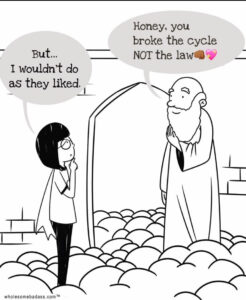
Alt text: Wholesome Badass girl speaking with Saint Peter. She says, “But I would not do as they liked,” and he replies, “You broke the cycle, not the law.”

Your Behavior Defines You – Not Me

Somewhere along the way, a practice took hold: metabolizing what other people believed, said, or did as information about me rather than data about them. Today, that data gets classified more appropriately. It may hurt deeply and alter what a relationship means. But it will no longer serve to indict me. In its crudest form: their hurtful behavior was somehow treated as a reasonable response to the fact of my existence. That premise no longer holds. Recognizing this has brought with it the gifts of self-esteem and dignity. There is something clarifying in reflecting on how consistently I attempted to engage difficult moments in good faith, even when the same was not afforded to me. Repeatedly presenting opportunities for course correction and repair—for people to respond responsibly, nobly, and peacefully—was also part of that good-faith engagement. Whether they did or did not is information about them. Were you ever asked to interpret someone else’s damaging behavior as information about you?  Like the people who do not hesitate to drag you through the mud and then ask you why you are so muddy, or better yet, ask others why you are like that? fkrz

Read More
Rattlesnake wearing a party hat on a pink unicorn bed, symbolizing hidden danger in plain sight.

When Influence Obscures The Facts

How a Narrative Protects Predatory Behavior The Branding Becomes the Lens I am recognizing something in real time: the story about someone can matter more than what they actually say and do. When someone is characterized unfavorably by a person of greater status or influence, the language is often directed toward creating a shared lens through which others understand them. That version can serve as the starting assumption. Hierarchy gives it weight. This is the branding. The packaging. And it matters who establishes it. From there, a trajectory takes shape. The branding creates two outcomes at once: one person is invalidated while the other is insulated and immune to scrutiny. The branding calls the person to defense, then uses that defense as evidence that the characterization was right. Distress is recast as instability, attempts at clarity as difficulty, withdrawal as withholding, and any strong response as confirmation. Evidence to the contrary is inadmissible. It does not weaken the characterization. This is what makes the role difficult to escape. The arrangement is zero-sum: for one person to remain credible and protected, the other has to remain discredited. This is not a self-fulfilling prophecy in the usual sense because the premise does not originate with the branded one. It is imposed from “above,” then used to interpret everything that follows. Reality gets outranked by narrative. A response can be disproportionate, messy, or wrong without making the underlying experience unreal. Someone can be difficult or unpopular and still have been treated poorly. But the formula reigns: When the conduct of the protected archetype is questioned: Well, I only acted this way because of who and how YOU/THEY are. Have you been in a relationship in which another person’s missteps, poor choices, words, or conduct were repeatedly assigned to something supposedly wrong with you? WTAF? As in: If I behave like an asshole, it is only because you suck.

Read More

In Charge of Rejection

The love I knew was conditional, unpredictable, and readily withheld. I had no template for love that was safe, steady, and kind. I continued to reenact that relational trauma in nearly every relationship. While I am the common variable, so are my template for connection and the personality type it consistently draws me to. For much of my life, I engaged in relationships that diminished me. I tried, with limited understanding and skill, to redeem them. Which seemed impossible, particularly once I stopped agreeing to matter less. I’d try emphatically to understand what was happening between us so we could really connect, navigate our differences, and engage on mutual terms and in good faith. Instead, I was met with defensiveness, denial, and accusations of manufacturing chaos. Eventually, stonewalling. I was seeking connection with people whose behavior, I now see, as prioritizing deference. I didn’t recognize that we weren’t seeking the same thing, or that my attempts to communicate and establish mutuality might be received as defiance. Apparently, I was challenging the terms of a power dynamic I hadn’t even recognized. And when I finally stopped trying, that was unacceptable, too. With profound grief, I have had to acknowledge that the bond is too harmful to continue. The choice to stop chasing connection and approval has been ill-received. And cited only as further evidence of my troublesome, ungrateful, poor character and as the sole cause of our issues. “See? This is what you always do.” “Well, I guess that’s how much it meant to you.” “I thought you said you wanted to work things out.” “And you wonder why things are the way they are.” But isn’t it kind of like a doctor calling the time of death or delivering a diagnosis? The doctor doesn’t speak the death or disease into existence. He simply records it and moves forward accordingly. I’m not claiming to be a doctor. Obviously. I’m just saying, I’m finally able to trust my own experience and recognize the larger pattern without allowing someone else’s explanations, justifications, or occasional good moments to override it. And I can make my decisions based on that pattern rather than its exceptions.

Read More
Split-screen illustration of a fish swimming in calm blue water and a girl surrounded by criticism, shame, and silent treatment. Both think, “just another day.”

What If It Was the Water?

I spent much of my life believing something was terribly wrong with me. In fact, I’m fairly certain that was suggested more than a handful of times. My struggle to exist harmoniously didn’t make me question my environment. It seemed only to confirm that I was the problem. It reminds me of the quote: “When a flower doesn’t bloom, you fix the environment in which it grows, not the flower.” My failure to thrive was unmistakable. Overwhelmed by the intensity and confusion of the dynamic, I developed constant, involuntary, maladaptive behaviors. Rather than recognizing them as reactions to what I was experiencing, they were treated as evidence of my defectiveness. And that’s how I learned to see myself. And then, to add insult to injury, I was labeled as negative for my low self-esteem and the anger that came from living in constant turmoil without reprieve or guidance. It really was an inescapable loop.  As a young adult, I began recognizing the consequences of directly expressing my needs or limits. I lacked both the understanding and the agency to respond in any useful way.  I was essentially boxing with ghosts. I was taking hits, swinging blindly, and looking completely unhinged (which I was) to anyone watching. And so I relocated, first across the country and then out of the country, attempting to match the physical distance to the devastating emotional distance. Learning to identify the water hasn’t undone what living in it taught me—or made me an excellent swimmer. But I’m discovering who I am when I’m not constantly overwhelmed and reacting to what’s happening around me. And for the first time, I’m enjoying who I am.  Engaging with life from a place of intention and agency is a far cry from living in reaction to something I couldn’t see or name.

Read More
Split illustration of trauma integration. On the left, a distressed girl sits among a heap of clutter beneath “The Accumulation of the Unresolved.” On the right, she sits peacefully before organized bins labeled Patterns, People, Dynamics, Impacts, Triggers, Beliefs, Coping, Messages, Roles, Boundaries, and Still Processing. A separate bin reads “Things to Let Go.” Copy alt text

Who Are We Beyond Survival Mode?

For me, survival mode has felt like living under the weight of an ever-growing, tangled mess. Every unsettling interaction compounded it. I couldn’t untangle it, and I couldn’t leave it alone. After decades of debilitating confusion, I’m finally recognizing patterns and finding ways to organize my experiences. The mess hasn’t disappeared, but it’s loosening its grip on me. I missed so much of my life trying to figure out what had just happened and worrying about what might happen next. I’m beginning to see how life could be more.

Read More
A woman in Japan reacting with surprise and joy as a Japanese woman bows respectfully to her.

What I Thought Was Normal

I can’t help but laugh in disbelief as I recall my initial encounter of Japan. I seriously took the bowing personally. Not joking. I was 22, and not an all an adult. My understanding of respect, deference, and what people were entitled to take from one another was impossibly distorted. What I experienced as exceptional “kindness” was, in many ways, ordinary cultural respect. How could I have known? I do not recall behavioral models for respect and kindness. I was witness to only varied posturing, which was baffling and not at all intuitive for me. And no system with which to engage and demonstrate high regard for others. Just like weird reverence and what I would now call coercive abuse. A New Way to Relate For much of my life, the only familiar relational dynamic was binary: power over or be powered over. I saw rare others (like unicorns) living with more ease, mutuality, and peace, but that seemed remote. I knew only the system I had been brought up with. And if I had to choose from the menu of options I understood, I definitely believed it preferable to be on the giving end of the abuse because I equated that with authority and rightness. In recognizing and unlearning harmful patterns, I am also staring head-on at the ways I engaged and contributed. I had internalized the belief that how others treated me was information about who I was and what I deserved, and so learned to try and excuse my own harmful behavior by charging it to someone else…like my reaction to them was reflective of ONLY them. I could make no sense of why relationships hurt so much and why connection seemed synonymous with struggle. Looking back, of course it was miserable. If the only options were intimidation or submission, there was no room for flow, cohesion, or safety. And I am actually an avid fan of submission and surrender, but only with those who can be trusted on the other side of that dynamic—more harmony and collaboration than coercion. I have been utterly shocked to learn that some things can be familiar, common, and still symptomatic of unwellness. What feels pivotal is seeing both directions clearly: the harm done to me, and the harm I learned to repeat and then to end. I am deeply pained and regret the harm I learned to absorb, carry, and then offload onto other people. I understand more now, and I live differently, but understanding does not undo impact. Still—so much fkn unlearning. Reparenting yourself at 60 is a lot. What did you once think was normal and acceptable that you now view differently?

Read More
Black-and-white cartoon of a worried girl handing over a paper labeled “OUCH” while a giant hand stamps it “DEFECTIVE.” Pink text at the top reads “When hurt gets submitted as evidence,” and a small watermark at the bottom says “wholesomebadass.com.”

When Your Sensitivity Is Framed as the Problem

In my family of origin, and then quite unsurprisingly in the marriage I chose, I re-enacted the familiar pattern. I accepted the charge for all discomfort—mine and everybody’s. If only I would’ve just gotten different, as was directed so very many times, we could’ve all been soooo close and comfortable. Your discomfort was my fault; so was my own. My distress was treated as a burden to the people I depended on to care for and guide me, and as proof that I was unreasonable, selfish, ungrateful, dramatic—defective. I lived in a state of perplexity that expressing any version of no or ouch consistently created friction, the very opposite of what a child might anticipate. My best efforts to communicate what I could and could not tolerate were dismissed as negative, dramatic, hysterical, oversensitive. My behavior, existence, personality, and pain were used as evidence against my character and worthiness each time they caused discomfort for one of the archetypes. My discomfort indicted me. Yours also did. I can see now how neurodivergence, scapegoating, and narcissistic family dynamics all fed the same machinery: difference was treated as defect, one person carried the emotional burden for everyone, and any separate reality that disrupted the preferred one became an offense. The opposite of sensitivity is not strength. It is insensitivity. The fact that I am affected does not make me weak, dangerous, or wrong. The way that I exist may be uncomfortable, but it’s not fucking violent or lacking in good character. What was violent, and what I have come to question as a matter of character, was the coercive control deployed in service to THE narrative, system, version of love, care, and peace. Have you ever noticed how people deeply invested in appearing strong can be the least able to, in good faith, directly engage friction?

Read More
Black-and-white line drawing of two stick figures in a leaking boat. One figure wears a life vest, holds a life preserver, and says, “You need to calm down,” while the other figure looks distressed and bails water out of the boat.

The Advantage of Appearing Unbothered

I am beginning to recognize and more effectively name and navigate familiar systems, patterns, and personalities. In power imbalances, the person with more status or authority can seem even more credible when appearing almost completely unaffected — mildly inconvenienced at most. Beneath a curated exterior — detached, unreadable, even smiling or measured — strategically executed impunity may pass for sovereignty, shielded from challenge by status/rank itself. By contrast, an emotional response to threat or injury can be marked as excessive: evidence of defect, weakness, and wrongness, rendering the account of what happened inadmissible. Once that logic is established, power-over can pass as reasonable and justified. This is where emotional violence can comfortably hide: in the latitude granted by role, status, or perceived legitimacy to diminish, exclude, intimidate, or overpower another person while the resulting distress is treated as further proof that the response was warranted.

Read More
Alt text: Wholesome Badass girl speaking with Saint Peter. She says, “But I would not do as they liked,” and he replies, “You broke the cycle, not the law.”

Your Behavior Defines You – Not Me

Somewhere along the way, a practice took hold: metabolizing what other people believed, said, or did as information about me rather than data about them. Today, that data gets classified more appropriately. It may hurt deeply and alter what a relationship means. But it will no longer serve to indict me. In its crudest form: their hurtful behavior was somehow treated as a reasonable response to the fact of my existence. That premise no longer holds. Recognizing this has brought with it the gifts of self-esteem and dignity. There is something clarifying in reflecting on how consistently I attempted to engage difficult moments in good faith, even when the same was not afforded to me. Repeatedly presenting opportunities for course correction and repair—for people to respond responsibly, nobly, and peacefully—was also part of that good-faith engagement. Whether they did or did not is information about them. Were you ever asked to interpret someone else’s damaging behavior as information about you?  Like the people who do not hesitate to drag you through the mud and then ask you why you are so muddy, or better yet, ask others why you are like that? fkrz

Read More
Rattlesnake wearing a party hat on a pink unicorn bed, symbolizing hidden danger in plain sight.

When Influence Obscures The Facts

How a Narrative Protects Predatory Behavior The Branding Becomes the Lens I am recognizing something in real time: the story about someone can matter more than what they actually say and do. When someone is characterized unfavorably by a person of greater status or influence, the language is often directed toward creating a shared lens through which others understand them. That version can serve as the starting assumption. Hierarchy gives it weight. This is the branding. The packaging. And it matters who establishes it. From there, a trajectory takes shape. The branding creates two outcomes at once: one person is invalidated while the other is insulated and immune to scrutiny. The branding calls the person to defense, then uses that defense as evidence that the characterization was right. Distress is recast as instability, attempts at clarity as difficulty, withdrawal as withholding, and any strong response as confirmation. Evidence to the contrary is inadmissible. It does not weaken the characterization. This is what makes the role difficult to escape. The arrangement is zero-sum: for one person to remain credible and protected, the other has to remain discredited. This is not a self-fulfilling prophecy in the usual sense because the premise does not originate with the branded one. It is imposed from “above,” then used to interpret everything that follows. Reality gets outranked by narrative. A response can be disproportionate, messy, or wrong without making the underlying experience unreal. Someone can be difficult or unpopular and still have been treated poorly. But the formula reigns: When the conduct of the protected archetype is questioned: Well, I only acted this way because of who and how YOU/THEY are. Have you been in a relationship in which another person’s missteps, poor choices, words, or conduct were repeatedly assigned to something supposedly wrong with you? WTAF? As in: If I behave like an asshole, it is only because you suck.

Read More