Wholesome Badass

A Work in Progress — Healing from All the Things​

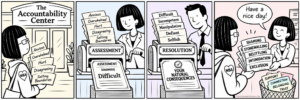
Four-panel illustration of a woman whose handwritten feelings become character judgments, then officially stamped consequences.

The Accountability Center

There’s a certain convenience in discrediting someone who displeases you. A few casual conversations about their character, their personality, their many shortcomings. Before long, everyone knows “what they’re like”. And then, even the most diminishing and degrading treatment can be framed as a natural consequence of how they are. The characterization doesn’t even have to be accurate. It just has to be sufficiently accepted.

Read More
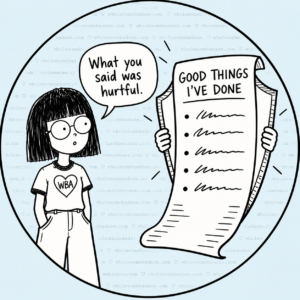
Black-and-white illustration of a girl saying, “What you said was hurtful,” facing a large shield covered by a receipt titled “Good Things I've Done.”

After All I’ve Done for You.

May I Remind You? Different people. Different circumstances. Continued familiar patterns. A few months ago, I said to my neighbor, “Hey, when you said X, it hurt my feelings.” Her response? “May I remind you…” followed by a list of ways she’d been helpful to me. I still don’t know why her response stunned me. It was entirely consistent with a familiar archetype: the person who expects things to automatically go their way and has no tolerance for frustration, disappointment, or anything that challenges their preferred version of themselves. And 100% of the time, with this archetype, my direct expression of hurt is received not as information about my experience or how our connection has been affected, but as an accusation to defend against or a claim to debate. I never responded. Interesting, though. We’d each been generous and helpful to one another. But I’d never considered my generosity protection against accountability. I’ve read about rejection sensitivity and narcissistic traits, particularly the need to be right, entitlement to having things their way, and the insistence on a narrative in which they can only be the hero or the victim. I’m increasingly interested in recognizing and understanding the patterns rather than proving anything about specific people. Since when does being helpful mean you can’t also have been hurtful? Both can be true. And similarly—Have you ever known someone who would only say “No” to a request along side listing all of the things they’d done for others or everything they “had” to do? Or who offered a reluctant yes or vague maybe when they already knew the answer was no?But with no thoguthful pause to genuinely ask, “Can we figure out a time that works for both of us?”Also, I do not discount that going to the gym and getting your hair done are legitimate needs. I find the long narrative that presents them as both the heroically generous and the overburdened victim to be unwholesome.

Read More
A reflection on how appearances shape credibility, character judgments, and the recognition of harm.

The Art of Concealed Cruelty

The ability to engineer someone else’s downfall while appearing to have had nothing to do with it. I’m intimately familiar with calculated hostility. What I still cannot fathom is the level of executive function required to provoke someone, anticipate their reaction, and use it against them while presenting as entirely uninvolved. For someone as highly sensitive and reactive as I am, with my nervous system pretty much on the outside of my body, that kind of calculation is incomprehensible. My long game and executive function were scorched by ongoing unresolved trauma. As a child, I was frequently crying, throwing up, having meltdowns, and reacting intensely to things that seemed not to even register for others. In my family, my reactivity was met only with shame and punishment. I was judged ungrateful, negative, too sensitive, thin-skinned. I suppose the hope was that enough callousness might eventually toughen me. My skin never thickened, but I learned to be mean. Vicious even. Sometimes it offered a momentary release. The relief was fleeting. The guilt and shame were not. Contempt was standard fare, but some people (audibly clearing my throat) seemed instinctively savvy about rules and skills that eluded me. They could deliver a devastating strike with complete self-possession and have it pass for teasing, a misunderstanding, or a reasonable response to someone who had displeased them. My reactions were unmasked, unbridled. Obvious, undeniable, and punishable. And I was bewildered. Wasn’t I doing as my family does? My sister, seven years older, seemed to have mastered the poise I lacked. Provoking and baiting could pass as harmless while leaving me visibly distraught. Whatever provoked my distress— became secondary to my reaction. My emotional reaction could be counted on to steal the show and seal the case. Poise posed as evidence of good character; my reactivity, evidence of bad. I was innocent only of understanding the rules. Now, nearly 60, with language and recovery, I think the unspoken rule I couldn’t metabolize wasn’t that ridicule and belittling were wrong. Apparently, they were perfectly acceptable, even applauded, when directed at someone considered deserving, provided they were delivered with composure. Only recently have I begun to identify concealed hostility. Diminishing remarks disguised as observations. “Brutal honesty” that is more brutal than honest. Provocations. The ability to degrade or discredit someone while appearing calm, unaffected, reasonable. Have you ever been provoked into a reaction that was then used as evidence against you?

Read More
Wholesome Badass girl draws a new relational blueprint based on nurturing, honest communication, accountability, and trust, while discarding an old blueprint of scapegoating, manipulation, and emotional neglect.

The Caller Was Inside the House

The people I relied on for protection were the same people I needed protection from. They were also the ones teaching lil baby Magda about herself, relationships, and the world. And so she gravitated toward relational patterns imprinted on her lil nervous system long before she could recognize or question them. Always reaching for the emotionally inaccessible archetype… She loved these people and wanted their approval, affection, and inclusion. They were her models for love, conflict, emotional regulation, and accountability. She mimicked some of their harmful behaviors, too. For how could she reject a model she hadn’t yet learned to recognize? I can share how Lil Baby Magda was harmed without asserting I, Big Magda, never caused harm. I own my unwholesome and misguided contributions without accepting responsibility for how others behaved. My first blueprint of the world was emotional instability, chaotic relationships, and illegible, amorphous rules and codes. My internal blueprint developed in response: my lens for perception, beliefs, vigilance, expectations, sense of worth, and capacity to care for myself, regulate my emotions and live with intention and dignity. Life might have been confusing even in a nurturing, steady family system. I might always have required more clarity, consistency, patience, and support. I lost decades tangled up in what the fuck had just happened and why, while forecasting what else would go wrong. What did I do? What did they mean? What did I miss? How do I keep it from happening again? Even when nothing was happening, I was still agonizing over things said and done years earlier. All that attention and energy spent trying to understand and prevent harm left no bandwidth to experience my own life. How much of what I’ve believed about my personality, character, worthiness, and lovability came from the people who taught me how to be a person? What might I have achieved if I hadn’t spent my life trying to figure out what was wrong with me? The messaging was consistent, collective, and insidious: Get different or be erased. If I was the designated problem and couldn’t correct myself, what was left? I couldn’t get different. I couldn’t get gone. I failed at both. And now I’m beginning to see a third way. Finally, I am getting different—not by correcting myself to fit the original blueprint, but by rejecting it.
Read More
Black-and-white cartoon of a worried girl handing over a paper labeled “OUCH” while a giant hand stamps it “DEFECTIVE.” Pink text at the top reads “When hurt gets submitted as evidence,” and a small watermark at the bottom says “wholesomebadass.com.”

When Your Sensitivity Is Framed as the Problem

In my family of origin, and then quite unsurprisingly in the marriage I chose, I re-enacted the familiar pattern. I accepted the charge for all discomfort—mine and everybody’s. If only I would’ve just gotten different, as was directed so very many times, we could’ve all been soooo close and comfortable. Your discomfort was my fault; so was my own. My distress was treated as a burden to the people I depended on to care for and guide me, and as proof that I was unreasonable, selfish, ungrateful, dramatic—defective. I lived in a state of perplexity that expressing any version of no or ouch consistently created friction, the very opposite of what a child might anticipate. My best efforts to communicate what I could and could not tolerate were dismissed as negative, dramatic, hysterical, oversensitive. My behavior, existence, personality, and pain were used as evidence against my character and worthiness each time they caused discomfort for one of the archetypes. My discomfort indicted me. Yours also did. I can see now how neurodivergence, scapegoating, and narcissistic family dynamics all fed the same machinery: difference was treated as defect, one person carried the emotional burden for everyone, and any separate reality that disrupted the preferred one became an offense. The opposite of sensitivity is not strength. It is insensitivity. The fact that I am affected does not make me weak, dangerous, or wrong. The way that I exist may be uncomfortable, but it’s not fucking violent or lacking in good character. What was violent, and what I have come to question as a matter of character, was the coercive control deployed in service to THE narrative, system, version of love, care, and peace. Have you ever noticed how people deeply invested in appearing strong can be the least able to, in good faith, directly engage friction?

Read More
Black-and-white line drawing of one person subtly tipping a bicyclist off balance while shrugging and thinking, “sheesh...always so dramatic.”

Rattle the Cage, Judge the Reaction

If I can rattle your cage and then stand beside your reaction looking calm and reasonable, I can create a defining contrast: you unstable; me credible. Your distress is excellent leverage. I get to have my way with you and come out looking better for it. Have you ever known someone with the kind of energy that would steal your wallet, watch you become rightfully upset, be the first to publicly comfort you and help search for it—and then somehow be the one to find it and hand it back? It is a hell of a trick to create friction, then step forward as the hero for managing the fallout. Have you ever experienced a situation where the focus immediately pivots from what happened to how you reacted—as if composure is evidence of innocence, reasonableness, or rightness?

Read More
Rattlesnake wearing a party hat on a pink unicorn bed, symbolizing hidden danger in plain sight.

The Curated Impression

How a Narrative Protects Predatory Behavior The Branding Becomes the Lens I am recognizing something in real time: the story about someone can matter more than what they actually say and do. When someone is characterized unfavorably by a person of greater status or influence, the language is often directed toward creating a shared lens through which others understand them. That version can serve as the starting assumption. Hierarchy gives it weight. This is the branding. The packaging. And it matters who establishes it. From there, a trajectory takes shape. The branding creates two outcomes at once: one person is invalidated while the other is insulated and immune to scrutiny. The branding calls the person to defense, then uses that defense as evidence that the characterization was right. Distress is recast as instability, attempts at clarity as difficulty, withdrawal as withholding, and any strong response as confirmation. Evidence to the contrary is inadmissible. It does not weaken the characterization. This is what makes the role difficult to escape. The arrangement is zero-sum: for one person to remain credible and protected, the other has to remain discredited. This is not a self-fulfilling prophecy in the usual sense because the premise does not originate with the branded one. It is imposed from “above,” then used to interpret everything that follows. Reality gets outranked by narrative. A response can be disproportionate, messy, or wrong without making the underlying experience unreal. Someone can be difficult or unpopular and still have been treated poorly. But the formula reigns: When the conduct of the protected archetype is questioned: Well, I only acted this way because of who and how YOU/THEY are. Have you been in a relationship in which another person’s missteps, poor choices, words, or conduct were repeatedly assigned to something supposedly wrong with you? WTAF? As in: If I behave like an asshole, it is only because you suck.

Read More
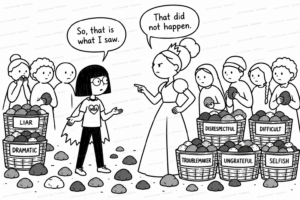
Black-and-white cartoon of a girl describing what she witnessed while a stern woman denies it. Villagers hold baskets of stones labeled liar, dramatic, selfish, ungrateful, and disrespectful, illustrating gaslighting and scapegoating.

Beyond Reproach?

Whatever is said or believed about me does not change what was said and done. I keep coming back to the possibility that the golden child can occupy the position of a protected abuser. So much of my childhood was lost in the shadow of what happened with my female sibling, older than me by 7 years. Decades later, she came for my children. I am only beginning to recognize the correlation between the two. Not identical acts. A familiar code. She acts. I object. My objection is treated as the offense. My experience is displaced. Her version is granted authority. Others are drawn in. Her position remains protected. Mine grows increasingly difficult to hold without defending myself. She was afforded the identity and cover of “good,” while I was named a menace for directly objecting and emotionally reacting to behavior that was, in fact, objectionable by almost any standard. She was able to compromise me in plain sight from behind the protective shield of who everyone believed her to be. It was never-ending. From the outside, it must have looked as if I were crazy—boxing with ghosts. People could see my distress. They could not see the quiet dog whistles, unwanted touching, exclusions, implications, and positioning I was responding to. And I can say now that I was fucking crazed by what was happening—not only because it was harmful, but because the harm was denied and protected. The asymmetry was brutal: one person retained the cover of goodness while my visible distress was treated as if it had appeared out of nowhere- a thing I elected to do. My reaction was indeed spectacular. What preceded it remained invisible. Maybe that is part of what I am processing now. For decades, people must have thought, Yikes. What is wrong with her? I have spent years interrogating that question too. Only recently have I become more interested in a different question: What happened to her, to lil Magda? Why is it easier to ask what is wrong with someone than to ask what happened to them? The first question leaves the existing narrative intact. The second invites examination. It is a fascinating pattern: harm can be easily masked by a role, a reputation, even an act that looks virtuous from across the room. A person can be doing harm while being protected by the belief that they are good. Years later, I would be profoundly affected by a pastor whose attention felt like the most extraordinary care. I can see now how I had been groomed to mistrust my own perception, particularly when harm came through someone occupying a role presumed to be protective—a shepherd, someone understood to be good, trustworthy, and morally authoritative. I keep thinking of the line, “Not all villains wear black.” There is an almost absurd irony in that for me: I tend to dress mostly in black, while my female sibling favors white. hmmmm…. I don’t think clothing color informs us of character, of course. Have you ever watched harmful behavior happen in plain sight while others showed and spoke no objection – maybe because of the status, influence, or authority of the person doing it, or the lesser status of the person being harmed—so that neutrality itself functioned as permission? What is that even called? It reminds me of that scene in Boardwalk Empire where a priest appears to be baptizing a man in front of the entire church. What everyone else sees is a sacred ritual performed by someone occupying one of the most trusted positions in the room. What is actually happening is murder.

Read More
Four-panel illustration of a woman whose handwritten feelings become character judgments, then officially stamped consequences.

The Accountability Center

There’s a certain convenience in discrediting someone who displeases you. A few casual conversations about their character, their personality, their many shortcomings. Before long, everyone knows “what they’re like”. And then, even the most diminishing and degrading treatment can be framed as a natural consequence of how they are. The characterization doesn’t even have to be accurate. It just has to be sufficiently accepted.

Read More
Black-and-white illustration of a girl saying, “What you said was hurtful,” facing a large shield covered by a receipt titled “Good Things I've Done.”

After All I’ve Done for You.

May I Remind You? Different people. Different circumstances. Continued familiar patterns. A few months ago, I said to my neighbor, “Hey, when you said X, it hurt my feelings.” Her response? “May I remind you…” followed by a list of ways she’d been helpful to me. I still don’t know why her response stunned me. It was entirely consistent with a familiar archetype: the person who expects things to automatically go their way and has no tolerance for frustration, disappointment, or anything that challenges their preferred version of themselves. And 100% of the time, with this archetype, my direct expression of hurt is received not as information about my experience or how our connection has been affected, but as an accusation to defend against or a claim to debate. I never responded. Interesting, though. We’d each been generous and helpful to one another. But I’d never considered my generosity protection against accountability. I’ve read about rejection sensitivity and narcissistic traits, particularly the need to be right, entitlement to having things their way, and the insistence on a narrative in which they can only be the hero or the victim. I’m increasingly interested in recognizing and understanding the patterns rather than proving anything about specific people. Since when does being helpful mean you can’t also have been hurtful? Both can be true. And similarly—Have you ever known someone who would only say “No” to a request along side listing all of the things they’d done for others or everything they “had” to do? Or who offered a reluctant yes or vague maybe when they already knew the answer was no?But with no thoguthful pause to genuinely ask, “Can we figure out a time that works for both of us?”Also, I do not discount that going to the gym and getting your hair done are legitimate needs. I find the long narrative that presents them as both the heroically generous and the overburdened victim to be unwholesome.

Read More
A reflection on how appearances shape credibility, character judgments, and the recognition of harm.

The Art of Concealed Cruelty

The ability to engineer someone else’s downfall while appearing to have had nothing to do with it. I’m intimately familiar with calculated hostility. What I still cannot fathom is the level of executive function required to provoke someone, anticipate their reaction, and use it against them while presenting as entirely uninvolved. For someone as highly sensitive and reactive as I am, with my nervous system pretty much on the outside of my body, that kind of calculation is incomprehensible. My long game and executive function were scorched by ongoing unresolved trauma. As a child, I was frequently crying, throwing up, having meltdowns, and reacting intensely to things that seemed not to even register for others. In my family, my reactivity was met only with shame and punishment. I was judged ungrateful, negative, too sensitive, thin-skinned. I suppose the hope was that enough callousness might eventually toughen me. My skin never thickened, but I learned to be mean. Vicious even. Sometimes it offered a momentary release. The relief was fleeting. The guilt and shame were not. Contempt was standard fare, but some people (audibly clearing my throat) seemed instinctively savvy about rules and skills that eluded me. They could deliver a devastating strike with complete self-possession and have it pass for teasing, a misunderstanding, or a reasonable response to someone who had displeased them. My reactions were unmasked, unbridled. Obvious, undeniable, and punishable. And I was bewildered. Wasn’t I doing as my family does? My sister, seven years older, seemed to have mastered the poise I lacked. Provoking and baiting could pass as harmless while leaving me visibly distraught. Whatever provoked my distress— became secondary to my reaction. My emotional reaction could be counted on to steal the show and seal the case. Poise posed as evidence of good character; my reactivity, evidence of bad. I was innocent only of understanding the rules. Now, nearly 60, with language and recovery, I think the unspoken rule I couldn’t metabolize wasn’t that ridicule and belittling were wrong. Apparently, they were perfectly acceptable, even applauded, when directed at someone considered deserving, provided they were delivered with composure. Only recently have I begun to identify concealed hostility. Diminishing remarks disguised as observations. “Brutal honesty” that is more brutal than honest. Provocations. The ability to degrade or discredit someone while appearing calm, unaffected, reasonable. Have you ever been provoked into a reaction that was then used as evidence against you?

Read More
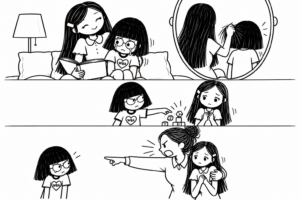
Wholesome Badass girl draws a new relational blueprint based on nurturing, honest communication, accountability, and trust, while discarding an old blueprint of scapegoating, manipulation, and emotional neglect.

The Caller Was Inside the House

The people I relied on for protection were the same people I needed protection from. They were also the ones teaching lil baby Magda about herself, relationships, and the world. And so she gravitated toward relational patterns imprinted on her lil nervous system long before she could recognize or question them. Always reaching for the emotionally inaccessible archetype… She loved these people and wanted their approval, affection, and inclusion. They were her models for love, conflict, emotional regulation, and accountability. She mimicked some of their harmful behaviors, too. For how could she reject a model she hadn’t yet learned to recognize? I can share how Lil Baby Magda was harmed without asserting I, Big Magda, never caused harm. I own my unwholesome and misguided contributions without accepting responsibility for how others behaved. My first blueprint of the world was emotional instability, chaotic relationships, and illegible, amorphous rules and codes. My internal blueprint developed in response: my lens for perception, beliefs, vigilance, expectations, sense of worth, and capacity to care for myself, regulate my emotions and live with intention and dignity. Life might have been confusing even in a nurturing, steady family system. I might always have required more clarity, consistency, patience, and support. I lost decades tangled up in what the fuck had just happened and why, while forecasting what else would go wrong. What did I do? What did they mean? What did I miss? How do I keep it from happening again? Even when nothing was happening, I was still agonizing over things said and done years earlier. All that attention and energy spent trying to understand and prevent harm left no bandwidth to experience my own life. How much of what I’ve believed about my personality, character, worthiness, and lovability came from the people who taught me how to be a person? What might I have achieved if I hadn’t spent my life trying to figure out what was wrong with me? The messaging was consistent, collective, and insidious: Get different or be erased. If I was the designated problem and couldn’t correct myself, what was left? I couldn’t get different. I couldn’t get gone. I failed at both. And now I’m beginning to see a third way. Finally, I am getting different—not by correcting myself to fit the original blueprint, but by rejecting it.
Read More
Black-and-white cartoon of a worried girl handing over a paper labeled “OUCH” while a giant hand stamps it “DEFECTIVE.” Pink text at the top reads “When hurt gets submitted as evidence,” and a small watermark at the bottom says “wholesomebadass.com.”

When Your Sensitivity Is Framed as the Problem

In my family of origin, and then quite unsurprisingly in the marriage I chose, I re-enacted the familiar pattern. I accepted the charge for all discomfort—mine and everybody’s. If only I would’ve just gotten different, as was directed so very many times, we could’ve all been soooo close and comfortable. Your discomfort was my fault; so was my own. My distress was treated as a burden to the people I depended on to care for and guide me, and as proof that I was unreasonable, selfish, ungrateful, dramatic—defective. I lived in a state of perplexity that expressing any version of no or ouch consistently created friction, the very opposite of what a child might anticipate. My best efforts to communicate what I could and could not tolerate were dismissed as negative, dramatic, hysterical, oversensitive. My behavior, existence, personality, and pain were used as evidence against my character and worthiness each time they caused discomfort for one of the archetypes. My discomfort indicted me. Yours also did. I can see now how neurodivergence, scapegoating, and narcissistic family dynamics all fed the same machinery: difference was treated as defect, one person carried the emotional burden for everyone, and any separate reality that disrupted the preferred one became an offense. The opposite of sensitivity is not strength. It is insensitivity. The fact that I am affected does not make me weak, dangerous, or wrong. The way that I exist may be uncomfortable, but it’s not fucking violent or lacking in good character. What was violent, and what I have come to question as a matter of character, was the coercive control deployed in service to THE narrative, system, version of love, care, and peace. Have you ever noticed how people deeply invested in appearing strong can be the least able to, in good faith, directly engage friction?

Read More
Black-and-white line drawing of one person subtly tipping a bicyclist off balance while shrugging and thinking, “sheesh...always so dramatic.”

Rattle the Cage, Judge the Reaction

If I can rattle your cage and then stand beside your reaction looking calm and reasonable, I can create a defining contrast: you unstable; me credible. Your distress is excellent leverage. I get to have my way with you and come out looking better for it. Have you ever known someone with the kind of energy that would steal your wallet, watch you become rightfully upset, be the first to publicly comfort you and help search for it—and then somehow be the one to find it and hand it back? It is a hell of a trick to create friction, then step forward as the hero for managing the fallout. Have you ever experienced a situation where the focus immediately pivots from what happened to how you reacted—as if composure is evidence of innocence, reasonableness, or rightness?

Read More
Rattlesnake wearing a party hat on a pink unicorn bed, symbolizing hidden danger in plain sight.

The Curated Impression

How a Narrative Protects Predatory Behavior The Branding Becomes the Lens I am recognizing something in real time: the story about someone can matter more than what they actually say and do. When someone is characterized unfavorably by a person of greater status or influence, the language is often directed toward creating a shared lens through which others understand them. That version can serve as the starting assumption. Hierarchy gives it weight. This is the branding. The packaging. And it matters who establishes it. From there, a trajectory takes shape. The branding creates two outcomes at once: one person is invalidated while the other is insulated and immune to scrutiny. The branding calls the person to defense, then uses that defense as evidence that the characterization was right. Distress is recast as instability, attempts at clarity as difficulty, withdrawal as withholding, and any strong response as confirmation. Evidence to the contrary is inadmissible. It does not weaken the characterization. This is what makes the role difficult to escape. The arrangement is zero-sum: for one person to remain credible and protected, the other has to remain discredited. This is not a self-fulfilling prophecy in the usual sense because the premise does not originate with the branded one. It is imposed from “above,” then used to interpret everything that follows. Reality gets outranked by narrative. A response can be disproportionate, messy, or wrong without making the underlying experience unreal. Someone can be difficult or unpopular and still have been treated poorly. But the formula reigns: When the conduct of the protected archetype is questioned: Well, I only acted this way because of who and how YOU/THEY are. Have you been in a relationship in which another person’s missteps, poor choices, words, or conduct were repeatedly assigned to something supposedly wrong with you? WTAF? As in: If I behave like an asshole, it is only because you suck.

Read More
Black-and-white cartoon of a girl describing what she witnessed while a stern woman denies it. Villagers hold baskets of stones labeled liar, dramatic, selfish, ungrateful, and disrespectful, illustrating gaslighting and scapegoating.

Beyond Reproach?

Whatever is said or believed about me does not change what was said and done. I keep coming back to the possibility that the golden child can occupy the position of a protected abuser. So much of my childhood was lost in the shadow of what happened with my female sibling, older than me by 7 years. Decades later, she came for my children. I am only beginning to recognize the correlation between the two. Not identical acts. A familiar code. She acts. I object. My objection is treated as the offense. My experience is displaced. Her version is granted authority. Others are drawn in. Her position remains protected. Mine grows increasingly difficult to hold without defending myself. She was afforded the identity and cover of “good,” while I was named a menace for directly objecting and emotionally reacting to behavior that was, in fact, objectionable by almost any standard. She was able to compromise me in plain sight from behind the protective shield of who everyone believed her to be. It was never-ending. From the outside, it must have looked as if I were crazy—boxing with ghosts. People could see my distress. They could not see the quiet dog whistles, unwanted touching, exclusions, implications, and positioning I was responding to. And I can say now that I was fucking crazed by what was happening—not only because it was harmful, but because the harm was denied and protected. The asymmetry was brutal: one person retained the cover of goodness while my visible distress was treated as if it had appeared out of nowhere- a thing I elected to do. My reaction was indeed spectacular. What preceded it remained invisible. Maybe that is part of what I am processing now. For decades, people must have thought, Yikes. What is wrong with her? I have spent years interrogating that question too. Only recently have I become more interested in a different question: What happened to her, to lil Magda? Why is it easier to ask what is wrong with someone than to ask what happened to them? The first question leaves the existing narrative intact. The second invites examination. It is a fascinating pattern: harm can be easily masked by a role, a reputation, even an act that looks virtuous from across the room. A person can be doing harm while being protected by the belief that they are good. Years later, I would be profoundly affected by a pastor whose attention felt like the most extraordinary care. I can see now how I had been groomed to mistrust my own perception, particularly when harm came through someone occupying a role presumed to be protective—a shepherd, someone understood to be good, trustworthy, and morally authoritative. I keep thinking of the line, “Not all villains wear black.” There is an almost absurd irony in that for me: I tend to dress mostly in black, while my female sibling favors white. hmmmm…. I don’t think clothing color informs us of character, of course. Have you ever watched harmful behavior happen in plain sight while others showed and spoke no objection – maybe because of the status, influence, or authority of the person doing it, or the lesser status of the person being harmed—so that neutrality itself functioned as permission? What is that even called? It reminds me of that scene in Boardwalk Empire where a priest appears to be baptizing a man in front of the entire church. What everyone else sees is a sacred ritual performed by someone occupying one of the most trusted positions in the room. What is actually happening is murder.

Read More