Wholesome Badass

A Work in Progress — Healing from All the Things​

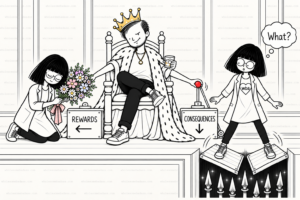
A crowned man sits on a throne, rewarding a favored woman with flowers while directing another woman toward a dangerous trap labeled “Consequences.” The image illustrates favoritism, othering, and emotional violence.

When Discomfort Is Handled as Provocation

I’m recognizing a pattern in the personality type I’ve come to call The Archetype: disproportionate retaliation in response to discomfort. There is a swift intolerance for anything or anyone that appears to interfere with their ideas, preferences, plans, comfort, or agenda. Frustration, inconvenience, disagreement, or a perceived lack of deference is handled as a provocation to be consequenced. They justify their retaliation as a natural consequence of being provoked, while simultaneously denying they had been affected or reacted at all. In this dynamic, labeling someone as troublesome and treating them accordingly takes precedence over acknowledging feeling threatened and dealing with difficult feelings. Something is causing discomfort? Annihilate it.

Read More

Toxic and Nurturing Relationship Data

For most of my life, I didn’t even recognize healthy and unhealthy connection as distinct possibilities. Like a fish unaware of the water it’s swimming in, I understood relationships through the only environment I’d ever known. I had learned distorted definitions of love, safety, trust, and connection. What if the most important measure of love isn’t how much someone loves a person, but what happens in the experience of being loved by them? Family ties, intensity, chemistry, and intermittently good experiences aren’t evidence of a healthy relationship. I’m recognizing how toxicity can exist in the way a relationship functions—the architecture of the bond—not simply in either person. Someone may have an entirely different experience with a person than I did, particularly when admiration, usefulness, or reliance shapes how that person relates to them. When someone says, “I’ve never experienced them that way,” I recognize that may be true. What’s hurtful and inappropriate, is when their experience is intended to invalidate mine. Their experience doesn’t disprove mine, any more than mine disproves theirs. I’m describing the relationship I experienced, not issuing a verdict on every relationship that person has. I’m going to place my trust in the prevailing patterns over the peak moments and occasional exceptions. ♡ Feelings I Associate with Nourishing Love ♡ ☠ Feelings I Associate with Harmful Relationship Dynamics ☠ Healing ♡ Alienation-Division Soothing ♡ Diminished-Disregarded Safety ♡ Confused Growth ♡ Silenced Exploration ♡ Frightened Self-expression ♡ Power-imbalance Expansion ♡ Contracted Yes, I am the common denominator in all my relationships—as are we all. So is the relational template I carried into them. It influenced not only the relationships I entered, but what I helped create and sustain within them. That template shaped: I recognize my contribution to my relational patterns without taking ANY esponsibility for another person’s behavior.

Read More
Maslow’s hierarchy of needs with a little girl at the bottom and a thermometer showing only physiological needs fulfilled. Safety, belonging, esteem, and self-actualization remain unrealized.

From Surviving to Thriving

Maslow’s Hierarchy of Needs Magda’s Progression: Bottom Level—Cleared. ✅* Food, shelter, clothing. Check, check, check. But I was starved for affection, acceptance, and the security of belonging. After years of therapy, recovery work, and training in child development, I sense that my pervasive distress came from a genuine need for affection, acceptance, and the security of belonging. I’m no psychic, but I’d bet if you asked anyone I’m genetically linked to, they’d tell you the problem was that I was a selfish, ungrateful PITA. How the fuck was I supposed to grow into anything promising when the requirement was to become less—or else? I was fortunate in what I had, and deeply affected by what I didn’t. In my 40s, when I found recovery, I learned to practice gratitude. Not portray it. And all the gratitude in the world couldn’t substitute for the nurturing and secure bonding I needed to develop emotional stability and maturity. * Maslow’s hierarchy of needs identifies how human needs progress from basic survival and safety to love, belonging, esteem, and ultimately self-actualization (reaching one’s potential). Unmet needs can inhibit that progression. Remaining in survival mode can keep us caught in cycles of stress, anxiety, and reactivity.

Read More
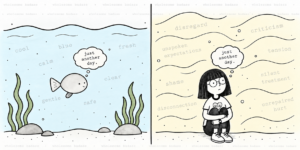
Split-screen illustration of a fish swimming in calm blue water and a girl surrounded by criticism, shame, and silent treatment. Both think, “just another day.”

What If It Was the Water?

I spent much of my life believing something was terribly wrong with me. In fact, I’m fairly certain that was suggested more than a handful of times. My struggle to exist harmoniously didn’t make me question my environment. It seemed only to confirm that I was the problem. It reminds me of the quote: “When a flower doesn’t bloom, you fix the environment in which it grows, not the flower.” My failure to thrive was unmistakable. Overwhelmed by the intensity and confusion of the dynamic, I developed constant, involuntary, maladaptive behaviors. Rather than recognizing them as reactions to what I was experiencing, they were treated as evidence of my defectiveness. And that’s how I learned to see myself. And then, to add insult to injury, I was labeled as negative for my low self-esteem and the anger that came from living in constant turmoil without reprieve or guidance. It really was an inescapable loop.  As a young adult, I began recognizing the consequences of directly expressing my needs or limits. I lacked both the understanding and the agency to respond in any useful way.  I was essentially boxing with ghosts. I was taking hits, swinging blindly, and looking completely unhinged (which I was) to anyone watching. And so I relocated, first across the country and then out of the country, attempting to match the physical distance to the devastating emotional distance. Learning to identify the water hasn’t undone what living in it taught me—or made me an excellent swimmer. But I’m discovering who I am when I’m not constantly overwhelmed and reacting to what’s happening around me. And for the first time, I’m enjoying who I am.  Engaging with life from a place of intention and agency is a far cry from living in reaction to something I couldn’t see or name.

Read More
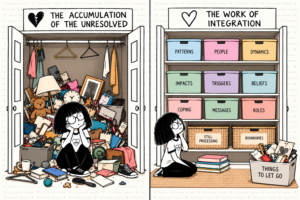
Split illustration of trauma integration. On the left, a distressed girl sits among a heap of clutter beneath “The Accumulation of the Unresolved.” On the right, she sits peacefully before organized bins labeled Patterns, People, Dynamics, Impacts, Triggers, Beliefs, Coping, Messages, Roles, Boundaries, and Still Processing. A separate bin reads “Things to Let Go.” Copy alt text

Who Are We Beyond Survival Mode?

For me, survival mode has felt like living under the weight of an ever-growing, tangled mess. Every unsettling interaction compounded it. I couldn’t untangle it, and I couldn’t leave it alone. After decades of debilitating confusion, I’m finally recognizing patterns and finding ways to organize my experiences. The mess hasn’t disappeared, but it’s loosening its grip on me. I missed so much of my life trying to figure out what had just happened and worrying about what might happen next. I’m beginning to see how life could be more.

Read More
Wholesome Badass girl draws a new relational blueprint based on nurturing, honest communication, accountability, and trust, while discarding an old blueprint of scapegoating, manipulation, and emotional neglect.

The Caller Was Inside the House

The people I relied on for protection were the same people I needed protection from. They were also the ones teaching lil baby Magda about herself, relationships, and the world. And so she gravitated toward relational patterns imprinted on her lil nervous system long before she could recognize or question them. Always reaching for the emotionally inaccessible archetype… She loved these people and wanted their approval, affection, and inclusion. They were her models for love, conflict, emotional regulation, and accountability. She mimicked some of their harmful behaviors, too. For how could she reject a model she hadn’t yet learned to recognize? I can share how Lil Baby Magda was harmed without asserting I, Big Magda, never caused harm. I own my unwholesome and misguided contributions without accepting responsibility for how others behaved. My first blueprint of the world was emotional instability, chaotic relationships, and illegible, amorphous rules and codes. My internal blueprint developed in response: my lens for perception, beliefs, vigilance, expectations, sense of worth, and capacity to care for myself, regulate my emotions and live with intention and dignity. Life might have been confusing even in a nurturing, steady family system. I might always have required more clarity, consistency, patience, and support. I lost decades tangled up in what the fuck had just happened and why, while forecasting what else would go wrong. What did I do? What did they mean? What did I miss? How do I keep it from happening again? Even when nothing was happening, I was still agonizing over things said and done years earlier. All that attention and energy spent trying to understand and prevent harm left no bandwidth to experience my own life. How much of what I’ve believed about my personality, character, worthiness, and lovability came from the people who taught me how to be a person? What might I have achieved if I hadn’t spent my life trying to figure out what was wrong with me? The messaging was consistent, collective, and insidious: Get different or be erased. If I was the designated problem and couldn’t correct myself, what was left? I couldn’t get different. I couldn’t get gone. I failed at both. And now I’m beginning to see a third way. Finally, I am getting different—not by correcting myself to fit the original blueprint, but by rejecting it.

Read More
Cartoon-style black-and-white drawing on a soft green background of a girl feeding papers labeled trauma, confusion, misinformation, doubt, and shame into a machine labeled “Processing Through Writing.” Papers coming out say agency, discernment, and intention. Her bag has a small WBA heart logo, and the image is watermarked with wholesomebadass.com.

The Shit Before the Shift

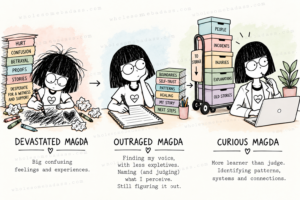
No Dimmer Switch I feel everything the most amount—the good and the unpleasant—constantly. Everything in high definition. I am a deep feeler, or as the archetype likes to say: thin-skinned, overly sensitive. Not a crime. Not a defect. But not an easy way to be in the world. From my tiniest days, I recall feeling inconsolably rattled, navigating my tightly wound nervous system and sensitive disposition with no guidance, knowledge, language, or skill set for any of it. I cannot recall another version of myself underneath it all – who ever felt secure, grounded, safe, and not overwhelmed. That has been my baseline. It is not a great point of departure. Billed to Me I was raised to believe that other people’s harsh behavior spoke directly to the quality of my person, my character, and my worth. Which was terribly confusing, because I was also often scolded for asking if a person was upset with me, “Not everything is about you.” And yet other people’s unfavorable moods and behaviors were consistently billed to me or altogether denied. So… difficult moods and feelings—mine and theirs—were my responsibility. And no clue how to manage that. Painfully aware: I was constantly and undeniably failing. While nobody taught or encouraged me to know, soothe, value, or care for myself, I was expected to read, anticipate, prevent, and manage other people’s difficult feelings. So many times, blood relatives would demand in a menacing tone, “What are you so angry about?” But it was not a genuine inquiry. It was a callout: look at you, with that massive chink in your armor. Feel ashamed and pipe down or else. There is real sadness in looking back and realizing how much unmanaged, daily compounded stress was attributed exclusively to my “poor character.” I spent more than forty years trying to do the impossible thing of getting different and becoming someone else. My only ambition. What a tragic fucken waste. Stripped of any potential to self-actualize. The Familiar And having been been handled like a piece of literal shit—a poopy diaper—I did not instinctively seek nourishing and affirming relationships. I had learned that love looked like people who genuinely were not FOR me—unless and only when I was useful to them. This explains so much. At many levels, I believe the only thing I shared in common with my family of origin was that we all held me in the lowest regard. That is hard to reconcile. And tragically, my only direction was toward the familiar. Ooof. Decades of trying to feel better, by any means possible, without really knowing what I was trying to feel better from. From being a shiftless piece of shit?? There is literally no relief from that. I mistook random positive intermittent reinforcement for kindness and brought that out into the world with me as the love I sought. And sometimes the love I gave. I hate that. Better Information I am proud to have interrupted that cycle, that I did not hand that poison directly to my sons. No matter what is said about me, it cannot be denied that I rode faithfully for my children. Without exception. Maybe not perfectly or without pain to them, but with fierce loyalty and constant sacrifice. In learning about trauma and nervous systems. Neglect. Generational abuse. Coercive abuse. Scapegoating. Triangulation. Attachment, fear, compulsion. I recognize how I confused what was recognizable with what was safe and acceptable. For and from myself. Agency With better information now, I get to experience something that for so long eluded me: agency—where I carefully consider who, what, how, and when to engage, and whether engagement is even required or prudent. Writing helps me recognize and organize all of the me’s inside of me—with no intent to prosecute my past or acquit any of my me’s. I work tirelessly to untangle my myths and misconceptions about myself, love, connection, and kindness. It is a true miracle to have grown into the loving, honest, dependable, funny, compassionate, and loyal woman I am. And this is also true: I have not always known how to move in these ways—or how to move with people who equally value them. First the unlearning. The shit before the shift, I guess. What were you led to believe about yourself because of the way someone else treated you? And do you still belive it?
Read More
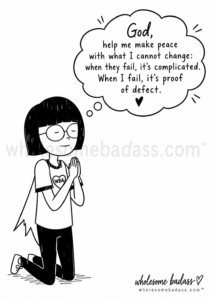
Black-and-white Wholesome Badass illustration of a woman kneeling in prayer with a thought bubble about making peace with unequal standards around failure.

Ordinary Failure

The archetypal persona seems to move through every telling of their own life with access to explanations they do not extend to anyone else. When they prevail, it reflects strength, intelligence, resilience, discernment, character. When they do not, the result still has to preserve something essential about who they are. Win or lose, the story protects against one ordinary possibility: that they simply did not have what the moment called for, or failed to handle it superbly. I continue, almost obsessively, returning to these archetypes, patterns, and systems because I am trying to identify the structure beneath them, with the hope that naming the whole may eventually matter more than cataloging its parts. Have you ever felt reduced to a flaw by someone who is never wrong, while every one of their own failures comes with a full explanation- like either the hero or the victim of circumstances, but never simply a person who dropped the ball? It is exhausting for someone like me.

Read More
A crowned man sits on a throne, rewarding a favored woman with flowers while directing another woman toward a dangerous trap labeled “Consequences.” The image illustrates favoritism, othering, and emotional violence.

When Discomfort Is Handled as Provocation

I’m recognizing a pattern in the personality type I’ve come to call The Archetype: disproportionate retaliation in response to discomfort. There is a swift intolerance for anything or anyone that appears to interfere with their ideas, preferences, plans, comfort, or agenda. Frustration, inconvenience, disagreement, or a perceived lack of deference is handled as a provocation to be consequenced. They justify their retaliation as a natural consequence of being provoked, while simultaneously denying they had been affected or reacted at all. In this dynamic, labeling someone as troublesome and treating them accordingly takes precedence over acknowledging feeling threatened and dealing with difficult feelings. Something is causing discomfort? Annihilate it.

Read More

Toxic and Nurturing Relationship Data

For most of my life, I didn’t even recognize healthy and unhealthy connection as distinct possibilities. Like a fish unaware of the water it’s swimming in, I understood relationships through the only environment I’d ever known. I had learned distorted definitions of love, safety, trust, and connection. What if the most important measure of love isn’t how much someone loves a person, but what happens in the experience of being loved by them? Family ties, intensity, chemistry, and intermittently good experiences aren’t evidence of a healthy relationship. I’m recognizing how toxicity can exist in the way a relationship functions—the architecture of the bond—not simply in either person. Someone may have an entirely different experience with a person than I did, particularly when admiration, usefulness, or reliance shapes how that person relates to them. When someone says, “I’ve never experienced them that way,” I recognize that may be true. What’s hurtful and inappropriate, is when their experience is intended to invalidate mine. Their experience doesn’t disprove mine, any more than mine disproves theirs. I’m describing the relationship I experienced, not issuing a verdict on every relationship that person has. I’m going to place my trust in the prevailing patterns over the peak moments and occasional exceptions. ♡ Feelings I Associate with Nourishing Love ♡ ☠ Feelings I Associate with Harmful Relationship Dynamics ☠ Healing ♡ Alienation-Division Soothing ♡ Diminished-Disregarded Safety ♡ Confused Growth ♡ Silenced Exploration ♡ Frightened Self-expression ♡ Power-imbalance Expansion ♡ Contracted Yes, I am the common denominator in all my relationships—as are we all. So is the relational template I carried into them. It influenced not only the relationships I entered, but what I helped create and sustain within them. That template shaped: I recognize my contribution to my relational patterns without taking ANY esponsibility for another person’s behavior.

Read More
Maslow’s hierarchy of needs with a little girl at the bottom and a thermometer showing only physiological needs fulfilled. Safety, belonging, esteem, and self-actualization remain unrealized.

From Surviving to Thriving

Maslow’s Hierarchy of Needs Magda’s Progression: Bottom Level—Cleared. ✅* Food, shelter, clothing. Check, check, check. But I was starved for affection, acceptance, and the security of belonging. After years of therapy, recovery work, and training in child development, I sense that my pervasive distress came from a genuine need for affection, acceptance, and the security of belonging. I’m no psychic, but I’d bet if you asked anyone I’m genetically linked to, they’d tell you the problem was that I was a selfish, ungrateful PITA. How the fuck was I supposed to grow into anything promising when the requirement was to become less—or else? I was fortunate in what I had, and deeply affected by what I didn’t. In my 40s, when I found recovery, I learned to practice gratitude. Not portray it. And all the gratitude in the world couldn’t substitute for the nurturing and secure bonding I needed to develop emotional stability and maturity. * Maslow’s hierarchy of needs identifies how human needs progress from basic survival and safety to love, belonging, esteem, and ultimately self-actualization (reaching one’s potential). Unmet needs can inhibit that progression. Remaining in survival mode can keep us caught in cycles of stress, anxiety, and reactivity.

Read More
Split-screen illustration of a fish swimming in calm blue water and a girl surrounded by criticism, shame, and silent treatment. Both think, “just another day.”

What If It Was the Water?

I spent much of my life believing something was terribly wrong with me. In fact, I’m fairly certain that was suggested more than a handful of times. My struggle to exist harmoniously didn’t make me question my environment. It seemed only to confirm that I was the problem. It reminds me of the quote: “When a flower doesn’t bloom, you fix the environment in which it grows, not the flower.” My failure to thrive was unmistakable. Overwhelmed by the intensity and confusion of the dynamic, I developed constant, involuntary, maladaptive behaviors. Rather than recognizing them as reactions to what I was experiencing, they were treated as evidence of my defectiveness. And that’s how I learned to see myself. And then, to add insult to injury, I was labeled as negative for my low self-esteem and the anger that came from living in constant turmoil without reprieve or guidance. It really was an inescapable loop.  As a young adult, I began recognizing the consequences of directly expressing my needs or limits. I lacked both the understanding and the agency to respond in any useful way.  I was essentially boxing with ghosts. I was taking hits, swinging blindly, and looking completely unhinged (which I was) to anyone watching. And so I relocated, first across the country and then out of the country, attempting to match the physical distance to the devastating emotional distance. Learning to identify the water hasn’t undone what living in it taught me—or made me an excellent swimmer. But I’m discovering who I am when I’m not constantly overwhelmed and reacting to what’s happening around me. And for the first time, I’m enjoying who I am.  Engaging with life from a place of intention and agency is a far cry from living in reaction to something I couldn’t see or name.

Read More
Split illustration of trauma integration. On the left, a distressed girl sits among a heap of clutter beneath “The Accumulation of the Unresolved.” On the right, she sits peacefully before organized bins labeled Patterns, People, Dynamics, Impacts, Triggers, Beliefs, Coping, Messages, Roles, Boundaries, and Still Processing. A separate bin reads “Things to Let Go.” Copy alt text

Who Are We Beyond Survival Mode?

For me, survival mode has felt like living under the weight of an ever-growing, tangled mess. Every unsettling interaction compounded it. I couldn’t untangle it, and I couldn’t leave it alone. After decades of debilitating confusion, I’m finally recognizing patterns and finding ways to organize my experiences. The mess hasn’t disappeared, but it’s loosening its grip on me. I missed so much of my life trying to figure out what had just happened and worrying about what might happen next. I’m beginning to see how life could be more.

Read More
Wholesome Badass girl draws a new relational blueprint based on nurturing, honest communication, accountability, and trust, while discarding an old blueprint of scapegoating, manipulation, and emotional neglect.

The Caller Was Inside the House

The people I relied on for protection were the same people I needed protection from. They were also the ones teaching lil baby Magda about herself, relationships, and the world. And so she gravitated toward relational patterns imprinted on her lil nervous system long before she could recognize or question them. Always reaching for the emotionally inaccessible archetype… She loved these people and wanted their approval, affection, and inclusion. They were her models for love, conflict, emotional regulation, and accountability. She mimicked some of their harmful behaviors, too. For how could she reject a model she hadn’t yet learned to recognize? I can share how Lil Baby Magda was harmed without asserting I, Big Magda, never caused harm. I own my unwholesome and misguided contributions without accepting responsibility for how others behaved. My first blueprint of the world was emotional instability, chaotic relationships, and illegible, amorphous rules and codes. My internal blueprint developed in response: my lens for perception, beliefs, vigilance, expectations, sense of worth, and capacity to care for myself, regulate my emotions and live with intention and dignity. Life might have been confusing even in a nurturing, steady family system. I might always have required more clarity, consistency, patience, and support. I lost decades tangled up in what the fuck had just happened and why, while forecasting what else would go wrong. What did I do? What did they mean? What did I miss? How do I keep it from happening again? Even when nothing was happening, I was still agonizing over things said and done years earlier. All that attention and energy spent trying to understand and prevent harm left no bandwidth to experience my own life. How much of what I’ve believed about my personality, character, worthiness, and lovability came from the people who taught me how to be a person? What might I have achieved if I hadn’t spent my life trying to figure out what was wrong with me? The messaging was consistent, collective, and insidious: Get different or be erased. If I was the designated problem and couldn’t correct myself, what was left? I couldn’t get different. I couldn’t get gone. I failed at both. And now I’m beginning to see a third way. Finally, I am getting different—not by correcting myself to fit the original blueprint, but by rejecting it.

Read More
Cartoon-style black-and-white drawing on a soft green background of a girl feeding papers labeled trauma, confusion, misinformation, doubt, and shame into a machine labeled “Processing Through Writing.” Papers coming out say agency, discernment, and intention. Her bag has a small WBA heart logo, and the image is watermarked with wholesomebadass.com.

The Shit Before the Shift

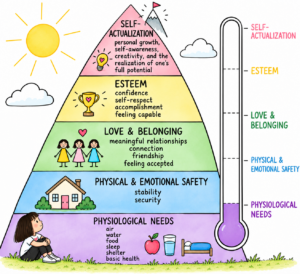
No Dimmer Switch I feel everything the most amount—the good and the unpleasant—constantly. Everything in high definition. I am a deep feeler, or as the archetype likes to say: thin-skinned, overly sensitive. Not a crime. Not a defect. But not an easy way to be in the world. From my tiniest days, I recall feeling inconsolably rattled, navigating my tightly wound nervous system and sensitive disposition with no guidance, knowledge, language, or skill set for any of it. I cannot recall another version of myself underneath it all – who ever felt secure, grounded, safe, and not overwhelmed. That has been my baseline. It is not a great point of departure. Billed to Me I was raised to believe that other people’s harsh behavior spoke directly to the quality of my person, my character, and my worth. Which was terribly confusing, because I was also often scolded for asking if a person was upset with me, “Not everything is about you.” And yet other people’s unfavorable moods and behaviors were consistently billed to me or altogether denied. So… difficult moods and feelings—mine and theirs—were my responsibility. And no clue how to manage that. Painfully aware: I was constantly and undeniably failing. While nobody taught or encouraged me to know, soothe, value, or care for myself, I was expected to read, anticipate, prevent, and manage other people’s difficult feelings. So many times, blood relatives would demand in a menacing tone, “What are you so angry about?” But it was not a genuine inquiry. It was a callout: look at you, with that massive chink in your armor. Feel ashamed and pipe down or else. There is real sadness in looking back and realizing how much unmanaged, daily compounded stress was attributed exclusively to my “poor character.” I spent more than forty years trying to do the impossible thing of getting different and becoming someone else. My only ambition. What a tragic fucken waste. Stripped of any potential to self-actualize. The Familiar And having been been handled like a piece of literal shit—a poopy diaper—I did not instinctively seek nourishing and affirming relationships. I had learned that love looked like people who genuinely were not FOR me—unless and only when I was useful to them. This explains so much. At many levels, I believe the only thing I shared in common with my family of origin was that we all held me in the lowest regard. That is hard to reconcile. And tragically, my only direction was toward the familiar. Ooof. Decades of trying to feel better, by any means possible, without really knowing what I was trying to feel better from. From being a shiftless piece of shit?? There is literally no relief from that. I mistook random positive intermittent reinforcement for kindness and brought that out into the world with me as the love I sought. And sometimes the love I gave. I hate that. Better Information I am proud to have interrupted that cycle, that I did not hand that poison directly to my sons. No matter what is said about me, it cannot be denied that I rode faithfully for my children. Without exception. Maybe not perfectly or without pain to them, but with fierce loyalty and constant sacrifice. In learning about trauma and nervous systems. Neglect. Generational abuse. Coercive abuse. Scapegoating. Triangulation. Attachment, fear, compulsion. I recognize how I confused what was recognizable with what was safe and acceptable. For and from myself. Agency With better information now, I get to experience something that for so long eluded me: agency—where I carefully consider who, what, how, and when to engage, and whether engagement is even required or prudent. Writing helps me recognize and organize all of the me’s inside of me—with no intent to prosecute my past or acquit any of my me’s. I work tirelessly to untangle my myths and misconceptions about myself, love, connection, and kindness. It is a true miracle to have grown into the loving, honest, dependable, funny, compassionate, and loyal woman I am. And this is also true: I have not always known how to move in these ways—or how to move with people who equally value them. First the unlearning. The shit before the shift, I guess. What were you led to believe about yourself because of the way someone else treated you? And do you still belive it?
Read More
Black-and-white Wholesome Badass illustration of a woman kneeling in prayer with a thought bubble about making peace with unequal standards around failure.

Ordinary Failure

The archetypal persona seems to move through every telling of their own life with access to explanations they do not extend to anyone else. When they prevail, it reflects strength, intelligence, resilience, discernment, character. When they do not, the result still has to preserve something essential about who they are. Win or lose, the story protects against one ordinary possibility: that they simply did not have what the moment called for, or failed to handle it superbly. I continue, almost obsessively, returning to these archetypes, patterns, and systems because I am trying to identify the structure beneath them, with the hope that naming the whole may eventually matter more than cataloging its parts. Have you ever felt reduced to a flaw by someone who is never wrong, while every one of their own failures comes with a full explanation- like either the hero or the victim of circumstances, but never simply a person who dropped the ball? It is exhausting for someone like me.

Read More