Wholesome Badass

A Work in Progress — Healing from All the Things​

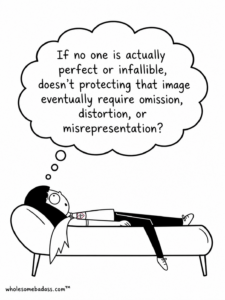
Black-and-white Wholesome Badass drawing of a girl lying on a couch with a thought bubble that says, “If no one is actually perfect or infallible, doesn’t protecting that image eventually require omission, distortion, or misrepresentation?”

Can the Need to Appear Infallible Make Someone Less Honest?

I am increasingly interested in the archetypal persona—the kind of person for whom being, or even appearing, incorrect, uncertain, or imperfect seems almost unthinkable. Like what happens when being seen as good, right, or infallible is key to the archetypal identity? One who can readily accept and explore a mistake or misstep has less reason to distort the truth. If admitting fault threatens the whole structure, there is reason to alter, omit, or misrepresent whatever threatens it. The story may need managing.Incomplete truths may need to stand in for the whole truth.Harm may need minimizing.Someone else may need to be positioned as wrong. At some point, the way we protect our image is also information about our character. Maybe goodness is not being beyond error. Maybe it is the ability to remain honest when we have erred or fallen short. As I continue to seek a wholesome path through life—one rooted in spiritual grace—I am also finding out exactly how badassery shows up in my daily life as a byproduct. I think the two may be inextricably linked.
Read More
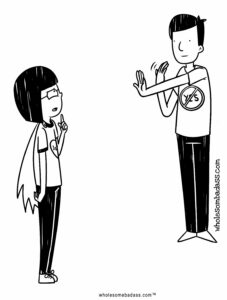
Black-and-white illustration of a girl facing a man whose right hand beckons her closer while his left hand signals stop.

The System with No Name

For most of my life, I could see the individual friction points but not the structure they shared. I experienced them as isolated interactions. A misunderstanding. A rupture. A person who was displeased with me (and seemingly intent on making me pay). A relationship I had somehow failed to navigate correctly. I explained. Apologized. Twisted myself. Worked harder. Questioned myself. Tried another approach (but still, tragically, as myself). There was the conviction that if I could just understand what I was missing, I could make myself fit. My life energy was wastefully consumed trying to navigate first my family of origin, then people and patterns that mimicked the dynamic where I was expected to want, feel, and need what I did not– and also agree to matter less. I realize nobody got handed the rules. For mainstream, untraumatized, neurotypical people, it seems to make sense and work. Expressing any version of no or ouch or confusion consistently resulted in friction. This was baffling to me, honestly. I seriously expected support or comfort, or maybe even some genuine interest. Now, after nearly six decades of swinging and missing by miles, I have begun to recognize patterns. Systems. Dynamics. Power imbalance. Coercion. All of it. I see now how easily familiarity masqueraded as normalcy. If a relational structure has been encoded deeply enough, it does not necessarily feel like a structure. It can simply feel like the way things, people, and relationships are—like water to a fish, not something experienced as a condition or even a variable, but simply the world as it is. And when the majority can function comfortably inside it, a person who cannot is what—a traitor, deviant, pariah? The person who does not go with THE FLOW is THE problem. Gosh—-That boxing-with-ghosts fucking energy- it was pure mind fuckery. I kept approaching each interaction as though there must be a successful response available to me. As though enough insight, enough humility, enough explanation, enough effort would eventually make the thing workable. It didn’t. What I am now able to do is name my experience of it—to take something that has remained amorphous and make it legible. Healing has helped me recognize systems that are damaging to me rather than inclusive or supportive, like FOR and not opposed to me. I can choose more carefully where I participate, what I adapt to, and what I no longer agree to organize myself around. Putting it into language demystifies it. Ideally, that helps someone else recognize the structure too—something that may have previously defied articulation andfelt like theirs alone. Like a shared truth. Are you also learning to recognize the systems and people who are for you—and those who are not?

Read More
Black-and-white cartoon of a worried girl handing over a paper labeled “OUCH” while a giant hand stamps it “DEFECTIVE.” Pink text at the top reads “When hurt gets submitted as evidence,” and a small watermark at the bottom says “wholesomebadass.com.”

When Your Sensitivity Is Framed as the Problem

In my family of origin, and then quite unsurprisingly in the marriage I chose, I re-enacted the familiar pattern. I accepted the charge for all discomfort—mine and everybody’s. If only I would’ve just gotten different, as was directed so very many times, we could’ve all been soooo close and comfortable. Your discomfort was my fault; so was my own. My distress was treated as a burden to the people I depended on to care for and guide me, and as proof that I was unreasonable, selfish, ungrateful, dramatic—defective. I lived in a state of perplexity that expressing any version of no or ouch consistently created friction, the very opposite of what a child might anticipate. My best efforts to communicate what I could and could not tolerate were dismissed as negative, dramatic, hysterical, oversensitive. My behavior, existence, personality, and pain were used as evidence against my character and worthiness each time they caused discomfort for one of the archetypes. My discomfort indicted me. Yours also did. I can see now how neurodivergence, scapegoating, and narcissistic family dynamics all fed the same machinery: difference was treated as defect, one person carried the emotional burden for everyone, and any separate reality that disrupted the preferred one became an offense. The opposite of sensitivity is not strength. It is insensitivity. The fact that I am affected does not make me weak, dangerous, or wrong. The way that I exist may be uncomfortable, but it’s not fucking violent or lacking in good character. What was violent, and what I have come to question as a matter of character, was the coercive control deployed in service to THE narrative, system, version of love, care, and peace. Have you ever noticed how people deeply invested in appearing strong can be the least able to, in good faith, directly engage friction?

Read More
Black-and-white line drawing of two stick figures in a leaking boat. One figure wears a life vest, holds a life preserver, and says, “You need to calm down,” while the other figure looks distressed and bails water out of the boat.

The Advantage of Appearing Unbothered

I am beginning to recognize and more effectively name and navigate familiar systems, patterns, and personalities. In power imbalances, the person with more status or authority can seem even more credible when appearing almost completely unaffected — mildly inconvenienced at most. Beneath a curated exterior — detached, unreadable, even smiling or measured — strategically executed impunity may pass for sovereignty, shielded from challenge by status/rank itself. By contrast, an emotional response to threat or injury can be marked as excessive: evidence of defect, weakness, and wrongness, rendering the account of what happened inadmissible. Once that logic is established, power-over can pass as reasonable and justified. This is where emotional violence can comfortably hide: in the latitude granted by role, status, or perceived legitimacy to diminish, exclude, intimidate, or overpower another person while the resulting distress is treated as further proof that the response was warranted.

Read More
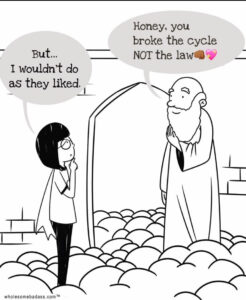
Alt text: Wholesome Badass girl speaking with Saint Peter. She says, “But I would not do as they liked,” and he replies, “You broke the cycle, not the law.”

Your Behavior Defines You – Not Me

Somewhere along the way, a practice took hold: metabolizing what other people believed, said, or did as information about me rather than data about them. Today, that data gets classified more appropriately. It may hurt deeply and alter what a relationship means. But it will no longer serve to indict me. In its crudest form: their hurtful behavior was somehow treated as a reasonable response to the fact of my existence. That premise no longer holds. Recognizing this has brought with it the gifts of self-esteem and dignity. There is something clarifying in reflecting on how consistently I attempted to engage difficult moments in good faith, even when the same was not afforded to me. Repeatedly presenting opportunities for course correction and repair—for people to respond responsibly, nobly, and peacefully—was also part of that good-faith engagement. Whether they did or did not is information about them. Were you ever asked to interpret someone else’s damaging behavior as information about you?  Like the people who do not hesitate to drag you through the mud and then ask you why you are so muddy, or better yet, ask others why you are like that? fkrz

Read More
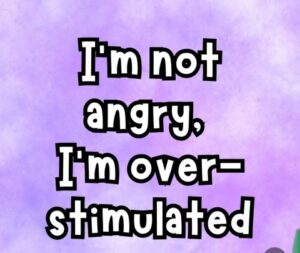
Text image with the words: “I am not angry. I am overstimulated.” Indicates that emotional reactions may reflect overwhelm, not anger.

When Dysregulation Is Treated as Being Intentionally Difficult

I do not seem naturally wired to preserve “harmony” by pretending not to see what I see and not feel what I feel. It is not as if everyone is having roughly the same experience and others make the more agreeable decision to go with the flow while I make the objectionable decision to diverge, which gets me branded not as divergent but deviant. Difficult to govern gets conflated with untrustworthy and unworthy. Not a team player. I simply cannot go with a flow that feels wildly dysregulating. My nervous system picks up and responds to things that either do not hit other people’s radar at all or do not register with anything close to the same intensity. It is not unlike some version of a dog whistle. We can be in the same room, inside the same system, and not be receiving the same input or impact from it. If something barely bothers a person, accommodating it will require little of them—nothing to resist or mask. They can easily carry on, genuinely unaffected. If the same thing is creating unmanageable discomfort in me, going along can leave me completely taxed. My depletion gets read as attitude. And yet the person who can comfortably accommodate is regarded as flexible and cooperative—which may not be untrue. But the converse about me is not necessarily true. Yes, I am less easy. But I don’t think less easy is the same as difficult or deviant. So how much of what I have understood as something wrong with me was actually the branding of a person who could not seamlessly abide without a trace a visible strain?

Read More
Black-and-white cartoon of a woman asking if something is wrong. Another woman denies it, then meets privately with two others to discuss a folder labeled “The Problem With Her.”

When the Narrative Outranks What Happened

The Alchemy of the Unexitable Loop: Someone behaves toward you in bullying, degrading, diminishing, or disruptive ways, then denies it or explains it as a consequence of who you are. Literally: they turn their own behavior into evidence against you. I am wired to sense shifts in energy. I don’t mean that in some mystical way, and I don’t mean that I am being paranoid. I am attuned at a sensory and emotional level to things other people may have the luxury of not noticing. Cold, detached silence. Avoidant eye contact. Being ignored. A change in tone. The almost imperceptible shift from being in connection with someone to being very clearly outside of it. And because nothing had been indicated, I would ask. What’s wrong? Nothing. And the coldness intensified. Naturally I would ask again. So fkn earnest. And now the inquiry itself was the only issue. Suddenly there was something concrete to point to: my questioning. My inability to leave it alone. My insistence that something was wrong when I had been clearly told there wasn’t. And there is the loop. I experienced the tension. I inquired directly. My asking was labeled as escalation. The heightened tension was then used to explain the tension I had originally asked about. Therefore, apparently, I had imagined it. Or caused it. Or manufactured chaos where none had existed. And now my behavior could justify whatever came next. There was no direct confrontation. No, “I’m angry with you.” No, “I didn’t love that.” No, “Can we talk about what happened?” No good-faith request to understand. Not even a simple statement of displeasure. At least not to me. The displeasure was expressed elsewhere, to others. So while insisting that nothing was wrong, an entirely different conversation could be unfolding outside of my participation. Because gossip and triangulation are somehow more dignified and “peace-keeping” than openly addressing friction? There was no opportunity to acknowledge the discord, clarify anything, take responsibility for what was actually mine, or repair the relationship. Instead, the grievance traveled laterally. Triangulation. Gossip. Division. And if it eventually did come directly to me, it wasn’t offered as information that might help us understand each other. It came with teeth, delivered for maximum injury. Not: Here is what landed poorly for me. More: Here is what is wrong with you. There was a negative space where repair should have happened, while a narrative developed without me. By then, the equation was complete. I had detected something I wasn’t supposed to detect. I had asked about something I was told wasn’t happening. My asking was cast as evidence that I had created the problem. And having created the problem, I had apparently earned whatever harmful thing followed. Another person’s harmful reaction gets explained entirely by my character. That’s the alchemy. Have you ever been in a relationship with someone whose coldness you could feel, but when you asked what was wrong, you were told nothing? And asking only made things worse. Whatever happened next was regarded only as the thing you had coming to you. For being this way. Literally: their behavior gets reassigned to your character.

Read More
A warmly lit room with an open closet, hanging clothes, photographs, books, keepsakes, boxes, and a ceramic mug surrounding a scattered pile of personal belongings. The image includes the quote, "Nothing ever goes away until it has taught us what we need to know," by Pema Chödrön.

Making Sense of Life Through Patterns

With all of the therapy, writing, reading, reflection, and somatic work, a lot is coming up for me. Memories. Patterns. Correlations that I had not previously made. I am finding that this process is much less like the discovery of something new and much more like noticing something that has been there all along. I would describe it as so much stuff from the past lying in a tangled heap on a closet floor, too overwhelming to tackle or ignore. Slowly, I am making order of it, identifying items and events, and putting them in their places. The tangled mess shrinks, and the grip of it all is loosening. I am also discovering that memory is a strange thing. I don’t trust every detail, every conversation, or every interpretation. But I do trust patterns, especially those that repeat themselves in what seems like perpetuity. I am trying very hard to engage this with humility, admitting my blind spots. I recognize that other people have had different experiences and interpretations. I can’t know intent or motivation, but only I can name the impact they have had on me.

Read More
Black-and-white Wholesome Badass drawing of a girl lying on a couch with a thought bubble that says, “If no one is actually perfect or infallible, doesn’t protecting that image eventually require omission, distortion, or misrepresentation?”

Can the Need to Appear Infallible Make Someone Less Honest?

I am increasingly interested in the archetypal persona—the kind of person for whom being, or even appearing, incorrect, uncertain, or imperfect seems almost unthinkable. Like what happens when being seen as good, right, or infallible is key to the archetypal identity? One who can readily accept and explore a mistake or misstep has less reason to distort the truth. If admitting fault threatens the whole structure, there is reason to alter, omit, or misrepresent whatever threatens it. The story may need managing.Incomplete truths may need to stand in for the whole truth.Harm may need minimizing.Someone else may need to be positioned as wrong. At some point, the way we protect our image is also information about our character. Maybe goodness is not being beyond error. Maybe it is the ability to remain honest when we have erred or fallen short. As I continue to seek a wholesome path through life—one rooted in spiritual grace—I am also finding out exactly how badassery shows up in my daily life as a byproduct. I think the two may be inextricably linked.

Read More
Black-and-white illustration of a girl facing a man whose right hand beckons her closer while his left hand signals stop.

The System with No Name

For most of my life, I could see the individual friction points but not the structure they shared. I experienced them as isolated interactions. A misunderstanding. A rupture. A person who was displeased with me (and seemingly intent on making me pay). A relationship I had somehow failed to navigate correctly. I explained. Apologized. Twisted myself. Worked harder. Questioned myself. Tried another approach (but still, tragically, as myself). There was the conviction that if I could just understand what I was missing, I could make myself fit. My life energy was wastefully consumed trying to navigate first my family of origin, then people and patterns that mimicked the dynamic where I was expected to want, feel, and need what I did not– and also agree to matter less. I realize nobody got handed the rules. For mainstream, untraumatized, neurotypical people, it seems to make sense and work. Expressing any version of no or ouch or confusion consistently resulted in friction. This was baffling to me, honestly. I seriously expected support or comfort, or maybe even some genuine interest. Now, after nearly six decades of swinging and missing by miles, I have begun to recognize patterns. Systems. Dynamics. Power imbalance. Coercion. All of it. I see now how easily familiarity masqueraded as normalcy. If a relational structure has been encoded deeply enough, it does not necessarily feel like a structure. It can simply feel like the way things, people, and relationships are—like water to a fish, not something experienced as a condition or even a variable, but simply the world as it is. And when the majority can function comfortably inside it, a person who cannot is what—a traitor, deviant, pariah? The person who does not go with THE FLOW is THE problem. Gosh—-That boxing-with-ghosts fucking energy- it was pure mind fuckery. I kept approaching each interaction as though there must be a successful response available to me. As though enough insight, enough humility, enough explanation, enough effort would eventually make the thing workable. It didn’t. What I am now able to do is name my experience of it—to take something that has remained amorphous and make it legible. Healing has helped me recognize systems that are damaging to me rather than inclusive or supportive, like FOR and not opposed to me. I can choose more carefully where I participate, what I adapt to, and what I no longer agree to organize myself around. Putting it into language demystifies it. Ideally, that helps someone else recognize the structure too—something that may have previously defied articulation andfelt like theirs alone. Like a shared truth. Are you also learning to recognize the systems and people who are for you—and those who are not?

Read More
Black-and-white cartoon of a worried girl handing over a paper labeled “OUCH” while a giant hand stamps it “DEFECTIVE.” Pink text at the top reads “When hurt gets submitted as evidence,” and a small watermark at the bottom says “wholesomebadass.com.”

When Your Sensitivity Is Framed as the Problem

In my family of origin, and then quite unsurprisingly in the marriage I chose, I re-enacted the familiar pattern. I accepted the charge for all discomfort—mine and everybody’s. If only I would’ve just gotten different, as was directed so very many times, we could’ve all been soooo close and comfortable. Your discomfort was my fault; so was my own. My distress was treated as a burden to the people I depended on to care for and guide me, and as proof that I was unreasonable, selfish, ungrateful, dramatic—defective. I lived in a state of perplexity that expressing any version of no or ouch consistently created friction, the very opposite of what a child might anticipate. My best efforts to communicate what I could and could not tolerate were dismissed as negative, dramatic, hysterical, oversensitive. My behavior, existence, personality, and pain were used as evidence against my character and worthiness each time they caused discomfort for one of the archetypes. My discomfort indicted me. Yours also did. I can see now how neurodivergence, scapegoating, and narcissistic family dynamics all fed the same machinery: difference was treated as defect, one person carried the emotional burden for everyone, and any separate reality that disrupted the preferred one became an offense. The opposite of sensitivity is not strength. It is insensitivity. The fact that I am affected does not make me weak, dangerous, or wrong. The way that I exist may be uncomfortable, but it’s not fucking violent or lacking in good character. What was violent, and what I have come to question as a matter of character, was the coercive control deployed in service to THE narrative, system, version of love, care, and peace. Have you ever noticed how people deeply invested in appearing strong can be the least able to, in good faith, directly engage friction?

Read More
Black-and-white line drawing of two stick figures in a leaking boat. One figure wears a life vest, holds a life preserver, and says, “You need to calm down,” while the other figure looks distressed and bails water out of the boat.

The Advantage of Appearing Unbothered

I am beginning to recognize and more effectively name and navigate familiar systems, patterns, and personalities. In power imbalances, the person with more status or authority can seem even more credible when appearing almost completely unaffected — mildly inconvenienced at most. Beneath a curated exterior — detached, unreadable, even smiling or measured — strategically executed impunity may pass for sovereignty, shielded from challenge by status/rank itself. By contrast, an emotional response to threat or injury can be marked as excessive: evidence of defect, weakness, and wrongness, rendering the account of what happened inadmissible. Once that logic is established, power-over can pass as reasonable and justified. This is where emotional violence can comfortably hide: in the latitude granted by role, status, or perceived legitimacy to diminish, exclude, intimidate, or overpower another person while the resulting distress is treated as further proof that the response was warranted.

Read More
Alt text: Wholesome Badass girl speaking with Saint Peter. She says, “But I would not do as they liked,” and he replies, “You broke the cycle, not the law.”

Your Behavior Defines You – Not Me

Somewhere along the way, a practice took hold: metabolizing what other people believed, said, or did as information about me rather than data about them. Today, that data gets classified more appropriately. It may hurt deeply and alter what a relationship means. But it will no longer serve to indict me. In its crudest form: their hurtful behavior was somehow treated as a reasonable response to the fact of my existence. That premise no longer holds. Recognizing this has brought with it the gifts of self-esteem and dignity. There is something clarifying in reflecting on how consistently I attempted to engage difficult moments in good faith, even when the same was not afforded to me. Repeatedly presenting opportunities for course correction and repair—for people to respond responsibly, nobly, and peacefully—was also part of that good-faith engagement. Whether they did or did not is information about them. Were you ever asked to interpret someone else’s damaging behavior as information about you?  Like the people who do not hesitate to drag you through the mud and then ask you why you are so muddy, or better yet, ask others why you are like that? fkrz

Read More
Text image with the words: “I am not angry. I am overstimulated.” Indicates that emotional reactions may reflect overwhelm, not anger.

When Dysregulation Is Treated as Being Intentionally Difficult

I do not seem naturally wired to preserve “harmony” by pretending not to see what I see and not feel what I feel. It is not as if everyone is having roughly the same experience and others make the more agreeable decision to go with the flow while I make the objectionable decision to diverge, which gets me branded not as divergent but deviant. Difficult to govern gets conflated with untrustworthy and unworthy. Not a team player. I simply cannot go with a flow that feels wildly dysregulating. My nervous system picks up and responds to things that either do not hit other people’s radar at all or do not register with anything close to the same intensity. It is not unlike some version of a dog whistle. We can be in the same room, inside the same system, and not be receiving the same input or impact from it. If something barely bothers a person, accommodating it will require little of them—nothing to resist or mask. They can easily carry on, genuinely unaffected. If the same thing is creating unmanageable discomfort in me, going along can leave me completely taxed. My depletion gets read as attitude. And yet the person who can comfortably accommodate is regarded as flexible and cooperative—which may not be untrue. But the converse about me is not necessarily true. Yes, I am less easy. But I don’t think less easy is the same as difficult or deviant. So how much of what I have understood as something wrong with me was actually the branding of a person who could not seamlessly abide without a trace a visible strain?

Read More
Black-and-white cartoon of a woman asking if something is wrong. Another woman denies it, then meets privately with two others to discuss a folder labeled “The Problem With Her.”

When the Narrative Outranks What Happened

The Alchemy of the Unexitable Loop: Someone behaves toward you in bullying, degrading, diminishing, or disruptive ways, then denies it or explains it as a consequence of who you are. Literally: they turn their own behavior into evidence against you. I am wired to sense shifts in energy. I don’t mean that in some mystical way, and I don’t mean that I am being paranoid. I am attuned at a sensory and emotional level to things other people may have the luxury of not noticing. Cold, detached silence. Avoidant eye contact. Being ignored. A change in tone. The almost imperceptible shift from being in connection with someone to being very clearly outside of it. And because nothing had been indicated, I would ask. What’s wrong? Nothing. And the coldness intensified. Naturally I would ask again. So fkn earnest. And now the inquiry itself was the only issue. Suddenly there was something concrete to point to: my questioning. My inability to leave it alone. My insistence that something was wrong when I had been clearly told there wasn’t. And there is the loop. I experienced the tension. I inquired directly. My asking was labeled as escalation. The heightened tension was then used to explain the tension I had originally asked about. Therefore, apparently, I had imagined it. Or caused it. Or manufactured chaos where none had existed. And now my behavior could justify whatever came next. There was no direct confrontation. No, “I’m angry with you.” No, “I didn’t love that.” No, “Can we talk about what happened?” No good-faith request to understand. Not even a simple statement of displeasure. At least not to me. The displeasure was expressed elsewhere, to others. So while insisting that nothing was wrong, an entirely different conversation could be unfolding outside of my participation. Because gossip and triangulation are somehow more dignified and “peace-keeping” than openly addressing friction? There was no opportunity to acknowledge the discord, clarify anything, take responsibility for what was actually mine, or repair the relationship. Instead, the grievance traveled laterally. Triangulation. Gossip. Division. And if it eventually did come directly to me, it wasn’t offered as information that might help us understand each other. It came with teeth, delivered for maximum injury. Not: Here is what landed poorly for me. More: Here is what is wrong with you. There was a negative space where repair should have happened, while a narrative developed without me. By then, the equation was complete. I had detected something I wasn’t supposed to detect. I had asked about something I was told wasn’t happening. My asking was cast as evidence that I had created the problem. And having created the problem, I had apparently earned whatever harmful thing followed. Another person’s harmful reaction gets explained entirely by my character. That’s the alchemy. Have you ever been in a relationship with someone whose coldness you could feel, but when you asked what was wrong, you were told nothing? And asking only made things worse. Whatever happened next was regarded only as the thing you had coming to you. For being this way. Literally: their behavior gets reassigned to your character.

Read More
A warmly lit room with an open closet, hanging clothes, photographs, books, keepsakes, boxes, and a ceramic mug surrounding a scattered pile of personal belongings. The image includes the quote, "Nothing ever goes away until it has taught us what we need to know," by Pema Chödrön.

Making Sense of Life Through Patterns

With all of the therapy, writing, reading, reflection, and somatic work, a lot is coming up for me. Memories. Patterns. Correlations that I had not previously made. I am finding that this process is much less like the discovery of something new and much more like noticing something that has been there all along. I would describe it as so much stuff from the past lying in a tangled heap on a closet floor, too overwhelming to tackle or ignore. Slowly, I am making order of it, identifying items and events, and putting them in their places. The tangled mess shrinks, and the grip of it all is loosening. I am also discovering that memory is a strange thing. I don’t trust every detail, every conversation, or every interpretation. But I do trust patterns, especially those that repeat themselves in what seems like perpetuity. I am trying very hard to engage this with humility, admitting my blind spots. I recognize that other people have had different experiences and interpretations. I can’t know intent or motivation, but only I can name the impact they have had on me.

Read More