People line up for comforting lies but don't want unpleasant truths

The Matthew Effect

“For to everyone who has, more will be given, and he will have an abundance.
But from the one who has not, even what he has will be taken away.”

This is what’s known as the Matthew Effect.
Advantages accumulate. Disadvantages compound.

Those who start with luck, privilege, resources, or even just a stable home—tend to keep winning.
Those who start with trauma, poverty, or pain—tend to keep struggling.

And people who keep losing often internalize the idea:
“Maybe it’s just me. Maybe I’m bad.”

But it’s not about worth.
It’s not about who’s better or who deserves more.

It’s about starting positions—and what builds from them.

Confidence, stability, resilience, deservingness, risk tolerance, belief in your future, agency—those things grow over time, or they erode. The Matthew Effect is a law of momentum.

But momentum can be broken.
And it can be rebuilt. Though I continue trying, I find myself unable to sustain any positive momentum for long.

TRIANGULATION It’s one of the narcissist’s favorite manipulations and they use it to create chaos and then harness that chaos to control and the people in that situation.

Triangulation, Alienation, Gaslighting Children

THERAPIST: So you’re upset that your mom pointed out missed chores and unmet expectations — even after a few consistent weeks of you doing them without reminders?

SON: Yeah. I did them for weeks, then missed a few days, and it’s like she forgets everything I did.

THERAPIST: Feels like the past effort doesn’t count?

SON: Exactly. One mistake, and it’s all erased.

THERAPIST: Do you think those weeks should cancel out the fact that you didn’t follow through now?

SON: Yeah. I don’t have these issues anywhere else. At school, in sports, at work — I’m respected. She’s the only person who makes me feel like I’m always messing up.

THERAPIST: So in your mind, she’s the problem?

SON: Yes. She’s always overwhelmed, emotional, negative. She creates tension. I act out because of how she is.

THERAPIST: So when your behavior is off, it proves she’s toxic?

SON: Right. I’ve thought about it a lot. I’m not difficult anywhere else. She’s the common denominator.

THERAPIST: And once you’re 18?

SON: Then I won’t have to deal with her. I’ll be only with people who get IT.

THERAPIST: Can I ask — does this connect to how she talks about your dad?

SON: Yeah. She’s always bringing up what he did, how he hurt her. But he doesn’t act like that with me. So what is she doing — trying to make me take her side?

THERAPIST: That’s tough. When one parent talks about the other’s harm, and you don’t see it, it puts you in a hard spot. What if it’s not about taking sides — but about acknowledging what’s real for her?

SON: I don’t know.

THERAPIST: You’ve witnessed moments that harmed made her feel scared, alone. That’s not taking sides — that’s honesty.

SON (quiet): Maybe.

THERAPIST: What does your dad do to help you deal with your mom?

SON: He doesn’t really. But he listens. He agrees with me. He gets it. He doesn’t push me to fix things.

THERAPIST: Feels good to be understood.

SON: Yeah. At least someone’s on my side.

THERAPIST: I get that.

SON: So what — I’m supposed to just be perfect?

THERAPIST: No. Just honest. Kind. Accountable. Like you are in school, sports, work. Not perfect — just consistent.

THERAPIST (calm, direct): What do you think it would cost you to show up with honesty and accountability — no matter what she’s doing?

SON: I don’t know. It would feel like I’m giving in. Like I’m saying she’s right.

THERAPIST: But you noticed that when you were doing your part — following through, keeping your word — things improved at home – because you were steady and intentional.

THERAPIST: You’re not responsible for the whole relationship — but you are responsible for what you bring into it. Your choices. Your actions. The good and the bad. Are you willing to consider that?

SON (cool, final): No. I don’t think I need to “work on myself” around her. I just need to stay out of the drama and wait it out. Once I’m 18, I’ll be able to walk away. It’s uncomfortable being near her. I don’t want to associate with her. I don’t want to be like her — she’ll just drag me down.

THERAPIST (calm, firm): It’s important to recognize that when you bring that kind of energy into your mom’s space — the dismissiveness, the disrespect — you’re creating tension. And when she reacts to that, it seems like you only see her reaction as the only problem— what about the energy you bring in the first place?

THERAPIST: When you act that way, she’s not creating conflict — she’s responding to it. Her calling it out is not speaking the problem into existence. You seem heavily invested in a binary outcome- where you are right and she is wrong.

SON: Because she is. It is not worth it.

THERAPIST: Ok, so you have made your decision. How would you expect her to react to someone who has that energy for her and communicates so much disregard in all manner of ways?

When a flower does not bloom, you fix the environment in which it is planted, not the flower.

Living With Trauma and Overwhelm

Growing up highly sensitive and neurodivergent, I wasn’t seen as struggling — I was seen as willful and defiant, seeking control and attention with my needs. Survival meant submission — something I never fully understood or mastered — and it cost me dearly just to exist.

I was not taught to soothe myself.
I was not allowed to understand myself.
In fact, my attempts were discouraged — even punished.

If I had an uncomfortable or overwhelming feeling, it was regarded disobedience and disrespect.
It was regarded as a problem I was speaking into existence.

The responses were shaming, shunning, stonewalling — banishment.
And nobody explained any of it to me. The pain and confusion were devastating.

Nobody said, “Hey, here’s what’s happening. You’re safe. You’re loved. We are here with you.”

My unmasked discomfort became the reason for everything that was wrong.

And I couldn’t process it.
I couldn’t make it make sense.
I couldn’t figure out what I was doing wrong — and I couldn’t stop doing it — because it was just me: my body, my feelings, my reactions.

I was not taught to regulate.

Now, at 56 years old, I’m trying to learn.

Trying to learn how to stay with myself through discomfort instead of shutting down, spiraling, or abandoning myself the way I was abandoned.
Trying to navigate the panic that comes when my system gets overloaded.

Because it happens fast.
Because trauma rewired my body.
Because sensory integration issues mean I get overstimulated easily — lights, sounds, textures, crowds, too much too fast, any emotional input — and my whole system floods.

And it’s not just the discomfort — it’s the fear of the panic that compounds it.

Terrified: how much will this cost me?

It’s the fear of what happens when I get overwhelmed — because when I was little, the cost of overwhelm was love, inclusion, access.

So I was always anxious.
Anxious about being anxious.
Anxious about getting in trouble for being anxious.
Anxious about ruining everything.

I can’t tell you how many times I heard:

“Why must you ruin everything?”
“Why can’t you just be grateful?”

And I didn’t understand.

I didn’t understand that what they meant was:

  • If I were grateful, I wouldn’t burden anyone with my needs.
  • If I were considerate, I would figure it out by myself.
  • If I were a better kid, I would make it easier for them to be kind to me — by not needing anything.

But I didn’t understand that.
I didn’t understand the code.

I didn’t understand that I was feeling things more intensely than the people around me.
I didn’t understand that what overwhelmed me didn’t even register for them.

And I never could comprehend how in place of comfort, there would be alienation, invalidation, and persecution.

I was raised to believe that any pain of mine- was either imagined or well earned.
Either way, there was no comfort for pain of that sort — for a piece of shit like myself.

No support.
No nurturing.
No safety.

Abusers Mantra- That Did Not Happen

“But What Did She Do?”

Friend:

So you’re not in contact with your daughter anymore?

Family Member:

No, she’s just too much. Always some issue with her. Always making everything harder than it has to be.

Friend:

Wow. What happened exactly? Did she hurt someone? Lie? Betray you?

Family Member:

No, not really. It’s more like… she always has needs and limits and feelings that are too much and make no sense.  So sensitive.  Demanding.  Needy. Always demanding  conversation. It’s exhausting.

Friend:

That doesn’t sound like a crime. Did she ask to talk about something hard?

Family Member:

Yeah, but she turns everything into a problem. Like, she’ll say something felt hurtful, or ask someone to stop doing something—and suddenly, it’s a whole thing. She speaks problems into existence. If she’s upset, that’s the problem. Not what caused it.

Friend:

So she brings up something painful and you say she’s just trying to cause drama?

Family Member:

Exactly. We always told her: stop manufacturing chaos. If you’re hurting, you probably imagined it, earned it, or brought it on yourself.

Friend:

That sounds brutal. What happens when she does try to talk about it?

Family Member:

She gets overwhelmed. Emotional. Then she cries and it’s like, see? You can’t even talk to her. She’s unstable.

Friend:

Did you ever try family therapy?

Family Member:

Yes, once. She completely fell apart in the session. Couldn’t handle us calmly telling the therapist how hard she is. The therapist saw right through her.

Friend:

Or maybe she broke down because the room was against her and you used that as proof?

Family Member:

Whatever. She just needs everything to be her way. We can’t do that.

Friend:

So what’s the worst thing she actually did?

Family Member:

She refused to keep showing up -opted out until we had more useless conversations. She always said she’d come to the table if people would be kind. But she made herself the outsider. Ask anyone—she sucks.

Friend:

But if nobody can name what she actually did—not how she felt, or how you felt about her, but what she really did—then what was she punished for?

Family Member:

For being impossible. Creating Tension to get attention.

Friend:

Hmmm

14 Years Later

Friend:

Wait… so you don’t talk to your mom anymore?

Son:

Nah. She’s impossible. Always on my case, trying to control everything.

Friend:

That sucks. But like—what did she do? Was she abusive? Did she lie to you or betray you? Does she slave you areound with endless and unreasonable chores?

Son:

No. She just… always had these expectations….demands. And like tried to be my boss. Always correcting me. She wanted me to be perfect.

Friend:

Okay… but was she unfair? Like punishing you for stuff that wasn’t real? Was she constantly grounding you or taking your phone for no reason?

Son:

No, not really. I think I got grounded maybe once. She barely ever took my phone.

Friend:

So you weren’t in trouble all the time?

Son:

No, not really. She’d just get mad when I didn’t follow through or when I ignored her.

Friend:

So… she had rules?

Son:

Yeah, but she wanted consistency. Like, if I did something well for three weeks, and then I would drop the ball and she would correct or redirect me. Like the three weeks did not even count.

Friend:

Oh, she wanted you to hold a good standard and get back to doing the good job. That doesn’t sound crazy. That sounds like accountability… parenting?

Son:

She just wouldn’t let me do whatever I wanted. She’d say no to stuff sometimes. She expected respect.

Friend:

Did you guys ever try family therapy?

Son:

Yeah, but I went thinking it’d be my chance to explain my side, and maybe get the therapist to see how hard she is. I don’t think she went in expecting that.

Friend:

So… you weren’t there to try to heal things?

Son:

Not really. And she got upset in the session, started crying, and then it was like—“see? She’s so emotional, you can’t even talk to her.”

Friend:

So her emotional reaction to being overwhelmed was used as proof that she’s the problem?

Son:

I mean… yeah.

Friend:

And the worst thing she did was… not agree immediately to let you drive across the country at 16 without a plan?

Son:

She said I could if I had check-ins and stayed with people we know. But it felt like she didn’t trust me.

Friend:

So she wanted to keep you safe and be part of the planning, and that made her the enemy?

Son:

I guess. But still… she sucks

Narrator:

This is the anatomy of a smear campaign.

A person becomes “too much” only after they become unwilling to be mistreated.

They say, “She’s hard to deal with.”

But what did she do?

Ask again.

From every angle.

Ask louder.

Ask in front of the people who repeat the story.

Ask the ones who believe it.

What did she do?

What did she do?

And if no one can name it,

then maybe—

just maybe—

she didn’t do anything at all.

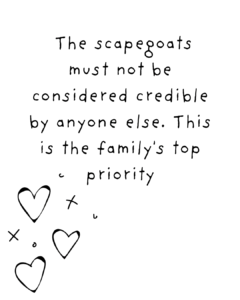
Maybe she just stopped agreeing to be the scapegoat.

Below are just a few of the books that have been especially informative and healing for me as I navigate my journey of recovery and self-understanding:

Winston Churchill quote- An appeaser is one who feeds a crocodile—hoping it will eat him last.

Serves Her Right

In the family system/code that believes and says, “Serves you right,” my boys seem to have been programmed to interpret my chaos, struggle, difficulty, and misfortune as proof of my badness. Instead of an instinct to comfort me or offer love and support, their reaction is more like: “Yep, that tracks. Makes sense. Serves her right. When will she learn? This is why they/we must treat her this way.”

She has clearly forfeited her right to express needs, limits, preferences, or boundaries. She is to be disregarded as a person—and as a parent with authority. (I literally have a screenshot of a text from my boys’ father to my son saying exactly these words: “Disregard your mother.”)

So, when I struggle—which is often—it reinforces their programming around my inherent and undeniable unworthiness. My difficulty serves as a sign that I am the problem, and that belief pushes them further into the groupthink stating: For us to be right, she must be wrong. For us to feel okay about how she’s treated, we shall agree that she is the problem.

In a zero-sum, binary mindset, someone must be wrong as proof of the other’s rightness. And when you dare to challenge, the response isn’t a conversation or reflection—it’s annihilation- crush anyone who questions you – put them in their place. You rewrite the narrative so you’re either the hero or the victim—and the person you’ve decided to harm simply got what they deserved.

Then, you may comfortably call betrayal and torment a “natural consequence.”

But natural consequences don’t require enforcement. That’s what makes them natural. In this system, though, what’s “natural” is to worry about becoming a target. “Natural” to hold someone else in the crosshairs to ensure your own inclusion/”safety”—for another day.

Unraveling and Rebuilding

This past month broke me open.

I ended a relationship I cared deeply about.

COVID knocked me all the way down—but gave me sleep like I’ve never had.

My house fell apart, my body’s adjusting to a new pain management protocol, and my heart’s hurting most of all—especially as I try to break toxic family patterns with my son, who sees me as always wrong and unworthy.

I’m still showing up. But I’m also starting to wonder what it would look like to let go.

This is what survival has looked like lately.

I Wasn’t Ignoring Reality—I Was Conditioned to Doubt It

I do not think it is that I was stubbornly holding onto false hope—I was being actively manipulated, fed contradictions, and caught in a cycle designed to keep me confused. I didn’t choose to ignore reality; I had been conditioned to doubt my own perception of it.

Intermittent reinforcement was one of the most powerful psychological traps I experienced. It kept me waiting for our next “good moment,” convincing me that the relationship could be what I was promised it would be—if only… And with the mixed messaging/ gaslighting, reality became harder to grasp because my instincts were constantly being challenged.

Looking back, I see how I wasn’t just struggling to leave—I was struggling to see. The mixed messages, the highs and lows, the carefully timed affection—it all kept me tethered to something that was not actually there. Hope wasn’t the issue—being conditioned to doubt myself, my perceptions, and my reality left me believing the illusion.

Sorry I slapped you

I wonder if there’s a medication and also a dose high enough that could help me have felt less affected by the CVS cashier. He wasn’t just ringing me up; he was theatrically overperforming the role of one who works a cash register—projecting his voice as if addressing an auditorium, while tossing a ball high in the air from one hand to the other. As sensory overload set in, I felt trapped. He stretched our interaction longer than needed, demanding my attention while chattering in the brightly lit, warm, and humid store. I teetered on the edge of desperation, longing to pay and leave—to unhook from him.

I recognize that managing my nervous system is my responsibility. What if we all collectively focused on or even considered kindness as a way of being in the world? Kindness doesn’t require an audience—unlike friendliness, which often thrives on performance. The cashier was indeed friendly. I chose kindness by exercising restraint and not pointing out how his ball tossing and repeated errors due to distraction from his own behavior were unprofessional.

Call me uptight and sensitive, but—of the two of us, I. was. the. more. kind. one.—within that exchange of an unwanted and protracted transaction, which I experienced as more of an extraction. If you’re currently experiencing judgmental thoughts about my sensitivity, please consider this: you’re not kind, though I imagine quite friendly. It may be useful to know that the opposite of sensitivity is not strength, but INSENSITIVITY.

Harm Without Malice

Love Bombed: My Story of Worship, Betrayal, and No Contact (Part 7 of 32,000,000)

Reconciling Harm Without Malice

I feel like the absence of malice has to count for something. I truly believe this man is a highly empathic, loving soul. I think the idea that he has caused pain—pain he cannot magically make disappear or convince the hurt person that it isn’t real and if it is, it is not due to his intentions or actual choices—is deeply upsetting to him. 

He does things which happen to be deeply harmful because he needs to, because he’s good at it. And when faced with his culpability, he will do anything to deny it or smooth it over—not because he wants to harm, but because he doesn’t want harm to exist. This man is just doing the thing he loves, and it happens to be devastating.

But if harm keeps happening, and his response is to deny it rather than take accountability, what does that say about his version of empathy? Does he care more about not feeling like a harmful person than about actually not being one? It does seem so.

It’s strange to hold two truths at once: that someone can be deeply loving and also deeply harmful. That they can hate the idea of causing pain while continuing to cause it. And that, in the end, the absence of malice doesn’t undo the damage.

I’m realizing now that love without accountability isn’t love that can be trusted. Unwavering trust and safety matter more than the high of feeling adored. Both – And! I really thought I we had it ALL.

“One doesn’t have to operate with great malice to do great harm. The absence of empathy and understanding is sufficient.” ~Charles M.Blow.

Disclaimer: I am sharing my personal experience exactly as I recall it. This is my truth, my story, and my perspective~ to document what I lived through.

Love Bombing: Lies Before Hello

Love Bombed: My Story of Worship, Betrayal, and No Contact (Part 6 of 32,000,000)

The Story He Told Me

When we met, I was deeply moved. How he soldiered through the last 13 years of his 30-year marriage – cold and disconnected—no affection, no gratitude, no shared experiences. He spoke of serving well and faithfully as a parent, provider, and fixer, but never feeling like a true partner. And realized he needed more. I was the more.

Before me, he engaged a woman who requested of him to hit her hard enough to leave marks, who called him Daddy and insisted he call her Baby, Daddy’s Baby Girl, who threatened suicide if he upset her. But again, he did not speak negatively of anyone outright. He artfully shared in ways which allowed me to draw my own sympathetic conclusions.

I felt heartbroken for him. How is it possible for someone so awake, intentional, and generous—so full of love and light—to have only experienced misfortune in love?

The Little Lies

He found me on a dating app, and the lies started small, but immediately. I clearly indicated my preference for a man my height or taller—he lied about his height. I wanted someone politically aligned—he lied about his politics. I wasn’t a fan of thick Southern accents—he assured me he didn’t have one. But he was from South Georgia. Of course he had one. He explained it all away when I called him on it. So charming, who could be mad? Fuck it be short. Vote for the enemy. Speak like someone from the woods of South Georgia. Who even cares because you are soooooo good for me, so good for my nervous system. An emotional and sensory delight.

Initially, I tried to decline: I don’t think we need to talk or meet.
He replied, What’s it gonna hurt?
And so, of course we spoke. Then, met. And it went all the way, full tilt, everywhere. Immediately.

Disclaimer: I am sharing my personal experience exactly as I recall it. This is my truth, my story, and my perspective~ to document what I lived through.