Wholesome Badass

A Work in Progress — Healing from All the Things​

Cartoon-style black-and-white drawing on a soft green background of a girl feeding papers labeled trauma, confusion, misinformation, doubt, and shame into a machine labeled “Processing Through Writing.” Papers coming out say agency, discernment, and intention. Her bag has a small WBA heart logo, and the image is watermarked with wholesomebadass.com.

The Shit Before the Shift

No Dimmer Switch I feel everything the most amount—the good and the unpleasant—constantly. Everything in high definition. I am a deep feeler, or as the archetype likes to say: thin-skinned, overly sensitive. Not a crime. Not a defect. But not an easy way to be in the world. From my tiniest days, I recall feeling inconsolably rattled, navigating my tightly wound nervous system and sensitive disposition with no guidance, knowledge, language, or skill set for any of it. I cannot recall another version of myself underneath it all – who ever felt secure, grounded, safe, and not overwhelmed. That has been my baseline. It is not a great point of departure. Billed to Me I was raised to believe that other people’s harsh behavior spoke directly to the quality of my person, my character, and my worth. Which was terribly confusing, because I was also often scolded for asking if a person was upset with me, “Not everything is about you.” And yet other people’s unfavorable moods and behaviors were consistently billed to me or altogether denied. So… difficult moods and feelings—mine and theirs—were my responsibility. And no clue how to manage that. Painfully aware: I was constantly and undeniably failing. While nobody taught or encouraged me to know, soothe, value, or care for myself, I was expected to read, anticipate, prevent, and manage other people’s difficult feelings. So many times, blood relatives would demand in a menacing tone, “What are you so angry about?” But it was not a genuine inquiry. It was a callout: look at you, with that massive chink in your armor. Feel ashamed and pipe down or else. There is real sadness in looking back and realizing how much unmanaged, daily compounded stress was attributed exclusively to my “poor character.” I spent more than forty years trying to do the impossible thing of getting different and becoming someone else. My only ambition. What a tragic fucken waste. Stripped of any potential to self-actualize. The Familiar And having been been handled like a piece of literal shit—a poopy diaper—I did not instinctively seek nourishing and affirming relationships. I had learned that love looked like people who genuinely were not FOR me—unless and only when I was useful to them. This explains so much. At many levels, I believe the only thing I shared in common with my family of origin was that we all held me in the lowest regard. That is hard to reconcile. And tragically, my only direction was toward the familiar. Ooof. Decades of trying to feel better, by any means possible, without really knowing what I was trying to feel better from. From being a shiftless piece of shit?? There is literally no relief from that. I mistook random positive intermittent reinforcement for kindness and brought that out into the world with me as the love I sought. And sometimes the love I gave. I hate that. Better Information I am proud to have interrupted that cycle, that I did not hand that poison directly to my sons. No matter what is said about me, it cannot be denied that I rode faithfully for my children. Without exception. Maybe not perfectly or without pain to them, but with fierce loyalty and constant sacrifice. In learning about trauma and nervous systems. Neglect. Generational abuse. Coercive abuse. Scapegoating. Triangulation. Attachment, fear, compulsion. I recognize how I confused what was recognizable with what was safe and acceptable. For and from myself. Agency With better information now, I get to experience something that for so long eluded me: agency—where I carefully consider who, what, how, and when to engage, and whether engagement is even required or prudent. Writing helps me recognize and organize all of the me’s inside of me—with no intent to prosecute my past or acquit any of my me’s. I work tirelessly to untangle my myths and misconceptions about myself, love, connection, and kindness. It is a true miracle to have grown into the loving, honest, dependable, funny, compassionate, and loyal woman I am. And this is also true: I have not always known how to move in these ways—or how to move with people who equally value them. First the unlearning. The shit before the shift, I guess. What were you led to believe about yourself because of the way someone else treated you? And do you still belive it?

Read More
Illustration of two one woman sharing details of someone else's private struggle. And being praised for kind thoughtfulness. The woman they are discussing sits nearby, unaware.

The Irony of Weaponized Concern

The Reality of Gossip Discussing the details of someone else’s life—their hardships, their choices, or how they live—is a fundamentally unwholesome practice. Gossip happens, and we can be honest about that and not pretend that engaging in it is useful, considerate, or kind.  The “Concerned” Persona So it is fascinating to witness someone who is known for not being particularly fond of a person take an openly concerned stance in sharing the depth of their worry for that person’s wellness, stability, and functionality. The energy attempt:  “I’m only saying this because I care…” Engineered Destabilization It is a stunning social loophole. Cloaking gossip with empathy, is an attempt to engineer a kind of social undermining while seeking praise for thoughtfulness. If I knew how to do emojis from my Mac- Barfing emoji for sure right fkn here. The Blind Spot What is confusing, is how easily bystanders buy the act. How does a person or group look at someone with an obvious grudge or bias, listen to them trade in the unfavorable assessment of another person’s private life, and see a caring soul instead of an invasive, scheming act? Skull and Crossbones emoji here. The Performance vs. Real Consideration Genuine care and consideration tend to be quiet and direct and require no recognition. They check in and ask what they can do to help. They honor respect and privacy with discernement and intention. When the “concern” is instead passed around from person to person, it isn’t support—it’s unwholesome gossip disguised as  goodness. It makes you ask “how does a sound person buy into the performance?” Insert Comedy Tragedy mask emoji here. Whatever else may be true, this also happened.

Read More
Goat standing alone on a cliff symbolizing family scapegoating and avoidance of responsibility

The War They Wanted: A Story of Estrangement

My sons learned, by design, to have zero tolerance for their mother. Ordinary acts of parenting—direction, correction, consequences, even simple questions—were rejected and reframed as manipulation or control. I once read a message from their father telling them, “Disregard your mother.” And they did. Their dismissal was not only permitted but modeled, reinforced, and quietly supported by people who positioned themselves as adversaries. During months of medical crisis—unmanaged pain, heavy medication, complications, emotional collapse—I was met with silence. I lost forty pounds. I couldn’t sit, stand, or lie down without pain. Without sleep, I struggled to function. My children showed little response, a kind of learned distance. My medical devastation wasn’t received as a call for care, but seemed to reinforce the narrative they had been taught to hold. Soon after that year of collapse came two heart attacks—more data, more interpretation, more judgment. I can hold compassion for how my children were shaped without accepting mercilessness as something I choose to live near. My healing has required restraint, even when injustice invites engagement. Over time, my options narrowed to two: escalate or collapse. In that narrowing, the structure became clear. Conflict was the point. They wanted a war—because war produces a winner and a loser, and in war, restraint is a liability. There is no framework of love or care in which it is acceptable to erase a parent. Participating in any activity that knowingly divides children from a parent is emotional violence. I continue to learn about the generational dynamics of scapegoating and parental alienation. I recognize myself in the stories of others whose former partners aligned with extended families in campaigns framed as concern—please pray for her, we’re worried—while undermining, diminishing, and dividing.

Read More
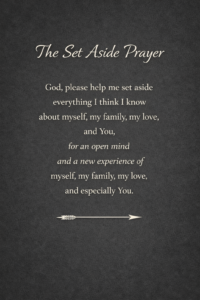
Minimalist graphic displaying the Set Aside Prayer about letting go of assumptions to allow openness, healing, and alignment

The Logic of Familiarity

Looking back, I notice how often I gravitated toward people who couldn’t tolerate my pain but expected the world to organize itself around their pleasure. When they were uncomfortable, everyone rushed to soothe them. What’s especially painful is this: humanity was withdrawn from me when I was small and needed it most. There was a kind of protected harm at work. Each time I struggled, my sister’s standing rose, and my mother’s case against me grew. Anyone could see how that drove beliefs about worth and entitlement—how my suffering had been useful to my sister. She was not only pitied and comforted when I suffered, but rewarded for not being me. It has been like this since my first breath. And I repeated this dynamic in which I consent to mattering less, in almost every relationship I chose. There were exceptions. Sweet Greg. The love bomber, obviously. And the sweetheart I’m seeing now—kind, present, generous, not looking for a reason to deny my comfort or my reality. Still, nothing replaces a family that shelters you—parents, a big sister, your own children. I remember when we moved here and my mother and sister swooned over how sweet my boys were, what a good mother I was. Even that disrupted the familiar roles. Me forming a family of my own threatened a long-standing narrative: one child – the problem, another elevated in contrast, and a mother sustained by sympathy for having such a difficult child. Looking back, it’s devastating to see how carefully that arrangement was preserved. The measures I go to in order to heal, recover, and live, seems diametrically opposed to those to whom I’m genetically linked. I read this the other day: “The way is the goal.” It captures it perfectly. It reminds me of the Set Aside Prayer—and of one of my favorite tattoos: the word –align– inside of an arrow.

Read More
A quote on a dark, stormy abstract background that reads: When it comes to abusive behavior, if they know to hide it, they know it's wrong. If they don't do it in front of other people, they know how to control it.

Beyond Conflict: Identifying the Patterns of Coercive Control in Family Dynamics

Coercive control is a strategic pattern of behavior used to dominate another person and strip away their sense of autonomy. It is not defined by a single violent event, but by a continuous web of intimidation, isolation, and micro-regulation of the victim’s life. When applied to the family unit, this control is often maintained through three primary mechanisms: 1. Scapegoating Scapegoating is the process of blaming one person for the family’s internal problems or the controller’s own failures. The goal: To create a “common enemy.” By making one person—often a child or the other parent—the source of all conflict, the controller deflects accountability and keeps the rest of the family in a state of hyper-vigilance. The result: The victim internalizes the shame, believing they are fundamentally “broken.” 2. Triangulation Triangulation occurs when the controlling person refuses direct communication and instead pulls a third person into the dynamic to create friction or competition. The goal: To divide and conquer. By telling different versions of a story to different people, the controller ensures loyalty while fostering suspicion between others. The result: It prevents victims from forming a united front, leaving the controller as the sole source of “truth.” 3. Parental Alienation In the context of coercive control, parental alienation is the ultimate extension of triangulation. It involves one parent using psychological manipulation to turn a child against the other targeted parent. The goal: To sever the bond between the child and the other parent, effectively erasing that parent’s influence and presence. The result: The child becomes a tool of the controller’s campaign, often resulting in long-term psychological trauma for both the child and the alienated parent. How They Intersect These are not isolated tactics, but interdependent components of a single power dynamic. Coercive control in a family setting operates through a calculated cycle of isolation and psychological pressure. It begins with scapegoating, reinforced through triangulation that manipulates communication and divides family members. These efforts culminate in parental alienation, where the scapegoated parent’s influence is erased, leaving the controller in command of the family’s reality. Coercive control thrives in silence and isolation. Identifying scapegoating, triangulation, and alienation for what they are is essential for protecting your mental health. The confusion you feel is a documented byproduct of the system, not a reflection of your worth as a parent or person.

Read More
Thomas Merton quote about abundance and deprivation, reflecting themes of emotional neglect, trauma, and inherited power dynamics

My Trajectory- The Matthew Effect

The Path that Formed Me I didn’t “pick bad people.” I picked familiar nervous systems—people whose emotional vacancy felt like home, because that’s what I learned from the people I loved and needed most. I’m tracing a path laid out long before I understood it. Neurodivergent, highly sensing, physically and emotionally reactive to things others barely notice. My discomfort didn’t fit the acceptable range. It wasn’t seen as different, but as wrong. And the fear of consequences for that discomfort made every moment fretful. My mother couldn’t tolerate the burden of learning how to comfort, nurture, and shelter me. So I was cast as “too sensitive,” “dramatic,” “manipulative,” “too much,” and later, “crazy.” Once she offloaded the responsibility of soothing me by turning it into judgment—impossible, ungrateful—others eagerly joined in: her mother, her brother, then my sister. Any sign of pain, need, or boundary was met with distance, disgust, silence, shunning. Instead of bridging me to support, she ostracized me—building a wall around me. I see now the water I was swimming in. And my boys were bathed in it too. “For unto every one that hath shall be given, and he shall have abundance: but from him that hath not shall be taken away even that which he hath.”—Thomas Merton

Read More
Woman with half her face visibly distressed and tearful, the other half covered by a composed mask of her own face, symbolizing emotional masking and how composure is rewarded while distress is invalidated.

When “What Are You So Angry/Upset About?” Isn’t Actually Concern

I’m finally recognizing how validity gets measured not necessarily by the truth of what’s said, but by the composure of the person saying it. My sister recognized this dynamic early on. As someone deeply sensitive and reactive, I was easy to push. She could use subtle, almost invisible cues—like dog whistles—to trigger me. When I reacted, my distress was visible. She soared, by contrast, appearing calm, composed. The comparison was stark: her unaffectedness made her look right, while my emotional presentation made me look wrong. If you’re overwhelmed, overstimulated, or visibly distressed, your words can be dismissed simply because the delivery isn’t “correct.” You’re invalidated—not for what you say, but for failing to mask emotion. Meanwhile, those who appear composed—whether less sensitive, more resilient, or simply checked out—are granted credibility. In conflict, content matters less than presentation. This dynamic is often weaponized. A question like, “What are you so angry about?” masquerades as concern but functions as control, subtly discrediting the other person. In closed systems—family, workplace, or community—the sensitive one easily becomes the scapegoat. Sensitivity is reframed as weakness, instability, or unreliability. Any emotional communication that challenges the status quo is disqualified before it’s even heard, dismissed not for its substance but for the unmasked feelings attached. Composure paraded as proof of virtue; sensitivity condemned as proof of sin.

Read More
Quote image: “If you’re not at the table, you’re probably on the menu.” Exclusion, scapegoating, triangulation, and black-sheep labeling in family and social systems.

Dissent and Discipline: Understanding Family Dynamics

The Binary World I Grew Up In In my family, things weren’t simply liked or disliked—they were either the best or the worst. No middle ground, no “not for me.” If you didn’t love something, you had to hate it. Once something was labeled right or wrong, it became collective truth. Everyone had to agree—or at least pretend to. Questioning, hesitating, or feeling differently wasn’t just disagreement; it was dissent. And dissent made you the enemy. That breach wasn’t corrected, it was punished. Not to remove the threat, but to create a cautionary tale: this is what happens when you don’t fall in line. You lose protection. You’re cast out. Cooperation or neutrality didn’t exist—only winners and losers. And victory was best established by the outcast’s observable demise. Since exile wasn’t enough. You were destabilized—pressured, undermined, and then blamed for the very instability imposed on you. The campaign is subtle, managed through half-truths and character attacks disguised as concern. And here’s the part that hurts the most: I absorbed it. I carried those hateful beliefs and destructive behaviors into my own life. It’s true that hurt people hurt people. For decades, I caused pain equal to what I had lived—sometimes more. The first 35 years of my life were marked by destruction, fueled by the system I came from.

Read More
Cartoon-style black-and-white drawing on a soft green background of a girl feeding papers labeled trauma, confusion, misinformation, doubt, and shame into a machine labeled “Processing Through Writing.” Papers coming out say agency, discernment, and intention. Her bag has a small WBA heart logo, and the image is watermarked with wholesomebadass.com.

The Shit Before the Shift

No Dimmer Switch I feel everything the most amount—the good and the unpleasant—constantly. Everything in high definition. I am a deep feeler, or as the archetype likes to say: thin-skinned, overly sensitive. Not a crime. Not a defect. But not an easy way to be in the world. From my tiniest days, I recall feeling inconsolably rattled, navigating my tightly wound nervous system and sensitive disposition with no guidance, knowledge, language, or skill set for any of it. I cannot recall another version of myself underneath it all – who ever felt secure, grounded, safe, and not overwhelmed. That has been my baseline. It is not a great point of departure. Billed to Me I was raised to believe that other people’s harsh behavior spoke directly to the quality of my person, my character, and my worth. Which was terribly confusing, because I was also often scolded for asking if a person was upset with me, “Not everything is about you.” And yet other people’s unfavorable moods and behaviors were consistently billed to me or altogether denied. So… difficult moods and feelings—mine and theirs—were my responsibility. And no clue how to manage that. Painfully aware: I was constantly and undeniably failing. While nobody taught or encouraged me to know, soothe, value, or care for myself, I was expected to read, anticipate, prevent, and manage other people’s difficult feelings. So many times, blood relatives would demand in a menacing tone, “What are you so angry about?” But it was not a genuine inquiry. It was a callout: look at you, with that massive chink in your armor. Feel ashamed and pipe down or else. There is real sadness in looking back and realizing how much unmanaged, daily compounded stress was attributed exclusively to my “poor character.” I spent more than forty years trying to do the impossible thing of getting different and becoming someone else. My only ambition. What a tragic fucken waste. Stripped of any potential to self-actualize. The Familiar And having been been handled like a piece of literal shit—a poopy diaper—I did not instinctively seek nourishing and affirming relationships. I had learned that love looked like people who genuinely were not FOR me—unless and only when I was useful to them. This explains so much. At many levels, I believe the only thing I shared in common with my family of origin was that we all held me in the lowest regard. That is hard to reconcile. And tragically, my only direction was toward the familiar. Ooof. Decades of trying to feel better, by any means possible, without really knowing what I was trying to feel better from. From being a shiftless piece of shit?? There is literally no relief from that. I mistook random positive intermittent reinforcement for kindness and brought that out into the world with me as the love I sought. And sometimes the love I gave. I hate that. Better Information I am proud to have interrupted that cycle, that I did not hand that poison directly to my sons. No matter what is said about me, it cannot be denied that I rode faithfully for my children. Without exception. Maybe not perfectly or without pain to them, but with fierce loyalty and constant sacrifice. In learning about trauma and nervous systems. Neglect. Generational abuse. Coercive abuse. Scapegoating. Triangulation. Attachment, fear, compulsion. I recognize how I confused what was recognizable with what was safe and acceptable. For and from myself. Agency With better information now, I get to experience something that for so long eluded me: agency—where I carefully consider who, what, how, and when to engage, and whether engagement is even required or prudent. Writing helps me recognize and organize all of the me’s inside of me—with no intent to prosecute my past or acquit any of my me’s. I work tirelessly to untangle my myths and misconceptions about myself, love, connection, and kindness. It is a true miracle to have grown into the loving, honest, dependable, funny, compassionate, and loyal woman I am. And this is also true: I have not always known how to move in these ways—or how to move with people who equally value them. First the unlearning. The shit before the shift, I guess. What were you led to believe about yourself because of the way someone else treated you? And do you still belive it?
Read More
Illustration of two one woman sharing details of someone else's private struggle. And being praised for kind thoughtfulness. The woman they are discussing sits nearby, unaware.

The Irony of Weaponized Concern

The Reality of Gossip Discussing the details of someone else’s life—their hardships, their choices, or how they live—is a fundamentally unwholesome practice. Gossip happens, and we can be honest about that and not pretend that engaging in it is useful, considerate, or kind.  The “Concerned” Persona So it is fascinating to witness someone who is known for not being particularly fond of a person take an openly concerned stance in sharing the depth of their worry for that person’s wellness, stability, and functionality. The energy attempt:  “I’m only saying this because I care…” Engineered Destabilization It is a stunning social loophole. Cloaking gossip with empathy, is an attempt to engineer a kind of social undermining while seeking praise for thoughtfulness. If I knew how to do emojis from my Mac- Barfing emoji for sure right fkn here. The Blind Spot What is confusing, is how easily bystanders buy the act. How does a person or group look at someone with an obvious grudge or bias, listen to them trade in the unfavorable assessment of another person’s private life, and see a caring soul instead of an invasive, scheming act? Skull and Crossbones emoji here. The Performance vs. Real Consideration Genuine care and consideration tend to be quiet and direct and require no recognition. They check in and ask what they can do to help. They honor respect and privacy with discernement and intention. When the “concern” is instead passed around from person to person, it isn’t support—it’s unwholesome gossip disguised as  goodness. It makes you ask “how does a sound person buy into the performance?” Insert Comedy Tragedy mask emoji here. Whatever else may be true, this also happened.

Read More
Goat standing alone on a cliff symbolizing family scapegoating and avoidance of responsibility

The War They Wanted: A Story of Estrangement

My sons learned, by design, to have zero tolerance for their mother. Ordinary acts of parenting—direction, correction, consequences, even simple questions—were rejected and reframed as manipulation or control. I once read a message from their father telling them, “Disregard your mother.” And they did. Their dismissal was not only permitted but modeled, reinforced, and quietly supported by people who positioned themselves as adversaries. During months of medical crisis—unmanaged pain, heavy medication, complications, emotional collapse—I was met with silence. I lost forty pounds. I couldn’t sit, stand, or lie down without pain. Without sleep, I struggled to function. My children showed little response, a kind of learned distance. My medical devastation wasn’t received as a call for care, but seemed to reinforce the narrative they had been taught to hold. Soon after that year of collapse came two heart attacks—more data, more interpretation, more judgment. I can hold compassion for how my children were shaped without accepting mercilessness as something I choose to live near. My healing has required restraint, even when injustice invites engagement. Over time, my options narrowed to two: escalate or collapse. In that narrowing, the structure became clear. Conflict was the point. They wanted a war—because war produces a winner and a loser, and in war, restraint is a liability. There is no framework of love or care in which it is acceptable to erase a parent. Participating in any activity that knowingly divides children from a parent is emotional violence. I continue to learn about the generational dynamics of scapegoating and parental alienation. I recognize myself in the stories of others whose former partners aligned with extended families in campaigns framed as concern—please pray for her, we’re worried—while undermining, diminishing, and dividing.

Read More
Minimalist graphic displaying the Set Aside Prayer about letting go of assumptions to allow openness, healing, and alignment

The Logic of Familiarity

Looking back, I notice how often I gravitated toward people who couldn’t tolerate my pain but expected the world to organize itself around their pleasure. When they were uncomfortable, everyone rushed to soothe them. What’s especially painful is this: humanity was withdrawn from me when I was small and needed it most. There was a kind of protected harm at work. Each time I struggled, my sister’s standing rose, and my mother’s case against me grew. Anyone could see how that drove beliefs about worth and entitlement—how my suffering had been useful to my sister. She was not only pitied and comforted when I suffered, but rewarded for not being me. It has been like this since my first breath. And I repeated this dynamic in which I consent to mattering less, in almost every relationship I chose. There were exceptions. Sweet Greg. The love bomber, obviously. And the sweetheart I’m seeing now—kind, present, generous, not looking for a reason to deny my comfort or my reality. Still, nothing replaces a family that shelters you—parents, a big sister, your own children. I remember when we moved here and my mother and sister swooned over how sweet my boys were, what a good mother I was. Even that disrupted the familiar roles. Me forming a family of my own threatened a long-standing narrative: one child – the problem, another elevated in contrast, and a mother sustained by sympathy for having such a difficult child. Looking back, it’s devastating to see how carefully that arrangement was preserved. The measures I go to in order to heal, recover, and live, seems diametrically opposed to those to whom I’m genetically linked. I read this the other day: “The way is the goal.” It captures it perfectly. It reminds me of the Set Aside Prayer—and of one of my favorite tattoos: the word –align– inside of an arrow.

Read More
A quote on a dark, stormy abstract background that reads: When it comes to abusive behavior, if they know to hide it, they know it's wrong. If they don't do it in front of other people, they know how to control it.

Beyond Conflict: Identifying the Patterns of Coercive Control in Family Dynamics

Coercive control is a strategic pattern of behavior used to dominate another person and strip away their sense of autonomy. It is not defined by a single violent event, but by a continuous web of intimidation, isolation, and micro-regulation of the victim’s life. When applied to the family unit, this control is often maintained through three primary mechanisms: 1. Scapegoating Scapegoating is the process of blaming one person for the family’s internal problems or the controller’s own failures. The goal: To create a “common enemy.” By making one person—often a child or the other parent—the source of all conflict, the controller deflects accountability and keeps the rest of the family in a state of hyper-vigilance. The result: The victim internalizes the shame, believing they are fundamentally “broken.” 2. Triangulation Triangulation occurs when the controlling person refuses direct communication and instead pulls a third person into the dynamic to create friction or competition. The goal: To divide and conquer. By telling different versions of a story to different people, the controller ensures loyalty while fostering suspicion between others. The result: It prevents victims from forming a united front, leaving the controller as the sole source of “truth.” 3. Parental Alienation In the context of coercive control, parental alienation is the ultimate extension of triangulation. It involves one parent using psychological manipulation to turn a child against the other targeted parent. The goal: To sever the bond between the child and the other parent, effectively erasing that parent’s influence and presence. The result: The child becomes a tool of the controller’s campaign, often resulting in long-term psychological trauma for both the child and the alienated parent. How They Intersect These are not isolated tactics, but interdependent components of a single power dynamic. Coercive control in a family setting operates through a calculated cycle of isolation and psychological pressure. It begins with scapegoating, reinforced through triangulation that manipulates communication and divides family members. These efforts culminate in parental alienation, where the scapegoated parent’s influence is erased, leaving the controller in command of the family’s reality. Coercive control thrives in silence and isolation. Identifying scapegoating, triangulation, and alienation for what they are is essential for protecting your mental health. The confusion you feel is a documented byproduct of the system, not a reflection of your worth as a parent or person.

Read More
Thomas Merton quote about abundance and deprivation, reflecting themes of emotional neglect, trauma, and inherited power dynamics

My Trajectory- The Matthew Effect

The Path that Formed Me I didn’t “pick bad people.” I picked familiar nervous systems—people whose emotional vacancy felt like home, because that’s what I learned from the people I loved and needed most. I’m tracing a path laid out long before I understood it. Neurodivergent, highly sensing, physically and emotionally reactive to things others barely notice. My discomfort didn’t fit the acceptable range. It wasn’t seen as different, but as wrong. And the fear of consequences for that discomfort made every moment fretful. My mother couldn’t tolerate the burden of learning how to comfort, nurture, and shelter me. So I was cast as “too sensitive,” “dramatic,” “manipulative,” “too much,” and later, “crazy.” Once she offloaded the responsibility of soothing me by turning it into judgment—impossible, ungrateful—others eagerly joined in: her mother, her brother, then my sister. Any sign of pain, need, or boundary was met with distance, disgust, silence, shunning. Instead of bridging me to support, she ostracized me—building a wall around me. I see now the water I was swimming in. And my boys were bathed in it too. “For unto every one that hath shall be given, and he shall have abundance: but from him that hath not shall be taken away even that which he hath.”—Thomas Merton

Read More
Woman with half her face visibly distressed and tearful, the other half covered by a composed mask of her own face, symbolizing emotional masking and how composure is rewarded while distress is invalidated.

When “What Are You So Angry/Upset About?” Isn’t Actually Concern

I’m finally recognizing how validity gets measured not necessarily by the truth of what’s said, but by the composure of the person saying it. My sister recognized this dynamic early on. As someone deeply sensitive and reactive, I was easy to push. She could use subtle, almost invisible cues—like dog whistles—to trigger me. When I reacted, my distress was visible. She soared, by contrast, appearing calm, composed. The comparison was stark: her unaffectedness made her look right, while my emotional presentation made me look wrong. If you’re overwhelmed, overstimulated, or visibly distressed, your words can be dismissed simply because the delivery isn’t “correct.” You’re invalidated—not for what you say, but for failing to mask emotion. Meanwhile, those who appear composed—whether less sensitive, more resilient, or simply checked out—are granted credibility. In conflict, content matters less than presentation. This dynamic is often weaponized. A question like, “What are you so angry about?” masquerades as concern but functions as control, subtly discrediting the other person. In closed systems—family, workplace, or community—the sensitive one easily becomes the scapegoat. Sensitivity is reframed as weakness, instability, or unreliability. Any emotional communication that challenges the status quo is disqualified before it’s even heard, dismissed not for its substance but for the unmasked feelings attached. Composure paraded as proof of virtue; sensitivity condemned as proof of sin.

Read More
Quote image: “If you’re not at the table, you’re probably on the menu.” Exclusion, scapegoating, triangulation, and black-sheep labeling in family and social systems.

Dissent and Discipline: Understanding Family Dynamics

The Binary World I Grew Up In In my family, things weren’t simply liked or disliked—they were either the best or the worst. No middle ground, no “not for me.” If you didn’t love something, you had to hate it. Once something was labeled right or wrong, it became collective truth. Everyone had to agree—or at least pretend to. Questioning, hesitating, or feeling differently wasn’t just disagreement; it was dissent. And dissent made you the enemy. That breach wasn’t corrected, it was punished. Not to remove the threat, but to create a cautionary tale: this is what happens when you don’t fall in line. You lose protection. You’re cast out. Cooperation or neutrality didn’t exist—only winners and losers. And victory was best established by the outcast’s observable demise. Since exile wasn’t enough. You were destabilized—pressured, undermined, and then blamed for the very instability imposed on you. The campaign is subtle, managed through half-truths and character attacks disguised as concern. And here’s the part that hurts the most: I absorbed it. I carried those hateful beliefs and destructive behaviors into my own life. It’s true that hurt people hurt people. For decades, I caused pain equal to what I had lived—sometimes more. The first 35 years of my life were marked by destruction, fueled by the system I came from.

Read More