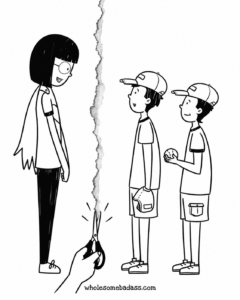
I can’t deny how “clean” and persuasive the narrative against me can look.
That’s what happens when people of similar energetic makeup benefit from the same imbalance — the same rupture without repair. The story writes itself.
I’m learning to recognize and name that attraction and familiarity. This isn’t self-exoneration.
It’s pattern literacy.
And it unsettles the most convenient explanation — that things are “difficult” only where I’m involved — when all other relationships remain intact through the shared commitment to avoidance of (conflict) resolution through silence, distance, and collective denial.
I continue noticing how this pattern shows up at every scale.
We’re taught to admire extreme wealth as proof of virtue — intelligence, discipline, superiority, deservingness. The story goes: They have more because they earned more. Which quietly implies the inverse: Those in poverty or struggle have failed.
That belief system damages and divides all those without similar ranking.
It hides how power actually works — how wealth concentrates through access, legislation, subsidy, insulation, and protection — and reframes it as moral achievement. It teaches people to confuse accumulation with character. Control with competence. Detachment is mistaken for self-control. “Coolness” as competence.
And then how illuminated philanthropy serves as morally defining.
People and systems can be emotionally cold, harsh, and controlling, even malevolent in private relationships while being visibly giving in public. They receive credit and moral insulation for “doing good,” without accountability for the harm enacted out of view—especially when it lands on those with less power and presence.
The generosity is legible.
The damage is diffuse.
And the people negatively impacted are easy to disregard.
When I speak directly—calmly, clearly, logically—it’s often received as aggression. Meanwhile, dishonesty softened with politeness, or harm delivered with a smile, is protected, even rewarded. In the past, I would escalate or collapse, distracting from the issue with my reaction. I don’t do that anymore, but the outcome is no better.
My existence itself starts to feel like the problem.
I’ve been labeled “demanding” or “confrontational” simply for asking direct questions or naming inconsistencies. Clarity seems threatening to those who rely on ambiguity. Without wiggle room, there’s no easy exit, so instead of engaging with the issue, the focus shifts to me for raising it.
Clarity isn’t manipulation—it’s an attempt to understand what’s real.
Passive aggression works differently. It dismisses boundaries, contradicts itself, or withdraws without owning the impact. If I react, my reaction becomes the headline. The harm vanishes, replaced by concern about my tone, my intensity, my feelings. That’s where the punishable feeling comes from—not because I’m wrong, but because I’m visible.
This is especially common for people like me: highly sensitive, neurodivergent, earnest. In systems that prize politeness over honesty, directness breaks the spell. Accountability is reframed as hostility. Repair is avoided. The story becomes that the person naming the problem is the problem.
My choices narrow: stay invisible, or be made into a spectacle. Neither feels safe or healthy.
I’m not interested in winning arguments or proving anyone wrong. I want movement, repair, the question: what can we do to make this better? Yet again and again, I meet people who want only rightness—debates about tone, form, correctness—because once rightness is established, nothing more is required.
I’m still healing from how often my nervous system has been punished for my inability to play along. I’m learning not to disappear or become a spectacle. I keep seeking a third way.
I want to believe that in healthy systems, directness doesn’t equal war, disrespect, or danger. That standing without shame or silence isn’t audacious—or punishable.
I’m getting closer to being able to name and understand this pattern after friction or rupture in relationships with people heavily invested in their rightness and entitlement, and equally invested in my wrongness and unworthiness.
When the conversation—tilts into litigation mode, they get to focus on proving the impeccability of their form while pointing to my “sensitivity” and inability to percieve correctly as THE problem. Historically I offered up the gift of distraction – with high reactivity- my increasing escalation or full on collapse. Having withdraawn these unfortunate ways of feeding the binary dynamic, has not been well-recieved, which at first made no sense, to me. I was like “let’s celebrate”- Now we can really focus on repair—right? Wrong.
When I limit my communication to the question of “what we can each do to make this better for us”, it has been treated as an act of hostility or insolence – their focus and commitment are to their authority, rightness, and excellence of form. Because if they are right and in perfect form, then the only problem is the person who notices the problem or reacts imperfectly to it. When I fail to degrade myself in escalation or collapse, I am consistently met with stone cold silence.
There is a specific exhaustion in holding the map while being told the map is the problem:
I am seeking progress toward a shared intention.
They are seeking consensus.
I am seeking a plan.
They are working on their untouchable closing statement.
The intention for Wholesome Badass is to share my journey, my UN-learnings- openly, inviting community with Trusted Others who also are intensely feeling beings.